Feeds:
Posts
Comments
Lu is Partridge as Sid Vicious, Anson Boon as Johnny Rotten

“Pistol”  (Hulu): I never cared much for the angry artlessness of the Sex Pistols. Even so, one must admit that for a band that existed for less than three years, these Brit oafs made an indelible impression on rock ‘n’ roll.

The miniseries “Pistol” was created and largely written by Craig Pearce, frequent collaborator (“Moulin Rouge,” “The Great Gatsby” “Elvis“) of fellow Aussie Baz Luhrman. 

Danny Boyle (“Trainspotting,” “Slumdog Millionaire,” “Steve Jobs”) directed all six episodes, and is undoubtedly the single biggest factor in the show’s successful nailing of the punk scene.  Even for those who have no taste for the music, “Pistol” brilliantly presents — through camera angles, film stock, editing, set and costume design and especially some brilliant acting — the environment that birthed that rebellious genre.

It’s a social history lesson presented on a scale that is both epic and intimate. Not to mention overflowing with nervous energyl

After watching this series I finally understood the band’s importance.  (And it wasn’t for their music.)

The source material is Lonely Boy, the 2016 memoir by Steve Jones, the band’s guitarist and ostensible leader. Toby Wallace approaches the role of Jones with equal parts sex appeal, inner intelligence and outer oafishness. In the mid-70s he was on his way to becoming a career criminal when he drew the attention of  clothing shop entrepreneur Malcolm McLaren (a stone-cold brilliant Thomas Brodie-Sangster), an erudite and foppish hustler who avows anarchy but is at heart a voracious capitalist.

It is this Svengali’s idea to start a band with which to promote his clothing boutique, SEX.  Thus the birth of the Sex Pistols, an ensemble initially possessing few musical skills but exhibiting a full tank of rage, contempt  and ironic detachment.

As lead singer John ”Johnny Rotten” Lydon Anson Boon commands his every scene like a snarling feral rat.  Johnny is an insufferable asshole but don’t accuse him of duplicity; he’s just as snide, repellant and bitter in real life as in the spotlight. Later they’re joined by heroin-soaked Sid Vicious (Luis Partridge), who cares much more about getting his hair right than hitting the proper notes.

All the high (and low) points of the Pistols saga is on display here — the bad behavior, eyebrow-raising encounters with Britain’s staid media, drugs and drink.  In a sense it’s a predictable rise-and-fall-of-a-rock-band saga, but the details turn it into something truly memorable.

The series has a superb and expansive cast of supporting players, including Sydney Chandler as Jones’ Ohio-born squeeze Chrissie (the final episode delivers a forehead-slapping reveal: she is the future Chrissie Hynde of “Pretenders” fame);  Emma Appleton as Sid’s maddening groupie-with-a-vengance American muse and needle partner Nancy Spungen, and Maisie Williams (yes, GOT’s Arya Stark) as a punk fashion icon so buried beneath spiky hair and garish face paint that I didn’t recognize her until I read the cast list. 

Paul Walter Hauser, Taron Egerton

“Black Bird”  (Apple +): This prison drama from Dennis Lehane (“Mystic River”) features possibly the finest acting now available on streaming.

And, no, I’m not exaggerating.

Taron Egerton (“Kingsman,” “Rocketman”) does a complete transformation to get into the skin of Jimmy Keene, a swaggering real-life crook and lady’s man who after his conviction for drug distribution agreed to go undercover in a prison for mental cases.  

He was offered a full pardon if he could get a confession — or at least compelling evidence — of the crimes of fellow inmate Larry Hall (Paul Walter Hauser), who is being held for the murder of a young girl but in fact may have a dozen or more victims across several states.

There are the usual prison pic tropes at work here…Jimmy must negotiate a dangerous inmate heirarchy (Tony Amendola is chilling as a Mafia don who quietly rules the roost),  corrupt guards and other scary stuff.  Moreover, Jmmy cannot reveal his secret mission, meaning he’ll get no help from the prison administration and will have to survive by his own wits.

While a couple of cops (Greg Kinnear, Sepideh Moafi) work the case from the outside, Jimmy must befriend Hall, a muttonchopped mountain who talks in a soft childish voice and is infuriatingly slow to reveal much about himself. Hauser, who was terrific as one of the goons in “I, Tonya” and the star of Clint Eastwood’s “Richard Jewell,” smashes this one out of the park. Comparisons to Anthony Hopkins’ Hannibal Lecter are appropriate.

There’s also a heartbreaking subplot involving Jimmy’s father, a broken-down ex-cop played by the late Ray Lotta in his last film role.

Ultimately it comes down to an acting duel between Hall as a quietly terrifying psychopath and Egerton as a wiseass egotist who undergoes a near-total mental/emotional meltdown under the pressures of his assignment.

| Robert W. Butler

Hugh BonnevilleI “

“I CAME BY” My rating: B (Netflix)

110 minutes | No MPAA rating

If you’re gonna steal, steal from the best.

Which brings us to the Brit-made “I Came By,” a modestly effective thriller that cannily recycles characters and ideas from Hitchcock’s “Psycho.”

Along the way this effort allows Hugh Bonneville to join his former “Downton Abby” co-stars in making the leap from genteel civility to bonkers psychopathology.

Bonneville here plays our Norman Bates character…with a dash of Brit class-consciousness stirred in.  His Sir Hector Blake  is a much-admired former jurist who ended his law career ostensibly because he opposes the racial prejudices baked into the English legal system.  

In fact, he’s a killer who keeps a series of young men (at least one of them an illegal immigrant) imprisoned in his basement torture chamber, toying with them until it’s time to dispose of their remains in his late wife’s pottery kiln.

Now I’m not dishing spoilers here…Sir Hector’s secret life is revealed early on in “I Came By.”  What makes the film of interest is the way writer/director  Babak Anvari toys with our perceptions of just who we’re supposed to root for here.

“Psycho,” of course, was notorious for killing off its leading lady, Janet Leigh, at the end of Act I in that spectacular shower sequence. Nobody saw it coming.

Something like that happens here.  

Toby (George McKay) and Jameel (Percale Ascott) are a couple of young activists who have made a career of breaking into the homes of London’s rich and privileged,  leaving behind spray-painted graffiti on the living room walls.  Their signature message: “I Came By.”

Their partnership breaks up when Jameel learns he’s about to become a father.  Thus only Toby shows up to burgle Sir Hector’s posh house…and discover some ugly secrets in the cellar.

Not having much respect for the police, Toby decides to investigate on his own.

Bad decision.  The film then shifts to Toby’s mother Lizie (Kelly Macdonald), who alarmed by her son’s disappearance, starts sleuthing on her own.  (Think of her as the Vera Miles character in “Psycho”…or is she the Martin Balsam character?)

Anyway, “I Came By” does a nifty job of twisting our expectations.  Bonneville’s quietly sinister killer is the stuff of nightmares.  That he’s a smug upper class twit only makes his comeuppance more satisfying.

|

| Robert W. Butler

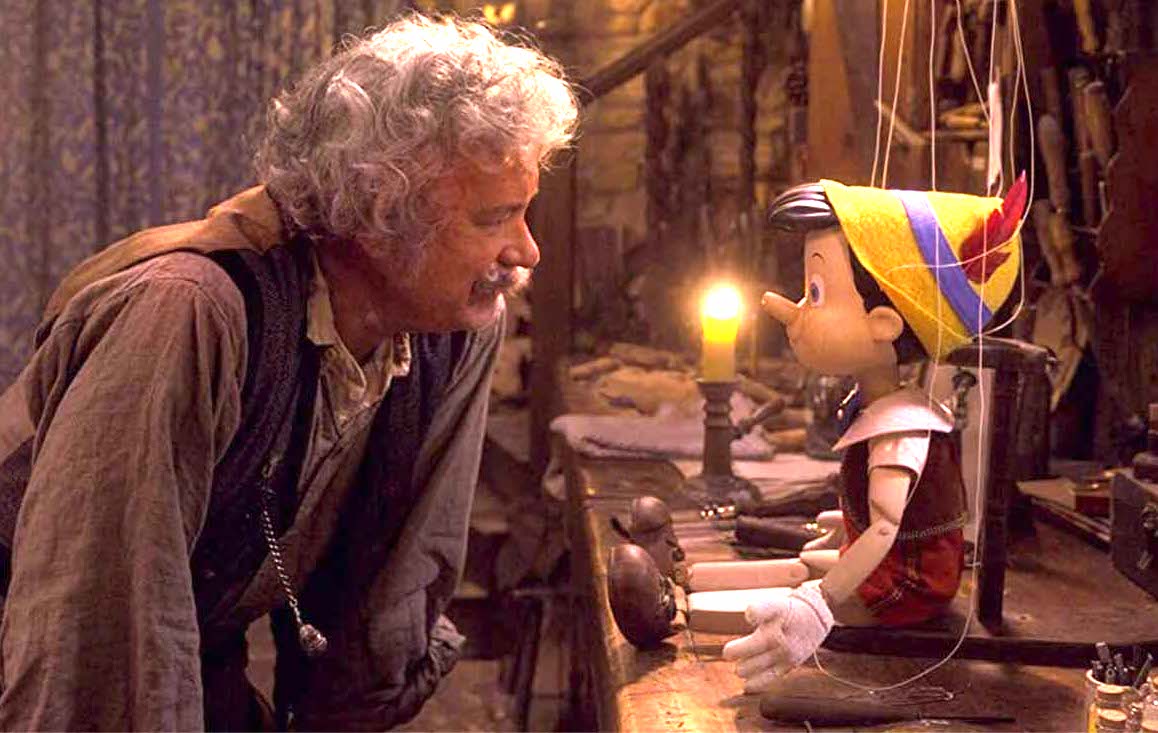
Tom Hanks and friend

“PINOCCHIO” My rating: C (Disney +)

106 minutes } MPAA rating: PG

Disney’s policy of systematically cannibalizing its animation classics and spewing out new live-action versions hits a wall with “Pinocchio.”

Not even Tom Hanks in front of the camera or Robert Zemeckis behind it  can make this blatantly opportunistic effort resonate.

The film does raise some interesting questions, though.

 The script of this  “Pinocchio” is probably 80 percent faithful to that of the 1940 animated effort…and yet the very things that work in the original fall flat here.  

Why?  If pressed I’d have to say that traditional cel animation (you know…hand-drawn cartoons) employs its obvious artificiality to mentally and emotionally prepare us for the fairy tale fantastic.  

It’s weird, but I find myself responding emotionally to the cartoon (for instance, Geppetto’s heartbreaking longing for a son) when the same scenes, played out with a real actor (Tom Hanks, working to project from behind an Einstein-level ‘stache and wig of exploding hair) feel phony.

Thus the cartoon Figaro the kitten is utterly charming (amazing how the animators captured his cat-ness) while the photo-realistic, CG-generated Figaro of the new film evokes barely a “Meh.”

And don’t even get me started on Jimmy Cricket, a brilliantly conceived character in the original who comes off as grotesquely creepy when rendered in three-dimensional detail. God…that green face! (By the way…that’s Joseph Gordon Levitt providing the insect’s voice…he does a pretty spot-on imitation of Cliff Edwards’ cracker-barrel Americana Jimmy from 1940.)

Zemeckis and co-writer Chris Weitz work a few changes practically guaranteed to raise accusations of wokeness…like casting a black performer (Cynthia Erivo) as the Blue Fairy, giving the puppet master Stromboli a physically handicapped apprentice (Laquita Tale) and turning Pleasure Island from an all-boy environment to one to which naughty girls are enticed as well.

They pay lip service — barely — to the brilliant songs from the original — “When You Wish Upon a Star,” “An Actor’s Life for Me,” “I’ve Got No Strings” — while adding a couple of lackluster new tunes.

Most dismaying of all is that the CG Pinocchio (voiced by Benjamin Evan Ainsworth) is impossibly bland.  Disney’s original puppet was a much sanitized version of the mischievous imp in Collodi’s book,  but this one registers a big zero.

If the new “Pinocchio” is largely underwhelming, it does have a couple of nifty moments.  Our wooden hero’s debut performance as the star of a puppet show is very nicely handled, with the evil Stromboli (Giuseppe Battiston) at the helm of a steam-powered Rube Goldberg-ish backstage contraption.

Geppetto’s workshop, with its dozens of synchronized cuckoo clocks (many clever referencing other Disney animated films), is a visual wonderland worth getting lost in. 

The conniving Honest John the fox gets  terrific voice coverage from Keegan-Michael Key; less effective is Luke Evans as the evil singing Coachman who shanghai’s Pinocchio to Pleasure Island.

And that paradise for bratty kids has been conceived as a sort of anti-Disneyland, complete with “It’s a Small World” boat canal on which our hero cruises the premises.

One benefit of modern streaming technology:  You can watch the 2020 “Pinocchio” and then immediately switch over to the 82-year-old original…make up your own mind about which works best.

For me, there’s no contest.

| Robert W. Butler

In which I dish thumbnail sketches of various shows I’ve been streaming over the last month.

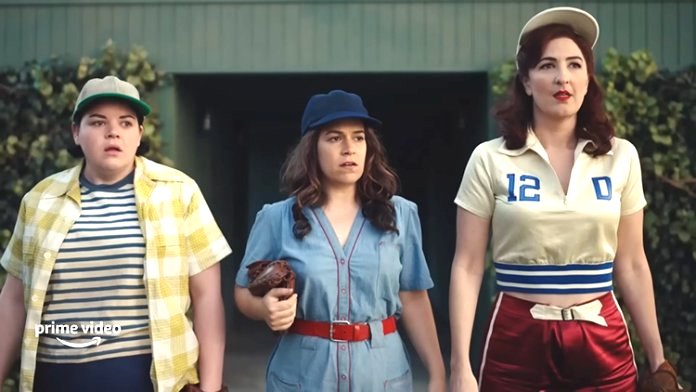
“A LEAGUE OF THEIR OWN” (Amazon Prime):  It’s an extended riff on Peggy Marshall’s classic 1992 movie about all-female professional baseball during World War II…with a couple of major differences. 

For starters, this is the gayest TV show since “Pose.” Series creator Abbi Jacobson  found in her research that something like 70 percent of the professional women baseball’s were lesbians; indeed, Jacobson plays the lead character, a married catcher (her hubby’s off to war) confronting her own conflicted sexuality. And then there’s a major subplot centering on an African-American woman who dreams of becoming a pro pitcher (and, yes, she’s gay, too).

Series creator Abbi Jacobson (center)

 The only major male role — that of a washed up professional ballplayer hired to coach the ladies (played in the film by Tom Hanks) — is taken here by Nick Overman, but he is given little to do and vanishes halfway through. 

The series does a pretty decent job of balancing comedy and drama (and it’s got the biggest collection of authentically 1940’s faces I’ve ever seen in a modern production). It’s also a MAGA-ite’s worst nightmare.  Despite the utmost in modesty when it comes to woman-on-woman action (the language is far raunchier than anything we see), this show undoubtedly will trigger seizures in those uninformed folk who tune in expecting inoffensive nostalgia and instead  get a massive dose of baked-in wokeness.

Ewan McGregor

“OBI-WAN KENOBI”(Disney +):  Got through an episode and a half of this “Star Wars” prequel before bailing.  Too bad…I looked forward to seeing Ewan McGregor as the Jedi legend in exile on Tatooine, but wretched writing and awful acting (especially from the heavies) quickly soured me.

“LOSING ALICE” (Apple +): If Alfred Hitchcock had made “All About Eve” you might get something like this Israeli mind-twister.

Fortysomething director Alice (Ayelet Zurer) comes out of retirement to make a film based on a hot screenplay by first-time writer Sophie (Lihi Kornowski). Along the way she decides to cast Sophie in the leading role, opposite Alice’s actor husband David (Gal Toren).

Ayelet Zurer, Lihi Kornowski

Thing is, Sophie is a sly, seductive, infuriating trickster.  She does awful things, but always talks her way out of hot water. It’s even possible that she swiped her screenplay from a fellow film school student (who has mysteriously vanished. GULP!).

Both Zurer and Kornowskii are borderline brilliant here. The former is a mature woman starting to come apart amidst the pressures of a problematic film production, a marriage starting to unravel and the gnawing insecurities. The latter is a sly minx who can shift from charm to hysterical betrayal in the blink of an eye; one moments she’s radiating youthful cheerfulness, the next she’s oozing malevolent sensuality.

At the same time “Losing Alice” is a nifty insider’s look at the nuts and bolts of putting together a movie.

“BAD SISTERS” (Apple +):  This black comedy actually makes a solid case for murder.

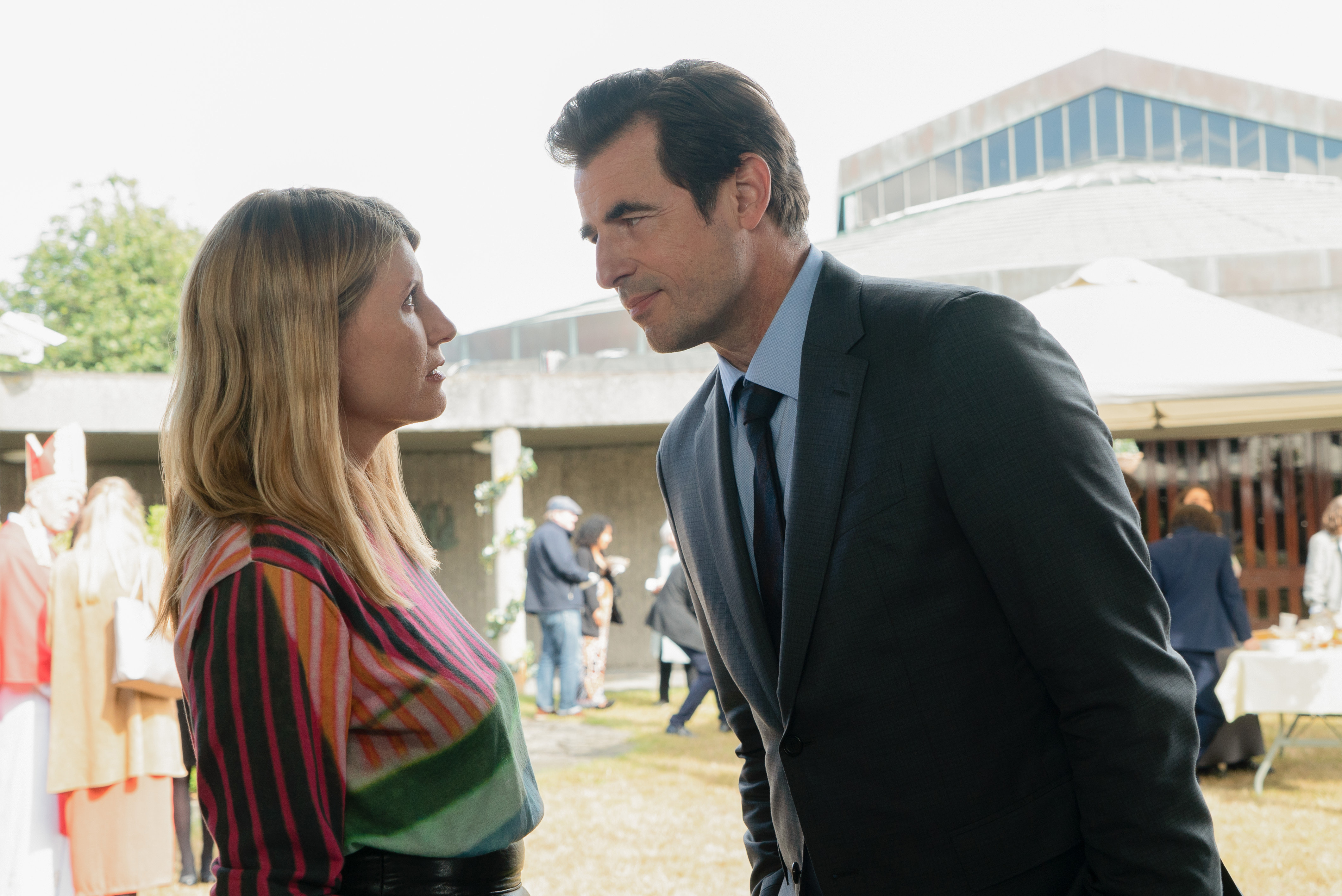
Adapted by the prolific Sharon Horgan (“Catastrophe”) from a Belgian series, “Bad Sisters” centers on five Irish siblings who conspire to kill one of their husbands, a supercilious male chauvinist schemer played with such malevolent relish by Danish actor Claes Bang that you’ll hang on every episode just to see what evil shit he’ll come up with next. 

Bang took the starring role in the 2020 Amazon Prime miniseries “Dracula,” but his bloodsucker was actually pretty likable compared to the character of John Paul.

Sharon Horgan, Klaus Bang


Here the actor more than holds his own against a cast of great female performers, psychologically tormenting his wife (Anne-Marie Duff) while infuriating/defying his sisters-in-law, all of whom have personal reasons to consider homicide.

He sabotages Eva (Horgan) at the office where both work, reneges on a promise to finance a massage studio for little sister Becky (Eve Hewson), threatens to expose the extramarital affair of Ursula (Eva Birthistle), and simply infuriates the bad-tempered, one-eyed Bibi (Sarah Greene).

The show’s narrative runs on two intertwined timelines: One follows the siblings’ often comically inept efforts to kill John Paul; the other post-murder scenario finds the sisters dogged by a couple of insurance drones who suspect foul play. 

The dialogue is absolutely wicked. Can’t wait to see where this takes us.

| Robert W. Butler

Jella Haase

“KLEO” My rating: B+ (Netflix)

Establishing and maintaining a consistent attitude in a feature-length film isn’t easy.  It must be harder still in a limited series with a running time of nearly eight hours that walks a tightrope between conflicting moods.

Yet the German “Kleo” pulls it off with an attention-grabbing blend of action, intrigue, social satire and flat-out hilarity.

The titular heroine of this series (Jella Haase)  is a round-faced orphan who has been raised by her grandfather — one of East Germany’s security czars — to be the perfect deadly tool of Communism.

The first episode — set just before the collapse of the Soviet Union — follows young Kleo into West Berlin where, guzzled up in decidedly non-proletariat wig and costume, she assassinates a reveler at a disco. She returns to kudos from her spymaster bosses and warm embraces from her boyfriend/handler Andi (Vladimir Burlakov), by whom she is pregnant.

But Kleo’s world is turned upside down when she is falsely accused of treason, convicted by a kangaroo court and thrown into prison.  Released only after the fall of the Berlin Wall, Kleo — who has miscarried — is determined to find out why she was betrayed. It all seems to harken back to that disco mission.

Over the series she works her way through the hierarchy of the now-defunct Stasi (the East German secret police), looking for answers and leaving a trail of bodies. (Think former Nazis scurrying like rats for cover.)

It’s easy enough to spot the influences behind this series from creators Hanno Hackfort, Bob Konrad and Richard Kropf.

Most obviously there’s “La Femme Nikita” and “Killing Eve,” both of which featured young female assassins who are masters of both murder and disguises.

The violence — often mixing shock and black comedy — seems a clear reference to the work of Quentin Tarantino.  Indeed, late in the series Kleo finds herself targeted by one of her former Stasi colleagues, played by Vincent Redetzki with a manic eccentricity that brilliantly mimics Tarantino’s onscreen persona.

And “Kleo” is a hugely satisfying “buddy” picture.  Our girl teams up with a bumbling West German cop who witnessed the long-ago disco assassination and ever since has been obsessed with getting to the bottom of it.  He’s played by Dimitrij Schaad, whose performance is blitheringly endearing. (If there’s an American remake, he MUST be played by Charlie Day.)

Dimitrij Schaad, Jella Haase

As much as it is a spy mystery, “Kleo” is a commentary on Communism and the collision of Soviet repression with Western hedonism.  Kleo has only known the buttoned-down life  of socialist dogma; now she must negotiate a world of wide-open possibilities and capitalist idiocy.  

The latter is perfectly embodied in the person of Thilo (Julius Feldmeier), a druggie slacker from West Berlin she finds squatting in her old apartment (he moved to the East to take advantage of cheaper rents). Thilo believes he is an alien from a distant star and keeps looking for signs that the mothership is coming to bring him home. In the old Soviet-backed regime he’d be eliminated as an undesirable; here he’s practically status quo.

Now none of this works without a terrific actress holding down the crucial role of Kleo.  And the series has a brilliant leading lady in Jaase. 

Her Kleo is clever when it comes to spy craft, but she’s an emotional infant.  Jaase interprets her as a big (if deadly) child whose training as a government killer hasn’t  entirely erased her humanity.

The question that keeps us always guessing is which side of Kleo we’ll encounter in any given situation –K the ruthlessly effective assassin or the eternal adolescent looking for love.

To be honest, I can’t recall just what answers Kleo finds during her blood-soaked search.  It’s probably because what happens around the central mystery and the world in upheaval through which our girl moves is far more compelling.

| Robert W. Butler

John Boyega

“BREAKING” My rating: B (In theaters)

103 minutes | MPAA rating: PG-13

At some point early in the riveting “Breaking” most viewers are going to say to themselves that John Boyega is the new Denzel.

By the time the film is over they’ll be thinking that Denzel is the old John Bpyega.

The British Boyega has covered a lot of territory in just a few years on screen, from being a regular in the “Star Wars” universe to playing an alien-battling London punk in “Attack the Block” and an African American security guard with a conscience in Kathryn Bigelow’s “Detroit.”

If starring as a rebel Imperial storm trooper made Boyega a household name in some quarters, his performance in “Breaking” should sling him into the ranks of  Oscar contenders.  

As Brian Brown-Easley, a real-life Marine veteran undergoing a mental-emotional meltdown, Boyega gives a performance that is by turns subtle, in your face and heartbreaking.

For its first 30 minutes writer/director Abi Damaris Corbin’s film is basically a three-character drama unfolding in real time.  In a setup that will remind many of “Dog Day Afternoon,”  Boyega’s character walks into an Atlanta-area bank and passes a teller a note announcing that his backpack contains a bomb.

But it’s not a robbery.  We soon learn that Brian is at the end of his rope because his monthly veteran’s benefit has been seized by a collection agency to cover the unpaid tuition incurred in his brief and disastrous attempt at a college education. As his last stand he’s decided to hold the bank hostage until the media gets his story out and he gets his money back.

As hostage situations go, this one is unsettling for its civility.  Brian lets everyone in the bank leave save for a cashier (Selenis Leyva) and the branch manager (Nicole Beharie). And despite waving around what he claims is a detonator (looks like he assembled it with parts from the junk drawer), Brian fights his own peaking anxiety to present himself as polite and non-threatening…or at least as non-threatening as one can be in these circumstances.

In fact, Brian finds an ally of sorts in the manager, who turns down an opportunity to escape because she figures she’s all that’s between this desperate fellow and a sniper’s bullet.  The cashier, on the other hand, is perennially poised on the edge of hysteria.

Little by little the screenplay by Corbin and Kame Kwei-Armah introduces other characters. There’s a police hostage negotiator (the late Michael Kenneth Williams) who must work his away around a shoot-first commanding officer (Jeffrey Donovan) and  a new police chief determined to establish his bona fides as tough on crime.

Michael Kenneth Williams

Brian manages to get a call through to a news producer (Connie Britton) at a local TV station.

And periodically he rings up his estranged wife (Olivia Washington) and their precocious young daughter (London Covington), whose home has been invaded by a couple of grimly unhelpful FBI agents. 

“Breaking” moves with a sort of grim inevitability, balancing fear and suspense against Brian’s desperation.  And while everyone in the film is solid, Boyega’s performance is a tour de force as it shifts back and forth between depression, hope, anger, guilt…there are few emotional bases this young actor doesn’t tag here.

It’s one of those performances you’ll want to see twice, just to figure out how he pulled it off.

| Robert W. Butler

Aubrey Plaza

“EMILY THE CRIMINAL” My rating: B (Theaters)

95 minutes | MPAA rating: R

A seemingly normal young woman finds a new career on the wrong side of the law in “Emily the Criminal,” a low-keyed drama that argues persuasively that when the system is rigged crime actually does pay.

Aubrey Plaza is our titular protagonist, a young woman with a dead-end job hauling catered lunches to high-rise L.A. offices, a huge college loan debt, and an art degree she can’t put to use.

As John Patton Ford’s film begins Emily is undergoing a job interview in which she is caught trying to hide the fact that she has a criminal record. Evidently she once assaulted a boyfriend…whether or not he deserved it is an open question. The fact of her arrest is enough to keep Emily  from being hired by any reputable business.

A catering co-worker suggests something, well, a bit dicey.  And soon Emily finds herself with a dozen or so other economic burnouts being addressed by Youcef (Theo Rossi), who informs them that they are needed as “dummy shoppers.”  

The gig is not dangerous and no one will be physically hurt, Youcef announces in businesslike tones that eerily echo every new-employee orientation session you’ve ever sat through. But it is illegal, he admits.

Basically Emily and her fellow shoppers will be given a credit card — the information is stolen, Yuocef acknowledges — with which to buy a big flat-screen television.  They will bring the electronics to Youcef; he will pay them $200 in cash.

Easy money.

Emily is ready to walk out but there’s something about Youcef — perhaps it’s his honesty in revealing the illegality of the operation — that makes her put her conscience on the back burner.  Her first gig goes smoothly.

Her second, though, quickly turns hairy.  She’s supposed to use a credit card and forged money order to pick up a luxury car, and it’s pretty clear that the foreign types who are doing the selling are a bit shady themselves. Emily barely gets away with the vehicle and a bloody nose.

Theo Rossi

She’s shaken…but also stirred.  One of the marvels of Plaza’s performance is the way she mines her character’s central core of anger and alienation.  If the world won’t give Emily a  break, she’ll make her own.

Emily gets one last chance to go straight with a gig at a hipster ad agency;  during the interview the CEO (Gina Gershon) reveals that it’s a non-paying internship that may — or may not — result in actual employment. It’s one indignity too many for our girl, who storms out more determined than ever to make it any way she can.

Meanwhile her relationship with Youcef segues from student/mentor to hot and heavy.  Youcef (you may remember Rossi as one of the biker regulars on “Sons of Anarchy”) is a sweet fella who takes Emily to meet his Lebanese mama (Sheila Korsi); in fact, Emily will learn that Youcef is way too nice a guy for the illegal business in which he’s involved. 

Ford’s screenplay so matter-of-factly presents Emily’s situation that her bad moral choices make perfect sense; meanwhile he’s slowly turning up the tension as our girl’s escapades become ever more dangerous.

Holding down the whole shebang is Plaza, who plays Emily absolutely straight but with a deep pocket of percolating rage.  There’s not a sign of the actress‘ trademark snark; in fact, aside from some grimly satiric jabs at the 21st century work environment, the film is humorless.

| Robert W. Butler

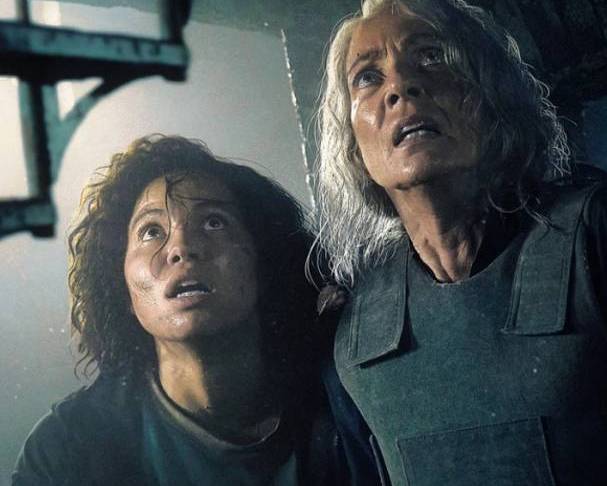
Amber Midthunder and adversary

“PREY” My rating: B (Hulu)

99 minutes | MPAA rating: R

We’re way past expecting anything of interest to come out of the long-running “Predator” series,  yet Hulu’s  “Prey” consistently takes us by surprise while remaining faithful to the franchise’s mythology.

The gimmick at the heart of writer/director Dan Trachtenberg’s film:  “Prey” is set in the early 1700s in the American West.  Our human protagonists are members of the Comanche tribe; their alien adversary is pretty much the same laser-equipped killing machine we’re familiar with from all those other films.

Trachetnberg and co-writer Patrick Sidon go out of their way to faithfully depict the lifestyle of this continent’s original inhabitants…so much so that you could eliminate the sci-fi/horror elements and still have a pretty solid ethnological study of Native American existence.

Our lead character is Naru (Amber Midthunder), a young woman who defies tribal tradition by insisting on leading the life of a hunter…a role restricted to men.

She’s proficient with bow and arrow and tomahawk (even dreaming up a leather lanyard for the latter that allows her to retrieve a thrown weapon with a jerk of her arm). She has trained a dog — a creature viewed by her clan as an alarm system and possibly dinner — to be her hunting companion; they communicate through hand signals.

Naru’s widowed mother (Michelle Thrush) tolerates and even secretly encourages her daughter’s rebellious streak.  Her big brother Tabu (Dakota Beavers), one of the tribe’s best warriors, does his best to shield her from the jeers of the other young men (not that Naru really needs much help in defending herself from  male chauvinism).

And then, of course, a spaceship drops a predator into paradise.

The film builds slowly as tribal members discover clues that something new and scary is wandering through their post-card perfect landscape.  Three quarters of the way through there’s a battle between the Predator and a crew of French-Canadian fur trappers; turns out single-shot flintlock rifles are no match for alien technology.

“Prey” does a pretty good job of introducing modern (some would say “woke”) elements into the mix without clubbing us over the head with them.  Naru’s nascent feminism is implied rather than articulated.  

The presence of white men is introduced when Naru stumbles across a meadow filled with bison  carcasses, stripped of their hides and left to rot. (Never mind that the actual slaughter of the buffalo didn’t occur until after the Civil War, a 150 years later. The mountain men of this period would have been after beaver pelts.)

Moreover, while the natives live honorably by a shared code, the Frenchmen are presented as thugs and rapists…which is probably not too far from the truth.

Basically it all boils down to Naru using her ingenuity to outsmart her sophisticated enemy; as Arnold Schwarzenegger learned in the original “Predator,” sometimes the simplest solutions wisely applied will trump alien wiles.

The performances are unforced and natural; both Midthunder and Beavers exude screen charisma without making a big deal of it.

Technically the film is quite beautiful, evoking the sort of pristine wilderness captured so hauntingly in “The Revenant.” Costuming and props appear to be utterly authentic.

“Prey” was shot with English dialogue (except for the Frenchies). But for a fully immersive experience I’d go with Hulu”s “Comanche dub” option, which allows the aboriginal characters to speak in their tribal language.  Their words are translated into English subtitles, but “Prey” is such an effective piece of visual storytelling that you could watch it without subtitles and still perfectly understand what’s going on.

| Robert W. Butler

Colin Farrell, Joel Edgerton, Viggo Mortensen

“THIRTEEN LIVES” My rating: A (Amazon Prime)

147 minutes | MPAA rating: PG-13

“Thirteen Lives” may be the most engrossing, satisfying film of Ron Howard’s career.

It’s a virtual masterclass in dramatic construction and emotional massaging; moreover it is one of the few films I can think of that contains not one misstep, one wrong performance, one phony moment.

Howard’s recreation of the 2018 rescue of 12 Thai soccer players and their coach from a flooded cave (the screenplay is by William Nicholson and Don MacPherson) manages simultaneously to be a deeply emotional experience and a clear-eyed recreation of actual events. 

 It is modest to a fault, tempering overwhelmingly dramatic material through the lens of a measured docudrama style. Clearly, Howard’s recent forays into documentaries (“The Beatles: Eight Days a Week,” “Pavarotti,” “Rebuilding Paradise,” “We Feed People”) proved invaluable in finding just the right approach for this massive effort.

The payoff is nothing short of spectacular.

In many regards Howard’s 1995’s “Apollo 13” provided the model for this sort of fact-based historic recreation; “Thirteen Lives” is even more successful in capturing the tension between individual human drama and big, overwhelming events.

Though the film features Viggo Mortensen, Colin Farrell and Joel Edgerton as cave rescue specialists from the UK, there’s no actorly showboating, no obvious star turns.  Everyone seems to be foregoing their moment in the spotlight in favor of a group dynamic.

In this the performances reflect Howard’s overall message that while there certainly were heroes at work (including two Thai Navy Seals who died in the rescue efforts), this is  a tale of literally thousands of individuals who came together to accomplish the impossible.

Howard has never been a director who flexed his stylistic muscles; his approach here is straightforward, even impersonal. This allows us to concentrate on the story itself, which has been presented with marvelous economy and insight.

In the film’s opening minutes we meet the kids and their coach on the practice field.  They decide to treat themselves to a visit to the nearby Tham Luang, a spectacular cave nearly four miles long.  We see them park their bikes at the entrance and eagerly race into the darkness.

We won’t see them again for another hour, or 10 days in real time.  They go missing, their bikes are discovered, and immediately the authorities launch a rescue effort.

Tham Luang completely floods during the monsoon season, and the boys have been unlucky enough to enter the cavern just as an early storm is pouring millions of tons of water into the subterranean system.  It is presumed that they have been trapped by rising waters and forced to retreat ever deeper into the darkness.

While Thai military divers search for them in a labyrinth of submerged stalactites and passages so narrow they must remove their oxygen tanks, an army of volunteers descend on the mountain above the cave with shovels, pumps, pipes and chutes fashioned from split bamboo in an effort to divert water off the hillside and away from the cave.

on Howard

Local officials meet with local farmers to explain the process.  Will their crops be ruined when their fields flood? a woman asks.  Yes they will.  The farmers exchange glances and nod. Those 13 lives come first.

The cave rescue specialists played by Farrell and Mortensen arrive on the scene virtually without portfolio and by virtue of their independent status (they’re not part of the Thai military or government) have the freedom to take extraordinary risks. 

But discovering the boys alive doesn’t end the crisis.  The rain that trapped them was only a preview; within two weeks the full-fledged monsoon will fill every air pocket in the cave with water for several months.  They cannot wait out the weather; they must find a way out.

Several experienced divers have almost panicked and drowned in the treacherous waters.  There is virtually no safe way to guide the boys through several kilometers of cloudy runoff; none of the children have used scuba equipment and several cannot swim.  

That’s where Edgerton’s character comes in.  In addition to being a cave rescue diver, he’s an anesthesiologist; maybe they can suit the children up in scuba gear, knock them out with drugs and pull them to safety? 

“They’re packages,” one of the rescuers explains. “We’re just delivery guys.”

The second hour of “Thirteen Lives” is a step-by-step look at how the rescuers pulled it off. This is an exquisitely timed, bite-your-nails adventure that will have viewers shaking their heads in disbelief.

By film’s end audiences will feel nearly as battered and worn out as the kids and their saviors.  But it’s a good ache.

| Robert W. Butler

Patton Oswalt, James Morosini

“I LOVE MY DAD”  My rating: B- (Glenwood Arts) 

96 minutes | MPAA rating: R

Is “I Love My Dad” clever/charming or just plain creepy?

Reactions will run the gamut for filmmaker James Morosini’s second feature, an autobiographical slice of parent/child dysfunction that flits nervously between comedy and tragedy.

Middle aged Chuck (Patton Oswalt) has proven such a disappointment to his estranged teenage son Franklin (writer/director Morosini) that the kid has severed all lines of communication.

Chuck lives hundreds of miles from his son and ex-wife (Amy Landecker) and has missed most of Franklin’s adolescence, including the boy’s recent stint with a support group for high schoolers with suicidal tendencies.

Franklin, you see,  is an emotional mess and for this he blames good old Dad, a font of moral bankruptcy and selfishness.

But Chuck now finds himself desperately looking for connections with the child he’s pretty much ignored, and he comes up with a mind-bogglingly inappropriate scheme.

He’ll catfish Franklin by creating an online presence, disguising himself as a teenage girl who will exhibit a romantic interest in the lonely kid.  That way he can pry into Franklin’s life in the guise of another teen.

Remember, Franklin has been undergoing counseling for suicidal thoughts.  What could go wrong?

Chuck uses as his model the cute young waitress (Claudia Sulewski) who serves him breakfast at his local diner.  Without her permission he raids her online accounts, downloading her collection of selfies and building a fictional profile.

Morosini’s screenplay (it won the 2020 Screencraft competition) makes a big leap when it employs fantasy sequences to depict encounters between Franklin and his dream girl.  In reality they’re simply typing back and forth on their computer keyboards, but in Franklin’s mind this beautiful, funny, charming woman is right there in front of him, waiting to be kissed.

Claudia Sulewski, James Morosini

For his part, Chuck must keep scrambling to answer Franklin’s demands for a real honest-to-God telephone conversation with his long-distance paramour.  He recruits the help of his bed buddy and boss (Rachel Dratch) who immediately screws everything up by agreeing to a face-to-face meeting. 

Despite some overtly comic moments, the mood of “I Love My Dad” is one of every-growing anxiety. After all, Franklin is a fragile young man, and Morosini’s screenplay keeps digging an ever-deeper hole that will make his rude awakening to the truth all that more traumatic.

Saving the day (because I’m not sure I buy the “happy” ending Morosini supplies) are the performances.  

Oswalt is of course a great funnyman, but in recent years he’s successfully made the jump to dramatic roles; here he balances parental angst with an almost childlike eagerness to love and be loved.

Director Morosini radiates bruised soulfulness as Franklin and, despite being 31 years old when he shot the film, makes us believe he’s a teen.

And Sulewski — making her acting debut after a successful career as a YouTube and Instagram influencer — is dynamite in dual roles, both as the luscious “dream” girl and as the down-to-earth real-life waitress. 

| Robert W. Butler