Feeds:
Posts
Comments
Joanne Woodward, Paul Newman

“THE LAST MOVIE STARS” (HBO MAX)

As the title suggests, HBO MAx’s “The Last Movie Stars,” is about Hollywood.

But even more, it’s about marriage.

Actor Ethan Hawke, here donning his directing cap, fashioned this six-part documentary series at the request of the family of movie royalty Paul Newman and Joanne Woodward. 

The famous couple’s children revealed that some 30 years ago their father began interviewing just about everyone the Newmans knew: directors, fellow actors, housekeepers, family members, close friends.…even the first wife Newman left for Woodward.

 Those interviews were captured on audio tapes which Newman (who died in 2008) subsequently burned (no explanation of why). But transcriptions of the sessions still exist.

Would Hawke like to use that written material to create a doc on the couple?

Well, YEAH.

“The Last Movie Stars” may be unique among show-biz documentaries for its innovative narrative approach.

A good chunk of the series is Zoom footage of Hawke (like everyone else, stuck at home during the pandemic) talking with the actors who would provide the voices of the interview participants. 

Initially this struck me as self-indulgent…the whole thing carries the whiff of how-I-made-a-documentary.  But before long it became apparent that by having Newman and Woodward’s fellow actors comment on their lives and films, we were getting an invaluable look into the couple’s professional world…an insider’s look.

(For the record, George Clooney reads Newman’s words while Laura Linney voices Woodward’s.  Other participants include Sam Rockwell, Billy Crudup, Steve Zahn, LaTanya Richardson Jackson, Sally Field, Rose Byrne, Mark Ruffalo…and that’s just scratching the surface.)

There are, of course, a ton of clips from the actors’ films, with special emphasis on the ones in which they played opposite each other (their last such collaboration was the Kansas City-lensed “Mr. and Mrs. Bridge”). 

What you soon realize is that Woodward was a great actor, while Newman was a great star (indeed, in some of the old color footage the actor’s eyes are so stunningly blue that you find yourself looking for signs of digital enhancement.)

“Mr. and Mrs. Bridge”

Whereas Woodward appears to have arrived on screen fully formed and a master of the medium, Newman took a while to find his acting chops.  In the meantime his physical beauty and unforced sex appeal would keep the roles coming.

So, yes, we get a lot of clips from films like “Hud,” “Hombre,” “Cool Hand Luke,” “Paris Blues,” “The Stripper,” “The Long Hot Summer,” “Butch Cassidy and the Sundance Kid” — enough to make you want to seek out those treasures for fresh viewings.

But behind the glitz “The Last Movie Stars” is about a man and a woman who managed, against the odds, to stay married for half a century in a business notorious for chewing up and spitting out relationships.

How did they persevere?  As the doc shows, it wasn’t always the idyllic partnership the fan magazines depicted.

Although the series hints (so delicately that you might miss it if you step out for a glass of water) that Newman had an extramarital dalliance our two,  the man didn’t take seriously his sex symbol status.  He was ironic and self-effacing, thankful to be accepted by a woman whom he considered his superior professionally and personally. 

At one point Woodward banned him from the house for a period of weeks. He did penance by sleeping in his car in the driveway.

Meanwhile Woodward (who at age 93 is suffering from dementia) could be ruthlessly honest about putting her work on hold to raise the couple’s three children (and to be stepmother to Newman’s three kids from his first marriage).  She had to play the “little woman: while  her husband’s career — both as actor and race car driver — steamed ahead unchecked.

Woodward actually tells one TV interviewer that if she had it to do over again, she doesn’t know if she’d have children.

Even so, the testimony of her offspring and of family friends suggest that she was a terrific mother who never let those misgivings get in the way of her parental obligations.

In the end, “The Last Movie Stars” becomes an engrossing emotional experience.  One might question whether the series needed to be six hours long, but over time you find yourself sucked into the lives of these two.

In the last episode it is revealed that after he received a diagnosis of terminal cancer, Newman secretly crept into the attic and placed in his wife’s Christmas stocking the last present he would ever give her, a present she would not discover until months after his passing.

I’d call that love.

| Robert W. Butler

Ryan Gosling

“THE GRAY MAN” My rating: C (Netflix)

122 minutes | MPAA: PG-13

“The Gray Man” is so generic its makers could have forgone a title and opted instead for a universal product code.

It would be fitting for a movie whose hero is known only as Six.

The latest from directing siblings Anthony and Joe Russo (Marvel’s “Avengers” franchise) is an international spy thriller that aspires to “Bourne”/”Mission: Impossible”-level intensity but ends up looking like a wannabe.

Apparently mediocrity doesn’t come cheap. “The Gray Man” is allegedly the most expensive original film yet made by Netflix. Maybe they should have spent some of the pyrotechnic budget on a script.

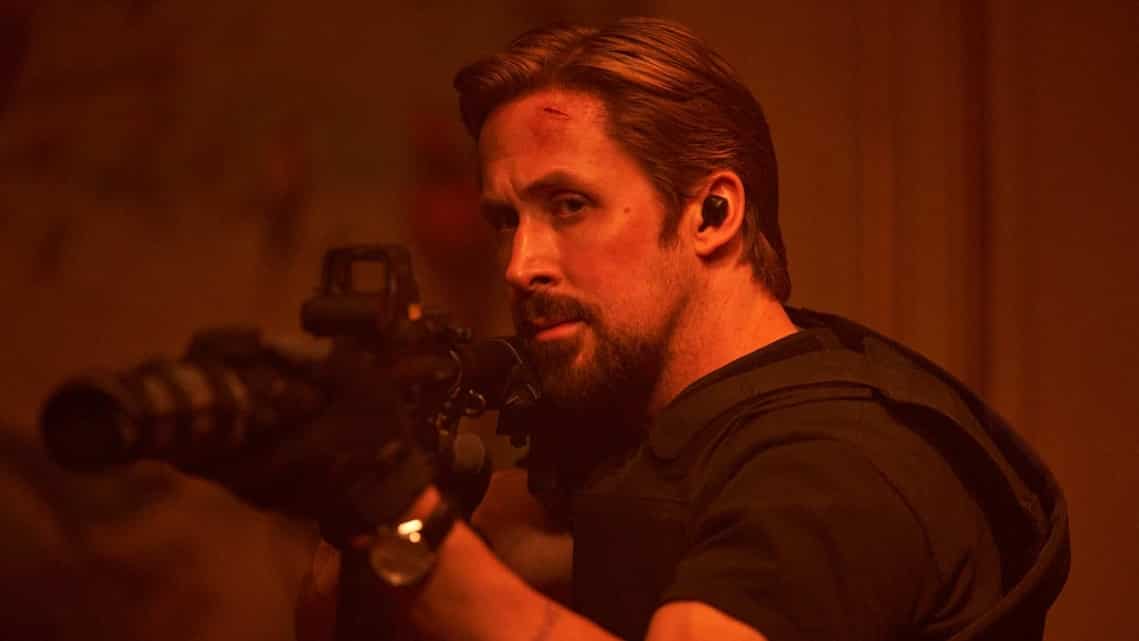
In the first scene a prison inmate (Ryan Gosling) is recruited by CIA operative Fitzroy (Billy Bob Thornton), who offers to train him as a super secret agency assassin. He will become part of the shadowy Sierra program…in fact, we will know him only as Sierra Six.

Fifteen years later Six is in Bangkok on assignment. He’s been given an agency handler, Miranda (Ana de Armas) and instructions to attend a big New Year’s bash and eliminate a fellow who is peddling CIA secrets to the highest bidder.

Thing is, he discovers that the target is one of his fellow Sierra assassins.

The MacGuffin here is a memory stick crammed with evidence of wrongdoing by an agency bigwig (“Bridgerton’s” Regé-Jean Page), who sends the smarmy/ruthless Hansen (Chris Evans) to retrieve it. Hansen’s plan is to get to Six by kidnapping the now-retired Fitzroy and his 15-year-old niece (Julia Butters) — the only two people on earth with whom Six has any sort of relationship.

Chris Evans

Well, the story takes us all over Asia and Europe. Inevitably Hansen’s minions catch up with Six, who always slips away — but not without numerous casualties among the local cops and citizenry.

The action scenes come with preplanned regularity and are busy without really making much of an impression…perhaps because the filmmakers were aiming for a PG-13 rating and couldn’t get really lowdown and dirty.

Gosling — admittedly one of our best actors — really doesn’t have a character to play here. Six is pretty much a blank page.

Faring much better is Evans, who is a shamelessly gleeful villain. With a tight haircut and pencil mustache he looks like the leading man in a ’30s porn short. All that’s missing are the black socks and garters. It may be ham, but it’s the most flavorful thing on screen.

Thornton and de Armas don’t have to do much emoting, and reliable performers like Alfre Woodard and Shea Whigham barely make an impression in brief supporting roles.

Technically the film is OK, and it practically serves as a primer for the use of drone footage…the camera is always zooming through the air, bobbing along the sidewalks and floating over and under structures.

In retrospect “The Gray Man” is a natural for a streaming service…it isn’t good enough to warrant the price of a ticket at the cineplex.

| Robert W. Butler

Dakota Johnson, Cosmo Jarvis

“PERSUASION” My rating: C (Netflix)

107 minutes | MPAA rating: PG

The Jane Austen purists are hating the new Netflix adaption of Austen’s Persuasion. They object to the many rom-comish liberties screenwriters Ron Bass and Alice Victoria Winslow and director Carrie Cracknell have taken with the novel.

But then the Austen hardcores also hated the 2005 Kiera Knightley “Pride and Prejudice,” which I found quite swoonworthy.

Rather more shocking are the reactions of the mainstream British press: “A travesty.” “Torture.” “At no point do you ever get the sense that anyone’s actually read Persuasion.”

A critic for The Guardian declared it the worst movie ever made, and offered similar thoughts about American actress Dakota Johnson’s lead performance…which suggests to me that the reviewer has only recently come to the job.

Well, this “Persuasion” isn’t very good. It’s not that the filmmakers shouldn’t be free to toy with the source material…just that in almost every case they fail to make their case.

The plot centers on Anne Elliott (Johnson) who several years earlier rejected the love of the Naval officer Wentworth (Cosmo Jarvis); friends and family members argued persuasively that he was beneath her. Now officially a spinster, Anne rues that decision.

But wait…Wentworth has returned. He is now the wealthy is captain of his own ship and in the market for a bride. Torn between shame at her earlier behavior and a slow-simmering longing, Anne doesn’t know what to do. This is Regency England after all…individuals are not encouraged to break social norms by speaking their minds.

Then there’s Anne’s wealthy cousin, Elliott (Henry Golding), who comes a-courting but seems, well, disingenuous.

Those who have seen the 1995 “Persuasion,” which took Anne’s predicament as a source of near-tragedy, may be shocked to see how much the new film yuks up the material.

Dakota’s Anne may tell us she fears a life of solitude, but she sure as hell doesn’t act like it. She’s sassy and witty…it’s impossible to feel sorry for her, especially when she spends so much time chugging red wine and stroking her pet bunny. She’s like your fun auntie.

Moreover, Anne treats the camera as her confidante, talking directly to the audience and often rolling her eyes in our direction when members of her family act stupidly, which is always.

The surrounding cast members (in keeping with other post-“Bridgerton” period pieces, they represent a variety of races) offer little support. Most of the women are encouraged to overplay their comic roles (one commentator has suggested the whole thing might benefit from a TV laugh track) while the men are uninteresting stiffs. (The exception is Richard E. Grant, delightfully shallow as Anne’s pompous spendthrift Papa.)

Weirdly enough, after messing ruthlessly with the tone of the piece (surely this is the first time we’ve been treated to the sight of an Austen heroine squatting in the woods to pee), the filmmakers have taken pains to faithfully recreate the costuming and decor of the early 19th century. It’s all been nicely captured by cinematography Joe Anderson, who polishes every image as if it was meant to be framed.

I didn’t hate this Persuasion. I almost wish I did…that would be better than my utter indifference.

| Robert W. Butler

“Dreaming Walls: Inside the Chelsea Hotel” My rating: B ()

80 minutes | No MPAA rating

One can say with some confidence that virtually every important American of 20th century arts and letters has spent time in New York’s Chelsea Hotel, either as an overnight guest or as a long-term resident.

The roster of artists, writers and musicians who have slumbered (and sometimes partied) under its roof range from Brendan Behan, Salvador Dali and Virgil Thomson to the Sex Pistol’s Sid Vicious and the impossible-to-top young lovers Patti Smith and Robert Mapplethorpe.

Heck, Leonard Cohen wrote a song about the joint.

But do not go to “Dreaming Walls: Inside theChelsea Hotel” expecting a litany of the famous and depraved. Documentarists Maya Duverdier and Amelie van Elmbt have given us something more akin to a tone poem than your traditional nonfiction feature. The best approach is simply to let it wash over you.

Early on one of the Chelsea’s octogenarian inhabitants hobnobs in the hallway with a construction worker who has spent much of the last decade renovating the venerable structure for its new incarnation as a boutique hotel. The young laborer admits while on the job he has sensed the presence of ghosts.

In a sense, Duverdier and Elmbt’s camera becomes one of those ghosts, drifting silently through halls and apartments, some now stripped down to the studs. Periodically the faces of famous Chelsea residents of yore are projected onto the peeling walls…spectres from a colorful past.

Here’s where the Chelsea is right now…the renovations are half completed, but are being held up by long-time habitués who, embracing the New York City equivalent of squatter’s rights, are doing all they can to slow the march of progress. Some have been moved to newly redone (and much smaller) apartments. Others refuse to vacate their homes of longstanding.

The tenants’ association has undergone a bitter division between those who — despite the attendant noise, dust and chaos — welcome progress and those who stubbornly oppose it (one curmudgeon refers to the whole process as “a slow-motion rape”).

Clearly the management recognizes that only death will loosen the grip of some of these old-timers. Work crews have installed a new elevator that will take them and their walkers to an exit at the rear of the building, thus sparing the hotel’s new young, hip and moneyed clientele the trauma of seeing poorly dressed wraiths inching their ways through the lobby.

Lacking any narration or titles to tell us what’s going on, we must get the lay of the land by listening to the residents talk. Happily, they are an interesting bunch, ranging from dancer/choreographer Susan Kleinsinger to artist Skye Ferrante, who fashions exquisite three-dimensional portraits of his fellow Chelseans using only pliers and wire.

There’s a smattering of old films taken at the Chelsea, including an appearance by the late Stanley Bard, for decades the hotel’s manager and probably the person most responsible for nurturing the building’s bohemian atmosphere (he was that rarest of creatures, a businessman who put esthetics on an equal footing with income).

One resident refers to the Chelsea as being like “a grand old tree, chopped down but rooted deep…there’s still life in there.”

“Dreaming Walls” is not encyclopedic and doesn’t want to be. But it gives a tantalizing taste of a grand old institution and the inevitability of change.

| Robert W. Butler

Freida Pinto, Sope Dirisu

“MR. MALCOLM’S LIST” My rating: C (In theaters)

117 minutes | MPAA rating: PG

The borderline insufferable “Mr. Malcolm’s List” owes its existence almost exclusively to “Bridgerton,” the Netflix Regency-era bodice ripper that melded multi-racial casting with Jane Austen-ish sensibilities and a good dose of heavy breathing.

Screenwriter Suzanne Allain (adapting her novel) and director Emma Holly Jones (the two also collaborated on a 2019 short film drawn from the book) have given us one of those costume-heavy romances of manners so popular with fans of Anglo-centric entertainment.

The gimmick — not that it’s much of a gimmick in the wake of “Bridgerton” and the recent Dev Patel “David Copperfield” — is that the many characters, from snooty aristocrats to household retainers, are played by a diverse cast representing many races.

Thus our heroine — the sweet, sensible, honest and basically broke Selina — is played by Indian star Freida Pinto of “Slumdog Millionaire” fame; her comically scheming, nose-in-the-air cousins are portrayed by Zawe Ashton (whose mother is Ugandan) and Oliver Jackson-Cohen (generic white guy, natch).

The Mr. Malcolm of the title — a fabulously wealthy gent who keeps a list of all the qualities he demands from a potential wife — is played by Sope Dirisu, who is of Nigerian descent.

There’s considerable talent on display given the credits of the many cast members, but all have been undone by the simpering, artificial tone imposed by the writing and directing. The players assume a sort of comic exaggeration that reeks of high school theatrics. I didn’t believe a minute of it.

Moreover, the film never took me by surprise. The plot appears to be strictly by the numbers…I say “appears” because I could only take about 45 minutes of “Mr. Malcolm’s List.” In the unlikely chance that the film utterly redeems itself in the last three reels, I hereby offer my apologies.

Production values are okay, but most of us are past the point where we’ll happily leave the theater whistling the gowns.

| Robert W. Butler

Austin Butler as Elvis Presley

“ELVIS” My rating: B (Theaters)

159 minutes \ MPAA rating: PG-13

Sixty years on it may be difficult for young people to truly fathom the earth-shaking phenomenon that was Elvis Aaron Presley.

Now, thanks to Biz Luhrmann’s monumental “Elvis,” a new generation can relive the madness and wonder of the early years of rock ‘n’ roll.

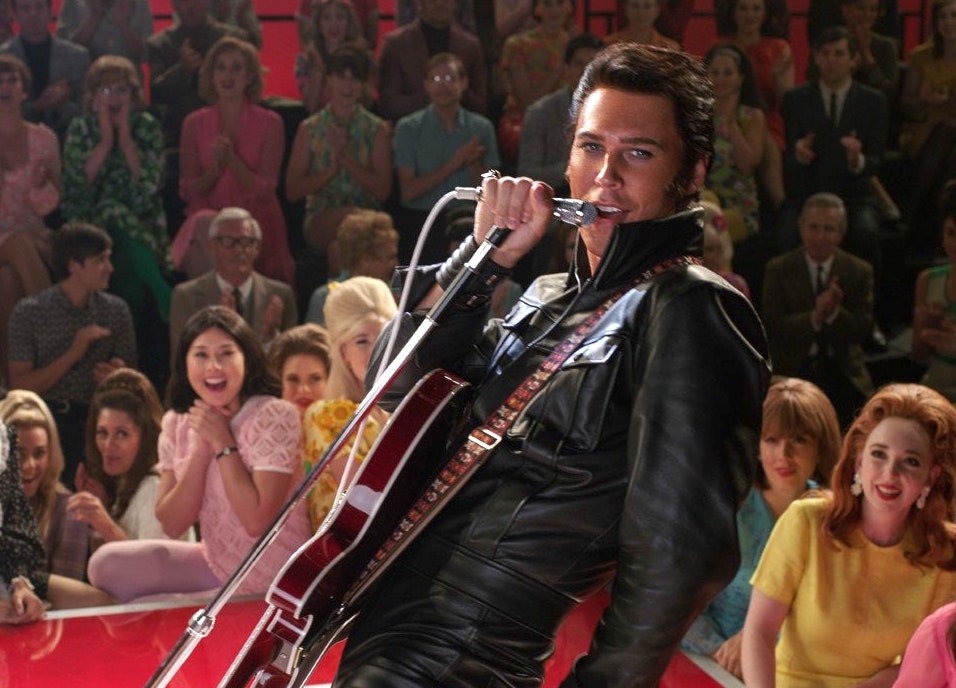
At its best “Elvis” is a kinetic fever-dream fantasia on rock’s most enduring icon, with newcomer Austin Butler portraying The King in such convincing style that there are moments when I wasn’t sure if I was watching an actor or old footage of the real man.

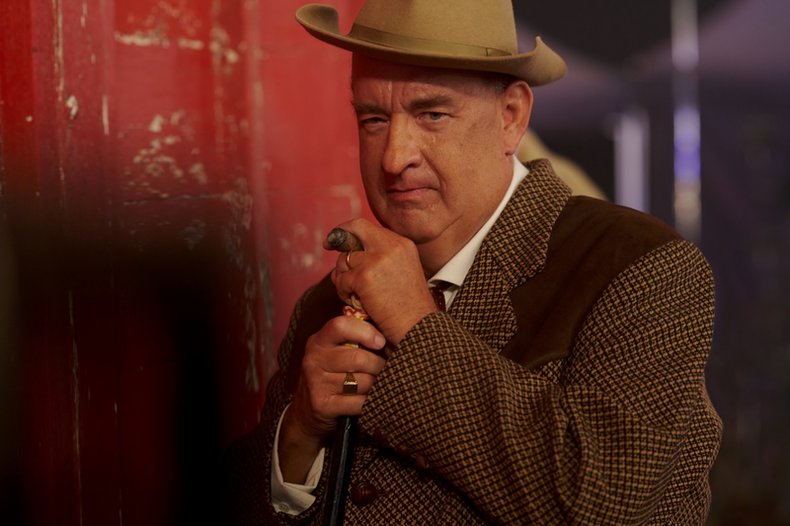
At other times the film presents as an overlong saga that bogs down in the unchanging relationship between Elvis and his creator/nemesis, Colonel Tom Parker, played by a prosthetics-heavy Tom Hanks as a sort of mumbling Jabba the Hutt.

Presley’s story is not without controversy. He was a natural performer whose sexual charisma flowed effortlessly, but he also seems to have been lazy, self indulgent and weak willed. He played other people’s songs (did he write any of his hits?) and was accused of hijacking the work of black performers. In latter years he was an addict whose bloated form had to be squeezed into those sequined jumpsuits.

But do not expect a revisionist approach in the screenplay by Luhrmann, Sam Bromell and Craig Pearce. If anything the film is borderline hagiographic (enough so that it carries glowing endorsements from Elvis’ former wife and daughter). What criticism it dishes is aimed squarely at Parker, who boosted his client’s career with brilliant marketing innovations like a Las Vegas residency and satellite concerts while, we’re told, smothering Elvis’ creative impulses through micromanagement.

Remember, this is a Baz Luhrmann movie, one that exploits all the tricks the Australian has perfected over a quarter century of Rococo filmmaking: swooping camera work, insistent rapid-fire editing, variations in film and video stock, animation…the complete contents of Luhrmann’s noggin seem to be splashed across the big screen. It’s such a staggering display that questions and objections fall by the wayside.

“Elvis” works best in its first half, when we get caught up in the giddy, dizzying whirlwind of first-generation rock. We see Elvis as a boy torn between the gutbucket blues he hears in a Mississippi roadhouse and the Gospel celebrations witnessed in a revival tent.

To those fertile elements young Elvis introduced a pelvis-pumping sexual braggadocio. It may have been a calculated act (initially he’s a bit embarrassed by it all), but by God did the girls (and not a few of their mothers) ever respond. These moments are sexy, funny and utterly captivating…after all these jaded years it still seems wholly fresh and original.

“Elvis” is narrated by Colonel Parker…who was neither a colonel nor a Parker but rather a Dutch con artist (he proudly proclaims himself a “Snow Man”) who entered the U.S. illegally and managed to live much of his life off the grid, promoting country music shows. Hanks adopts a near-indecipherable European accent (quite a shock if you’re expecting a good-ol’-boy drawl) that must work its way around an ever-present cigar.

So on top of this being the story of Elvis, we get a heaping helping of Parker apologetics, with the Colonel defending himself from charges that he kept Elvis from realizing his full potential. (For instance, Elvis never realized his dream of a world tour because Parker vetoed the idea. At the time nobody realized that the Colonel didn’t have a passport and couldn’t get one without facing deportation.)

And that’s a problem because Hanks’ Parker is a repellant character. I wanted to spend less time with him and more with Elvis.

More to the point, the Colonel is an unreliable narrator, self-serving and sly. (Luhrmann has fun cinematically name-dropping in the opening scene, referencing Orson Welles’ “Citizen Kane” as Parker suffers a heart attack in his memorabilia-crammed home — briefly we see that event through the cloudy atmosphere of a snow globe).

Tom Hanks as Colonel Tom Parker

Basically this is a two-character drama. Oh, there are plenty of peripheral characters — Elvis’ parents (Helen Thomson, Richard Roxburgh), his child bride Priscilla (Olivia DeJonge), not to mention fellow musicians like Little Richard (Alton Mason), Big Mama Thornton (Shonka Dukureh),Sister Rosetta Thorpe (Yola), Hank Snow (David Wenham) and B.B. King (Kevin Harrison Jr.).

But most of these characters are little more than window dressing (or, in the case of the black performers, a way of deflecting charges of cultural appropriation). Aside from Elvis and the Colonel, nobody here seems to have a whole lot of gravitas.

Which means there’s much resting on the young shoulders of Butler. Well, out of costume the kid doesn’t look all that much like Elvis but manages — with the help of makeup and wigs — to absolutely nail Presley’s onstage essence, from the gyrating hips to the slightest cock of his cocky head. Like I said, there are moments — especially a late scene in which an on-his-last-legs King croons “Unchained Melody” to a legion of fans) when Luhrmann seems to be cutting between original Elvis footage from 50 years ago and newly filmed material with Butler. Which is which? Damned if I know.

It’s a high wire act. Butler must suggest the darker side of Elvis, must make a nod to the drugs and women and dissipation without undermining the film’s worshipful attitude toward the man’s capacity to entertain and enchant. In a weird way “Elvis” is as important for what it leaves out as what it keeps in, but through it all Butler somehow keeps this big ship steady through sheer force of his screen persona.

It’s a phenomenal movie debut.

Hanks no doubt captures the essence of the Colonel, but I found myself on edge every time the big creep appears.

So to sum up: Butler is a great Elvis. Luhrmann’s kitchen-sink style mostly proves the perfect way to present the King’s story. But in its final third the film runs out of steam…more importantly, when it’s not recreating one of those iconic concert moments “Elvis” becomes emotionally muted, perhaps the result of the filmmakers’ efforts to present its legendary subject in the best possible light.

It’s not a whitewash, exactly, but it comes close.

| Robert W. Butler

Chris Hemsworth

“SPIDERHEAD” My rating: C (Netflix)

106 minutes | MPAA rating: R

A promising premise goes nowhere in “Spiderhead,” a si-fy-ish melodrama that at least allows Chris Hemsworth to play something not of the Marvel Universe.

Scripted by George Saunders, Paul Wernick and Rhett Reese (on whose short story it is based), the film unfolds in a futuristic concrete edifice perched on the edge of an island.

Inside it looks like maybe a posh-if-sterile spa melded with a swingers’ resort. There are video games for the residents to play, good food and apparently a hands-off attitude when it comes to romantic connections between the participants.

But we soon discover that this is actually a high-tech prison dedicated to medical experiments. The residents/subjects are inmates from the mainland who have volunteered to be guinea pigs in return for a more relaxed environment: no armed guards, no bars, no locked doors. Moreover, most of the men and women are non-violent offenders.

We learn about the place through Jeff (Miles Teller), who was convicted of vehicular manslaughter. Most of the time he cohabits with Lizzy (Jurnee Smollett), who serves as chef in a well-equipped kitchen.

But periodically Jeff is called to the Spiderhead, a testing center run by Steve Abnesti (Hemsworth), a bespectacled brainiac who is clearly working hard to exude an aura of frat-bro affability. He treats his inmate/subjects like buddies…until it no longer serves his purposes.

Steve is a pharmaceutical wiz who has formulated a wide array of mood-altering drugs. His subjects — all volunteers, remember — never know what they’ll be dosed with when they start a session. It might be potion that makes them laugh uproariously at even the lamest joke. For that matter, under the influence thy will find even human suffering hilarious.

There’s a drug that makes two strangers fall almost instantly and carnally in love…although when the effect has worn off there are no residual feelings of romance or lust.

The worst tests, though, involve Darkenfloss, which plunges the subject into the deepest imaginable depression.

That’s where Jeff has issues. He is expected to collaborate with Steve on who gets Darkenfloss and the dosage to be administered…and he’s deeply disturbed at seeing his fellow human beings in the throes of crippling, even suicidal, downers.

A contest of wills develops between Jeff and Steve…at which point Steve shows his true fascistic colors.

The notion of drugs that can drastically change a person’s mood — almost like a hypnotic suggestion — should be fertile ground for some interesting scenes — everything from comedy to tragedy.

And yet “Spiderhead” — which was directed by Joseph Kosinski of “Top Gun: Maverick” fame — never really takes advantage of the possibilities. In a lot of ways it’s a standard-issue mad-scientist flick.

Let’s give some credit, though, to Hemsworth, who seems to have de-bulked for his role (he never takes his shirt off) and offers a physical vulnerability that is in sharp contrast with his Thor persona. He does a good job of nailing Steve’s malevolent scheming while hiding behind the guise of an apologetic and sympathetic sort.

| Robert W. Butler

Juancho Hernangomez, Adam Sandler

“HUSTLE” My rating: B- (Netflix)

117 minutes | MPAA rating: R

Even Adam Sandler haters should have a good time with “Hustle,” a warm-hearted sports drama that taps into the acting chops Sandler demonstrated in “Uncut Gems” without the attendant angst and anger.

Sandler plays Stanley Sugarman, a globe-trotting scout for the Philadelphia 76ers. A former college player who screwed up his hand in a car accident, Stanley worships the game of basketball. But years of nearly nonstop travel checking out far-flung potential players have taken their toll…Stanley has spent a big chunk off his life away from his wife (Queen Latifah) and tweener daughter (Jordan Hull).

And then there’s his unfulfilled ambition to become a coach. The team’s aged owner (Robert Duvall) is amendable, but his dickish son and heir (Ben Foster, at his dickishest) wants to keep Stanley exactly where he is. This arrogant tool doesn’t care if Stanley always misses his kid’s birthday parties.

Taylor Materne and Will Fetters’ screenplay centers on Stanley’s discovery in Spain of towering amateur player Bo Cruz (real-life NBA pro Juancho Hernangomez), who shows up on the public courts wearing clunky work boots and humiliates all comers.

“It’s as if Scottie Pippen and a wolf had a baby,” Stanley marvels.

On his own dime Stanley brings Bo back to the States, only to find that his bosses don’t see the same potential he does. The plot has Stanley underwriting Bo’s total-immersion training regimen in preparation for an appearance at the NBA draft combine, where hopeful players get to strut their stuff before team owners and coaches.

“Hustle” is packed to the gills with sport-flick cliches. There’s coach/player bonding, an extended (too extended, in fact) training montage, and the usual roadblocks that threaten to derail Bo’s journey to the pros.

But under Jeremiah Zagars’ direction and thanks to a supporting cast of real-life NBA legends (Julius Erving, Allen Iverson, Charles Barkley, Shaquille O’Neal — it’s like a sports-themed edition of “Where’s Waldo”), “Hustle” feels authentically lived in.

Indeed, one gets the impression that everyone involved in this project absolutely loves the game, and that affection wraps the enterprise in a warm glow.

The seriocomic interplay between Sandler’s and Hernangomez’s characters feels absolutely authentic…maybe Hernangomez is just playing himself, but he seems utterly at ease in front of the camera.

The result is two hours of feel-good that goes down easily. For basketball fans the whole experience should prove borderline orgasmic.

| Robert W. Butler

Emma Mackey, Romain Duris

“EIFFEL” My rating: B- (In theaters)

118 minutes | MPAA rating: R

Is “Eiffel” an historic epic posing as a romantic soap opera? Or the other way around?

In the end it may not matter. This French entry about the building of the Eiffel Tower mixes equal parts engineering/historic geekiness with a bittersweet love yarn that may be largely fictional…and the results are imminently watchable.

Martin Bourboulon’s film (the screenplay is by Caroline Bongrand, Thomas Bidegain and Natalie Carter) begins in New York City where French engineer Gustave Eiffel (Romain Duris) is being feted for his part in erecting the Statue of Liberty. Eiffel did not design the statue, but the steel framework he created for its interior ensures that the great lady will survive centuries of wind and water.

Back in Paris the architect becomes involved in a competition to create a visual landmark for the upcoming International Exposition of 1889. Other teams have proposed towers, but Eiffel deems all their designs “ugly.” He envisions something graceful and sweeping, a skyward soaring monument that appears to defy gravity.

Basically what we have here are two movies. In one the engineer struggles to bring his creation into being.

There are scenes set in the sweaty caissons sunk into the sloppy banks of the Seine which allow workers to prepare the ground in pressurized underwater chambers. There are labor issues. There are a host of design challenges. We see the tower at various stages…one assumes it’s all done with CG but it looks pretty dang convincing.

And then there’s the love story. One of the government officials overseeing the project is Eiffel’s old college buddy Antoine de Rustic (Pierre Deladonchamps); the widowed Eiffel (he has four children) gets the shock of his life when he meets Antoine’s beautiful wife Adrienne (Emma Mackey)…she is none other than the great love of his early years.

A fair chunk of “Eiffel” is devoted to a flashback set 20 years earlier when Eiffel, just starting his career, designed a provincial bridge and fell hard for the spoiled daughter (Mackey, mais oui) of a local bourgeoise. Their secret affair uncovered, the lovers were torn apart. Feeling betrayed, Eiffel got on with his life and career.

But seeing Adrienne again gets those juices flowing and the two once again become lovers, though fate is no kinder the second time around.

Aside from what he accomplished, Gustave Eiffel does not appear to have been a terrifically interesting personality; good thing, then, that Duris oozes quiet charisma. Newcomer Mackey, on the other hand, radiates a the sort of beauty and appeal one associates with Italian actresses like Claudia Cardinale or maybe even Gina Lollobrigida.

But the real star of the show, it’s safe to say, is cinematographer Matias Bouchard, whose images of a bygone era are picture postcard perfect.

| Robert W. Butler

“DOWNTON ABBEY: A NEW ERA” My rating: B (Theaters)

125 minutes | MPAA rating: PG

The chickens — every last one of them — have come home to roost by the time “Downton Abbey: The New Era” wraps up the saga of the Grantham clan.

Seriously, folks, there are at least a dozen or so mini-plots playing out against the two main narratives in Julian Fellows’ screenplay…just about every character gets his/her moment in the spotlight before bringing down the curtain.

On one level it’s ridiculous…like watching a stage juggler keep a dozen balls in the air while doing a tap dance on one leg and singing “Old MacDonald” in Farsi. At the same time you have to admire the craftsmanship that keeps it all from descending into pure chaos.

Fans of the PBS series and the previous film entry will be beside themselves.

The film begins with a wedding and ends with a funeral. By the time it’s over just about every character is domestically settled (if not in a conventional marriage then in an appropriate arrangement for the personalities in question).

Two big plots here. No. 1: Downton Abbey becomes a movie studio. No. 2: Half the clan heads off to the South of France to explore a new addition to the family holdings and poke around in unexplored Grantham history.

First, the movie narrative. Seems Downton has a very leaky and expensive roof to repair. When movie director Jack Barber (Hugh Dancy) proposes spending a small fortune for the right to film a motion picture at the abbey, the Granthams swallow their uneasiness about actors (you know, women plastered in makeup and men just plastered) and assent.

Michelle Dockery, Hugh Darcy

At the same time, dowager Violet (Maggie Smith) is informed that a French gentleman she knew as a young bride (we’re talking 1864…the Lincoln administration) has died and left her his estate on the Riviera. So a delegation of family and staff invade the Continent…they can check out the new digs while avoiding the chaos generated by those “movie people” back home.

So basically you’ve got two films that come together at the end.

The one set in England is a riff on “Singin’ in the Rain.” The movie crew are shooting a silent feature, but “The Jazz Singer” has just opened and halfway through filming the movie must convert to sound. (The time appears to be 1928…the Great Depression has not yet reared its ugly head.)

This poses problems for the movie-in-a-movie’s leading lady, Myrna Dalgleish (Laura Haddock), who dominates the screen with her cool beauty but in real life is an angry/insecure diva who speaks in a Cockney bray. At this point Lady Mary (Michelle Dockery), who has stayed behind to hold the fort, discovers she has a talent for voiceover work. At the same time cinema-crazed former footman Mr. Molesley (Kevin Doyle) uses his previously useless knowledge of literature to knock out desperately needed original dialogue for the actors.

Oh, yes, the male lead of the movie being shot is swashbuckling star Guy Dexter (Dominic West), who takes a shine (ahem) to the chief butler, Mr. Barrow (Robert James-Collier), who we learned in the earlier “Downton” movie bats for the other team.

And I haven’t even mentioned the simmering attraction between Dancy’s character and Lady Mary, whose husband (a race car driver played in the previous film by Matthew Goode) is off gallivanting abroad and never seen.

Meanwhile in France, Robert Grantham (Hugh Bonneville) begins to suspect that he is the offspring of an illicit dalliance between his mother and that now-deceased French fellow, whose widow (the great Nathalie Bay, here criminally underused) is incensed about losing her winter palace to a pack of stuffy Brits. But her son (Alex Skarbek) is more welcoming; he believes that Robert is his half brother.

Whoo-hooo! Dirty family laundry!

There are also minor (very minor) conundrums among the abbey staff and various far-flung Grantham relations and acquaintances.

To ensure lots of screen time for everyone in the massive cast (many of whom saw their story arcs resolved in the last movie and have little to do in this one), director Simon Curtis (“My Week with Marilyn,” “Woman in Gold”) breaks even the most banal conversation into a series of quick-cut reaction shots so as to register the faces of surrounding cast members. That way everyone gets screen time. It’s like “My Dinner with Andre” filmed like an action sequence.

Silly? Yes. Are we painfully aware of all the seams and cut-and-paste moments in the narrative? Yep.

Does it matter? Probably not. “Downton Abbey: The New Era” is like attending a reunion with people we all know well and whose company, foibles and all, we relish.

Not to mention the costumes and castles.

| Robert W. Butler