Feeds:
Posts
Comments
Bradley Cooper

“NIGHTMARE ALLEY” My rating: C+(In theaters)

150 minutes | MPAA rating: R

That Guillermo del Toro is one of our great film craftsmen isn’t in question.

An astonishing degree of attention has been lavished on every image in his “Nightmare Alley”; expect Oscar nominations in virtually all the technical categories: effects, cinematography, costuming, production design.

That said, the film as drama left me…well, indifferent.  

Adapted by del Toro and Kim Morgan from William Lindsay’s novel, this is really two movies.

In the first drifter Stanton Carlisle (Bradley Cooper) hobos around the Depression-era U.S. We’ve seen Stanton set fire to a house in which he has placed a body…it’s probable that he’s on the run from the law.

On the verge of starvation, Stanton gets a gig doing manual labor for the operator (William Dafoe) of a sleazy traveling carnival, the kind of shady operation that is always a step ahead of the local moralists and the cops.  (One of their disreputable attractions is “the Geek,” a hairy animalistic wraith who lives in darkness, emerging only to bite the heads off live chickens for the entertainment of the rubes).

For the newcomer the eerie carnival (think “Something Wicked This Way Comes”) offers not only shelter and a paycheck, but a chance to learn a new trade.  Stanton shacks up with Zeena the Seer (Toni Collette), learning the tricks of her fake mind-reading act. 

Meanwhile he is drawn to Molly (Rooney Mara), the young beauty who allows herself to be strapped into an electric chair and zapped with thousands of lightning bolts.

The second half of “Nightmare Alley” takes place a couple of years later.  Stanton and Molly have fled the carnival and established themselves as a top mentalist act, performing in posh nightclubs.  Stanton has transformed himself from ragged drifter to swank sophisticate.

Cate Blanchett, Bradley Cooper

But he’s still a crook at heart, and with the help of a high society shrink (Cate Blanchett) he plans his biggest grift, taking on an impossibly rich captain of industry (Richard Jenkins) who is tormented by his evil past and seeks some sort of metaphysical forgiveness.

Stanton is supremely confidant, but one suspects he is biting off way more than he can chew.

Lindsay’s novel, published in 1946 (and filmed the next year with Tyrone Power in the lead), is a classic noir effort that has been described as “a portrait of the human condition…a creepy, all-too-harrowing masterpiece.”

The main problem with the movie, I think, is that over the last 70-plus years film, television and literature have borrowed shamelessly from Lindsay’s opus.  His ideas have been recirculated with such regularity that del Toro’s film struggles beneath a smothering blanket of been-there-seen-that.

The problem is magnified by the film’s languid running time (2 and 1/2 hours) and the fact that despite the first-rate cast (I haven’t even mentioned Ron Perlman, David Strathairn, Mary Steenburgen, Clifton Collins Jr., Tim Blake Nelson and Holt McCallany), I found the film emotionally remote. The viewer is left on the outside looking in.

And still…del Toro masterfully creates an overwhelming aura of corruption and exploitation. 

We’ll have to be satisfied with that.

| Robert W. Butler

Dakota Johnson, Olivia Colman

“THE LOST DAUGHTER” My rating: B (In theaters)

121 minutes | MPAA rating: R

Many a man has bailed on his family and kept his social status…but let a woman exhibit indifference toward her children and the pillars of civilization start to crumble.

“The Lost Daughter,” Maggie Gyllenhaal’s impressive writing/directing debut, is about a bad mother. At least that’s what a traditional moralist would say.

But things aren’t nearly that cut and dried in this smart, thought-provoking adaptation of Elena Ferrante’s  novel. 

This is a deeply ambivalent, jaw-droopingly subtle effort that eschews the usual big dramatic exposition (“…this is why I did what I did…”) in favor of showing us, building its story (and its case) through the slow accumulation of images and information.

Leda (Olivia Colman) is vacationing alone on a Greek island.  She’s a college professor, a Brit by birth but working in America, and she’s going to spend her summer sitting in the sun and researching her next book.

She tolerates the scuzzy American ex-pat (Ed Harris) who manages the vacation home she rents.  And she’s amused by Will (Paul Mescal), her eager-to-please cabana boy. They enjoy a chaste flirtation.

But Leda is absolutely mesmerized — and appalled — by the family with whom she shares the beach.  They’re a loud, obnoxious bunch.  The head of the clan seems vaguely shady;  he’s got a pregnant trophy wife half his age.

The real object of Leda’s fascination, though, is the man’s daughter-in-law, Nina (Dakota Johnson), who has a handsome but pushy husband and a pretty but spoiled young daughter. 

Lena appears obsessed with the tiny interactions between weary, frustrated mother and willful child. When the little girl goes missing the family is thrown into a panic. Leda finds the child and returns her to the fold…but not without secretly claiming a souvenir of the encounter that will come back to haunt her.

“The Lost Daughter” is being described as a “psychological thriller.” Actually, “psychological jigsaw puzzle” seems more accurate.

Through casual conversation — Gyllenhaal’s dialogue is amazingly unforced and natural — we learn that Leda has two daughter, now in their 20s, who live with her ex.  Apparently she rarely sees them.

Peter Sarsgaartd, Jessie Buckley

In flashbacks we see her as a young mother (played now by Jessie Buckley), struggling to balance family and career, and engaging in an affair with a much-admired professor (Peter Sarsgaard, Guyllenhaal’s spouse) that will push her further away from her conventional existence.

Most women have days in which they would just as soon dump the husband and kids and strike out for parts unknown.  Leda is the rare individual who actually kicks motherhood aside in the hope of discovering a different sort of fulfillment. 

But one does not achieve that sort of liberation without paying a huge emotional price, and the wonder of Colman’s performance is how she tells us everything about what Leda is feeling without actually ever saying anything. 

A lesser filmmaker might make excuses for her heroine’s choices, providing her with explanatory monologues, poking at every little shred of guilt clinging to Leda’s consciousness.

There’s no need for that when you have a leading lady with Colman’s range.

Is Leda a heroine or a villainess?

Why not neither? Or both?

| Robert W. Butler

Kodi Smit-McPhee, Benedict Cumberbatch

“THE POWER OF THE DOG” My rating: B (Netflix)

126 minutes | MPAA rating: R

I’m not sure that “The Power of the Dog” totally adds up, but its individual equations are often so riveting as to carry us along on a wave of pure creativity.

Based on Thomas Savage’s late-60s novel, the latest from writer/director Jane Campion  (“The Piano”) is less a conventional Western than an incisive dissection of four distinct and often contradictory personalities.

It’s also one of the year’s most visually splendid efforts, so spectacularly framed and shot (by Ari Wegner) that at times it takes on the depth of a masterwork painting.

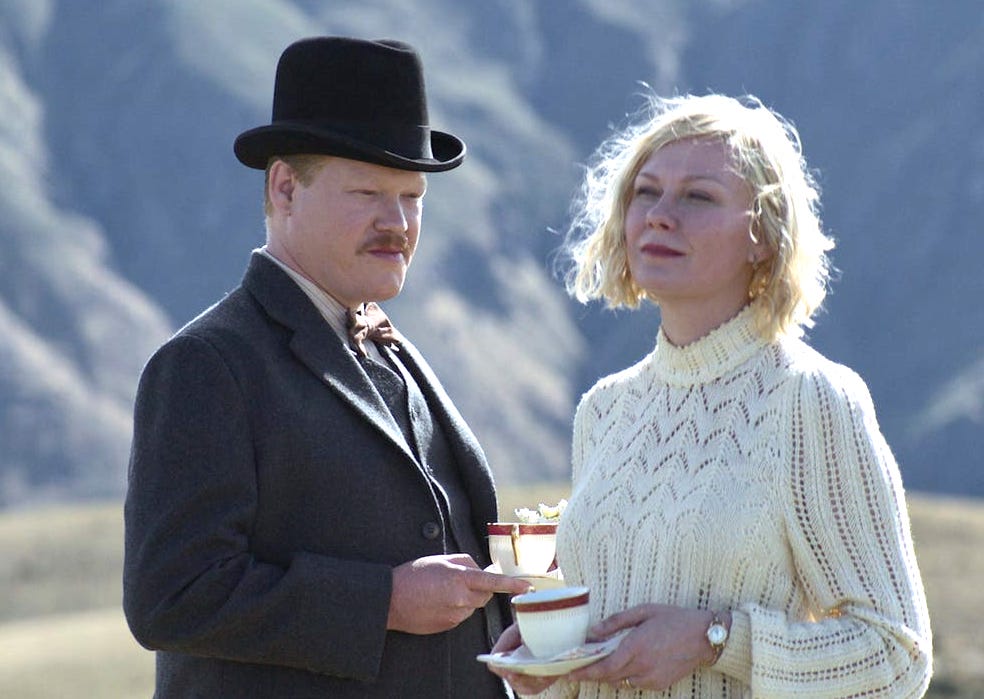
Bachelor brothers Phil and George Burbank (Benedict Cumberbatch, Jesse Plemons) own a sprawling Montana ranch in the 1920s.  Their substantial wood-paneled home, crammed with expensive furniture and a world-class collection of stuffed wildlife, speaks of massive riches.

And yet the brothers seem indifferent to their wealth.  Phil is the brains and muscle of the outfit, a lanky cowboy who calls the shots and — despite an Ivy League education — is most comfortable on horseback.  He and George inherited the ranch, but Phil learned how to run it at the feet of a near-mythical character called Bronco Henry, who has been dead for some years.

George is, well, kind of useless.  He’s a round-faced cipher who dresses like a banker even on a cattle drive; he has pretty much handed the reins to Phil, who openly addresses  him as “Fatso.”

Jesse Plemons, Kristen Dunst

Conflict arrives with George’s unexpected marriage to Rose (Kirsten Dunst, Plemmons’ real-life spouse),  operator of a boarding house in the small rail center where the Dunbars deposit their herd. 

Phil openly accuses Rose of being a gold digger.

Adding even more tension is Rose’s teenage son Peter (Kodi Smit-McPhee), an impossibly thin, lanky kid with an artistic bent (he fashions exquisite flowers from scraps of paper). Phil immediately labels Pete a “Nancy boy” and takes sadistic pleasure in tormenting the newcomer, inviting the other cowpokes to get in on the fun.

It doesn’t take a psych degree to see that the effeminate Peter is stirring up Phil’s own long-suppressed homoerotic tendencies.  Yet “The Power of the Dog”  is far from a traditional coming-out tale.

While there’s genuine sweetness in the thick George’s love of his new wife; that’s not enough to keep Rose from seeking solace in a bottle.  A  Montana ranch is lonely for a woman; Phil’s sneering putdowns make it even worse.

Meanwhile young Peter slowly emerges as the most complex character in sight.  Far from trying hide his “otherness,” he flaunts it.  His posture, his manner of talking, his clothing choices…all seem to be calculated as a silent affront to the cowboy machismo surrounding him.  

In the film’s latter stages it almost seems as if the hard-hearted Phil is undergoing a positive transformation. He slowly takes Peter under his wing, teaching him to ride and rope, and is pleasantly surprised to discover that he and the boy may be on the same aesthetic and philosophical wavelength.

But that is only the setup for a betrayal so devastating that it turns inside out what we think we know about at least two of these characters.

“Power of the Dog” is not a copacetic experience;  it seethes with anger and unhqppiness.  

But it unfolds in an environment of austere beauty. It was filmed in Campion’s native New Zealand, and the nearly bare hills and brown palette create a Western landscape unlike anything I’ve seen before.

The performances are pretty much off the charts, especially from Cumberbatch and Smit-McPhee — the former a bully who slowly reveals his sensitive side, the latter a seeming sissy who in reality harbors a methodical and implacable core of steel.

| Robert W. Butler

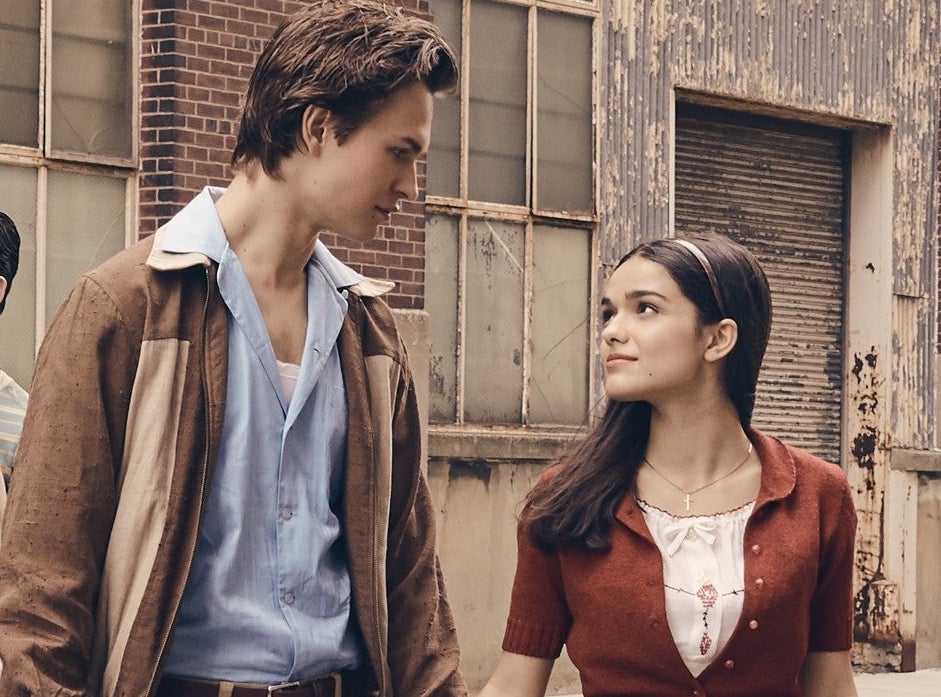
Ansel Elgort as Tony, Rachel Zegler as Maria

“WEST SIDE STORY”  My rating: B (In theaters)

156 minutes | MPAA rating: PG-13

There’s really no point in remaking “West Side Story” if you’re only going to recreate the 1961 version. Which was, after all, pretty damn definitive.

And so Steven Spielberg’s  daring re-imagining of this classic — my favorite piece of musical theater, rivaled only by Stephen Sondheim’s “Sweeney Todd” — consistently takes its audience by surprise. You may think you know the show inside out; just wait until the master filmmaker  lays a modern sensibility over the story’s late ‘50s ambience.

In this “WSS” the Puerto Rican characters deliver many of their lines in Spanish without subtitles (not that you’ll need them…you can tell by the performances what’s going on).

Moreover, where appropriate the film has been cast with Latinx performers…no lily white actors trying to pass for ethnics.

Spielberg and writer Tony Kushner, adapting the Arthur Laurents/Ernest Lehman script, have shaken things up, shifting the order of the musical numbers and in some cases giving songs to characters who didn’t sing them in the original.

Of course the dancing (not pure Jerome Robbins but close enough to generate goosebumps), the memorable Leonard Bernstein melodies and those brilliant orchestrations (jazz meets mainstream) remain potent enough to generate tears of aesthetic gratitude.

And the core story of star-crossed lovers seeking fulfillment in a world of hatred and strife is as strong as ever (hey, it’s Shakespeare’s “Romeo and Juliet”…borrow from the best.)

But perhaps the filmmakers’ biggest reach is to pump up the material’s psychological and social realism to a near breaking point. It is for this effort that Spielberg’s film has been generating off-the-charts praise — and yet I’ve got to admit to a lot of ambivalence.

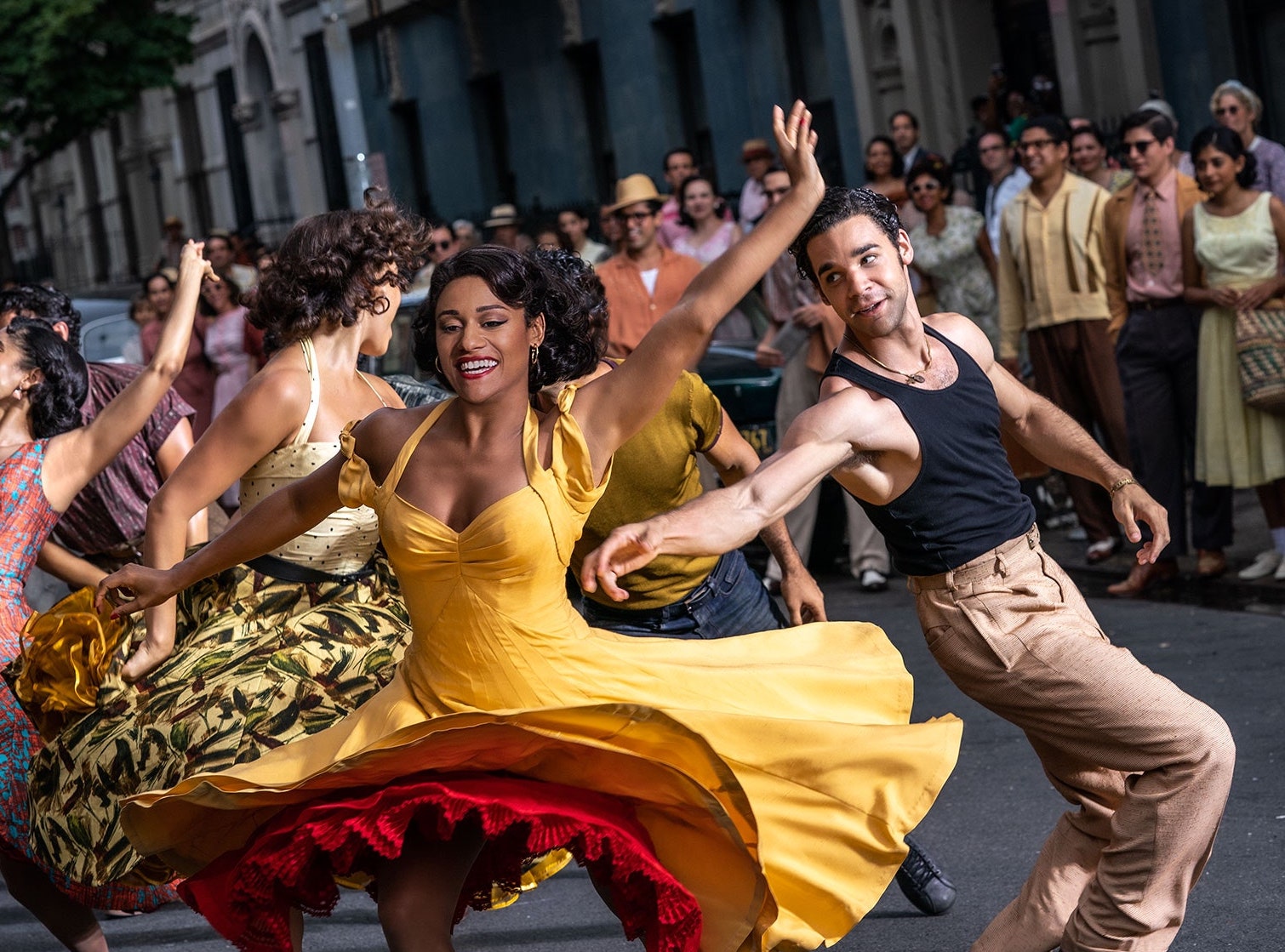
Ariana DeBose (in yellow) as Anita, David Alvarez as Bernardo

We understand that the film is taking on some big ideas from the first shot, a flyover of a Manhattan neighborhood falling under the wrecking ball. The few tenement walls still standing are surrounded by piles of rubble and abandoned bathtubs. A billboard announces that this will be the future home of Lincoln Center. 

Of course, when the livable turf is reduced, the remaining inhabitants must duke it out for possession of what’s left.

“West Side Story” has always had an undercurrent of social commentary (just listen to Sondheim’s caustic lyrics for “America”) and an aura of liberal awareness. But this new version brings those concerns front and center, then hammers away at them.

In this retelling Riff (Mike Faist) and his Jets view themselves as the last white men standing against a brown tidal wave. The cynical police detective Schrank (Corey Stoll) taunts the Jets as “the last of the can’t-make-it Caucasians,” in effect goading them into continual warfare with the just-off-the-boat Puerto Ricans.

That the Jets are nativists has always been an element of “West Side Story,” but never before has that idea been banged on so relentlessly.  No one in the film utters the words “Proud Boys,” but you’d have to have spent the last few years in a cave not to see the racial signifiers.

Simultaneously the film paints a vibrant picture of Latin culture, depicting a neighborhood where huge Puerto Rican flags are painted on walls and the locals can effortlessly turn a block of storefronts into a bubbling ethnic festival. (Indeed, the show-stopping “America” is here performed not at night on a rooftop but in bright sunshine on a busy city street.)

“I Feel Pretty,” a song that has always seemed vaguely out of place, gets a major transformation. Instead of being performed by Maria (Rachel Zegler), Anita (Ariana DeBose) and friends in a modest dress shop, the number unfolds after hours in the department store where the immigrant women fill the ranks of the cleaning crew.  They deliver the lyrics while surrounded by mannikins posed in vignettes drawn from majority white culture…what up to now has been a hummable but thematically thin song suddenly is crawling with wry political/social commentary.

Kushner’s script also pumps up what we know about the characters.  Thus we learn that our Romeo stand-in, Tony (Ansel Elgort), is on parole after spending a couple of years in prison for nearly killing another young man in a brawl. Once one of the Jets’ fiercest fighters, he’s now steering clear of conflict.

Anybody’s, the girl who desperately wants to be one of the Jets, is usually portrayed as a tomboy.  Here, though, she is played by non-binary actor Iris Menas, bringing a whole new level of sexual politics and sexual ambiguity into the mix.

Characters that were basically placeholders in earlier incarnations get a major reworking.

Officer Krupke (Brian d’Arcy James), usually depicted as  a hapless flatfoot, comes off as a decent if weary bloke who’d like to see everybody get along.

Perhaps the biggest character expansion falls to Chino (Josh Andres Rivera), Maria’s gang-approved suitor, who is anything but a thug…he’s going to night school and wants to become a CPA. This bespectacled brainiac is the hope of his community, so much so that Bernardo (David Alvarez) and the Sharks work to keep him out of their conflict with the Jets.

But all that is merely a prelude to the big whopper, the casting of Rita Moreno (she won an Oscar for her portrayal of Anita in the 1961 film) as the widow of Doc, operator of the local pharmacy/candy store.  

Doc, inspired by “Romeo and Juliet’s” Friar Lawrence, never had much of a presence in earlier “WSS” incarnations.  But Moreno emerges as a major character, Tony’s employer and moral backup; she even gets to sing the haunting “Somewhere,” a number traditionally performed by Tony and Maria.

Here’s the thing…all these augmentations and observations had the effect of taking me out of the central romance.

Oh, there were some terrifically romantic moments. Tony and Maria’s meeting at the community dance here unfolds beneath the bleachers, a very nice touch.  And songs like “Maria” and “Tonight” absolutely nail the swooning universal yearning for a love capable of changing the world.

But at a certain point I found the ever-thickening patina of commentary got in the way. A marvel of traditional musical theater is the way in which one-dimensional characters expand through song, finding their true humanity through the synthesis of melody and lyric.

This “West Side Story” gave me so much information, so much detail that I felt I was being force fed rather than discovering.

It’s at moments like this when your faithful critic wonders if I have at long last reached the ranks of grumpy old men.

| Robert W. Butler

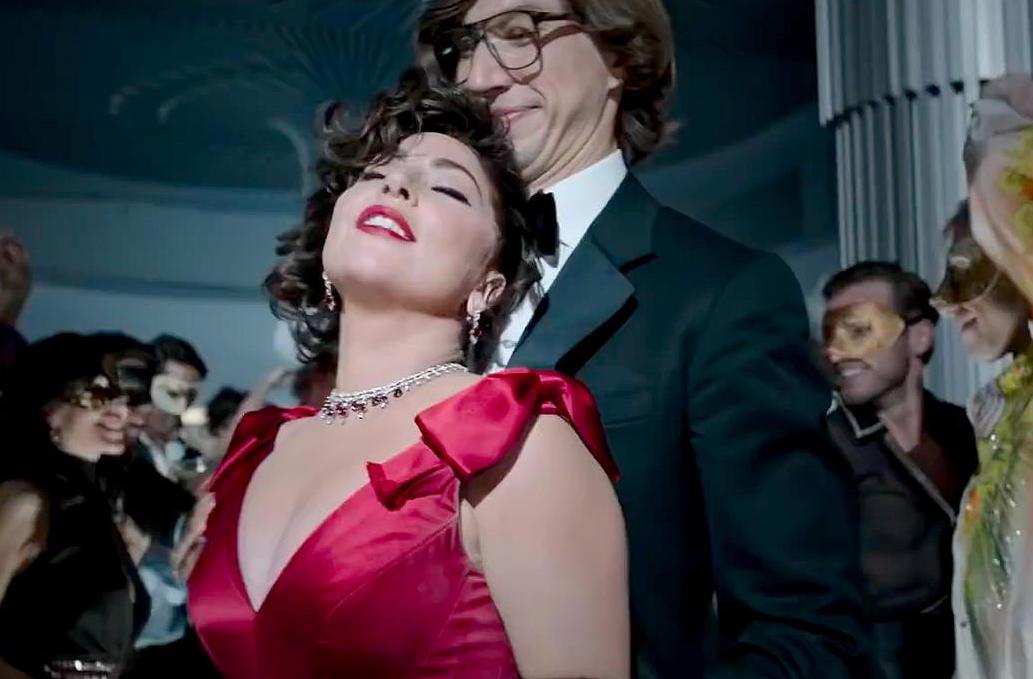
Lady Gaga, Adam Driver

“HOUSE OF GUCCI” My rating: C (In theaters)

167 minutes | MPAA rating: R

We’re all familiar with cinematic sagas of backstabbing among the filthy rich. Entire TV series have grown around that idea.

In fact, we’re so accustomed to the wealthy misbehaving that any example of the genre trying to capture our time and attention had best come up with something — an approach, an edge, an attitude — that sets it apart.

This is precisely what Ridley Scott’s “House of Gucci” fails to do.

This is a multi-character epic of greed and power that is intermittently intriguing but which overall suffers from a bad case of meh

The screenplay by Becky Johnston and Roberto Bentivegna (based on Sara Gay Forden’s nonfiction book) lacks a point of view or even an obvious purpose.  The story is based on facts, but the telling is satire- and irony-free, a bland recitation of events with no attempt to analyze or interpret.

In a shorter film this might have been finessed, but “…Gucci” runs for more than 2 1/2 hours…by the halfway point a viewer’s attention span starts to wander as it becomes clear we’re not going anywhere.

And director Scott’s heart clearly isn’t in it.  This effort lacks even his trademark visual pizzazz. 

The film is strongest in its early passages, when we’re introduced to Patrizia Reggiani (Lady Gaga), who works as a secretary for her papa’s Milanese trucking company.  Gaga once again establishes her bona fides as a genuine movie star…here she seems to be channelling Sophia Loren and Gina Lollobridgida, a potent mixture of sex and sassiness. 

Out partying  one night Patrizia bumps into a rather shy but charming young man who introduces himself as Maurizio Gucci (Adam Driver).

He describes himself as a humble law student, but Patrizia recognizes that this is one of the heirs to the Gucci fashion empire.  She starts stalking Maurizio, plotting an “accidental” meeting.

Is she a gold digger?  Well, Maurizio’s uber-cultured father (Jeremy Irons) certainly thinks so, but the film declines to pass judgment.  Patrizia is in some ways solidly plebeian (she doesn’t like reading) but she’s no shortage of ambition, something that gratifies her to Maurizio’s uncle Aldo (Al Pacino), who runs the Gucci empire from a New York high rise.

Under his new wife’s insistent prodding the laid-back Maurizio is slowly sucked into the firm’s management, undergoing a bit of a personality change in the process.  Power corrupts, don’t cha know?

In fact, Patrizia makes such a pest of herself, meddling in Gucci business, that divorce rears its ugly head. In a plot development that beggars the imagination (but which actually happened), she befriends a TV psychic (Salma Hayek) and together they put together a hit on hubby.

That’s the main plot thread of “House of Gucci,” but it’s only one of many.  

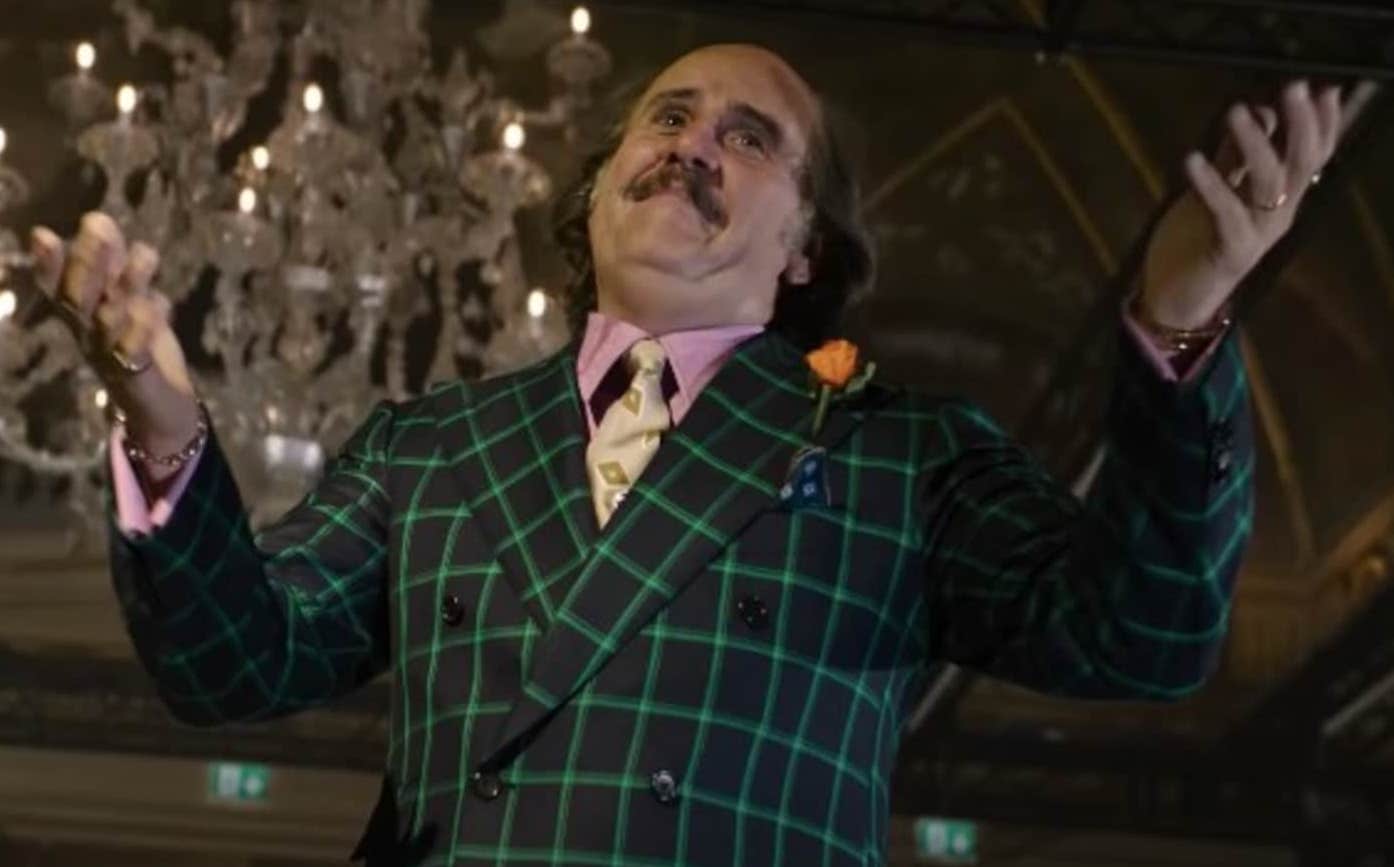
Jared Leto

The film jerks to life every time Jared Leto makes an appearance as Aldo’s son Paolo, a wannabe designer utterly lacking in taste and talent who owns a big chunk of Guggi stock but is considered an idiot by one and all.  

Leto is unrecognizable beneath bald pate, scraggly hair and double chin…his Paolo is like a parody of every hapless loser you’ve ever met.   You’re almost tempted to feel sorry for him, but the guy is so clueless and irritating we practically take pleasure in his humiliations.

(Some smart grad student in psychology is going to do a thesis on why one of the most handsome actors in Hollywood insists in role after role on uglying himself up beneath layers of grotesque makeup and prosthetics.)

There is no shortage of betrayals here.  Patrizia and Maurizio learn that Uncle Aldo has been cheating on his America taxes and turn him in so they can take over the company.  Then they must face a coup engineered by the CEO of Gucci America (Jack Huston).  

While Patrizia stews in divorcee hell, Maurizio cavorts with a thin French friend (Camille Cottin).

Damn, but these rich folk push the envelope.

Truth be told, most of the performances here are just fine.  It’s the storytelling that lets us down, keeping us at arm’s length and ultimately leaving us without any character to care about.

| Robert W. Butler

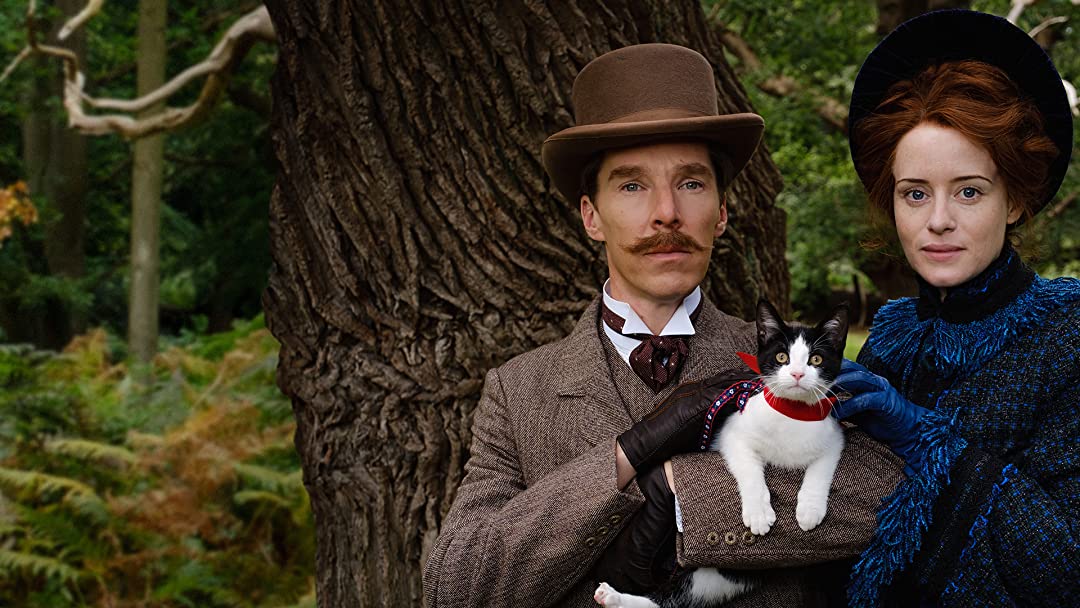
Benedict Cumberbatch, Claire Foy

“THE ELECTRICAL LIFE OF LOUIS WAIN”  My rating: B+ (Amazon Prime)

111 minutes | MPAA rating: PG-13

Whimsical charm and heartbreaking tragedy achieve a life-affirming reconciliation in “The Electrical Life of Louis Wain,” a mostly-factual biopic in which Benedict Cumberbatch gives one of his most memorable performances as a true English eccentric.

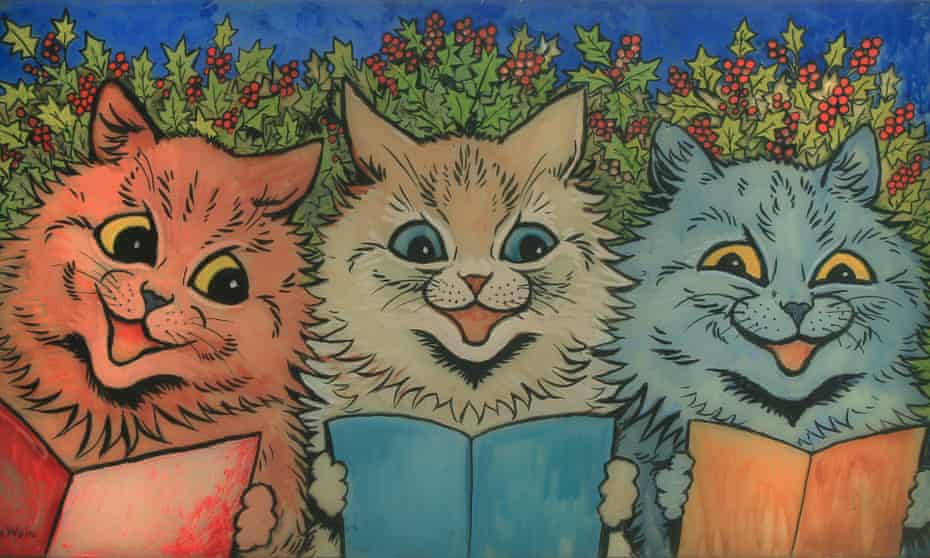
In his prime Louis Wain (1860 – 1939) was one of England’s most popular illustrators, a sort of artistic idiot savant who could churn out artwork at an amazing pace, painting or drawing using both hands simultaneously. 

His subject matter was equally odd — he specialized in portraits of cats,  often anthropomorphizing them. (You know the poker-playing dog paintings? Same idea, only with felines.) Before Louis Wain the British public regarded cats not as pets but as working animals whose job was to control the rodent population; his widely disseminated artwork turned that notion inside out.

At the onset of Will Sharpe’s film  (Sharpe also co-wrote the screenplay with Simon Stephenson) we find  Louis (Cumberbatch) working part time for a London newspaper editor (Toby Jones) who appreciates the artist’s keen eye and speed in producing drawings of country life, especially animals like bulls, sheep and fowl. (This was before newspapers could reproduce photographs.)

Beyond his skills as an illustrator,  Louis is a tad wacko.  He has theories about undetected electrical currents permeating all existence. (Later in life he would lecture that cats would evolve into superhuman creatures and turn blue in the process.)

He’s an emotionally constipated  social misfit in a late-Victorian world that is all about propriety. He’s a loner who does not play well with others…not that we can blame him. He lives with and provides the only financial support for his mother and five sisters (the most domineering and critical of his siblings is portrayed by the chameleonic Andrea Riseborough). Can’t blame the guy for zoning out in his own bubble.

But then the family hires Emily Richardson (Claire Foy) as governess for the youngest sisters, and Louis is smitten.  In her own way Emily is an outsider, too. They’re made for each other and ere long have moved to a storybook cottage in the countryside. (Erik Wilson’s astounding cinematography is like a pastel-dominated, hand-colored Daguerrotype and employs a square frame format; it’s sort of like watching a magic lantern show from that period.)

The couple adopt a kitten found mewling in a downpour. They take in this creature and treat it both as a child and as an equal.  

Jeeze…what a happy little family.

Except after only a few blissful years Emily sickens, leaving a distraught Louis once again in the demanding arms of his womenfolk.

There’s a bit of good news…the cat portraits he executed for the ailing Emily have morphed into a full-time avocation.  Suddenly he’s wildly popular.  (Not that this materially helped the Wains…Louis — always more an impetuous enthusiast than a calculating businessman —neglected to copyright any of his illustrations and now they’re being exploited while he receives not a penny.)

As it follows Louis’ long life (he died in a mental hospital at age 78) the film alternates between passages of enchanting oddness and moments of crushing sadness. This repetitive first-you’re-up-then-you’re down pattern might be offputting if not for Cumberbatch’s weirdly compelling performance.

In fact, one is tempted to declare Louis Wain the character Cumberbatch was born to play.   With his big, childlike noggin and ability to perfectly project the sense of a man caught up in private reveries, Cumberbatch embodies this oddball in ways that no conventionally handsome actor could.

There are moments here when the actor moves the viewer to tears; at the same time there’s an almost frightening clinical approach to the character.  After watching this performance you’ll understand why Wain fans still argue over whether he was truly schizophrenic (as he was diagnosed at the time) or instead occupyied his own special niche on the spectrum.

“The Electrical Life of Louis Wain” has been sumptuously mounted as it follow its subject from the 1880s to the eve of World War II, and the keen-eyed viewer will spot some sly guest appearances by notables like Taika Waititi and singer Nick Cage. The great Olivia Colman provides the slightly wry narration.

| Robert W. Butler

Jude Hill

“BELFAST” My rating: A- (In theaters)

98 minutes | MPAA rating: PG-13

The first moments of Kenneth Branagh’s “Belfast” announce that we’re on the cusp of greatness.

And over 90 minutes Branagh’s heartfelt writing/directing effort delivers one of the year’s supreme movie experiences.

The film opens with Chamber of Commerce-style color footage of modern Belfast; then the screen reverts to black and white.

The year is 1969 and cinematographer Haris Zambarloukos’ camera wanders breathlessly among the denizens of a bustling residential street. At the center of the action is 9-year-old Buddy (Jude Hill), all freckles, buck teeth and peach fuzz. He’s an explosion of youthful energy, slaying invisible dragons with a wooden sword.

And then playtime is suddenly over. Buddy freezes while the camera spins around him, revealing at one end of the street — slightly out of focus, making it all the more terrifying — a mob of Protestant rioters who proceed to smash the windows of Catholic houses.

Buddy stands petrified in horror; he’s plucked from the chaos by his mother (Catriona Balfe), who drags him and his teenage brother Will (Lewis McAskle) into the relative safety of their home. As nominal Protestants they’re not targets, but in the chaos anything could happen.

Catriona Balfe, Jamie Dornan

The scene is breathtaking…horrifying yet weirdly beautiful, and it establishes from the outset that the peaceful lives of Buddy and his kin are now forever changed. Religious intolerance and political anger have come to their little corner of Belfast; when next we see Buddy he’s negotiating barbed-wire checkpoints and barricades of abandoned furniture that seal off either end of the street.

“Belfast” references the sectarian civil war that raged in Northern Ireland for decades, but it’s not about history per se. Rather, this is Branagh’s attempt to conjure up his own childhood; it’s a memory play in which very personal moments play out against a looming background of potential violence. There’s not much discussion of politics or Irish history; that’s way over young Buddy’s head.

He’s more concerned with personal issues, like the little Catholic girl at school on whom he has a killer crush, or the threats directed at his father (Jamie Dornan) for refusing to join the Protestant militia (“There’s no ‘our side’ or ‘their side’ on our street.”)

He interacts with his crusty but loving grandparents (Ciaran Hinds, Judi Dench, both shoo-ins for Oscar nominations). He observes his parents’ relationship, the obvious sexual pull between them (in one intoxicating scene they dance in the street to blasts of radio-powered rock ‘n’ roll) and the tensions generated by his father’s work in England (he’s a construction carpenter) and gambling habit.

Judi Dench, Ciaran Hinds

And he is reduced to fearful tears when his parents introduce the idea of moving to London, away from danger and everything young Buddy has known.

The film is crammed with eccentric neighbors and memories of TV shows: Raquel Welsh in fur bikini in “One Million Years B.C.”, John Wayne’s comforting machismo in “The Man Who Shot Liberty Valence,” episodes of “Star Trek,” and especially “High Noon” (Buddy can’ help but see his own father as a Gary Cooper character faced with a deadly choice).

And there’s the terrifying sermon delivered by a spittle-spewing preacher that has a worried Buddy drawing up eschatological maps that he hopes will guide him away from hell and into the arms of the holy.

Throughout Branagh and his players maintain a careful balancing act between the deeply personal and the achingly universal; every few minutes the film delivers an emotional coda that will leave audiences reeling.

The acting is impeccable (the best ensemble cast in recent memory) and the technical production jaw-dropping beautiful. The framing of individual shots is a model of effective storytelling; it’s not deep focus, exactly, but every shot is so crammed with detail that you’d swear you could smell individual scenes.

Tie it all up with a killer soundtrack of songs by Belfast native Van Morrison, and you have 2021’s best film.

| Robert W. Butler

“FINCH” My rating: B (Apple +)

115 minutes | MPAA:PR-13

Tom Hanks

Tom Hanks could probably sell refrigerators to Eskimos.

That’s what he does, metaphorically speaking, in “Finch,” a post-apocalyptic science fantasy that is equal parts Cormack McCarthy’s “The Road,” Pixar’s “Wall-E” and Hanks’ “Cast Away.”

If that sounds like an unweildy mashup of unlikely bedfellows…well, it is. But Hanks is such a watchable presence that he makes this one-man show worthwhile.

Fitch (Hanks) lives alone in an industrial bunker beneath the ruins of St. Louis. A decade earlier a sonic flare wiped out modern civilization and left Earth scorched by deadly ultraviolet rays.

Most days Fitch suits up in protective gear to search for supplies. He leaves back in the safety of the bunker the only other living creature in his life, a dog named Goodyear on whom he lavishes affection.

The narrative of Miguel Sapochnik’s feature (the script is by Craig Luck and Ivor Powell) centers first on Finch’s constructing a humanoid-ish robot and programming it to learn more or less like a human child.

This creature, who will eventually name itself Jeff, begins by stuttering static but over time learns to talk (Jeff is voiced by Caleb Landry Jones). It is curious, just like a child, which means that it sometimes gets into trouble.

But it is also loyal to its creator/father and understands that its purpose is to take care of Goodyear should anything happen to Finch. Which seems likely, given the bloody cough he’s developed.

The bulk of the film takes place on the road as Finch loads up Jeff and the pooch into an ancient recreational vehicle in an attempt to outrun the killer storms that are racking the Midwest. They head out West; Finch has it in his head that he’d like to see the Golden Gate Bridge.

There are dangers, both natural and manmade. But “Finch” isn’t so much about reaching a destination as experiencing the possibilities of one’s humanity along the way.

Tom Hanks and “Jeff”

As mentioned earlier, this is pretty much a one-man show. Good thing that man is Hanks, who is able to plumb all sorts of levels without ever pushing too hard, developing his character’s crushing loneliness, his need for companionship, his parental instincts, his fears, his hopes and, finally, his resignation to his fate.

Of course he gets immeasurable help from the designers and animators of Jeff, a creation of metal and plastic that develops a personality before our eyes. I can’t tell you how much of Jeff is puppetry, how much CG, but the results are utterly convincing. Rarely does a human actor get the chance to express a character’s personality through physical performance; it’s rarer still to pull it off with a mechanical contraption.

But that’s what production designer Tom Meyer and his crew have achieved here. Jeff may be all nuts and bolts, but he’s also disarmingly human. This is no small accomplishment.

“Finch” is jammed with improbabilities and explains virtually nothing about Finch’s past or how he came to be in this situation.

But here again Hanks compensates just by being, well, Tom Hanks. His essential “Hank-ness” gently expands to fill the gaps. Watching, we understand that we’re in good hands.

| Robert W. Butler

Danielle Deadwyler, Jonathan Majors, Zazie Beetz

“THE HARDER THEY FALL” My rating: C+ (Netflix)

130 minutes | MPAA rating: R

If “The Harder They Fall” is a thematic and narrative mess, at least it’s a moderately entertaining mess.

Jaymes Samuel’s film aspires to Leone-level mythology while delivering an all-black (or mostly black) Western adventure.

Samuel and co-writer Boaz Yakin have come up with a wholly fictional (and wholly implausible) plot, but they’ve populated it with historic figures…or at least characters who bear the names of real African American noteworthies like Bill Pickett, Stagecoach Mary Fields, Cherokee Bill and Jim Beckworth.

Those names are the most realistic thing about the film. The characters are paper thin (they sometimes accrue a simulacrum of substance through the sheer charisma of the performers) and nothing like psychological realism rears its head.

Similarly, the physical production is impressive without ever really being convincing.  This is an oddly spic-and-span version of the West…the horses bleed when shot but apparently they don’t defecate, given the pristine state of the streets.  The wardrobe choices — especially for the women characters — are quite wonderful in their eccentricity, but at the cost of constantly reminding us that we’re watching a movie.

Indeed, the model for “The Harder They Fall” is less the traditional Western than a Marvel movie.  Instead of a crew of specially-gifted superheroes we get two competing crews of specially-gifted and peculiarly-costumed gunfighters.

In a prologue we see outlaw Rufus Buck (Idris Elba) invade a remote farmhouse, shoot the husband and wife and terrorize their young son.

Years later that child has grown to be Nat Love (Jonathan Majors), an outlaw gang leader whose specialty is preying on other outlaws.  You see, Nat thirsts for revenge on Rufus, but that killer is serving a life sentence in prison. So he occupies himself with bothering the still-active remnants of Rufus’ gang.

But wouldn’t you know it…Rufus pulls strings and gets himself freed from stir to run amok once again.  You know it’s all going to end with a big shootout that will reduce a frontier town to rubble and a mano-a-mano confrontation between Nate and his nemesis.

The film is packed with terrific actors on both sides of the feud:  Ed Gathegi, Damon Wayans Jr., Lakeith Stanfield. Regina King is too good an actress to be stuck with a cardboard villainess like Trudy Smith, but by God she looks great in her all-black outfit topped by a bowler hat.

Regina King, Idris Elba, LaKeith Stanfield

Zazie Beetz is an alluring explosion of hair as saloon owner Mary Fields, who is also hero Nate’s love interest.

And two members of the Love Gang just about steal the show:  Danielle Deadwyler as Cuffee, a cross-dressing diminutive saloon bouncer and R.J. Cyler as Beckworth, one of those mouthy, pistol-spinning wannabe gunfighters who exude more bravado than common sense.

Oh, and let’s not forget Delroy Lindo as grizzled lawman Bass Reeves, who teams up with one band of outlaws to defeat an even worse bunch.

This is an Old West where white faces are peripheral at best. Most of the action unfolds in all-black burgs, and while one assumes this milieu would have been rife with racism, the film really isn’t interested in making a social statemtent. 

(Although there’s one elaborate visual joke: the black outlaws decide to rob a bank in a white town…and when I say “white” I mean really white.  The whole place — houses, storefronts, hitching posts, boardwalks — have been painted bright white. You’d have to shade your eyes on a cloudy day.)

Samuel gets playful with the soundtrack, employing bits of Morricone mischief but relying mostly on reggae.  

On the downside there are several moments of pure sadism that leave a bad taste. And the screenplay features a couple of long monologues that really only prove how much better Tarantino is at this sort of thing.

But, hey, the film looks great. Mihai Malaimare Jr.’s cinematography lovingly dwells on both the Western landscape and the faces of the players.

If it all never really comes together coherently, at least there’s plenty to look at.

| Robert W. Butler

Matthias Schweighofer

“Army of Thieves” My rating: B- (Netflix)

127 minutes | No MPAA rating

The heist-in-zombie-plagued-Las Vegas title “Army of the Dead” was, to me, anyway, a big bloated bore.

Weirdly, I kinda love “Army of Thieves,” a prequel that provides the back story of Ludwig Dieter, the squirrelly safecracker from the first movie.

Combining the whimsey and visual panache of “Amelie” with the well-worn cliches of a caper flick (with, yeah,  zombies lurking in the distant background), this effort from director Matthias Schweighofer (who also stars as the nimble-fingered Dieter) manages to be consistently diverting.

In large part it’s because Schweighofer is so good as Dieter, a safe-obsessed German nerd who in moments of crisis shrieks like a schoolgirl. He’s anything but heroic…in fact, the sorts of manly characters who usually dominate action films are here portrayed as villains.

Dieter has a little-watched YouTube series in which he rhapsodizes about a safe designer from the early 1900s who produced four impenetrable bank vaults inspired by Wagner’s Ring Cycle.

They’ve got names like Siegfried and Valkyrie and each has a specific design guaranteed to discourage any robbery attempts.

Apparently Dieter has one steady viewer. He’s contacted by the gorgeous Gwendoline (“GoT’s” Nathalie Emmanuel) who wants him to join her team of bank robbers.  Her plan is to hit the Ring Cycle safes in various banks across Europe, then move on to the final objective, the massive Gotterdammerung beneath a Las Vegas casino.

(News broadcasts scattered throughout the film inform us that there’s a zombie outbreak in Vegas.  The plague is yet to cross the Atlantic.)

Other members of the team include a master computer hacker (Ruby O. Fee), a skilled if overly-chatty getaway driver (Guz Khan) and the preening Brad (Stuart Martin), an imposing physical specimen who’s a dead-ringer for Hugh Jackman in Wolverine mode.

Turns out the intimidating Brad is also Gwendoline’s current squeeze, a situation that poses additional dangers as our dweeby protagonist finds himself falling ever more deeply for his boss lady’s charms. (Hard to blame him…Gwendoline is pretty charming.)

Shay Hatton’s screenplay (he also penned “Army of the Dead”) is jammed with amusing wordplay (whereas the earlier film was jammed with over-the-top mayhem) and the heist sequences have been paced and edited for maximum tension.

“Army of Thieves” ends pretty much where “Army of the Dead” began…but its pleasures don’t require any knowledge of the earlier movie.  It’s just fun.

| Robert W. Butler