Feeds:
Posts
Comments

“MIL COLMILLAS” My rating: B (HBO Max)

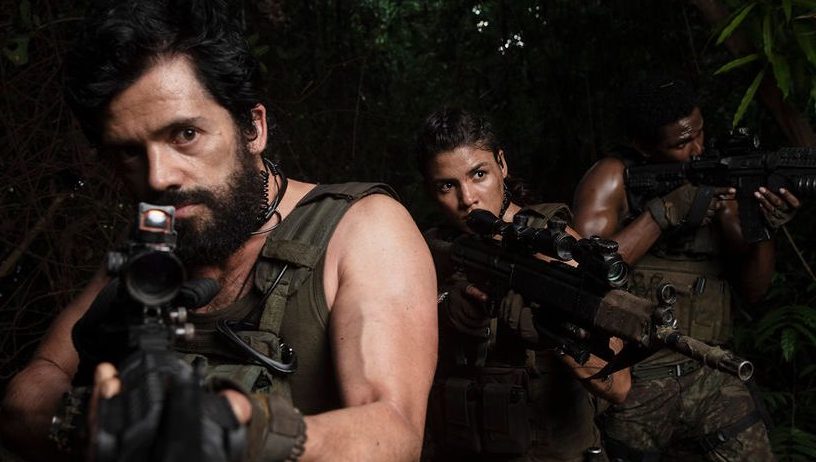
Among my current guilty pleasures is HBO Max’s “Mil Colmillos,” a Colombian TV series that slices and dices several strains of popular sci-fi and action flicks to create its own heady cocktail of mayhem and horror.

Is it good?  Not sure. After all, in English the title is “A Thousand Fangs,” which pretty much announces its pulpy intentions.

What I do know is that I gobbled up its first seven episodes and am now anxiously awaiting the arrival of Season 2.

A squad of Columbian special forces soldiers are sent on a secret assignment into the jungle of a neighboring country.  Since their presence there is completely illegal, they cannot rely on outside help…they’re on their own.

But each episode also contains a mini-episode set in the 1500s in which conquistadores and their Indian scouts go searching in this same jungle for treasure…and stumble across countless horrors.

Both the modern soldiers and the matchlock-toting Spaniards are picked off one by one by the jungle and its denizens.

Just what they’re up against is never made clear.  There are, it goes without saying, fanged humanoids looking for a snack.  But there are also masked locals whipped into a frenzy by a charismatic leader; one entire episode is devoted to the commandos’ defense of a long-abandoned factory compound besieged by hundreds of these fearless, faceless killers.

There are hints of an ancient Indian curse, and possibly a psychotropic drug loose in the environment that can turn a well-trained soldier into a murderous drone.

And it’s pretty obvious that the big brass back at the base know stuff they haven’t shared with the boots on the ground.

There are dark caves and tunnels. Crumbling ruins. Thick vegetation that could be hiding…anything. 

A cynical little voice in the back of my head tells me that that the creators of “Mil Colmillos” cannot possibly find a logical way to sort out all the elements they are throwing at us, that ultimately the series is going to collapse beneath the weight of its pretentions.

And yet on an episode-by-episode basis this is terrific stuff, a survival fantasy in which the characters are reduced to a couple of salient traits (just so we can tell them apart) and simply staying alive becomes their reason for being.

The series borrows shamelessly. “Predator,” zombie flicks, the Kurtz sequence of “Apocalypse Now,” plague melodramas and just about every “lost patrol” movie ever made are sampled and mined for high-tension possibilities.

Yeah, the big payoff may never materialize.  But at the very least “Mil Colmillos” is a happy waste of time.

| Robert W. Butler

“LUNANA: A YAK IN THE CLASSROOM” My rating: B+ (On demand)

110 minutes | No MPAA rating

The familiar trope about the pompous city slicker who falls for the simple charms of the sticks gets an innovative reworking in the Oscar-nominated “Lunana: A Yak in the Classroom.”

This quiet heart-tugger from the Himalayan nation of Bhutan (It’s been nominated in the foreign language film category) opens in the tiny country’s capital city where twenty something Ugyen (Sherab Dorji) dreams of rock stardom, hopefully in Australia. The closest he’s gotten to fame, though, is open mike night at a local club.

In fact, Ugyen is a bit of a spoiled slacker, resentful that he still has a year to go on his national service contract as an elementary school teacher. He’s even less thrilled when he’s assigned to finish out the year in the mountain town of Lunana, the most remote burg in Bhutan and, by extension, site of the the most remote school in the world.

It takes a long bus ride and a week of uphill walking to even get to the place, and Ugyen almost immediately announces to the town’s headman, Asha (Kunzang Wangdi), that he wants to get back to civilization like, yesterday. The place is cold, the homes are heated with burning yak dung, and there’s no way to recharge Ugyen’s precious iPod (forget about cell phone service).

The school itself is basically four walls, a couple of unsteady tables. No supplies. No paper. No blackboard.

Screw this.

Except…there are the people. Like Michen (Ugyen Norbu Lhendup), Ugyen’s mountain guide, exuding uncluttered decency and charity from every pore. Or Saldon (Keldon Lhamo Gurung), serenading her herd of yaks, singing traditional songs with the voice of an angel. And especially Pem Zan (Pem Zan), a jawdroppingly adorable little girl thrilled to learn at the feet of this worldly guy from the big town.

Ugyen Norbu Lhendup, Pem Zan, Sherab Dorji

The deal is sealed when Saldon lends the teacher her favorite yak, Norbu, who takes up residence in the classroom (where it’s relatively warm) and supplies Ugyen with yak patties for the stove.

Little by little, our man gets sucked into life at the top of the world. And we along with him.

Writer/director Pawo Choyning Dorji manages to avoid all the predictable cliches to deliver a hugely satisfying movie experience. This is all the more amazing when you consider that “Lunana…” has no plot to speak of…no big dramas, no swooning romance. Yet it modestly expands to fill and feed the viewer’s soul.

Special nod to cinematographer Jigme Tenzing, whose images effectively capture both the lush forests of the lower slopes and the semi-barren mountain crests surrounding Lunana. Like almost everything about this movie, they are effortlessly poetic.

| Robert W. Butler

“LOTAWANA” My rating: B (VOD on AppleTV, iTunes, Google Play, Amazon, Vudu)

90 minutes | No MPAA rating

How best to describe “Lotawana,” Trevor Hawkins’ low-budget, locally-made feature shot mostly in the Kansas City ‘burb of Lake Lotawana?

Maybe “Malick-lite.”

In myriad ways the film comes off as an homage to the idiosyncratic works of Terrence Malick, both in its offhand approach to narrative (like Malick, Hawkins seems to have shot lots of footage and then found his story in the editing room, almost as an afterthought) and in its cosmic/transcendental appreciation of the natural world around us.

The plot — to the extent that “Lotawana” has one — follows the relationship between Forrest (Todd Blubaugh, looking uncannily like folkie Eric Andersen as a young man) and Everly (Nicola Collie), two societal dropouts who find each other and fall in love.

Forrest lives on a sailboat on a Midwestern lake, going ashore mostly to ride his motorcycle at breakneck speed and to hike/camp in the Missouri woods. How this modern-day Thoreau can afford a boat and a bike with no employment is never explained (well-to-do parents?).

Everly’s past is just as vague. She mentions not getting along with her mother and she talks with a hard-to-pin-down accent (Maybe she’s a Brit. Or Australian).

Not much happens in the first half hour. Then Everly announces she’s pregnant. The couple argue, reconcile, plan for a baby with what meager resources they can muster, and undergo a tragedy that almost drives them apart.

In the film’s latter stages we find Everly coping with the emotional turmoil by burgling lakeside vacation homes. The closer she gets to being discovered, the more exciting it is for her. Forrest isn’t so sure. (There are echoes here of the young lover-criminals in Malick’s “Badlands.”)

But then conventional plotting isn’t on Hawkins’ agenda. Scenes don’t so much play in real time as fragment into film snippets; the dialogue is mostly small talk (certainly there are no big quotable speeches).

Serving as his own cinematographer Hawkins concentrates on natural moments — birds, insects, sunsets, fluttering leaves. Forrest and Everly seem to view themselves as unspoiled, semi-civilized inhabitants of this idyllic world.

Happily the movie doesn’t swallow that story without a bit of chewing. Hawkins clearly recognizes the delusional nature of his characters. Why else would he name Forrest’s boat Lorelei after the mythological siren who lures sailors to their doom?

And then there’s the fact that Forrest and Everly, despite their naive ambition to achieve absolute freedom, are bobbing in a relatively small body of water from which they cannot escape.

Some viewers will be seduced by the film’s poetic evocations; others will conclude that the ship is awash with pretentions.

I found myself torn between those two extremes, simultaneously fascinated by Hawkins’ atypical storytelling and visual panache and mildly irritated by the film’s refusal to give us any sort of backstory that would tell us how our protagonists came to be the people they are.

Hawkins — who has nearly 30 shorts under his belt, many of them in the travel/nature genre — shot the film with a crew of only a dozen (most of them friends and family members) and financed the production by mortgaging his house on Lake Lotawana. And he simultaneously produced “At the Helm, the Making of Lotawana,” a documentary about the struggle to complete the film.

| Robert W. Butler


f

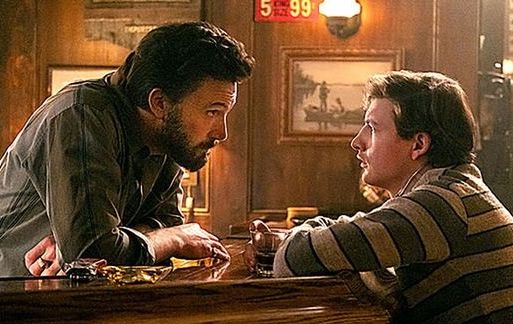
Ben Affleck, Tye Sheridan

THE TENDER BAR” My rating:  B (Amazon Prime)

106 minutes | MPAA rating: R

Will the real Ben Affleck please stand up?

I cannot think of another major actor — okay…Nicolas Cage — whose public persona ranges so widely between genius and ass-hat smirk monkey. 

One cannot dismiss successes like Affleck’s Oscar-winning “Argo”; at the same time the man’s personal and romantic ups and downs are a publicist’s nightmare and a constant inspiration for late-night talk-show monologues.

I’m happy to report that Affleck gives one of his best performances — hell, one of the best performances of the year — in “The Tender Bar,”  George Clooney’s knowing adaptation of J.R. Moehringer’s coming-of-age memoir.

Affleck is essentially a supporting player here but his work is so subtle, insightful and charismatic that all the tabloid baggage falls away and we are left in the thrall of an actor connecting perfectly with his character.

The rest of the film is no slouchfest, either. 

Early on young JR (played to perfection by first-timer Daniel Ranieri) and his mom (Lily Rabe) are forced by economic necessity to return to Mom’s blue-collar home town on Long Island. There they take up residence with crusty Grandpa (Christopher Lloyd), quiet Grandma (Sondra James) and especially JR’s uncle, Charlie (Affleck).

JR is essentially fatherless — his biological sire is a  boozing, womanizing, peripatetic radio deejay several years behind on the child support checks.  Under the circumstances one understands why the kid gravitates to his effortlessly suave uncle.

Charlie runs a working man’s bar filled with garrulous regulars.  Like young JR, Charlie is a huge consumer of good literature. At the same time, he never comes off as effete or uber-intellectual; he’s beloved by his dirt-under-the-nails customers for his arid irony, unforced toughness and down-to-earth humanism.

In effect Charlie and his barflies become JR’s adopted father figures, dispensing whiskey-fueled wisdom and (sometimes intentionally, often not) important life lessons.

Chsitopher Lloyd, Daniel Ranieri

The film wafts back and forth between JR’s boyhood and his young adulthood as an Ivy League university student bent on a literary career (he’s played at this age by Tye Sheridan).

We eavesdrop on his doomed love affair with an upper-middle-class fellow student (Briana Middleton); she’s the child of mixed-race parents who clearly think this proletarian yahoo isn’t nearly good enough for their daughter.

We follow him on his first foray into big-city newspapering.

And the film reaches a dramatic crescendo with a rare meeting of JR and his absent father (Max Martini) in which whatever dreams the kid may have of reconnection are dashed once and for all.

“The Tender Bar” is less a film of big dramatic moments than a gently unfolding idyll of self-discovery and familial nurturing. It’s wistful, warm and wise.

Affleck, Ranieri and Sheridan are terrific.  Also deserving of special notice is Lloyd, whose scraggly Grandpa turns out to be an incredibly smart guy hiding out in a seedy, grumpy-old-man exterior.  You can see where Uncle Charlie got his mojo.

| Robert W. Butler

Denzel Washington, Frances McDormand

“THE TRAGEDY OF MACBETH” My rating: B+ (At the Screenland Armour, AMC Town Center)

105 minutes | MPAA rating: R

Has there ever been a more visually ravishing “Macbeth” — or any Shakespeare film, for that matter — than this new version of “the Scottish play” from Joel Coen (half of the famous Coen Brothers in his first solo outing)?

Here’s a case where every element — from acting to the drop-dead gorgeous black-and-white cinematography to the brilliantly conceived production design — come together to reinforce the play’s haunting themes of human desire, fate and inevitability.

Denzel Washington makes a fine Macbeth, while Frances McDormand (aka Mrs. Joel Coen) is even better as his force-of-nature-manipulative Lady.
The lesser roles have been precisely cast and captured for the screen.

But a character unto itself is the brilliant look of the production.  Filmed by cinematographer Bruno Delbonnel in a 1:33:1 frame ratio (the classic “Academy aperture”), with settings by Stefan Dechant and costumes by Mary Zophres, the film manages to be simultaneously stripped down and abundantly evocative.

The influence of great German expressionist films like the silent “Cabinet of Dr. Caligari” is found everywhere.  The yarn unfolds in a sort of nonspecific Medieval world, but one presented with a minimum of period detail.  

The castle walls are looming, smooth and white; there’s none of the grime and wear-and-tear of a realistic rendering. When late in the film the cold hard lines of Macbeth’s throne room are softened by fallen leaves blowing across the stones, the contrast delivers an almost visceral shock.

Like one of those Busby Berkley musical extravaganzas that ostensibly take place in a nightclub (a nightclub that would have to be the size of a football field with an Olympic-sized swimming pool tossed in), this “…Macbeth” might be a gigantic stage production unhampered by the limitations of an actual theater. 

The perfect artificiality of the presentation actually emphasizes and amplifies the play’s dramatic elements; against these stark backdrops human faces take on additional power. 

I’m not going to go into a lot of detail as to plotting. I figure if you’re reading this you’re familiar with the basics (oh, OK…Macbeth and the Missus conspire to kill the king and take his crown, then have to keep murdering to keep it).

But Coen’s screenplay does work a few interesting changes.  For example, the character of Ross (here played by the impossibly slender and slinky Alex Hassell) is typically a spear carrier with a few lines.  Coen has made him a semi-sinister Machiavelli whose allegiance is always in question.

Kathryn Hunter

The biggest departure is in the depiction of the “three weird sisters,” the trio of witches who predict Macbeth’s rise to power.  At the beginning of the film there is but one witch, a twisted crone (Kathryn Hunter) whose old bones contort into a human knot that moves like a crab. In one dazzling shot her image is reflected in a pool of water…but not one image: Two.  So now we have three of her.

Hunter’s performance is scary and riveting.  At times she resembles a fallen bird; at others she dons a cloak and hood, looking a lot like Death in Bergman’s “The Seventh Seal.”  Of all the images seared into my brain by this movie, Hunter’s gnarled form is the most haunting.

Indeed, a case can be made that this “Macbeth” is more satisfying visually than verbally. That’s not a knock against Washington, McDormand and their co-stars (among them familiar faces like Brendan Gleeson, Ralph Ineson, Harry Melling and Stephen Root as the drunken porter).

It’s just that the picture is such an overwhelmingly visual experience.

| Robert W. Butler

Simon Rex (and friend)

RED ROCKET” My rating: B (Theaters)

128 minutes | MPAA rating: R

Filmmaker Sean Baker sure loves his losers.

His debut feature, “Tangerine,” was a screwball comedy about a transsexual prostitute on Skid Row; his Oscar-nominated “The Florida Project” unfolded amongst the societal outcasts living in a shabby motel in the shadow of Walt Disney World.

It’s a logical progression to his latest, the phallo-centric “Red Rocket,” about an “adult film” actor with a heart of…well, not gold, exactly. Maybe brass. Okay then, tin.

Journeyman actor Simon Rex gives a career high perf as Mikey Saber (as porn names go, this one is actually kind of subtle), who one morning washes up penniless and bruised in the Texas Gulf Coast burg he left two decades earlier.

Clearly, Mikey is trying to outrun something or someone.

He makes his weary way to the home of his estranged wife Lexi (Bree Elrod) and her chain-smoking, tubercular-looking mother, Lili (Brenda Deiss, a hoot in her acting debut).

The women want nothing to do with Mikey, who sets up camp on their porch until they change their minds.

Here’s the thing about Mikey: Despite his present miserable circumstances, he talks a good fight. He always has a show-biz story to relate (frequently about the porn biz; his matter-of-factness and professionalism in describing hair-raising physical acts somehow makes it all seem normal), and he’s overflowing with plans for the future.

He’s nothin if not upbeat. Faced with one humiliation after another, he squares his shoulders and tries again.

Little by little he works his way into the house and into Lexi’s bed; he also begins selling for a surly family of ganga dealers, earning enough to pay the monthly mortgage on Lexi and Lili’s home.

Simon Rex, Suzanna Son

But then he spots teenage Strawberry (Suzanna Son) working at a donut shop in the shadow of the oil refinery. She’s red haired and freckled and cute as a button, and Mikey is smitten. Yes, he’s twice her age and then some (she’s barely legal, according to Lone Star law), but his love is pure. So pure that envisions a future with Strawberry in porn.

He’ll return to Los Angeles in triumph and pick up where he left off.

This is all very tacky, but the marvel of Rex’s performance (which is racking up all sorts of nominations this awards season) is the way he humanizes this silly, shallow, delusional yet somehow endearing character. Face it…the potential for creepiness is off the charts, yet Rex slides effortlessly through the needle’s eye.

| Robert W. Butler

Alana Haim, Cooper Hoffman

“LICORICE PIZZA” My rating: B (Theaters)

133 minutes | MPAA rating: R

The name Paul Thomas Anderson on a movie (“Magnolia,” “There Will Be Blood,
“Boogie Nights,” “The Master”)  usually portends a good dose of  anger, angst and a journey through the underbelly of human experience.

But “Licorice Pizza” is something else entirely — a lighthearted cultural memoir of ‘70s teen life in L.A.’s San Fernando Valley. 

So lightly plotted as to be weightless, the film is a celebration of youthful energy and ambition. I’ve no idea how much of it is true memoir and how much fiction, but Anderson has absolutely nailed the essence of its setting in much the same way George Lucas did with “American Graffiti”.

Basically this is a love story…or more accurately a study of long-suffering adolescent lust.

Alana (Alan Haim, of the rock sister trio Haim, for which Anderson has directed several music videos) is in her mid-20s and working for a handsy  photographer who shoots portraits for high school yearbooks.  

They’re snapping mugs at a local school when she’s glommed onto by Gary Valentine (Cooper Hoffman), a vaguely pudgy 15-year-old (he looks uncannily like the “Mr. Tambourine Man”-era David Crosby) with the self confidence of a veteran grifter.

Gary wastes no time establishing his celeb bona fides.  He’s a child actor (well, former child actor) still recognized for his recurring role in a TV sitcom. He still goes out for auditions, but mostly his energy is devoted to entrepreneurial efforts…the kid has a never-ending supply of get-rich ideas.

For all his bravado — he appears to be on a first-name basis with every maitre’d in town — Gary is also quite obviously a virgin.  

Alana — whose life to date has been unremarkable — is amused by Gary’s chutzpah. Moreover, the kid actually does have several business concerns going; she could do worse than hook her star to this go-getter.

And so she becomes Girl Friday to a teenage Sammy Glick. 

As for the romantic thing…well, there’s a decade between them, though Gary is clearly the adult in the equation. Of course, under the law he is jail bait, which sets off the queasy meter whenever Alana (or those of us watching) contemplate the possibility of something physical between them.

Anderson’s screenplay finds this duo — often accompanied by a small tribe of tweener hustlers attracted by Gary’s grown-up schemes (they’re like human versions of the Minions) — going through a series of misadventures.

Bradley Cooper, Cooper Hoffman, Alana Haim

The most sustained of these has Gary marketing that new invention the water bed. In one jaw-dropping episode he installs a new bed in the posh home of real-life hairdresser-turned-producer Jon Peters, played by Bradley Cooper as a coked-up maniac late for a date with girlfriend Barbra Streisand.

There are other bizarre encounters, like the one with an over-the-hill action star (Sean Penn) who picks up  Alana  at a restaurant and, at the urging of a drunken movie director (Tom Waits), attempts a jump over a bonfire on a souped-up motorcycle.

And the yarn finds time to plumb Alana’s home life (her disapproving parents and  sisters are portrayed by the actress’s real family members) and her brief fling with a young actor who alienates the clan by admitting he is no longer a practicing Jew.

Astoundingly enough, neither Haim nor Hoffman has ever acted before (although she’s done the rock ’n’ roll thing and he is the son of the late Philip Seymour Hoffman).  Their performances work precisely because they’ve not been over-polished…there’s just a touch of endearing amateurism lurking about, one reinforced by the duo’s look — neither is movie-star handsome/beautiful, and this makes them all the more embraceable.

| Robert W. Butler

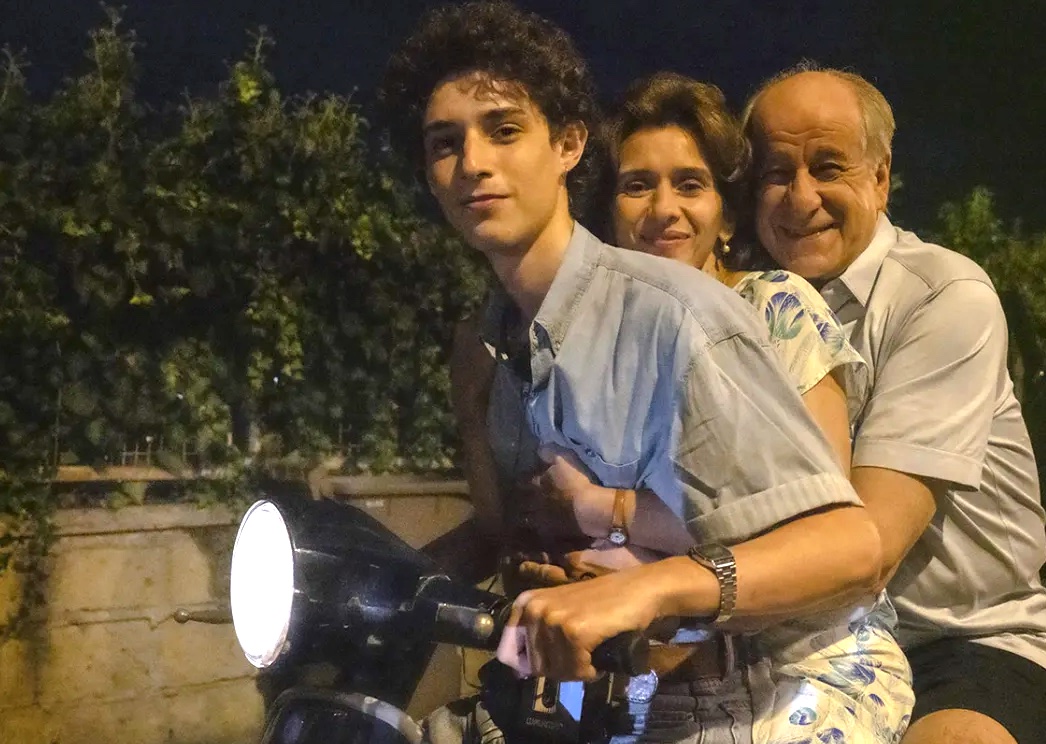
Filippo Scotti, Teresa Saponangelo, Tony Servillo

“HAND OF GOD” My rating: B (Netflix)

130 minutes | MPAA rating: R

First things first:  Whenever you get a chance to watch Toni Servillo in a movie — and I don’t care if it’s a cameo in a bad Italian slasher flick — jump at it.

Servillo may be the greatest living cinema actor.  Doesn’t matter the role…he just is.

In the goofy/rapturous “The Hand of God” Servillo once again teams up with writer/director  Paolo Sorrentino (“The Consequences of Love,” “Il Divo,” “The Great Beauty,” “Loro” and the Servillo-less “Youth”) to deliver a filmic memoir of Sorrentino’s boyhood.

Servillo isn’t the star of the show — in fact his character disappears halfway through — but even as member of an ensemble he oozes energy and life., electrifying everything and everyone around him.  

Set in Naples int he 1980s, “Hand…” is a two-part yarn.  The first is an almost Fellini-esque study of a roiling, raunchy Neapolitan family, a band of eccentrics so memorable and entertaining you may want to hang out with them forever.

Our protagonist is teenage Fabietto (Filippo Scotti), probably the most introverted member of his clan. Papa Saverio (Servillo) is a wise and witty jokester who approaches life with a wry grin.  Mom Maria (Teresa Saponangelo) is a live wire who peps up family reunions by juggling oranges. 

They’re such a perfect couple that we — like young Fabietto — are dismayed to learn that away from his family Saverio is a womanizer.

There’s also big brother Marchino (Marlon Joubert), an impossibly handsome kid who naively believes that good looks are all he’ll need for an acting career.  Accompanying his sibling to auditions, Fabietto gets an inkling of what the film biz (his future career) is all about.

There’s a load of wild-hair aunts, uncles and cousins swirling around the family…it’s like something out of “Amacord.”  

The most arresting of these is Patrizia (Luisa Ranieri), married to Saverio’s brother and oozing sexuality and neurosis in equal measure.  Fabietto has a huge crush on Aunt Patrizia (who doesn’t think twice about sunbathing nude in front of everyone). But he’s seen enough of her emotional and mental crackups to have his adolescent lust tempered by adult pity.

Luisa Ranieri

The film’s first half is a deep dive into plotless family dynamics, and it is often rudely, riotously funny.

Then tragedy strikes and the tone shifts dramatically. Young Fabietto finds himself working through grief and anxiety. He loses his virginity (not to a girl his age but to the dowager living in the upstairs apartment, who apparently sees him as a sexual charity case). 

Fabietto takes comfort in his soccer obsession and the drama of whether his team will be able to sign a premium player who can turn everything around.

And late in the film he has an all-night chat with a veteran movie director (real-life filmmaker Antonio Capuano, who was a mentor to young Sorrentino), who lays out the path to the kid’s career in movies.

“The Hand of God” is so specific in its depiction of people, places and situations that we understand instinctively that much if not all of the film was pulled from Sorrentino’s personal memories.  This is a movie that really feels lived in.

And the neat thing is that for a couple of hours we get to live in it, too.

| Robert W. Butler

Bradley Cooper

“NIGHTMARE ALLEY” My rating: C+(In theaters)

150 minutes | MPAA rating: R

That Guillermo del Toro is one of our great film craftsmen isn’t in question.

An astonishing degree of attention has been lavished on every image in his “Nightmare Alley”; expect Oscar nominations in virtually all the technical categories: effects, cinematography, costuming, production design.

That said, the film as drama left me…well, indifferent.  

Adapted by del Toro and Kim Morgan from William Lindsay’s novel, this is really two movies.

In the first drifter Stanton Carlisle (Bradley Cooper) hobos around the Depression-era U.S. We’ve seen Stanton set fire to a house in which he has placed a body…it’s probable that he’s on the run from the law.

On the verge of starvation, Stanton gets a gig doing manual labor for the operator (William Dafoe) of a sleazy traveling carnival, the kind of shady operation that is always a step ahead of the local moralists and the cops.  (One of their disreputable attractions is “the Geek,” a hairy animalistic wraith who lives in darkness, emerging only to bite the heads off live chickens for the entertainment of the rubes).

For the newcomer the eerie carnival (think “Something Wicked This Way Comes”) offers not only shelter and a paycheck, but a chance to learn a new trade.  Stanton shacks up with Zeena the Seer (Toni Collette), learning the tricks of her fake mind-reading act. 

Meanwhile he is drawn to Molly (Rooney Mara), the young beauty who allows herself to be strapped into an electric chair and zapped with thousands of lightning bolts.

The second half of “Nightmare Alley” takes place a couple of years later.  Stanton and Molly have fled the carnival and established themselves as a top mentalist act, performing in posh nightclubs.  Stanton has transformed himself from ragged drifter to swank sophisticate.

Cate Blanchett, Bradley Cooper

But he’s still a crook at heart, and with the help of a high society shrink (Cate Blanchett) he plans his biggest grift, taking on an impossibly rich captain of industry (Richard Jenkins) who is tormented by his evil past and seeks some sort of metaphysical forgiveness.

Stanton is supremely confidant, but one suspects he is biting off way more than he can chew.

Lindsay’s novel, published in 1946 (and filmed the next year with Tyrone Power in the lead), is a classic noir effort that has been described as “a portrait of the human condition…a creepy, all-too-harrowing masterpiece.”

The main problem with the movie, I think, is that over the last 70-plus years film, television and literature have borrowed shamelessly from Lindsay’s opus.  His ideas have been recirculated with such regularity that del Toro’s film struggles beneath a smothering blanket of been-there-seen-that.

The problem is magnified by the film’s languid running time (2 and 1/2 hours) and the fact that despite the first-rate cast (I haven’t even mentioned Ron Perlman, David Strathairn, Mary Steenburgen, Clifton Collins Jr., Tim Blake Nelson and Holt McCallany), I found the film emotionally remote. The viewer is left on the outside looking in.

And still…del Toro masterfully creates an overwhelming aura of corruption and exploitation. 

We’ll have to be satisfied with that.

| Robert W. Butler

Dakota Johnson, Olivia Colman

“THE LOST DAUGHTER” My rating: B (In theaters)

121 minutes | MPAA rating: R

Many a man has bailed on his family and kept his social status…but let a woman exhibit indifference toward her children and the pillars of civilization start to crumble.

“The Lost Daughter,” Maggie Gyllenhaal’s impressive writing/directing debut, is about a bad mother. At least that’s what a traditional moralist would say.

But things aren’t nearly that cut and dried in this smart, thought-provoking adaptation of Elena Ferrante’s  novel. 

This is a deeply ambivalent, jaw-droopingly subtle effort that eschews the usual big dramatic exposition (“…this is why I did what I did…”) in favor of showing us, building its story (and its case) through the slow accumulation of images and information.

Leda (Olivia Colman) is vacationing alone on a Greek island.  She’s a college professor, a Brit by birth but working in America, and she’s going to spend her summer sitting in the sun and researching her next book.

She tolerates the scuzzy American ex-pat (Ed Harris) who manages the vacation home she rents.  And she’s amused by Will (Paul Mescal), her eager-to-please cabana boy. They enjoy a chaste flirtation.

But Leda is absolutely mesmerized — and appalled — by the family with whom she shares the beach.  They’re a loud, obnoxious bunch.  The head of the clan seems vaguely shady;  he’s got a pregnant trophy wife half his age.

The real object of Leda’s fascination, though, is the man’s daughter-in-law, Nina (Dakota Johnson), who has a handsome but pushy husband and a pretty but spoiled young daughter. 

Lena appears obsessed with the tiny interactions between weary, frustrated mother and willful child. When the little girl goes missing the family is thrown into a panic. Leda finds the child and returns her to the fold…but not without secretly claiming a souvenir of the encounter that will come back to haunt her.

“The Lost Daughter” is being described as a “psychological thriller.” Actually, “psychological jigsaw puzzle” seems more accurate.

Through casual conversation — Gyllenhaal’s dialogue is amazingly unforced and natural — we learn that Leda has two daughter, now in their 20s, who live with her ex.  Apparently she rarely sees them.

Peter Sarsgaartd, Jessie Buckley

In flashbacks we see her as a young mother (played now by Jessie Buckley), struggling to balance family and career, and engaging in an affair with a much-admired professor (Peter Sarsgaard, Guyllenhaal’s spouse) that will push her further away from her conventional existence.

Most women have days in which they would just as soon dump the husband and kids and strike out for parts unknown.  Leda is the rare individual who actually kicks motherhood aside in the hope of discovering a different sort of fulfillment. 

But one does not achieve that sort of liberation without paying a huge emotional price, and the wonder of Colman’s performance is how she tells us everything about what Leda is feeling without actually ever saying anything. 

A lesser filmmaker might make excuses for her heroine’s choices, providing her with explanatory monologues, poking at every little shred of guilt clinging to Leda’s consciousness.

There’s no need for that when you have a leading lady with Colman’s range.

Is Leda a heroine or a villainess?

Why not neither? Or both?

| Robert W. Butler