Feeds:
Posts
Comments
Donald Rugoff

“SEARCHING FOR MR. RUGOFF” My rating:B

94 minutes | No MPAA rating

“Searching for Mr. Rugoff” kicks off with a montage of co-workers, friends and family members discussing the late Donald Rugoff.

“A piece of work.”

“Reviled, feared.”

“A thorny, difficult man.”

“Self-destructive.”

“Really good at what he did.”

“A giant nobody knows about.”

That last comment is most telling, for Ira Deutchman’s documentary makes a case for Rugoff (1927 – 1989) being one of the most important figures in the film business.

Ruggoff didn’t make movies.  He showed them.  Throughout the 1960s and ‘70s his New York-based Cinema 5 distributed the creme-de-la-creme of foreign films, independents, art efforts and documentaries.

Moreover the iconic theaters he operated in Manhattan — the Beekman, Sutton, Paris, Plaza, Grammercy and Cinema I and Cinema II — became the physical embodiment of the whole film-as-art movement.

If back in the day you thrilled to the Maysles’ “Gimmer Shelter,” Nicholas Roeg’s “The Man Who Fell to Earth,” Bruce Brown’s “Endless Summer,” Robert Downey Sr.’s “Putney Swope,” Bergman’s “Scenes from a Marriage” or Werner Herzog’s “The Mystery of Kaspar Hauser,” you had Donald Rugoff to thank.

Director Deutchman — who in addition to his own wildly successful career as a distributor of art movies has for 30 years taught the Business of Motion Pictures class at Columbia — worked briefly for Rugoff in the ’70s. He explains for the camera that he was moved to make this documentary because a Google search revealed next to nothing about his infuriating, intimidating, insanely important mentor.

Dozens of Rugoff acquaintances — including filmmakers Costa-Gavras, Lena Wertmuller and Downey, critics like Annette Indsorff and a whole slew of past Cinema 5 grunts — lined up to talk about the man.

The picture that emerges is of an overweight schlub in mustard-stained shirts and ties who loved the movie biz above all human connections. He regularly reduced employees to tears — one recalls that he could be charming when hiring you, but that once on board you were his slave.

At the same time Rugoff was decades ahead of the curve in giving young women a foothold in a male-dominated industry (and apparently without even a hint of Weinstein-level predation). One source calls him “an equal-opportunity exploiter.”

Employees recall being stunned at coming to work to find Francois Truffaut or Jean-Luc Godard schmoozing in Rugoff’s office. If Don Rugoff picked up your film, he worked like a madman to make it a commercial and artistic  success. (Curiously, he was notorious for falling asleep during screenings; it may have had something to do with the brain tumor that eventually killed him, though there was also an urban myth that he had a steel plate in his head.)

His  Russian-immigrant father founded a nickelodeon business at the turn of the last century; Rugoff inherited the theaters (now showing films, naturally) when the old man died.

He was a visionary, if a mildly crazy one. His theaters looked like museum displays of modern-art furniture and decoration; he had an artist build life-size dioramas of each new movie and featured them prominently in his lobbies.

His idea of elegant theaters for upscale audiences was wildly successful, pulling the center of New York cinema from grungy Times Square to the Upper East Side. Under his ministrations the opening of a new art film became a cultural event; hip audiences lined up for blocks to see movies  that might barely play elsewhere in the States.

Rugoff was also a genius at old-school hucksterism.  To publicize “Monty Python and the Holy Grail” he dressed employees in costume company armor and had them gallump up and down the city streets to the clip-clopping of coconuts.

Because there’s relatively little archival material available on Rugoff (a few family photos, virtually no home movies or newsreels), “Searching for Mr. Rugoff” relies heavily on talking-head interviews.  These have been brilliantly edited to give the doc a specific rhythm.  


And one cannot underestimate the mental/emotional/cultural charge of the many clips from films Rugoff distributed…if like me you’re a veteran of that era, it’s a hugely pleasurable wallow in nostalgia.

Somewhat less effective — though modestly interesting — is Deutchman’s research into Rugoff’s final years on Cape Cod where, after having lost his company to a hostile takeover, he spent his last years converting a century-old church into a neighborhood film society. As is often the case with stories like this, he died a pauper.

After watching this doc you are left with the conviction that Don Rugoff, whatever his personal demons, changed film culture. He’s got my thanks.

| Robert W. Butler

“THE SWARM” My rating: C+(Netflix)

101 minutes | No MPAA rating

Can a horror movie be too classy for its own good?

That’s the question raised by Just Philippot’s “The Swarm,” a French entry that spends most of its time carefully picking apart a family in crisis before going all Irwin Allen in the last reel.

Virginie (Suliane Brahim) is struggling to stay afloat financially…and mentally, as it turns out.

Her family farm (she used to operate it as a goat breeding operation with her husband, but he hanged himself) is circling the drain. 

Her latest venture — raising locusts (us Midwesterners would immediately identify them as big grasshoppers) to use as feed for commercial poultry operations — is collapsing. The damn bugs make a lot of noise but won’t reproduce.

Virginie’s son Gaston (Raphael Romand) is a sweet kid whose life centers on soccer and the one goat remaining from the family’s earlier business.  His older sister Laura (Marie Narbonne), on the other hand, is a seething cauldron of adolescent resentments, fed up with her bullying provincial classmates and desperate to start life anew in a more copacetic environment. She blames Mom for her unhappiness.

Franck Victor’s screenplay devotes the lion’s share of it pages to exposing the tensions in the family.  Virginie is so consumed with making a go of the locust operation that she’s veering into  madness.

Suliame Brahim

She has a supportive friend and tentative  suitor in Karim (Sfian Khammes), who runs a nearby vineyard, but the poor guy is doomed to frustration.  Virginie has no time for romance.

Against these totally believable real-world issues Philippot and Victor poses a Frankenstein-ian dilemma,  Virginie accidentally discovers that her locusts thrive when given a diet heavy with fresh blood.  She tries offering her own body for snacking, but clearly her bug buddies are going to need more juice than she can provide.

Pretty soon the neighbor’s pets and farm animals are at risk (somebody’s been watching “Little Shop of Horrors”).

Given the movie’s title, it’s a foregone conclusion that  eventually all those voracious insects are going to escape their plastic greenhouses and get to chomping.

All this is played with absolute sincerity and not a hint of camp.  Which makes one wonder…is the film’s emphasis on family dynamics going to bore the horror crowd…and will the final conflagration seem simply silly to folks who take their drama seriously? (I mean, they’re only bugs, after all.)

A couple of things keep us invested in “The Swarm.” First there’s the performance of leading lady Brahim, a member of the acclaimed Comedy Francaise who does a fine job of locating the nuttiness beneath an everyday exterior. (She’s also the lead in Netflix’s “Twin Peaks”-ish series “Black Spot.”)

Then there’s the cinematography by Romain Carvanade, who I presume is behind the super close-up shots of the feeding locusts.  I’m not freaked out by creepy crawlies, but if you’ve got a bug phobia this could probably generate a nightmare or two.

| Robert W. Butler

Jena Malone, Pablo Schreiber

“LORELEI” My rating: B 

111 minutes | No MPAA rating

A shroud of been-there-done-that is draped around “Lorelei,” the feature writing/directing debut of Sabrina Doyle. At times the film seems to have been assembled from leftover parts of other movies.

But the show has been magnificently anchored by Pablo Schreiber and Jena Malone, performers who usually get supporting roles but here waste no time in seizing the material and making the most of it. In the end, they put “Lorelei” across the finish line.

The film opens with Wayland (Schreiber) leaving prison after a 15-year sentence for armed robbery. He’s met at the gates by members of his old motorcycle gang; by keeping quiet and taking the fall he spared his buddies jail time.

Now he returns to his small town in rural Oregon, moving into a church-run halfway house.  But it’s all too clear that he could easily slide back into his old criminal ways; moreover, the tough-love preacher who is housing him (Trish Egan) and his parole officer (Joseph Bertot) aren’t about to cut him much slack. They’ve seen too many ex cons return to stir.

And then Wayland  spots Dolores (Malone) attending the church’s support group for single moms.  He and Dolores were high school lovers, and after some tentative verbal sparing (the film’s sexual subtext could raise blisters) they pick up where they left off.

Well, sorta.  Dolores seems to have spent the last 15 years sleeping around. She has three kids by three different men; she gets by with a part-time gig changing sheets at a sleazy motel and collecting welfare.

So while she’s at work the reluctant Wayland is forced into the role of father figure.

Yeah, it’s a familiar narrative. Practically a cliche.

On one level “Lorelei” is a brutally honest examination of desperate love among the struggling class.  The pleasure Wayland and Delores take in each other is infectious; at the same time it is diluted by the constant battle  to survive and the daily indignities of poverty.

But Doyle’s screenplay should be called for excessive wokeness.  Dolores’ oldest child (Chancellor Perry) is mixed race; the middle kid (Amelia Borgerding) is a furiously angry tweener; the youngest (Parker Pascoe-Sheppard) is clearly trans.

Lets see…are there any hot-button social issues we’ve left out?

But here’s the thing: It works. I got caught up in the love story and the family dynamic…so much so that not even a wildly improbable third act development (it’ll explain where the title “Lorelei” comes from) could dilute my pleasure.

Whatever Doyle’s shortcomings as a scenarist, she shows terrific control as a director.

In the end “Lorelei” emerges as a flawed but deeply felt piece of humanistic cinema, heart-tugging without sticky sentimentality.

| Robert W. Butler

Dev Patel

“THE GREEN KNIGHT” My rating: B 

130 minutes | MPAA rating: R

“The Green Knight” is  writer/director David Lowery’s big-screen adaptation of the 500-year-old epic poem (we don’t know the author) “Sir Gawain and the Green Knight.”

As such you might expect a big dose of sword and sorcery and some major-league action/adventure violence.

Think again.  Lowery’s narrative approach has more in common with Robert Bresson’s austere “Lancelot du Lac” than with, say, the atavistic carnage of “Braveheart.”

Here he is attempting cinematically to approximate the experience of reading a long poem from a distant past. In doing so he embraces storytelling that eschews rational explanations and psychological realism. 

And yet “The Green Knight” is not a relic preserved in amber. The film is a visual tour de force thanks to the splendid cinematography of Andrew Droz Palermo (he shot Lowery’s “A Ghost Story,” as well as the KC-area lensed documentary “Rich Hill”), the costumes by Malgosia Turnsganza and the production design of Jade Healy.

Periodically Lowery inserts distinctively modern perspectives into this ancient tale. An example: We first meet knight-in-training Gawain (Dev Patel in a true star-making performance) awakening in a whorehouse on Christmas morning.  Actually, he gets a bucket of water in the face, courtesy of his playful  plebian lover (Alicia Vikander).

As he wanders through the bustling bordello in search of his boots, Gawain is teased by other guests and harlots, who kid him about spending more time partying than on his knightly training. The dialogue and camerawork bring a sense of naturalism and everyday immediacy.

Dev Patel

The movie’s distinctively modern moments coexist with a sort of formal pageantry. The result is a film that is overwhelmingly an intellectual/visual experience rather than an emotional one.

“The Green Knight” is probably going to divide audiences into lovers (it’s an overwhelmingly poetic/mystical experience) and haters (too long, too slow, not enough action).

A Yuletide celebration in the court of Gawain’s uncle King Arthur (Sean Harris) and his queen (Kate Dickie) is interrupted by the arrival of the Green Knight (Ralph Ineson), a towering figure who appears to be half tree (I was reminded of Groot from the “Guardians of the Galaxy” franchise).  This ominous visitor proposes a contest.  He will receive a blow from any of Arthur’s knights; in a year’s time that knight must seek out the Green Knight and stand to receive the same blow.

Young Gawain, apparently smitten with visions of glory, accepts the challenge and with Arthur’s sword strikes off the visitor’s head.  The Green Knight is nonplussed…he picks up his severed noggin and rides off with a laugh and a reminder that they will meet again next Christmas.

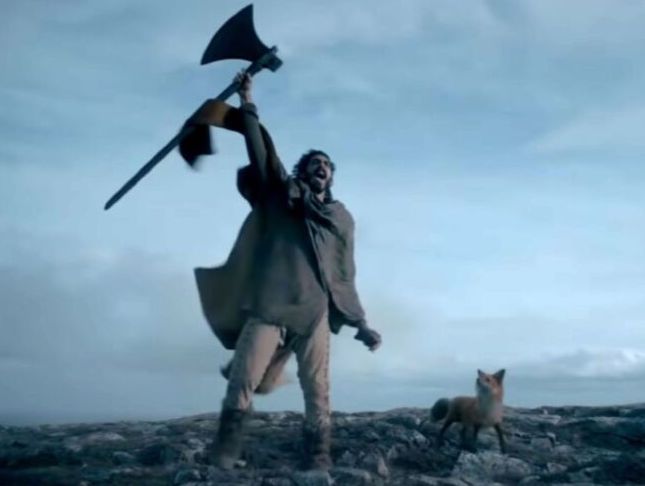
The bulk of the film unfolds on Gawain’s trek north to meet his fate. Along the way he is befriended by a fox (Is it a real animal? A CG effect? Whatever, it’s really convincing).  He is waylaid by a talky peasant (Barry Keoghan) who pilfers the remains of slain soldiers.

He spends a chaste night with a young woman named Winnifred (Erin Kellyman), and shares several days with a Lord (Joel Edgarton) and his cooly seductive wife (Vikander again).

At one point on his wanderings he encounters a migration of fog-enshrouded giants, huge naked hairless figures who might have stepped out of one of the recent “Alien” movies.

“The Green Knight” is jammed with symbolism that will probably be lost on anyone not schooled in medievalism.  Some of the episodes seem arbitrary and pointless.

Much as he did with “A Ghost Story,” Lowery explores alternate realities.  In one instance the camera spins to show Gawain hogtied on the ground, then as a rotting skeleton, and then alive again as he struggles to free himself.

And the last 10 minutes is a sort of “Last Temptation of Christ” fantasy in which Gawain’s mind explores the life he might have had (a life in which he is a mighty king).

At its core this is a tale about a young man who acts impulsively and then must live with the consequences; will Gawain have the inner resolve to submit to the Green Knight’s blade? Or will he bring shame on himself and Arthur’s court?

What’s remarkable about Patel’s performance is that he talks about none of this, but the emotions bubbling beneath the surface are perfectly clear. Sometimes words aren’t necessary.

| Robert W. Butler

Nicolas Cage

“PIG” My rating: C+ (VOD)

92 minutes | MPAA rating: R

If Keanu Reeve’s John Wick will kill 100 thugs to avenge his pet puppy, how far will Nicolas Cage’s truffle-hunting hermit go to retrieve his kidnapped porcine pet and coworker?

That’s the setup of writer/director Michael Sarnoski’s “Pig,” a good idea that takes itself way too seriously.

The opening moments establish the relationship of the uber-hairy Robin (Cage) and his pig colleague in a cabin in the forests of the great Pacific Northwest.

Robin — who survives without telephone, electricity, running water or even a functional vehicle — hunts truffles, the gourmet fungi that grow among the tree roots and can sell for big bucks.

He locates these delectables with the help of his swine buddy (who’s a whiz at sniffing out their prey); then sells them to Amir (Alex Wolff), who transports them in his ridiculous yellow sports car to Portland and resells the delicacies to the city’s finest restaurants.

We’ve barely able to absorb the details of Robin and Pig’s lives when tragedy strikes. One night the cabin is invaded by unseen baddies; the pig is kidnapped and Robin beaten bloody.

Refusing to even wash the gore off his face (by film’s end he resembles Jim Caviezel in the latter stages of “Passion of the Christ”), Robin takes off for the big city, first on foot and then commandeering Amir and his posh wheels.

Amir throws a blanket over the passenger seat in a probably futile effort to keep Robin’s body odor from impregnating the leather upholstery.

One of Robin’s first stops is at an underground fight club — yeah, just like the movie “Fight Club” — where our man allows himself to once more be beaten senseless in return for hints as to where his pig pal might be.

Eventually the trail leads to Amir’s estranged father (Adam Arkin), a sort of restaurant godfather who rules his culinary world through intimidation and, if necessary, violence.

Along the way we discover that Robin was once a legendary chef but dropped out 15 years earlier for unspecified reasons. Possibly it’s because he hated the direction the restaurant biz was heading ($50 for what appears to be a single berry frozen in a cloud of dry ice fumes). Even more likely it’s because Robin is seriously damaged goods.

“Pig” is Sarnoski’s feature debut; it’s a good-looking film if an emotionally and intellectually impenetrable one.

Aside from his determination to get his pig back (it’s his only friend), Robin is a glowering cipher.

That said, Cage has such a commanding screen presence that I kept watching just to see what he’d do next. This one-time Oscar winner may in recent years have descended into hackdom, but he’s a hack with astounding charisma.

As Amir, Wolff has the thankless task of playing a weak-willed poseur in constant fear of Daddy damnation.

Arkin fares somewhat better; though his character is simply preposterous, the actor finds a vulnerable center.

There are opportunities for humor here which Sarnoski studious ignores. Instead he leans heavily on the pretention button, giving the film chapter titles like “Rustic Mushroom Tort” and “Mom’s French Toast and Deconstructed Scallops.”

When it’s over you may crave a Big Mac.

| Robert W. Butler

Peri Baumeister, Carl Anton Koch

“BLOOD RED SKY” My rating: B (Netflix)

121 minutes | No MPAA rating

SPOILER ALERT!!! This film contains a forehead-slapping reveal about halfway through; unfortunately, it’s just about impossible to describe the plot without revealing the big news. So…if you want a pristine viewing experience, STOP READING RIGHT NOW!

For the rest of you, here goes:

“Blood Red Sky” is like “Die Hard” on a trans-oceanic airplane flight. With terrorists. And vampires.

It’s an utterly ridiculous idea performed with such unflinching gravitas that somehow the whole lurid mess works.

The film opens with a commercial airliner touching down at a remote military base in Scotland. There’s a terrorist situation on board. A lone passenger, a little boy, escapes from a cargo door; the authorities try to question him but the kid seems too traumatized to talk.

Flash back to a few hours earlier. Single mom Nadja (Peri Baumeister) and her 10-year-old son Elias (Carl Anton Koch) are boarding a night flight from Europe to the USA.

Nadja apparently is a cancer victim…she hides her bald head beneath a wig and has the gaunt features of someone who’s been through serious chemo. Think Noomi Rapace as a crack addict

Nadja has an appointment in NYC with a medical specialist who may have answers for her condition.

But wouldn’t you know it? There’s a bunch of international terrorists on board. Their motives are fuzzy — they are posing as Islamic extremists but that may be a cover for a more mercenary goal — and they’ve incorporated into their conspiracy a co-pilot and flight attendant.

One of them, a sadist known as Eightball (Alexander Scheer), is so perverse in his treatment of the terrified passengers that even his criminal cohorts are appalled.

The highjackers herd the passengers to the rear of the plane, separating Nadja from her emergency medical kit. We assume the injections she’s been taking have something to do with her cancer, but denied her medication she begins changing. Her eyes transform into those of a cat; her bones seem to have grown sharp beneath her features. Her teeth…well, they’re getting ugly.

Tha’s right, ladies and gents, Nadja is a vampire. Flashbacks reveal how she was bitten by one of those nasty bloodsuckers while on a family vacation (her husband didn’t make it); now she relies on injections to keep her human form. Without them she’s getting very, very hungry for blood.

You’d think a twist like that would be enough for director Peter Thorwarth and co-writers Stefan Holtz. But no. Before long the terrorists have deliberately exposed themselves to the vampire’s bite and are transforming into flesh-gnashing fiends.

So now you’ve got bad vampires (the terrorists) and a good vampire (Nadja) squaring off in an epic confrontation. The crawlspaces and cargo areas in the belly of the aircraft become a claustrophobic battleground. Elias, because he’s a tiny person, takes a key role in exploring the labyrinthian maze.

And to make things even more complicated, Nadja is fighting desperately to ignore the call of blood and retain her human consciousness. Will she be able to save little Elias before reverting 100 percent to vampirism? And what happens when the sun comes up?

The premise of “Blood Red Sky” is too ludicrous to countenance…and yet I found myself hugely entertained by the whole preposterous enterprise.

| Robert W. Butler

Brooklynn Prince

“SETTLERS” My rating: B-

103 minutes | No MPAA rating

Mankind possesses the intelligence to travel to the stars. But we’ll never outrun the dark side of human nature.

That’s the unvarnished, uncomfortable message behind “Settlers,” the debut feature of writer/director Wyatt Rockefeller (and, yes, he’s a member of that Rockefeller clan).

With a title like this you expect a frontier drama with sodbusters, outlaws and a hostile environment. And in fact Rockefeller has given us what is essentially a Western,,,a Western set on Mars.

Nine-year-old Remmy (Brooklynn Prince, the knockout young star of “The Florida Project”) lives with her parents Reza (Johnny Lee Miller)and Ilsa (Sofia Boutella) on a Martian farmstead. It’s a hostile environment with limited resources (not even a breathable atmosphere…the secret behind their ability to survive will be revealed later); the family apparently raises just enough greenhouse veggies and food animals to stay alive.

No neighbors. No communication with the rest of the Mars, much less with faraway Earth.

Little Remmy is curious about her home planet, but Mom and Dad are parsimonious with details. She asks her father if he’s ever seen certain wild animals; he replies that he has not, and that before he left Earth about the only animals he saw were dogs.

Evidently humankind has so fouled up its birthplace that it is now all but uninhabitable. Moreover, Martian society — whatever it might once have been — has been reduced to outlawry and Darwinian self preservation.

So it’s a tough life for a curious little girl. Happily she discovers in a shed a boxy little robot she dubs Steve; Remmy trains him as if he were a pet.

Things get ugly when the three family members awaken one day to find that someone has scrawled “LEAVE” on their picture windows in what appears to be blood.

Ismael Cruz Cordova, Sofia Boutella

Enter Jerry (Ismael Cruz Cordova), who grew up on the farm and now wants to reclaim it after an absence of many years. Apparently Reza and Ilsa moved onto the property under somewhat less than legal circumstances.

Slow-bubbling sexual intimidation is a big part of “Settlers'” emotional palette. Despite an initial display of violence, Jerry seems a reasonably sane, even sympathetic sort. But as time passes primal urges do a number on him; initially they are directed at Ilsa and, after the passage of many years, at Remmy (played as a young adult by Nell Tiger Free).

“Settlers” feels less like a fully realized drama than as an outline for said drama. Rockefeller explains very little, leaving it up to the viewer to glean little nuggets of information with which to build a bigger picture of human life in the late 21st century.

Moreover he’s anti-melodramatic to a fault. No well-made tale here.

But when it comes to envisioning and creating a tangible world, “Setters” is terrifically seducive. Not a little of the film’s success lies with cinematographer Willie New and production designer Noam Piper, who create an utterly believable enclave of human effort in a hostile landscape (the production was shot mostly in a rocky desert area of South Africa).

| Robert W. Butler

Emily Blunt, Dwayne Johnson, Jack Whitehall

“JUNGLE CRUISE” My rating: C+

127 minutes | MPAA rating: PG-13

Like the famed Disneyland ride that inspired it, “Jungle Cruise” is jammed with instantly forgettable silliness; moreover the whole thing is 100 percent synthetic.

Just like a theme park attraction, this sprawling effort from director Jaume Collet-Serra embraces a sort of movie-set phoniness, a phoniness that is only accentuated by a near-complete reliance on CG scenery and action. Is anything we see on screen real?

Happily the film has as its stars the imminently watchable Emily Blunt and Dwayne Johnson (with able assists from Paul Giamatti, Jack Whitehall and Jesse Plemons), so when your eyes start to glaze over from all the computer eye candy there are at least a couple of real human faces to focus on.

The screenplay (credited to Michael Green, Glenn Ficarra, John Requa, John Norville and Josh Goldstein) takes as its template — for good and bad — the “Pirates of the Caribbean” movies. But that’s just the start…some wiseass college film student will undoubtedly cough up a thesis picking out all the movie and pop cultural references sprinkled throughout.

There’s also a bit of meta at work here. In recent years the theme park Jungle Cruise has come under fire for its White Man’s Burden approach to the third world, and the movie slyly comments on all this.

When we first encounter Amazon riverboat captain Frank Wolff (Johnson) he’s leading gullible tourists (the setting is the early 20th century) on a cruise that features encounters with wild animals (actually Frank has trained them) and spear-waving cannibals (Frank’s scurrilous rivertown buddies in feathers and warpaint).

Frank is clearly based on Humphrey Bogart’s perf in “The African Queen” (check out the little cap) with a dash of Han Solo “me first-ism”…he’s a charming cad who loves a good pun and cheerfully insults his clientele. He’s also deep in arrears to local mogul Nilo (Paul Giamatti…think Jabba the Hutt).

Enter Lily Houghton (Blunt), a scientist who with her effete sibling MacGregor (Whitehall, looking very much like a fetal Brendan Fraser) has come to South America to find a legendary tree whose flowers possess miraculous healing powers. Lily is a sort of female Indiana Jones, dismissed by the larger scientific community because she is, well, a girl. She’s determined to prove herself.

Jesse Plemons

Also, she wears men’s trousers. Captain Frank decides to call her “Pants.”

Yes, there’s a lot of love/hate bickering reminiscent of the Bogie/Kate Hepburn relationship in “African Queen.” It’s never as clever as that earlier film, but at least it’s out there trying.

Things get complicated with the appearance of Prince Joachim (Plemons), a Prussian martinet who arrives on the scene in a U-Boat (that’s right…a submarine in the Amazon River) and proceeds to revive ghostly, decaying Spanish conquistadors who have been entombed for centuries by a native curse. Now they and their leader, Aguirre (Edgar Ramirez), are sent out to intercept Frank and Lily.

Supernatural shenanigans ensue.

There are also killer waterfalls, hostile natives living in treetop villages (just like Ewoks) and computer-generated wildlife (snakes, bugs, even a pet jaguar Frank keeps below deck).

Through it all Frank and Lily exchange insults; brother MacGregor freaks out over the lack of amenities and confesses that he’ll never marry (uh, yeah, we got that early on).

There’s about enough charm and usable plot here for a lighthearted 90-minute romp. Alas, “Jungle Cruise” clocks in at more than two hours, which means that for a good quarter of its running time viewers will be checking their watches.

| Robert W. Butler

Mark Wahlberg

“JOE BELL” My rating: C+

90 minutes | MPAA rating: R

“Joe Bell” is a classic example of “yes/but” filmmaking.

It’s been well acted and competently directed. Its subject matter is drawn from real life and is heavy on inspirational uplift.

At the same time, it’s never saccharine. At times it’s downright disturbing.

And yet there’s something phony about star Mark Wahlberg’s latest. As much as I wish I were enthusiastic about “Joe Bell,” I’m not.

When we first meet the titular character he’s crossing America on foot, pushing an aluminum handcart filled with his pedestrian necessities. Joe sleeps in a tent on the side of the road; every few nights he gets a cheap motel room so that he can recharge his electronics, shower and get a solid 8 hours in a real bed.

He often phones back home to Oregon to discuss his travels with his wife Lola (Connie Britton).

Early in Reinaldo Marcus Green’s film Joe walks into a nondescript Idaho burg and within hours is addressing an auditorium of high school students about the evils of bullying. Joe isn’t a natural speaker…he looks uneasy and his language is rudimentary. Some of the kids in the audience are clearly bored. But the fervor behind his message comes through loud and clear.

Joe is accompanied on this trek by his teenage son Jadin (Reid Miller), an almost-pretty young man who, having grown up gay in a small town Oregon, knows all about bullying, though he never joins his dad on the podium to share his own experiences.

As they make their slow way down the two-lanes father and son carry on a running conversation about Joe’s decision to walk across America and his motives for doing so. Jadin suggests it’s because Joe is trying to make up for being a less-than-supportive father. Indeed, Joe seems to be perpetually struggling not to fall back into the judgmental, blue-collar machismo of his youth. When he feels cornered he’s capable of first-class redneck assholism.

“Joe Bell” was scripted by “Brokeback Mountain” scribes Diana Ossana and Larry McMurtry (it was the last screenplay by McMurtry, the great Texas writer who died earlier this year). And the things about “Joe Bell” that don’t work (for me, anyway) are tied directly to their narrative choices.

Here’s the rub: One cannot talk about the gimmick at the heart of “Joe Bell” without lobbing a huge spoiler. So let’s just say that this tale of a father’s quest to redeem himself with his gay son employs narrative trickery that, upon the big reveal, left this viewer feeling disgruntled and a bit cheated.

Makes me wonder if McMurtry and Ossana sat through an M. Night Shyamalan marathon before putting pen to paper.

That said, Walhberg gives one of his most nuanced and cliche-free performances here, nicely nailing the conflicts inside a real-life protagonist struggling mightily to do the right thing after a lifetime of bullheaded behavior.

Young Miller is terrific as the somewhat enigmatic Jadin; flashbacks to his tormented adolescence are geniuinely upsetting.

Britton is her usual excellent self, and Gary Sinise has a touching if somewhat improbable last-reel appearance, exuding decency as a rural Colorado sheriff who befriends our hero.

Also you can’t argue with the film’s canny use of Brandi Carlile’s “The Joke.”

| Robert W. Butler

German forester Peter Wohlleben

“THE HIDDEN LIFE OF TREES” My rating: B

101 minutes | MPAA rating: PG

More New Age navel gazing than rigorous scientific exploration, “The Hidden Life of Trees” is an art film posing as a documentary.

It is based, of course, on German forester Peter Wohlleben’s runaway best seller about, well, the stuff trees are up to right under our noses.

Among other things Wohlleben asserts that trees will band together to “feed” the stumps of their fallen fellows, that our leafy buds can communicate with one another, and that the best forest management is basically to leave the trees alone to do their thing.

Wohlleben’s ecological theories have been embraced by laymen and ridiculed by forest professionals — which is not to say that they lack merit. The pros have been wrong before.

Perhaps in keeping with the woo-woo sensibilities of the source material, Jorg Adolph and Jan Haft’s film steers clear of the usual dry scientific pontificating.

Yeah, we see Wohlleben addressing audiences of eager ecologists and leading woodland tours. There’s footage of him getting down and dirty with plant life in European forests. We see timber being harvesting according to his tree-friendly methodology (for instance, no heavy machinery…massive horses are employed to haul away the logs).

But huge swaths of “The Hidden Life…” are taken up with Daniel Schonauer’s dreamlike nature cinematography, much of it employing slow motion to capture seedlings magically rising from the forest floor and stretching toward the sunlight.

“The Hidden Life…” then, is more noteworthy for its visual wonders and environmental impressionism than for making a measured scientific argument.

Nothing wrong with that…just know what you’ll be getting ahead of time.

| Robert W. Butler