Feeds:
Posts
Comments

I CARRY YOU WITH ME” My rating: B+

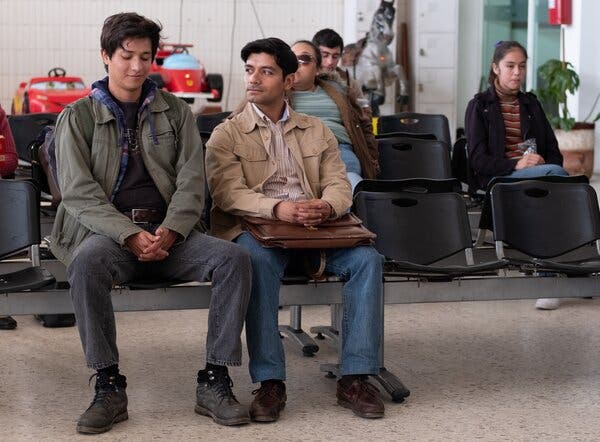
Armando Espitia, Christian Vazquez

111 minutes | MPAA rating: R

If Terrence Malick had made a gay-themed movie about the immigrant experience, it would be “I Carry You With Me.”

Like Malick’s “Tree of Life,” Heidi Ewing’s film is a dreamlike affair that shifts back and forth in time and relies on voiceover narration to reveal its lead character’s inner thoughts. It is unhurried and lyrical, but also trades heavily in social injustice issues.

And it’s pretty much all true. In this heady blend of gay love story and immigrant saga, documentary footage and fictional reenactments, the two main characters are not only based on two real individuals, but those two individuals play themselves in the movie’s last act.

Head spinning yet?

The picture begins with New York chef Ivan Garcia riding the NYC subway and reflecting, via narration, on the journey that brought him to a successful career while forcing him to leave behind his roots in Mexico. As we’ll learn, Ivan is an undocumented immigrant who, should he return home, would be prohibited from reentering the USA, leaving his two restaurants and 80 employees in the lurch.

The film then shifts back 30 years to Mexico where young Ivan (played as a 20-something by Armando Espitia), despite a culinary degree, can find work only as a restaurant busboy. When there’s an opening for a cook, the owner invariable gives the gig to one of his relations.

Ivan has a young son born out of wedlock; he adores the kid and walks a fine line in maintaining the peace with the boy’s mother, lest he lose visiting rights.

But Ivan has a secret. He is a closeted gay. Macho-centric Mexico makes life hard for homosexuals, and the situation is doubly complicated because should word of his sexual orientation reach the wrong ears, Ivan will never again see his boy.

One good thing: He meets the out Gerardo (Christian Vazquez), who introduces Ivan to the local (albeit underground) gay scene.

The screenplay by Alan Page and Ewing (this is her first fictional effort after a documentary career highlighted by the chilling “Jesus Camp”) depicts the young men’s deepening relationship against Ivan’s growing conviction that if he’s ever to realize his culinary dreams he’ll have to abandon Mexico and sneak into the U.S.

That means leaving behind Gerardo and his little boy.

On his coyote-led trip across the Rio Grande and through the Texas desert Ivan is accompanied by his childhood friend Sandra (Michelle Rodriguez), who very nearly succumbs to the journey’s many dangers.

Once in New York, Ivan works in a car wash and other menial gigs before finally working his way up the food industry ladder.

This immigrant tale is interrupted periodically with flashbacks to his and Gerardo’s childhoods (as boys they are portrayed by Yael Tadeo and Nery Arandondo, respectively). While Ivan was reared in a loving if financially strapped family, Gerardo was tormented by his father, a hairtrigger-tempered rancher carrying a full saddlebag of homophobia. This explains Gerardo’s estrangement from his clan, not to mention his determination to never hide his gayness come what may.

Eventually Gerardo joins Ivan in the US and they build a life and business together. As mature individuals they are portrayed by the real individuals — Ivan Garcia and Gerardo Zabaleta — who celebrate their success even as they mourn the loss of their Mexican identities.

In one heartbreaking scene Ivan shares a phone call with his now-grown son, whom he hasn’t seen for decades and whose attempts to visit his father in the U.S. have been stymied by government red tape.

“I Carry You With Me” began as a documentary, with Ewing filming her friends Ivan and Gerardo. But as she learned more about their epic yet intimate story, she decided to use actors to depict their earlier life in Mexico.

The resulting film is a genre-bending hybrid that nails both the triumph of these two enterprising individuals and the acute sense of loss they experience as men without a country.

“Haunting” isn’t too strong a word.

| Robert W. Butler

Sylvester Stone

“SUMMER OF SOUL”  My rating: A- (Hulu)

117 minutes | MPAA rating: PG-13

Even if it were merely a film record of the musical acts that appeared at 1969’s Harlem Cultural Festival, “Summer of Soul” would be the most joyous two hours of the summer of 2021.

But first-time director Ahmir “Questlove” Thompson (yes, the drummer/leader of Jimmy Fallon’s house band The Roots) has taken that half-century-old, never-seen-before footage and fashioned it into a powerful, heart-rending and historically significant experience.  

This was more than a series of concerts in Mount Morris Park in Harlem (now it’s called Marcus Garvey Park)…it was a seminal moment in the development of modern black culture. And Questlove’s love-infused doc absolutely nails it.

The Harlem Cultural Fest was spread over several weekends, each with its own theme: jazz, soul, gospel, etc.  Nearly 50,000 persons attended each of these free concerts.  Many of the audience members who attended as kids now recall that up to that point they have never seen so many black people in one place. 

The music ranged from jazz man Max Roach to Stevie Wonder, the Edwin Hawkins Singers (“Oh Happy Day”) to B.B. King, Nina Simone to Gladys Knight and the Pips.

The whole thing was captured on film and audio tape with an eye to turning it immediately into a theatrical movie event…alas, the entertainment powers put all their money behind that summer’s Woodstock festival in upstate New York.  With no buyers the pristine, technically perfect Harlem footage and audio tapes sat on a shelf for 50 years.


Questlove’s handling of this vintage material is respectful, yes, but he uses it as just one element in a massive collage of African American experience.  He shows some of the performers (Gladys Knight, members of the Fifth Dimension) footage of their performances at the fest and captures the looks of overwhelming emotion that pass across their faces as they witness  their younger selves and relive what for many of them was a sublime personal experience.

Mavis Staples, Mahalia Jackson

He talks to men and women, now in their 60s and 70s, who attended as youngsters and share their impressions and memories.

And he and editor Joshua L. Pearson  masterfully interweave the performance footage with old newsreels, photos and other archival elements…basically they’re demonstrating how the music became the soundtrack to hundreds of thousands of black lives.

Picking favorite performances is a futile exercise — everybody seems to have been at the top of their games — but for sheer show-stopping giddiness you cannot beat Sly and the Family Stone blowing away the crowd with “Higher” and “Everyday People” (“different strokes for different folks”).

And if you’re not moved to tears by watching Mahalia Jackson and Mavis Staples share a mic on “Precious Lord, Take My Hand” (the favorite hymn of Martin Luther King, who was assassinated a year earlier)…well, I can only conclude that you lack both a heart and ears. 

| Robert W. Butler

“TRUMAN AND TENNESSEE: An Intimate Conversation” My rating: B (Now available through the Tivoli at the Nelson-Atkins)

86 minutes | No MPAA rating

“Truman and Tennessee” isn’t your standard-issue documentary biography.  Rather it’s a kind of verbal duel between two of the great literary figures of the late 20th century.

Novelist Truman Capote and playwright Tennessee Williams weren’t just major figures in mid-century American literature.  They were personal friends. Both shared a Southern heritage. Both were gay at a time when being openly gay was illegal. 

After brief biographical segments (my God, but young Truman Capote was cute), Lisa Immordino Vreeland’s film works through a series of topics, allowing her two subjects to comment on things like writing, fame, sex, their childhoods, phobias, relationships.

This is accomplished in a couple of ways.  First, we hear excerpts from the two author’s canons read by the unseen Jim Parsons (who nails Capote’s pitchy whine) and Zachary Quinto (as the voice of Williams).

Then there are various TV interviews the two did over the years…although never together.  In fact, there apparently is no footage here of both men in the same room.

But something weird and wonderful happens.  Turns out both men appeared on David Frost’s interview program within months of each other. They both sat on the same set (it has a very ‘60s pop art motif) and in both instances Frosts’s crew employed the same camera angles. Moreover,  Frost asked both men many of the same questions.

The result is an eerie joint commentary, with footage from various broadcasts woven together into a tapestry of friendship. The effect is that of Truman and Tennessee sitting side by side (even if they weren’t), lobbing ideas back and forth.

An unsung heroine here is film editor Bernadine Colish, who has done a terrific job of incorporating old photos, news footage, home movies and especially clips from film adaptations of the two men’s output (“Breakfast at Tiffany’s,” “Cat on a Hot Tin Roof,” “Baby Doll,” “In Cold Blood” and many others).

The resulting film isn’t encyclopedic…rather it has a sort of impressionistic feel.  Yet because their own words have been so judiciously chosen by the filmmakers, we get terrific insights into Truman and Tennessee’s personalities.

Are there questions left unasked and unanswered?  Sure. But this doc isn’t about everything.  It’s about some things…some pretty wonderful things.

| Robert W. Butler

Rita Moreno

“RITA MORENO: JUST A GIRL WHO DECIDED TO GO FOR IT”  My rating: B (In theaters)

90 minutes | MPAA rating: PG-13

As she approaches her 90th year actress Rita Moreno can look back on a life packed with triumph (she’s an EGOT — the winner of an Emmy, a Grammy, an Oscar and a Tony), tragedy (a botched abortion, sexual assault) and a checkered career that has included both laughable ethnic stereotypes and her current status as a Latina icon.

The new doc “Rita Moreno: Just a Girl Who Decided to Go for It” is a warts-and-all look at a woman who despite her advanced years exhibits more energy, exuberance and insight than someone half her age.  She’s a born raconteur…and, boy, does she have a story to tell.

Mariem Perez Riera’s film (Norman Lear and Lin-Manuel Miranda are among the producers) opens with Moreno bustling around her home, preparing for her birthday celebration.  Then it settles down to a conversation — punctuated with old photos and film clips —  of her life, career and loves.

She was born in Puerto Rico and as a child came to US with her mother (she never again saw her father or brother…a story that could use some explanation), became enamored of the movies at an early age, dropped out of school at 15  and when still a teen dressed up like Elizabeth Taylor for an appointment with Louie B. Mayer, walking away with a Hollywood contract.

For years she was plastered with “makeup the color of mud” to portray Native American princesses, Latina spitfires, island girls, even the slave/concubine Tuptim in “The King and I.”  Her roles, she says, were limited to “sex objects and arm candy.”  

But she lacked the clout to do anything but follow orders.  Moreover, Moreno says she grew up “feeling without value,” a psychological handicap that dogged her until well into her adult life.

She describes the hair-raising sexism she encountered in Hollywood, including being raped by her agent (she had such low self-esteem that she kept working with him even after the incident) and her intense years-long affair with a domineering and manipulative Marlon Brando, who forced her to get a back-ally abortion from which she nearly died. (Today Moreno remains a fierce advocate of female reproductive rights.)

She became so depressed by her relationship with Brando that she attempted suicide.

(There’s no mention here of her well-known affair with Elvis Presley…what’s up with that?)

Continue Reading »

“LES NOTRES” My rating: B- (June 16)

103 minutes | No MPAA rating

On numerous levels the French-Canadian “Les Notres” (“Our Own”) is a head scratcher.

It’s part problem picture/social drama, part personality study — without fully committing to either — and regularly thwarts its audience’s expectations. It aspires to depth and yet often is satisfied with melodrama.

But there is no denying that teen actress Emilie Bierre absolutely dominates the screen as a 13-year-old with a devastating secret. It’s a star-making turn; indeed, Bierre’s low-keyed performance and quiet charisma keep us watching, somehow filling the gaps in what otherwise might be a terminally fragmented tale.

Magalie (Bierre) lives with her widowed mother Isabelle (Marianne Farley) in a quaint Quebec town. She is an unremarkable girl, average in just about every respect but one.

She’s pregnant.

This revelation comes early in the screenplay by director Jeanne Leblanc and co-writer Judith Baribeau (who also takes on one of the major supporting roles). The main thrust of the tale is how young Magalie deals with her situation…or doesn’t.

Mag — who even in the best of circumstances nurses a case of teen stubbornness (losing her papa at a tender age has had a major impact on her personality) — refuses to identify the father. And she won’t even consider an abortion.

Word soon gets out of the girl’s tender condition. Her classmates call her a slut to her face. Her best friend Manu (Leon Diconca Pelletier) — an orphan living in a foster home across the street — is widely believed to be the father. The poor kid already has one strike against him for being Hispanic, and is resented for having deposed his fellow jocks as the school’s best soccer player.

Continue Reading »

Anthony Ramos as Usnavi, Melissa Barrera as Vanessa

“IN THE HEIGHTS” My rating: B (HBO Max)

143 minutes | MPAA rating: PG-13

At its best the film version of the Broadway musical “In the Heights” is a colorful Valentine to a neighborhood and a way of life, overflowing with generosity of spirit and gleefully embracing Latinx culture.

It is also overlong, repetitive and, frankly, a bit boring when director John M. Chu (“Crazy Rich Asians”) must turn away from the massive musical numbers at which he excels.

Shot in the Washington Heights area of NYC where it takes place (there’s a bit of a “West Side Story” vibe at work), this adaptation of the Lin-Manuel Miranda/Quiara Alegria Hudes 2008 hit (he wrote the music and lyrics, she wrote the book) follows a handful of characters through a summer in the city.

Our narrator is Usnavi (Anthony Ramos), the owner (apparently) of a cafe/bar in the Dominican Republic.  He’s telling local children the story of how he grew up in Manhattan and came to the Caribbean island to reclaim his father’s long-abandoned seaside business. The entire film, then, is a massive flashback, periodically interrupted as it returns to the “present” for more interaction between Usnavi and the kiddies.

At the heart of the film are two romances.

In the big city Usnavi operates a corner bodega, a natural meeting place for characters from his neighborhood.  The guy is sweet, sensitive and nurturing  — watch him interact with his grandma Claudia (Olga Merediz) and with tweener Sonny (Gregory Diaz IV) to whom he serves as a surrogate big brother.  

Alas, Usnavi is a bit slow on the uptake when it comes to his relationship with local gal Vanessa (Melissa Barrera), who aspires to become a fashion designer.

Then there’s Benny (Corey Hawkins), right hand man at the local taxi company run by Kevin (Jimmy Smits).  Benny has long awaited the return of Kevin’s daughter Nina (Leslie Grace), who has just wrapped up her freshman year at Stanford.

Corey Hawkins, Leslie Grace

But all was not well for Nina in sunny Cal.  She missed her nurturing neighborhood and was out of sync with her classmates (subtle racism may have played a role); now she is determined not to return to school.  Her father won’t hear of it…he’s already sold off half his real estate to finance Nina’s education and is ready to go even deeper into debt to see his girl achieve the American Dream. Of course, if he sells the business Benny will be out of a job.

Lin-Manuel Miranda shows up as Piraguero, who hawks shaved ice treats from his handcart and frets about the corporate-backed ice cream truck that is competing for the neighborhood sweet tooth dollar.

Now that’s not much plot for a 2 1/2-hour movie, and ultimately it shows. Yes, the big musical numbers — a street party, a nightclub, the local swimming pool — are explosions of color and movement (they remind of that opening number of “La La Land”).

You might call Miranda’s musical score proto-“Hamilton”…the lyrics pour out in a torrent of rapping-like wordplay (if you’re watching on HBO Max, turn on the captions), though the songs have distinctively Latin and Caribbean elements. Actually, there may be more singing in this film than talking…the effect is operatic.

With all this good stuff going on I’m sorry to admit that halfway through I found “In the Heights”running out of steam.  Part of the problem is that Miranda and Hudes, having found their voice, rarely vary it.  Each song sounds like the last (at least to first-timer ears…perhaps with more intimacy with the score the subtle variations become more apparent.

Likewise, the personal relationships established at the film’s outset undergo few dramatic ups and downs as the story proceeds.

The good news is that “In the Heights” has a solid emotional core built around the idea of a nurturing community, and it is this overarching theme (more than the individual stories) that gives the movie its power and sends the viewer off in a warm cloud of feel-good.

| Robert W. Butler

“TAKE ME SOMEWHERE NICE” My rating: C+

91 minutes | No MPAA rating

The title of Ena Sendijarevic’s “Take Me Somewhere Nice” drips with irony. Like the film’s young protagonist, we might dream of the good life, but we’re not going to find it in modern-day Bosnia.

Alma (Sara Luna Zoric) lives in the Netherlands with her mother. They fled war-torn Bosnia when Alma was a baby, leaving behind her father, whom she has visited only once or twice.

Now, though, the old man is in a hospital and wants to see his offspring one last time. So Alma reluctantly boards a plane bound for her birthplace.

Her first glimpse of “home” is not encouraging. The airport is sterile and all but abandoned. The restaurants don’t have half the items listed on the menu. The cars are held together with baling wire and the crumbling high-rise apartment buildings are like something left over from the Soviet era.

The people, as embodied by her cousin Emir (Ernad Prnjavorac), aren’t much better. Emir is a surly oaf whose livelihood may be linked to petty crime; in any case he resents this familial obligation and goes out of his way not to be helpful.

At least his running buddy Denis (Lazar Dragoevic) is willing to pay attention to the visitor, though he clearly expects to be rewarded with easy sex. And he does have a certain moronic charm.

Basically “Take Me Somewhere Nice” is a road trip as Alma makes her way to the provincial burg where her dad lies dying. She starts out solo — Emir cannot be bothered — but is left stranded and without her luggage when the bus departs from a rest stop without her.

Continue Reading »

“THE KILLING OF TWO LOVERS” My rating: B

85 minutes | MPAA rating: R

With a title like “The Killing of Two Lovers” you pretty much expect the film to end in ugliness.

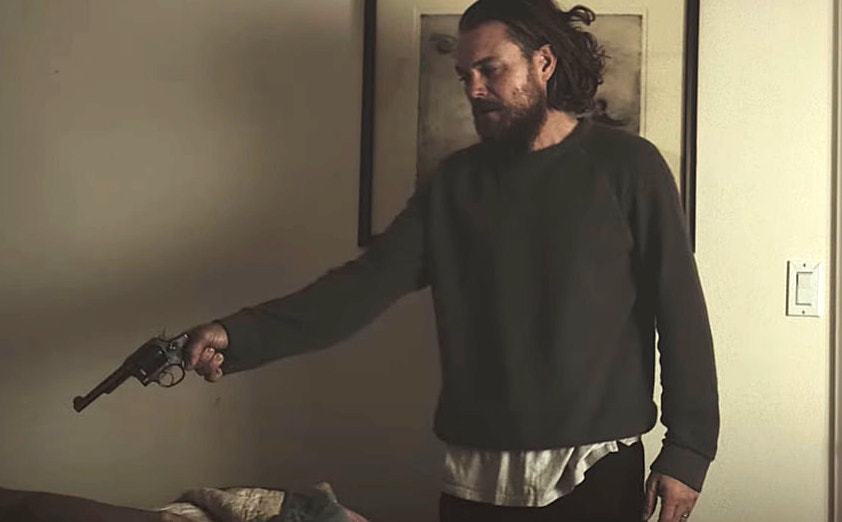
And our first glimpse of writer/director Robert Machoian’s fourth feature doesn’t do anything to allay those fears. In the opening scene a man holding a pistol surreptitiously enters a house and stands menacingly at the foot of the bed where a couple lie sleeping.

The intruder is David (Clayne Crawford), and we soon learn that this is his house. Or was. Currently David is residing just down the road in the home of his aged father.

The sleeping woman is his wife Nikki (Sepideh Moafi); her bedmate is her new lover Derek (Chris Coy).

This setup reeks of melodramatic possibilities, but instead of the revenge tragedy we expect Machoian delivers an insightful character study, both of a man and of a failed marriage.

Bearded and somewhat unkempt, David works as a handyman in the small, snow-swept Utah town he has always called home. He’s a working stiff with just a basic education; he once harbored dreams of guitar-picking stardom, but those are long gone.

He’s slowly sinking into depression and something like rage. He and Nikki are in a trial separation — they’ve agreed that each can see other people. David — who has eyes for no-one but Nikki — maintains they might still repair the marriage.

His wife — a college grad with professional aspirations — harbors no such illusions. It’s pretty clear she’s outgrown him.

Continue Reading »
Jonathan Rhys Meyers, Bront Palarae

“EDGE OF THE WORLD” My rating: C- (VOD)

104 minutes | No MPAA rating

There’s undoubtedly a great film to be made of the life of Sir James Brooke, the Englishman who in the early 19th century schemed and fought his way into ruling a good chunk of the island nation of Borneo.

Alas, “Edge of the World” isn’t that movie.

Written by Rob Allyn, directed by Michael Haussman and starring a horrendously miscast Jonathan Rhys Meyers, this movie doesn’t succeed even as coherent storytelling.

Brooke was the real-life inspiration for Conrad’s characters from Lord Jim and Heart of Darkness (see also John Milius’ 1989 “Farewell to the King” and Francis Coppola’s “Apocalypse Now”), an adventurer out of sorts with traditional Victorian society who went rogue and carved a place for himself on the edge of civilization.

What sort of personality would it take to maneuver his way into such a position of power, to juggle and exploit the antagonisms among local political/tribal factions and to combat attempts to unseat him?

Keep asking. This movie offers little insight. Rhys Meyers’ charisma-free performance suggests a man with a 24/7 migraine and dyspepsia. But as to his moral compass, his motivations, his innermost feelings — we’re out of luck. The film is heavy on Brooke’s voiceover narration, but he doesn’t actually say much.

Dominic Monaghan is unmemorable as Brooke’s right-hand man, while Josie Ho plays the colorless local girl who becomes the white rajah’s bride. About the only fun performance here comes from Bront Palarae as Brooke’s scheming, amoral rival, a local prince who thinks nothing of casually lopping off the noggin of any poor peasant who gets in his way.

Director Haussman comes to features after a career in music videos. It shows. The film often looks good, but the means of presenting an effective long-form narrative elude him.

| Robert W. Butler

Noah Jupe, Millicent Simmonds, Emily Blunt

“A QUIET PLACE PART II” My rating: B

97 minute | MPAA rating: PG-13

With only two directing credits under his belt, actor-turned-filmmaker John Krasinski has proven himself one of the brightest up-and-comers in cinema.

“A Quiet Place” and its just-released sequel, “A Quiet Place Part II” remind a bit of the Spielbergian splash made by “Jaws” more than four decades ago. Like that seagoing classic, Krasinski’s “monster” movies exhibit a Hitchcockian sense for building suspense.

They have their own look and — perhaps even more important for a franchise about eyeless aliens who use their ears to track human prey — their own sound.

And they effectively mine notions of family and parenthood, with a tiny clan battling indescribable horrors to survive.

“A Quiet Place Part II” is a generally enjoyable thrill ride, peppered with gotcha shock moments and performances that far exceed what we’ve come to expect from the horror genre.

Yet despite the many upsides of this sequel, I found myself a bit let down. Not by the execution, but by the sameness. Krasinski sticks with ideas he introduced in the first film, but I never felt he was advancing them so much as recycling them.

You’ll recall that Krasinki’s character Lee Abbott, died in the first film, sacrificing himself to save his children. The new film (the screenplay is credited to Krasinksi, Scott Beck and Bryan Woods) opens with a hugely effective flashback to the aliens’ arrival in the Abbott’s small upstate New York town. It’s got an impressive “War of the Worlds” vibe — and gives us our Krasinski fix before he vanishes from the screen for good.

Continue Reading »