Feeds:
Posts
Comments

Sergio Chamy, Romulo Aiken

“THE MOLE AGENT”  My rating: B+

84 minutes | No MPAA rating

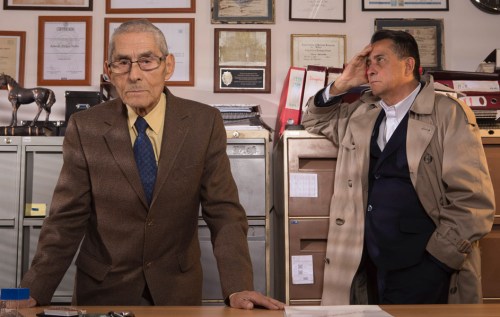
The opening of the charming/devastating documentary “The Mole Agent” finds dozens of graying gents in Santiago, Chile, responding to a help-wanted ad for “elderly men between 80 and 90.” (Face it — there aren’t many job opportunities for that particular demographic.)

The ad was placed by Romulo Aiken, the head of a private detective agency, who after a series of semi-comic interviews finally hires 83-year-old Sergio Chamy. Sergio is informed that he will spend the next three months undercover in a nursing facility.  The  daughter of  a resident suspects elder abuse by employees and has launched an elaborate scheme to expose these alleged crimes.

Not only will  Sergio have to learn the ins and outs of an iPhone (so that he can file daily reports with Romulo), but he’s given a pair of high-tech spectacles and a writing pen equipped with mini-cameras with which to record any nefarious goings-on.

Even more amazing, Romulo and filmmaker Maite Alberdi have already infiltrated the retirement home with a camera crew, ostensibly  to do a documentary about elder care but strategically placed to follow Sergio while he interacts with the residents and sleuths out the truth of the situation.

What starts out as a sort of mystery, though, quickly emerges as something else — a funny, heartbreaking examination of aging filled with colorful characters and enough choked-back sobs that wise viewers will keep a box of tissues within easy reach.

Continue Reading »

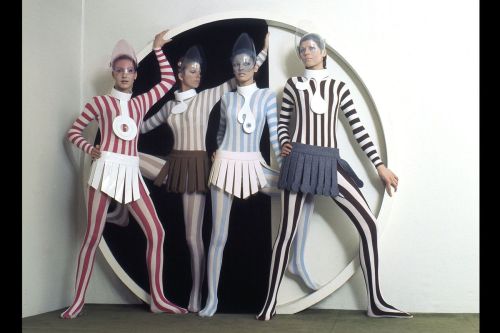
Classic ’60s clothing by Pierre Cardin

“HOUSE OF CARDIN” My rating: B+ 

95 minutes | No MPAA rating

With only a little hyperbole, an admirer of Pierre Cardin tells the makers of “House of Cardin” that virtually everyone on earth knows the Cardin name.

Apparently, though, nobody knows the man.

Early on in P. David Ebersole and Todd Hughes’ documentary, one of Cardin’s cohorts is asked to describe the great designer on a basic human level…and can muster only a blank and helpless look.

In old interview footage Cardin (he’s now 98 years young) admits to having “no sense of self…it’s not me, it’s the brand.”

Indeed, we’re three fourths of the way through this movie before the topic turns to something as fundamental as its subject’s sexuality…and even then it’s more a case of suggestion than assertion.

But if the Cardin personality is elusive, his accomplishments are not.  “House of Cardin” will prove a real eye-opener for those of us (this writer included), who pretty much assumed he was a Parisian fashion designer, period.

The doc’s format mixes filmed interviews Cardin has done over the decades, recent footage of the man still at work and holding court (he’s charming without ever revealing too much), archival photos and footage and tons of reminiscences by the likes of rocker Alice Cooper (Cardin was responsible for bringing Cooper’s Grand Guignol stage show to Paris in the early ’70s), actress Sharon Stone and model Naomi Campbell.

But some of the most informative stuff comes from his colleagues, the people who have worked with him for years and regard him as the benevolent if often exacting father of their big family. The guy couldn’t be a total cipher and elicit that sort of love.

The film deals with the basic biographical stuff up front.  Cardin is Italian, not French.  His family fled Mussolini’s fascist state when Pierre was a boy. During the war he worked for the French Red Cross in Vichy.  With the peace he came to Paris and, with unbelievable good luck, immediately began working in the haute couture fashion houses (Paquin, Dior) to which he aspired.

This self-taught clothing maker was soon collaborating with heavy-duty artistic types like filmmaker/poet Jean Cocteau and actor Jean Marais.  “I was a very good-looking young man,” the white-haired Cardin recalls.  “So everyone wanted to sleep with me.”

Continue Reading »

“DRIVEN TO ABSTRACTION” My rating: B- (Available for streaming on Aug. 28)

84 minutes | No MPAA rating

Aside from guns and drugs, the world of fine arts may be the biggest unregulated industry on earth.
“Driven to Abstraction,” Daria Price’s documentary about the fall of the nation’s oldest continuously operating commercial art gallery, makes it pretty clear that for all the high-falutin’ airs of the art world, on the business end it’s a Wild West show as often as not run by riverboat gamblers and con artists.
In 2011 New York’s Knoedler Gallery — in operation since 1846 — abruptly closed.  Speculation soon turned to disbelief — the Knoedler’s operator, Ann Freedman, one of the most reputable dealers in the biz,  was being sued for having sold forgeries as genuine works  by Mark Rotko, Jackson Pollock, Lee Krasner, Richard Diebenkorn and Frank Stella, among others.
Turns out that for at least 20 years Freedman had been selling modern “masterpieces” ostensibly plucked from the vast private holdings of a European collector.  Oddly enough, there was no record of these particular paintings; Freedman said she had been told the collector bought them directly from the artists before they went on the market or were even photographed for posterity.
But there were  red flags.  Scientific analysis showed that in some instances the paint used  was not available until years after the death of the artists involved.  And then there’s the little issue of the Jackson Pollock painting in which the artist misspelled his own last name in signing the work.
“Driven to Abstraction” chronicles the saga of the Knoedler Gallery and the biggest scandal in the history of art in such labyrinthine detail that a flow chart would come in handy.
Freedman claimed that she was a victim here, too,  that the works in question were sold to her by  Glafira Rosales, operator of a small-time gallery on Long Island. Rosales claimed to be the agent of the mysterious European collector unloading these masterpieces. Freedman maintains she never doubted the paintings were genuine. Continue Reading »

Ethan Hawke as Nicola Tesla

“TESLA” My rating: C+ 

102 minutes | MPAA rating: PG-13

The engineer and inventor Nicola Tesla (1856-1943) is one of history’s most fascinating characters…and one of the most elusive .

A scientific genius who pioneered alternating current electrical systems, he was a terrible businessman who died broke. He was also a hermit who avoided human intimacy and a lifelong virgin.

Moreover, even his biographers have found it hard to pin down the guy’s personality.  The man is  an engima.

When he has been portrayed on film — for instance by David Bowie in “The Prestige” (2006) and Nicholas Hoult in “The Current War” (2017) — he’s a supporting character.   The guy just wasn’t leading man material.

Which meant that Overland Park-born filmmaker Michael Almereyda had his work cut out for him in filming “Tesla,” a project which he has been dabbling with for more than 20 years.

Even with the tremendously skilled Ethan Hawke in the title role (Hawke starred in Almereyda’s modern-dress version of “Hamlet” back in 2000) it must be reported that there’s a hole in the middle of “Tesla” where the lead character should be.

Almereyda anticipated this obstacle, and has attempted to compensate with an expansive filmmaking language that throws curve after curve at his audience (and which, not coincidentally, can be achieved with a modest budget).

The resulting film delivers plenty of factual information about Tesla and his work, including the acknowledgement that more than a century ago he was doing stuff with electricity that scientists today cannot yet explain (like transmitting electrical current through the earth to light up a Colorado town many miles away).

The downside is that “Tesla” often plays more like a series of tableaus  than a coherent narrative.

Continue Reading »

Wreckage of U.S. aircraft in wake of failed Iran hostage rescue

“DESERT ONE” My rating: B

107 minutes | No MPAA rating

A demoralizing bit of recent American history comes vividly to life in “Desert One,”  Oscar-winner Barbara Kopple’s richly detailed retelling of this country’s failed attempt in 1979 to rescue our citizens being held hostage by the new revolutionary Irani regime.

To say that Kopple has cast a wide net in researching this story is an understatement. Giving first-person testimony are not only Jimmy Carter and Walter Mondale (then the U.S. president and vice-president) and members of the commando team that undertook the mission, but also Iranis who guarded the American prisoners, the hostages themselves, surviving family members of the men who died in the effort, and journalists like Ted Koppel who covered the event.

The actual raid doesn’t begin until nearly 40 minutes into the documentary. Kopple wisely spends much time explaining (or rather, having others explain…there’s no narration) the tortuous history of U.S.-Iran relations, our propping up of the dictatorial rule of the Shah of Iran and his long reign of terror waged against his country’s dissidents.

The revolt by Islamic fundamentalists is harrowingly recreated through vintage news footage and the testimony of the then-young Marine guarding the gate of the U.S. Embassy when the hordes descended upon it.

The life of the hostages is described in sometimes uncomfortable detail.  One American recalls having his hands cuffed in front of him for weeks at a time, which meant that after defecating he could not clean himself. And despite Irani claims that the prisoners were being treated humanely, there’s that notorious midnight episode in which prisoners were stripped to their underwear and led to a yard where they faced a mock firing squad. (Throughout the doc, Kopple employs animated sequences to depict scenes for which there is no archival footage.)

The hostage crisis stymied President Jimmy Carter, who was rebuffed in his efforts to negotiate with the Irani.  He reluctantly gave the OK to plan a rescue.  Specially skilled fighters from all areas of the military were chosen to train for the raid. Some may have been gung ho about the whole business; one fighter now says he never thought they could pull it off: “Too many moving parts.”

Indeed, this was a hugely ambitious and somewhat improbable effort.  A half dozen helicopters from American warships would fly into the Irani desert at night to meet two transport planes filled with fighters. They would then drive to Tehran, attack the prison, blow a hole in the wall to allow the hostages to escape, then regroup in a nearby sports stadium where U.S. ‘copters would lift them out.

Everything that could go wrong did go wrong.  Two choppers ran into a desert dust storm and returned to their ship.  The landing site was close to a rarely traveled road which — wouldn’t you know it? — was uncharacteristically busy that night.  The Americans soon found themselves babysitting (at gunpoint) a bus chartered by an extended Irani family (great testimony from a passenger who was only a child at the time).

Continue Reading »

Trai Byers

“THE 24th” My rating: B+

101 minutes | No MPAA rating:

An overlooked landmark in both black history and military history gets a compassionate/angry examination in “The 24th,” the latest from KC-area filmmaker Kevin Willmott.

The subject is the 1917 “riot” of black soldiers in Houston TX. After months of abuse from  both white citizens and the local police department and fearing they were about to be attacked by a white mob, the soldiers went on a late-night killing spree.  By the time the sun rose 11 civilians, five police officers and four soldiers were dead.

The upshot was the largest murder trial in American history, with 156 soldiers of the Third Battalion of the all-black 24th Infantry facing homicide and mutiny charges.

In capable hands of the Oscar-winning Willmott (“C.S.A.,” “Jayhawkers,” “Destination Planet Negro”…as well as the screenplays for recent Spike Lee efforts) the story of the 24th becomes an intimate epic, filled with suppressed fury and perfectly balancing personal moments against the sweep (one almost wants to say inevitable sweep) of history.

Astoundingly, this is accomplished on a bargain basement budget, with filming limited to less than three weeks.

Yet the movie never looks cheap; neither are its sentiments.

We meet the members of the 24th as they show up to provide security for the building of Camp Logan outside Houston.  There’s a war in Europe, and the men are anxious to prove their worth on the battlefield; the Army, though, cannot see them as anything but uniformed ditch diggers and night watchmen.

Our protagonist is William Boston (Trai Byers, co-writer of the screenplay with Willmott), who as a graduate of the Sorbonne is better educated than any of the white officers calling the shots. This is not lost on the regiment’s commanding officer, Col. Norton (Thomas Haden Church), who unsuccessfully urges Boston to sign up for officer training in Des Moines.

Boston is an idealist out to prove that colored soldiers are second to none; alas, his intellectual interests (in his spare time he reads!) and his light complexion make him suspect, especially to the  perennially angry Pvt. Walker (Mo McRae).

And then there’s Sgt. Hayes (Mykelti Williamson), the scarred black NCO who boasts of charging up San Juan Hill with Teddy Roosevelt but has spent the last 20 years in an alcoholic funk  kowtowing to a system that respects none of his sacrifice.  He cannot even look a white officer in the eye; occasionally he takes out his frustrations on his men.

Continue Reading »

“BOYS STATE” My rating: B+

109 minutes | MPAA rating: PG-13

After watching the spectacularly engrossing documentary “Boys State” I don’t know wether to celebrate our democracy or mourn its death.

Boys State, of course, is a week of politically-charged make-believe in which high school seniors, representing their schools and towns, gather in their capitol city to create political parties, draw up platforms and hold mock elections for various state offices.

Dick Cheney went to Boys State. So did Corey Booker. (BTW: Girls State does the same thing for young women.)

This elaborate exercise is sponsored by the American Legion, which despite its reputation for jingoism attempts to level the playing field by randomly dividing the participants into two parties, the Federalists and the Nationalists.  What each party stands for will be determined by its members during the course of a week.

A stated goal of Boys State is to advance civil discourse. We’ll see about that.

Amanda McBaine and Jesse Moss’s film unfolds in Austin, TX, where 1,100 boys have gathered. Initially one searches in vain for a face of color — this is one majorly white group — but it’s remarkable how many minority faces rise to prominence in just seven days.

The hero of “Boys State” is Steven, whom we meet on the bus ride to Austin. The Hispanic son of a one-time illegal immigrant, Steven doesn’t spew  teen testosterone like some of his fellows. He’s quiet, soaking up the vibes, tentatively making acquaintances.  He’s smart to cautiously feel out the mood of the other kids, because Steven is an unabashed liberal surrounded by gun-owning good ol’ boys (actually, good ol’ young boys).

Before it’s all over Steven improbably will be running as his party’s nominee for governor.  He may not agree entirely with the platform adopted (he’s for gun control and a woman’s right to choose), but he so exudes  basic human decency that even the kids who see things differently are impressed by his integrity.

Continue Reading »

Louis Armstrong

“JAZZ ON A SUMMER’s DAY”  My rating: B

85 minutes | No MPAA rating

There’s no shortage of reasons to catch the current reissue of 1959’s “Jazz on a Summer’s Day,”  with superb music and spectacularly good photography at the top of the list.

But at a time when most of us are spending way too many hours sequestered in our homes, Bert Stern and Aram Avakian’s record of the 1958 Newport Jazz Festival also hits an achingly romantic note,  taking us back to an era when it was safe for hundreds of us to assemble to hear music played by racially integrated bands.

1969’s Woodstock Fest may have been billed as “three days of peace and music,” but the Newport event a decade earlier delivered pretty much the same vibe…minus, of course, public nudity and drug sampling.

The performances captured here (the film spawned a best-selling soundtrack LP back in the day) provide a sort of Who’s Who of ’50s jazz.  They range from the New Orleans-steeped blowing of Louis Armstrong to the white-girl scatting of Anita O’Day (a knockout in black dress, feathered hat and white gloves), from the intellectually-rich piano stylings of Thelonious Monk to the early-rock glory of a duck-walking Chuck Berry. There’s even a touch of gospel glory courtesy of Mahalia Jackson.

(Of interest to KC area jazz fans:  Look for local boys Bob Brookmeyer, Buck Clayton and Basie alumnus Jo Jones playing with various configurations.)

Continue Reading »

Seth Rogen…and Seth Rogen

“AN AMERICAN PICKLE” My rating: B- (HBO Max)

90 minutes | MPAA rating: PG-13

Before bogging down in a flabby middle section, HBO’s “An American Pickle” (aka “In A Pickle”) establishes itself as a gonzo comedy with more than a little soul.

The time-travel fantasy offers Seth Rogen in non-stoner mode as both a turn-of-the-last-century Eastern European Jew and as his modern great-great grandson.

Putting aside the complexities of filming this double performance (it was shot in two phases to give Rogen a time to grow a luxurious Tevye-type beard), “American Pickle” shows the slacker funny man has some serious acting chops.

In a beautifully filmed prologue (using a square-frame format and pastel palette that evokes the earliest color photography) we witness the early life of Herschel (Rogen), a Jewish ditch digger in some Eastern European backwater circa 1919.

In a sweetly comic passage Herschel woos and weds Sarah (Sara Snook of HBO’s “Succession”); they then hop a boat to America where Herschel gets a job killing rats in a pickle factory and looks forward to the birth of their first child.

He dies in an industrial accident, falling into a vat of brine. Before anybody notices that Herschel is gone, the factory is shuttered.  One hundred years later he awakens, perfectly preserved by the pickle juice.

What follows is both a fish-out-of-water yarn and a sort of dysfunctional family reunion. Herschel is united with his one living relation, great-grandson Ben (Rogen again), a dweeby app developer whose lack of success flies in the face of Herschel’s longheld belief that their family is destined for greatness.

Continue Reading »

ACLU attorney Dale Ho before the U.S. Supreme Court

“THE FIGHT” My rating: B+ 

96 minutes | MPAA rating: PG-13

The cynic in me acknowledges that the new documentary “The Fight” comes awfully close to being a recruiting ad for the American Civil Liberties Union.

Except that this effort from co-directors Eli B. Despres, Josh Kriegman and Elyse Steinberg is a hugely engrossing, intellectually stimulating achievement that will leave viewers torn between hope and despair.

“The Fight” follows the efforts of the ACLU to battle four of the more draconian steps taken by the new Trump administration.

We see ACLU lawyer Dale Ho take on Trump’s order that the 2020 census contain a question about the respondents’ citizenship…a development that would undoubtedly keep non-citizens from participating and so skew the numbers that determine, among other things, how many representatives each state gets in the U.S. House.

Brigitte Amiri, a litigator for women’s rights, takes on the plight of a 17-year-old woman who, having been detained as an illegal alien, discovered she was pregnant and was denied the abortion she requested.

Lee Gelernt tackles the issue of child separation along the Border.

Joshua Block builds a case against the banning of transgender persons from the military. He’s assisted by young attorney Chase Strangio, who is himself transgender.

The common thread in all of these cases, as well as with Trump’s notorious Muslim ban, is the suppression of human rights for certain classes of people.

Continue Reading »