Feeds:
Posts
Comments

Lyricist/author Howard Ashman on the off-Broadwday  set of “Little Shop of Horrors”

“HOWARD” My rating: B+

93 minutes | No MPAA rating

“Howard” is a laughter-through-tears emotional powerhouse that will leave you convinced that when Howard Ashman died of AIDS in 1991, we lost a musical theater genius.

As the lyric-writing partner of composer Alan Menken, Ashman was largely responsible for the off-Broadway hit “Little Shop of Horrors” and then went on to rejuvenate a dying Disney animation division with monsters like “The Little Mermaid,” “Aladdin” and “Beauty and the Beast.” (The fact that those films went on to spawn wildly successful theatrical versions only adds lustre to his accomplishments.)

Don Hahn’s documentary begins with a recording session for “B&B” in New  York City.  As Hahn’s narration informs us, nobody at the time knew that within nine months Ashman would be gone.  He never got to see the finished film.

On the visual side Hahn (a producer of “Beauty…” and director of the doc “Waking Sleeping Beauty”) exploits a treasure trove of home movies from throughout his subject’s life.  There’s so much material, in fact, that the film needn’t rely on talking-head inserts.  The many contributors to this film (among them Menken and Jeffrey Katzenberg) are heard in voiceover but not seen, leaving center stage to Ashman.

The earliest glimpse into Ashman’s creativity comes from his sister, who recalls her brother turning his bedroom into an elaborate designed theater in which individual toys became players in a vast adventure.  Before long he was organizing neighborhood kids into giving backyard performances.

Young Howard had little interest in sports, but wrote poems for every occasion.

Continue Reading »

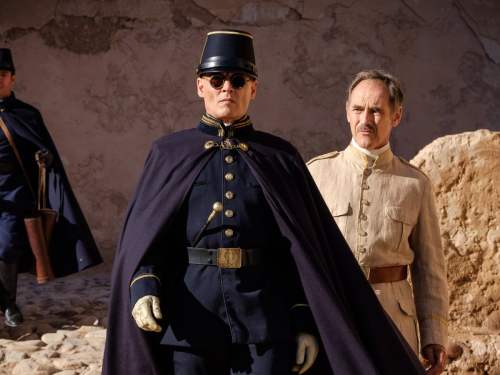
Johnny Depp, Mark Rylance

“WAITING FOR THE BARBARIANS” My rating: C (Begins streaming on  Aug. 7)

112 minutes | No MPAA rating

Not even the usually-comforting presence of Mark Rylance or a hammy performance from Johnny Depp can save “Waiting for the Barbarians,” a literary adaptation that probably should have stayed on the printed page.

Adapted by J.M. Coetzee from his novel and directed by Ciro Guerra, the film struggles to find a balance.  Its production design suggests  an old Foreign Legion movie like “Beau Geste” — except that “…Barbarians” lacks any sense of satisfying adventure.

Moreover, Coetzee’s subject is one individual’s moral struggle, an interior drama not easily depicted dramatically — even when you’ve got someone like the Oscar-winning Rylance assuming top honors.

Rylance plays The Magistrate, a bookish fellow toiling in a dusty desert town on the far-flung edge of an unspecified late 19th-century empire (French, Belgian, German?). Though he’s supposed to be in charge of local government, not to mention a garrison of bored soldiers, The Magistrate prefers to spend his time in archaeological digs, with occasional nocturnal visits to a local prostitute.

Then he’s paid a visit by Colonel Joll (Depp), a black-clad martinet with eccentric sunglasses who radiates quiet menace.  Bigwigs in the distant capital are convinced that the nomadic tribesmen who populate the desert are planning a revolution; Joll’s job is to collect intelligence on these “barbarians.”

To The Magistrate’s horror, tribal visitors to the town are randomly snatched and tortured, some fatally. But being a bit of a milquetoast, he’s powerless to do much more than sputter ineffectually.

Continue Reading »

Gillian Jacobs

“I USED TO GO HERE”  My rating: C+

80 minutes | No MPAA rating

We’re told that you can’t go home again.

You probably shouldn’t go back to school, either.

In “I Used to Go Here” writer/director Kris Rey gives us a heroine who is finding adult life problematical and plops her down in the college environment she left 15 years earlier.

Actually, lots of us nurture a secret back-to-school fantasy; “I Used to Go Here” suggests we should be careful what we wish for.

Kate (Gillian Jacobs) is a mess, thrown into turmoil and depression by the double whammy of being ditched by her fiancé and realizing that her first published novel is headed for the remainder bin. While her gal pals are married and procreating, Kate lives alone in Chicago, stewing  in her own self-pity.

So when an old college professor invites her back to campus to give a reading from the novel, Kate jumps at the chance.

Initially it seems as if her old college town has hardly changed at all.  But when she starts hanging with a scraggly bunch of kids  now living in the off-campus dive where she spent her senior year, Kate is hit full force with knowledge that she is now a middle-aged woman.

What to do?  Well, if reality sucks, make your own reality. Kates starts acting like the mostly carefree college student she once was. This leads her to a nighttime  raid on the home of her old creative writing teacher (Jemaine Clement in full pompous-professor mode) and striking up a quickie romance with a baby-faced undergrad (Josh Wiggins).

Nothing of real import happens in “I Used to Go Here,” but nevertheless the trip is largely pleasant one.  For this we can credit the screen presence of Jacobs (she was a regular on TV’s “Community”), who hits just the right mix of comic neurosis and romantic yearning.

| Robert W. Butler

David Myers Gregory, Vinnie Jones

“THE BIG UGLY”  My rating: C+

106 minutes |MPAA rating: R

Dramatically, there’s nothing special about “The Big Ugly,”  a crime/revenge yarn that hits the usual plot points without adding much to the genre.

What this melodrama from writer/director Scott Wiper does have going for it is its look.  The cinematographer is Jeremy Osbern, a Kansas Citian who has cut his teeth on shorts, a Kevin Willmott feature (“The Only Good Indian”) and is now breaking into the big time.

His work on “Big Ugly” is exemplary — as close to a classic noir look as color will allow.  At least half the film unfolds at night, in dimly-lit bars and bedrooms, and Osbern’s provocative use of shadow and silhouette is absolutely first rate.

The plot finds English tough guy Neelyn (Vinnie Jones) flying to America with his mob boss Harris (Malcolm McDowell). Neelyn is accompanied by his longtime girl Fiona (Leonra Crichlow), a good soul who loves him despite his drinking and murderous employment.

Continue Reading »

Gemma Arterton, Lucas Bond

“SUMMERLAND” My rating: B

99 minutes | MPAA rating:PG

One of literature’s more enduring themes — that of a misanthrope redeemed by the love of a child (Silas Marner, anyone?) — gets a clever reworking in Jessica Swale’s “Summerland.”

In her quaint cottage on the Dover seashore, Alice (Gemma Arterton) has pretty much managed to avoid the  unpleasantries of the world war taking place on the other side of the channel. A middle-aged recluse regarded by the local kids as some sort of witch (they stuff dirt and sticks into her mail slot), Alice immerses herself in her scholarly study of British folklore. She just wants to be left alone.

So she’s more than a little miffed when told that like many other residents of this rural area, she is expected to take in a child evacuated from London and its nightly air raids. Frank (Lucas Bond) is already traumatized at being separated from his soldier father and government-worker mother; things aren’t improved when Alice gives him a chilly reception and immediately launches an effort with the local schoolmaster (the venerable Tom Courtenay) to have the youngster reassigned to another home.

Swale’s screenplay follows one familiar trajectory, but manages to change things up with a couple of novel twists.

The cranky woman and the innocent child eventually will warm to one another.  This goes without saying.

Frank’s relationship with a another displaced child (Dixie Egerickx) feels fairly predictable as well.

But in a series of flashbacks we see young Alice  having an affair — her only sexual encounter, apparently — with a fellow university student, Vera (Gugu Mbatha-Raw). Their idyllic flapper-era romance ends when Vera opts for conventional marriage and children over a mixed-race lesbian relationship (which, in  late 1920s Britain, was a far dicier premise than it is today).

This soul-shattering disappointment explains Alice’s intervening years of surly solitude. Having been badly burned, she’s not keen on forming relationships of any depth.  Which makes the presence of curly-haired Frank all the more problematic.

Continue Reading »

“REBUILDING PARADISE”  My rating: B

95 minutes | MPAA rating: PG-13

The first 10 minutes of Ron Howard’s “Rebuilding Paradise” employ TV news footage, cell phone videos and audio communications between emergency workers to recreate the notorious Camp Fire that in  2018 consumed the northern California town of Paradise, killing more than  80 citizens.

No horror film of recent years is as terrifying as this masterfully edited depiction. You’ll watch with your mouth open in disbelief…that is, if you’re not already reduced to tears.

The ghastliness of those opening minutes are reinforced by the immediate plight of the fire’s survivors. Citizens quite literally got away with only their lives. Everything else — homes, possessions — has been reduced to smoking cinders.

“Rebuilding Paradise” chronicles the first year or so following the disaster, as individuals and the overall community come to grips with the extent of their loss and make tentative first steps toward returning to some kind of normalcy.

It’s not an easy process…or an easy one to watch.  But Howard’s film is at its core a paen to the resiliency of the human spirit (or, if you’re jingoistically inclined, to can-do Americanism)…which means that you leave the experience with a deep appreciation of and a sort of elation about the possibilities we all share.

Continue Reading »

Rosamund Pike as Madame Curie

“RADIOACTIVE” My rating: B (Amazon Prime)

109 minutes | MPAA rating: PG-13

Not content with the limitations of a conventional biopic, Marjane Satrapi’s film about Marie Curie blows up the form, not just depicting the life of a great scientist but exploring what over the decades her discoveries have meant to the world.

As suggested by the piece’s unconventional title — “Radioactive” — the fallout (pun intended) of Curie’s groundbreaking work is not entirely life-affirming.

Satrapi,  who first came to fame with her graphic novel Persepolis (about growing up in and then fleeing post-revolutionary Iran) and the 2007 animated feature based on it, has a lot of her mind here.  Perhaps too much for tidy presentation.

Happily she has as her lead Rosamund Pike,  whose work in recent years — especially “Gone Girl” and “A Private War” — has catapulted her into the first ranks of film actresses. Even when “Radioactive” threatens to fly out of control, Pike keeps things centered.

Beginning late in the 19th century and extending past Curie’s death in 1934 (poisoned by all the radioactive material she had handled over a lifetime), the film hits the usual biographical landmarks: Marie’s meeting and marriage to fellow physicist Pierre Curie (Sam Riley), her discovery of the elements radium and polonium, the death of Pierre and her years as a widow still devoted to scientific research. During World War I she traversed the front in a truck outfitted with primitive X-ray equipment that allowed military doctors to locate the bullets and shrapnel in the bodies of wounded soldiers.

But Jack Thorne’s screenplay (based on Lauren Redniss’ graphic novel Radioactive: Marie & Pierre Curie, A Tale of Love and Fallout) also leans heavily  on the feminist aspects of Curie’s story, especially her fights with a chauvinistic scientific establishment (embodied by Simon Russell Beale’s university bigwig) and her resentment of Pierre, who accepted their Nobel Prize while Marie stayed at home with the kids (“You stole my brilliance and made it your own”).

The film devotes considerable time to one of the more controversial parts of Curie’s story, her post-Pierre affair with a married co-worker (Aneurin Barnard). The relationship created an uproar: this Polish “harlot” was besmirching the sacred institution of French marriage.  (I know, I know…the French have a long history of besmirching marriage.)  Don’t recall that incident even being mentioned in the sanitized 1943 Greer Garson version of the yarn.

Continue Reading »

Dolph Lundren, Grace Jones…photo by Helmut Newton

“HELMUT NEWTON: THE BAD AND THE BEAUTIFUL” My rating: B

93 minutes | No MPAA rating

As with few other photographers (Ansel Adams and Robert Mapplethorpe immediately come to mind) the late Helmut Newton’s images cannot be mistaken for those of any other artist.

Newton (1920-2004) worked in fashion  and his most regular employer was Vogue magazine. But even when his stated assignment was to capture on film some item of apparel he still managed to work his sexual preoccupations and perverse sense of humor into the equation.

Though he frequently photographed the famous (Margaret Thatcher, David Bowie), Newton’s main fame rests on his nudes.  Though they’ve been classified as erotica, many find them anything but enticing.

No come-hither looks. No languid poses.

Newton’s women usually present themselves to us in-yer-face naked from top to high-heeled bottom, appproaching the camera defiantly and largely indifferent to the viewer’s gaze. This is the nude body as chilly, intimidating bulwark.

Elements of sado-masochism are not uncommon.

Some critics (Susan Sontag, famously) found his work essentially misogynistic; others, including many of the young women who were his models, regard their time with Newton as empowering.

Getting to the root of that conundrum is the underlying thread of “Helmut Newton: The Bad and the Beautiful” by documentarian Gero von Boehm, whose six-part “A Brief History of the World” is one of the highest rated documentaries ever on German television.

Continue Reading »

Petr Kotlar as The Boy

“THE PAINTED BIRD”  My rating: B

170 minutes | MPAA rating:

As horrifying as “The Painted Bird” is, I don’t regret the three hours spent watching it.

Like a few other films — I’m thinking particularly of the Soviet “Come and See” — Polish filmmaker Vaclav Marhoul’s adaptation of Jerzy Kosiriski’s 1965 novel tests a viewer’s capacity to absorb the terrors of war (in this case World War II on the Eastern Front).

Not that there’s much in the way of battlefield mayhem. The violence here is directed at civilians and, even worse, at one young boy. War or no war, this movie seems to be saying, superstitious, thick-headed humans will go out of their way to torment each other.

The protagonist of the yarn is The Boy (Petr Kotlar), who is presumably Jewish. Separated from his family, he leads a nomadic existence, wandering through fields and forests, barely surviving  thanks to the “kindness” of strangers, who as often as not abuse him physically, sexually and emotionally.

Harvey Keitel

When we first meet him he’s being chased through the woods by three boys who beat him and set fire to his pet ferret. Sort of sets the tone for the whole enterprise.

The boy is living with an old woman he calls “Auntie” (whether they’re actually related is doubtful). Upon her death he stumbles into a village where an old matriarch declares him a “vampire” and orders him  killed. He survives this threat — and all of the others that will test him — less by his wits than by pure luck.

At one point The Boy flees his pursuers by jumping into a river and being carried downstream on a fallen tree branch, only to be delivered into yet another hellish predicament.  This becomes a metaphor for his life; drifting helplessly from one crisis to the next.

All of this is unfolds with a minimum of dialogue and little or no psychological insight into the characters.  That goes as well for The Boy himself, who has been so numbed by his experiences that only acute physical pain can rouse him from his emotional lethargy. Continue Reading »

Charlize Theron

“THE OLD GUARD” My rating: C+ (Netflix)

118 minutes | MPAA rating: R

Netflix’s “The Old Guard” is almost instantly forgettable…but no movie that gives us Charlize Theron in kick-ass mode can be easily dismissed.

Adapted by directed by Greg Rucka from his graphic novel and competently directed by Gina Prince-Bythewood, “…Guard” stars Theron as Andy, a formidable warrior woman who runs a four-man team of freelance commandos (Marwan Kenzari, Matthias Schoenaerts,  Luca Marinelli).

When we first meet them they are “hired” by a former CIA guy (Chiwetel Ejiofor) to travel to Sudan to rescue schoolgirls kidnapped by a predatory militia. Andy and team show up armed to the teeth not only with modern automatic weapons but also with much Medieval cutlery.  No bulletproof vests…but then it turns out they don’t need them.

Because the members of this crew are immortal.  Andy is the oldest, having lived for at least 3,000 years.  The others were picked up over the centuries; apparently each is a genetic/metaphysical freak who for unknown reasons suddenly was endowed with rapid healing and near-instant resurrection.

Betrayed on their mission and left for dead (death doesn’t last long in this instance), the crew clean up the mercenaries who laid the trap (the kidnapped schoolgirls scenario was merely a ruse) and lick their rapidly healing wounds.

Andy, who has devoted her never-ending life to righting wrongs and getting rid of bad guys, has reached the point where she wonders if she’s doing any good any more. “The world isn’t getting any better,” she laments. “It’s getting worse.”

Then all four dream simultaneously about a U.S. Marine, Nile (Kiki Layne), who suffers a seemingly deadly wound in Afghanistan yet recovers within hours. Clearly, she is meant to be the next member of the team, although she greets that news with mixed emotions.  Yeah, living forever and healing instantly is pretty cool; on the other hand, remaining the same age while loved ones wither away is just plain demoralizing.

Continue Reading »