Feeds:
Posts
Comments

“THE VAST OF NIGHT” My rating: B+ (Amazon Prime)

89 minutes | MPAA rating: PG-13

The low-budget “The Vast of Night” is like the best episode ever of “The Twilight Zone.” With a dose of “American Graffiti” tossed in.

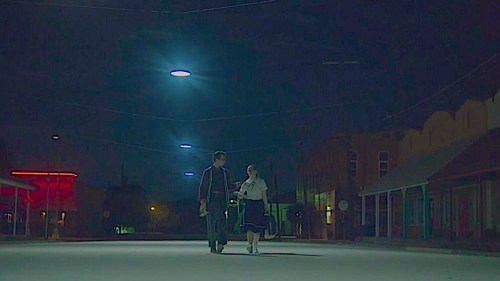
Unfolding on on fall night in the late 1950s in the tiny burg of Cayuga NM, Andrew Patterson’s film delivers a big dose of weirdness made all the more unsettling by its roots in banal reality.

It’s a Friday night and at the local gymnasium the high school basketball team is getting ready to kick off their season. Everett (Jake Horowitz), a twenty something who operates the local radio station, is setting up a tape recorder so that one of his colleagues can do a play-by-play of the game.

(Actually, the game tape won’t be broadcast until  the next day.  As Everett observes, nobody listens to find out who won — they already know — but to hear the names of their sons spoken through the ether. It’s an example of the minute details exploited so effectively in Patterson and Craig W. Sanger’s screenplay.)

Everett, who is so nerdy he’s actually cool in a Buddy Holly kind of way, won’t watch the game. He has to return to the station for that night’s program of recorded music and call-in commentary.

He’s accompanied on the walk across town by Fay (Sierra McCormick), a 16-year-old in cats-eye spectacles, pony tail and poodle skirt who is Cayuga’s nighttime telephone operator. (For the callow  youths reading this:  There was a time when a phone call to your neighbor required an operator poking wires into sockets on a huge circuit board; naturally a small-town operator knew the dirt on just about everybody.)

Fay is a science nerd who chatters enthusiastically about the articles she’s been reading in popular magazines (one predicts the development of telephones with tiny TV screens; another self-driving cars.)  Everett enjoys playing the role of big-brother/mentor.  They briefly refer to the Soviet Union’s recent success with Sputnik (Cold War paranoia wafts throughout).

Sierra McCormick

Once downtown Fay and Everett settle into their respective chairs and prepare for another boring night.  Heck, virtually every Cayugan is at the game.

And then Fay gets a call…well, not a call so much as a weird mechanical/electrical noise.  This coincides with reports of strange lights in the sky. She transfers the call to Everett, who puts it on the air.

He gets a call-in from Billy (the unseen but excellent Bruce Davis), a former soldier who in a long monologue tells of building a hangar in the desert for some sort of top-secret aircraft.  He recognizes the weird audio signal being aired by Everett as accompanying the strange craft.

Continue Reading »

Hiam Abbass, Ramy Youssef, Amr Waked

Like most boomers, I grew up on half-hour TV dramas. They once roamed the airwaves like herds of bison.

Maybe back then the entertainment industry didn’t think the fledgling television public had sufficient attention spans to endure a full hour of heavy dramatic lifting. Perhaps the studios were still trying to find the right balance between production costs and on-air quality, and a half-hour show minimized risk.

Whatever.  My generation came of age watching Westerns in which characters were introduced, a situation established and resolved (usually through gunplay) in a terse 25 minutes. (Plus five minutes for commercials.)

Not just Westerns.  Legal dramas and crime shows as well.

By the early ’60s the half-hour drama had given way to 60-minute productions which provided creators a chance to stretch a bit, dabble in nuance without the need to get in and out in record time.

Which is why I was surprised to discover that two of my new favorites — the Hulu series “Ramy” and “Normal People” — are half-hour dramas.

Yeah, yeah, technically “Ramy” is a comedy — this year its creator and star, Ramy Youssef, won the Golden Globe for best actor TV musical or comedy   — but as will soon be explained, the new second season of “Ramy” is essentially dramatic.

And as for “Ordinary Humans,” you don’t get much more intense than this tale of two Irish kids whose sexual/romantic relationship is followed over several years.

Okay, first “Ramy.”

Youssef stars (basically he’s playing  himself, or at least the self he presents in his standup routines) as Ramy, twenty something son of Egyptian immigrants who wants to be a good Muslim but also wants to be a normal American millennial.  He manages to avoid alcohol, but sex is his Achilles heel…he loves the ladies and whacking off to porn.

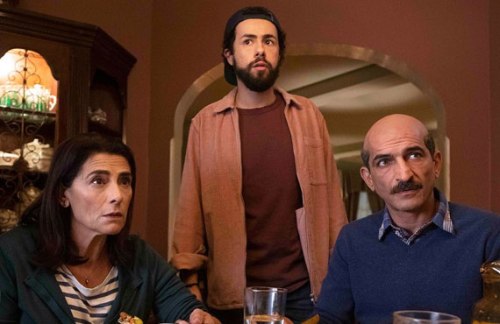
Season One sets up Ramy’s world and its inhabitants. His father Farouk (Amr Waked) is some kind of white-collar drone; mom Maysa (the sublime Hiam Abbass) is a homemaker and busybody with endless advice for Ramy (get a job, marry a nice Muslim girl) and his rebellious but still virginal sister Dena (May Calamawy).

Ramy’s running buddies are Mo ,(Mohammed Amer), who operates a diner and is always encouraging Ramy’s libidinous behavior (married, Mo lives vicariously through his friend), and the physician Ahmed (Dave Merheje), a nerd forever attempting to steer his pal along paths of righteousness.  Basically Ahmed and Mo are a good angel and a bad angel, each perched on one of Ramy’s shoulders and delivering hilariously contradictory advice.

A third pal is Steve (Youssef’s real-life best friend Steve Way), who has muscular dystrophy and is confined to a wheelchair from which he hurls world-class insults.

Another important character — and one who generates huge laughs in Season One — is Uncle Naseem (Laoth Nakli), who is also Ramy’s boss at a Manhattan jewelry store (the family lives in New Jersey). Broad, hairy, proudly chauvinistic and fiercely opinionated, Nasseem is an Arab version of a redneck who apparently agrees with Trump on everything except Muslim policy. Archie Bunker seems benign by comparison.

The debut season finds Ramy in various romantic entanglements (including an affair with a Jewish girl), but huge chunks of the season are devoted to exploring his world. This includes the daily schedule of Muslim prayer (Ramy is less than diligent), dietary and cleanliness laws (Ramy is reluctant to pray if he has recently farted) and prejudices within the Muslim community (Arabs aren’t so sure about their black American brethren).

In Season Two, which just debuted, things get considerably darker.

For starters, Ramy often takes a back seat as entire episodes are devoted to one character.  Maysa has been augmenting the family income as a Lyft driver; when she is suspended over a bad customer comment, she is sure the complainer is a trans woman, a recent fare.  She boneheadedly (but without malice) begins stalking the rider in an attempt to set things right.

Sister Dena, who at one point almost gives it up to a charming young man she meets on campus, finds herself in a deep depression when her glorious head of hair (no wraps for this girl) starts falling out in clumps.

Most of all there’s the episode devoted to the Uncle Naseem, whose bullish exterior hides a heart-breaking inner life.

These segments are essentially dramatic…there may be a chuckle or two, but they’re aiming at targets bigger than laughs.

The season is anchored by the great Mahershala Ali as Ramy’s new spiritual leader, a Sufi who cuts through all the chatter in Ramy’s head with his deep faith and psychological awareness.  This leads to Ramy’s romance with the Sheik’s daughter; the season ends with a betrayal by Ramy that makes us wonder if he’s really the nice goof we’ve always thought or simply too dense and selfish to warrant our affection.

Throughout the 30-minute format provides enough time to get the story told without lollygagging…”Ramy” will jump from one scene to the next almost before you can get the laugh out. Yet it rarely seems hurried.
Continue Reading »

Nine years ago, when I was laid off by the Kansas City Star after 41 years, I found an ally in Facebook.

I could post my movie reviews with a good chance of connecting with like-minded (think Boomer) readers.
But this is my last Facebook post for the foreseeable future. I no longer want to be a facilitator for Mark Zuckerberg’s greed.
When “The Social Network” came out in 2010 I actually thought the film’s depiction of Zuckerberg and the creation of Facebook was inherently unfair.
Now I think it was some sort of whitewash.
In the name of “fairness” Zuckerberg has decreed that any post — no matter how patently false, misleading or prejudiced — will get the hands-off treatment from Facebook. Let the reader beware.
Except that Zuckerberg is getting fabulously rich by allowing disinformation to inundate his web site, threatening our democracy, our freedoms and our humanity. Fuck his bullshit moral qualms; this is all about getting even richer. (Just how rich is enough, and at what cost, is a discussion for another time and place.)
Anyway, I’ll no longer be posting on Facebook. If you still want to read my reviews, check out ButlerFilm on Twitter (better still, click on the SUBSCRIBE button on this page and it’ll automatically send an email link to my new reviews).
It’s been interesting.
| Robert W. Butler

Rob Brydon, Steve Coogan

“THE TRIP TO GREECE” My rating: B-

104 minutes | No MPAA rating:

In a major break with tradition, neither Steve Coogan nor his comedy partner Rob Brydon do a Michael Caine impersonation in “The Trip to Greece.”

In all other regards, however, the fourth film in the series (after “The Trip,” “The Trip to Italy” and “The Trip to Spain”) hits its expected marks. Fans will find ample diversions, even if it seems that this time around the concept is running afoul of the law of diminishing returns.

The format, for those who’ve been living in a cave, finds the two British comedic actors once again playing lightly fictionalized versions of themselves. Coogan has been assigned to write a travel/food piece for a major publication; he and his bud Brydon get to traipse around the Greek countryside, stopping at quaint (and sometimes spectacularly fancy) eateries to sample the cuisine.

It’s not a bad way to travel: boats, islands, ancient ruins and 370-Euro lunches on an expense account.

Director Michael Winterbottom captures some scrumptious scenery and pays mouth-watering visits to the kitchens of the restaurants Coogan and Bryden patronize.

But the big attraction, as always, is the improvised comedy one-upmanship practiced by the leading men, whose hilarious star impressions and withering putdowns fuel the enterprise.

A discussion of Alexander the Great leads to the opinion that he was a ruthless gangster and a dead-on Brydon impression of Marlon Brando in “The Godfather.”

Brydon also sings the theme song from “Grease,” despite Coogan’s protests that the song is spelled differently than the country they’re traveling. This leads to innumerable falsetto Barry Gibbs/BeeGees impersonations.

A discussion of Laurence Olivier and Dustin Hoffman’s work in “Marathon Man” segues into a rapid-fire series of scenes from Hoffman movies, with Brydon nailing the actor’s delivery in “Midnight Cowboy” (“I’m waaawwwkin’ here”) and “Tootsie,” finally returning to “Marathon Man” and the scene in which a sadistic Olivier bores a hole in the captive Hoffman’s incisor (our boys imitate the sound of a high-speed dental drill).

A discussion of the first Olympics inspires Coogan and Bryden to hum/whistle/clluck their own version of Vangelis’ theme to “Chariots of Fire.”

And of course there are riffs spawned by Greek history: “Spartan women had a reputation as the most beautiful women in the world. Yet the men were gay. Go figure.”

For all the laughs, the series has a history of dabbling in life’s darker undercurrents. The divorced Coogan has an ongoing sexual arrangement with the female photographer sent to snap illustrations for the article, and in one of the films family-man Bryden succumbed to the double-whammy temptations of travel and female companionship.

This time there’s a brief visit to a refugee camp (“Well, that was sobering”), and Coogan gets regular updates from his grown son back in England on the status of his father, who is in hospice. The film ends with a lovely little interlude in which Brydon and his wife are reunited for a long weekend on a Greek beach.

Does it add up to much?  Nah, but it’s an enjoyable 104 minutes even if this fourth iteration smacks of deja vu.

| Robert W. Butler

Jean Dujardin

“DEERSKIN” My rating: B

77 minutes | No MPAA rating

When we first encounter Georges,  the protagonist of Quentin Dupleux’s deliciously nasty “Deerskin,” he looks like a college professor…crisp shirt, salt-and-pepper beard,  brown corduroy sports coat.

Georges (Jean Dujardin, the Oscar-winning star of  “The Artist”)  is driving to the French Alps in response to a personal ad. The object of his quest is a vintage deerskin jacket bedecked with fringe; the aging hippy who is selling it tosses in an almost-new camcorder for free.

Georges’ nice corduroy jacket goes in the trash (more precisely, he stuffs it down the toilet in a highway rest stop).  You see, Georges’ life is falling apart — his wife has left him and his credit card has been cancelled — and so he is pouring all his attention into the deerskin jacket; he cannot pass a reflecting surface without admiring his new look, often wiggling his shoulders to make the fringe fly.

“Killer style,” he proclaims.

In truth, the jacket is all wrong for him.  Georges is about three inches too tall and 30 pounds too heavy to make it work; there’s a good two inches of shirt visible between the bottom of the jacket and the waist of his slacks.

But he is a man possessed. He takes up residence in a rustic inn and mans a barstool at the local tavern where he is sure that everyone is envious of his jacket.

Denise the barmaid (Adele Haenel, of “Portrait of a Lady on Fire”) is unimpressed by Georges’ sartorial efforts but is intrigued by the camcorder.  When he tries to pass himself off as an experimental filmmaker, she volunteers to edit his footage.

Continue Reading »

Sam Elliott

“THE MAN WHO KILLED HITLER AND THEN THE BIGFOOT” My rating: B

98 minutes | No MPAA rating

When it comes to pulpy promise, it’s hard to beat a title like “The Man Who Killed Hitler and Then the Bigfoot.”

But what’s unsettling about this debut feature from writer/director Robert D. Krzykowski is the way it defies almost all audience expectations while giving us Sam Elliott in one of his greatest performances.

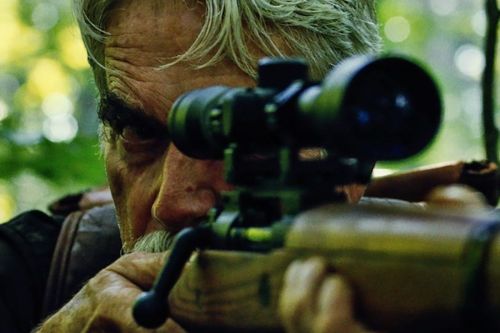
In fact, one cannot imagine “The Man Who Killed Hitler…” working without the presence of the 75-year-old Elliott, a white-haired warrior of such potent screen charisma that I would gladly watch him absentmindedly scratch his ass for 90 minutes.

We meet Calvin Barr in the late ’80s or early ’90s, occupying a bar stool in a tavern in the quaint Norman Rockwell-esque town he’s called his home for more than seven decades. Calvin is quiet and cryptic, a man who exudes a certain angst but would never talk about it.

Still, he’s obviously not your typical senior citizen.  He makes mincemeat of a trio of punks who try to hijack his car late one night.

The first 45 minutes of Krzykowski’s screenplay follow Calvin in both the present and the past, interspersing his unremarkable daily routine with flashbacks to his service in World War II. We see glimpses of young Calvin (Aiden Turner) being sent behind enemy lines disguised as a Nazi officer. His assignment is to put a bullet in Der Fuerher.

Other flashbacks take him to the pre-war years when he worked in a shop on Main Street and wooed a pretty school teacher (Caitlin FitzGerald); he was sent to war before they could wed or even consummate their affair. That loss will haunt him to his dying day.

Which could be soon. Forty-five minutes into the film our hero is paid a visit by a federal agent (Ron Livingston) who announces that Calvin’s country once again desperately needs his help.  It seems that an ever-widening area of  Canadian forest is being ravaged by a mysterious influenza that is being spread by none other than Bigfoot.

Blood tests have shown that Calvin is one of the few humans immune to the virus; now he’s being sent up North to stalk  the hairy creature: “If we cannot contain the beast, if we cannot destroy it and it escapes, this could be the end.”

I’ll say this about Krzykowski…whatever his talents as a filmmaker they are vastly surpassed by his abilities as a prognosticator.  Basically this film predicts the pandemic we’re now experiencing. Continue Reading »

Otamara Marrero, Sydney Sweeney

“CLEMENTINE” My rating: C+

90  minutes | No MPAA rating

There’s something to be said for an erotic slow burn.

“Clementine,” though, may burn too slowly for its own good.

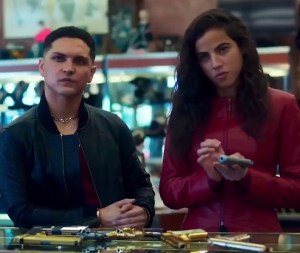
In the wake of her shattered relationship with an older woman, Karen (Otamara Marrero, a dead ringer for a young Rosario Dawson) flees Los Angeles and breaks into the Oregon lake home owned by her one-time paramour.

Her lover (played by Sonya Walger, though for most of the film we only hear her voice in phone conversations), a well-known artist, cheated on her;  that’s justification enough for the embittered Karen to smash a window and take up residence.

Her sojourn is interrupted by Lana (Sydney Sweeney), who claims to be 19 and says she lives on the other side of the lake.  Lana is an enticing/plerplexing blend of teen eroticism, youthful naïveté and percolating ulterior motives. About the only thing she says that can be trusted is her intense desire to become an actress; she’s already putting on a show.

Karen is intrigued but cautious…she doesn’t believe for a moment that the babyfaced Lana is a legal adult.

Stir into the cauldron a young handyman, Beau (Will Brittain), who looks after the place in the owner’s absence. Lana flirts with him while an irritated Karen looks on. Her mood is not  improved when she discovers that Beau has been sending reports back to her ex.

Continue Reading »

Lucas Jaye, Brian Dennehy

“DRIVEWAYS” My rating: B+

83 minutes | No MPAA rating

Andrew Ahn’s “Driveways” sneaks up on you.  Instead of wowing us with look-at-me style it quietly seduces us with its substance and deep appreciation for its characters.

That it also features  one of the last screen appearances of the late great Brian Dennehy only makes this gently emotional effort that much more affecting.

Single mom Kathy (Hong Chau) and her eight-year-old son Cody (Lucas Jaye) have driven for several days to settle the estate of Kathy’s sister Alice.  Upon arriving at Alice’s home (the film was shot in upstate New York) they discover  her dwelling crammed floor to ceiling with junk. Unbeknownst to Kathy, Alice was a serious hoarder.

The electricity has been turned off (there’s a back bill of $900). Oh, yeah…there’s also a dead cat decaying in the second-floor bathtub.

Instead of putting the house on the market and getting out of Dodge, the pair are stuck with a Herculean cleanup effort. They end up sleeping on a screened-in porch. Kathy spends every day hauling away the detritus of her sister’s life; Cody slowly gets to know Del (Dennehy), the semi-grumpy widower living next door.

Someone with a short attention span might argue that not all that much happens in Hannah Bos and Paul Thureen’s screenplay.  No, not much. Just life.

“Driveways” is less about plot than about its characters.  Chau’s Kathy is something of a tiger mom when it comes to protecting Cody, who suffers from the double whammy of being both incredibly sensitive (he throws up a lot) and way too smart to connect with other kids (his mother calls him “Professor”).

Which is not to say she’s that tough. After a few days of cleanup Kathy sneaks off to spend an hour or two in a local tavern. She just wants to feel like an adult for one evening.

Continue Reading »

Amber Havard, Rob Morgan

“BULL” My rating: B 

105 minutes | No MPAA rating

Fourteen-year-old Kris (Amber Havard) acts out.   A lot.

With her single mom in prison, Kris radiates abandonment and anger and quiet defiance.  She hangs with the older kids in her small town outside Houston, drinks and smokes.  And when she realizes that her neighbor Abe (Rob Morgan) spends most of his weekends on the road, she invites the other kids to party in his house, leaving the place a shambles.

After Abe returns to a trashed home, Kris’ grandma convinces the angry victim to not press charges. Instead the sullen teen will more or less become Abe’s slave, cleaning up the mess she made.

That’s how Kris learns that Abe is a former champion bull rider with countless mended bones and a drawer full of painkillers.  But he still makes a living on the rodeo circuit as a clown whose acrobatic antics keep angry bulls from stomping or goring their thrown riders.

To Kris this all looks like an exciting way of escaping her rut. There’s no reason why a girl can’t be a bull rider, right?

Most filmmakers would turn this plot into a heart-warming tale of forgiveness and renewed hope, a rodeo version of “The Karate Kid.”  Throw into the mix issues of race — Abe is black and Kris is white — and you can see “uplift” written all over it.

But writer/director Annie Silverstein isn’t having any of that crap. Her characters are too damaged for nice tidy resolutions and happy endings. Which somehow makes “Bull” all the more affecting.

Continue Reading »

Hugh Jackman, Allison Janney

“BAD EDUCATON” My rating: B 

108 minutes | TV-MA

In the world of public education Frank Tassone (Hugh Jackman) is a rock star.

The superintendent of the Roslyn School District in a posh corner of Long Island, Frank has over a decade ratcheted up his district’s reputation. Currently the high school he oversees is rated as the fourth best in the country; Frank promises his cheering fans that he won’t stop until Roslyn is Number One.

Moreover, Frank melds educational excellence with personal charisma. His wardrobe is right out of GQ. As are his daily ablutions. Like a veteran pol, he knows the names of innumerable students, their parents and civic supporters. He’s charming and selfless and handsome…small wonder this widower periodically must gently turn aside the romantic ministrations of newly divorced soccer moms.

His teachers and staff adore him and the city fathers are no less enthusiastic.  Like school board member Big Bob Spicer (Ray Romano), a real estate broker who knows that a top school district is a magnet for rich, upwardly mobile families looking to buy in the ‘burbs.

And behind closed doors with his confidants — especially business administrator Pamela Gluckin (Allison Janney) — he enjoys a good cussing session.

In short, Frank Tassone is too good to be true.  And you know where that can lead.

Scripted by Mike Makowsky (who was a Roslyn student during Tassone’s celebrated tenure) and directed by Cory Finley, “Bad Education” emerges as a black comedy so seductive that, like most of the folks in his orbit, we don’t want to believe that Frank Tassone could be anything but the white knight he appears to be.

Continue Reading »