Feeds:
Posts
Comments

Steve Coogan, John C. Reilly

“STAN & OLLIE”  My rating: B- 

97 minutes | MPAA rating: PG

An O.K. movie elevated by a pair of jaw-dropping lead performances, “Stan & Ollie” will be appreciated best by those already familiar with comic legends Stan Laurel and Oliver Hardy.

Which is what…six percent of the population?

Never mind. “Stan & Ollie” so perfectly channels the style of this great comedy duo that as soon as it’s over you’ll go to YouTube to check out the real thing. There many pleasures await.

Jon S. Baird’s film is a fact-based comedy centering on a 1953 tour of British music halls by Stan Laurel (the skinny Englishman) and Oliver Hardy (the obese Yank).  At the time they hadn’t worked together for almost two decades following Laurel’s expulsion from the Hal Roach Studio over demands for more money and control over their films.

In fact, Jeff Pope’s screenplay begins in 1937 with L (Steve Coogan) & H (John C. Reilly in an impressive fat suit and makeup) at work on their last film together. In one masterfully composed and executed tracking shot we follow the two stars from their dressing room through the bustling studio to a soundstage where boss Hal Roach (Danny Huston) awaits.

There Stan makes his demands, Roach fires him, and Oliver — who still has two years on his contract — must look for a new comedy partner if he’s to continue making a living.

All that is so much bad water under the bridge by the time 17 years later that Stan accepts an offer from a fly-by-night Brit promoter to tour England.  The idea is to prove to potential backers that L&H still are popular enough to warrant investing in their proposed film parody of the Robin Hood legend.

Initially, it doesn’t look good. The theaters and accomodations are crappy and the crowds thin. But Stan, the brains behind the outfit and a master promoter, signs on for enough public appearances at charity events, etc., that within a couple of weeks the two are playing to sold-out crowds.


Continue Reading »

“STUDIO 54” My rating: B- 

98 minutes | No MPAA rating

The notorious New York disco Studio 54 was in operation only for 33 months nearly 40 years ago.

Yet its reputation as the ultimate nightspot — a place one former patron describes as “Carefree. Hot. Sexy” — lives on. One comes away from  Matt Tyrnauer’s documentary convinced that there was never another disco to equal it, and that there never will be.

The main claim to fame of this particular doc is the on-screen presence of Ian Schrager, who co-founded Studio 54 along with his college buddy, the late Steve Rubell, and ended up serving prison time with Rubell on tax evasion charges. This is the first time in 40 years that Schrager — who has carved out a post-prison career as a developer of boutique hotels — has submitted to interviews about his experiences, and it provides Tyrnauer’s film with a unique perspective.

Schrader was always the silent partner, the guy largely responsible for designing the club with its elaborate lighting and set elements (a night at Studio 54 was like a Broadway production in which the customers were the cast). He allowed the flamboyant and, initially anyway, closeted Rubell to serve as the club’s host and good will ambassador.

A former customers attest, the essence of the club was celebrity and total freedom.  The owners tried to get famous people into the doors and keep out the ugly and uninteresting (though if you were ugly in an interesting way you had a good shot at  getting in).  A list handed out to employees described who would be comped (Keith Richards and Mick Jagger got in free) and who had to pay (all other members of the Rolling Stones).

But the club was weirdly egalitarian. Along with celebs and millionaires it welcomed drag queens, persons of color (as long as they had something interesting to offer) and folks whose main claim to fame was that they looked good.

Continue Reading »

Ah-in Yoo, Jong-weo Jun, Steven Yeun

“BURNING” My rating: B 

148 minutes | No MPAA rating

Class warfare, economic hardship, generational conflict and, who knows, maybe even a murder are the issues swirling around in  “Burning,” a film that seems in no hurry to get anywhere but in which, we realize much later, every moment counts.

Chang-Dong Lee’s drama — South Korea’s official nominee for this year’s Oscar for Foreign Language Film — centers on Jong-Su (Ah-in Yoo), a twenty something living on the economic edge in modern Seoul.  It’s not clear exactly how Jong-Su survives. We see the army veteran lugging bagged clothes around the streets, but whether his business is legit or not is never plumbed.

He’s schlepping his way through the day when he stumbles across Hae-Mi (Jong-Seo Jin), with whom he grew up in a rural farming community.  Hae-Mi is now employed as a sort of model; clad in a cheerleader outfit she hawks bargains on the sidewalk outside a department store.

She’s bouncy and adventurous and claims to be on a spiritual quest.  After bedding the bowled-over Jong-Su she asks him to feed her cat while she goes searching for inner truth in Africa.

Jong-Su agrees (he never sees the cat but the food bowl keeps emptying and the litter box keeps filling); moreover he uses his visits to Hae-Mi’s one-room apartment as an opportunity to masturbate.  He may not be a very demonstrative guy, but it’s pretty clear Jong-Su is smitten.

Which makes it all the worse when Hae-Mi returns from Kenya with a new guy in tow.  This is Ben (Steven Yeun, late of cable’s “Walking Dead”), who is clearly playing in another league.  Ben dresses well, drives an expensive sports car, seems utterly unimpressed by anything (at one point he claims never to have wept) and, when asked what he does, replies “I play.”

Jong-su, who wants to be a novelist (though we never see him writing), takes to calling this new acquaintance “the Great Gatsby.”

At least Ben lets the puppylove-tormented Jong-Su  hang out with him and Hae-Mi.  One one particular weekend the three party on Jong-Su’s rundown family farm (his divorced father is in jail after an altercation with a neighbor); during a marijuana-steeped evening Hae-Mi does a naked dance as the sun sets and Ben reveals to Jong-Su that his hobby is setting fire to the ugly plastic-draped greenhouses that litter the landscape.  Continue Reading »

Felicity Jones as Ruth Bader Ginsberg

“ON THE BASIS OF SEX” My rating: B

120 minutes | MPAA rating: PG-13

“RBG,” last year’s documentary about Supreme Court Justice Ruth Bader Ginsberg, was so encyclopedic and emotionally engaging that at first flush a fiction film based on the same material seems superfluous.

Of course, “RBG” didn’t feature an eager and mildly acrobatic bedroom encounter between the young Ruth and her husband Marty. So there’s that.

Directed by Mimi Leder, “On the Basis of Sex” concentrates on the early years of Ginsberg’s legal career and culminates with her arguing a landmark legal case that forced the government to end discrimination based on sex.

If the film follows a predictable David-vs-Goliath path, it is nevertheless informative, accurate (RBG has given it her stamp of approval) and inspiring.

And it succeeds in making its heroine wildly appealing not for her looks or her ability to elicit warm fuzzies but because of her towering intellect and fierce determination. A different kind of leading lady, indeed.

We join Ruth Bader Ginsberg (Felicity Jones) at the 1956 orientation session for Harvard Law School.  She’s one of only nine women in a class of 500; at a special luncheon for the ladies, the dean (Sam Waterston) asks each woman to explain why she deserves a slot that could have gone to a man.

Ooookay, then.

Ruth is clearly p.o.-ed by the numerous displays of chauvinism she encounters, but her style is to buckle down and beat the guys at their own game.  Which she does on a regular basis.

She’s supported in all this by her husband, Marty (Armie Hammer), on his way to becoming a wildly successful tax lawyer but more than happy to be the family’s cook and primary childcare provider while the Missus buckles down with the books.  Not only is Marty a good-natured saint, he looks (in this film, anyway) exactly like Armie Hammer.  The whole package. Which makes his early diagnosis of testicular cancer even more unsettling.

Like the documentary “RBG,” this film alternates between two aspects of its subject’s life. There’s the Ginsbergs’ personal story — by most accounts Marty and Ruth had one of the century’s great marriages. But not all is copacetic. Ruth is excoriated by her teenage daughter as “a bully…and she wants everyone to know how smart she is.”

Continue Reading »

Lois Robbins, Jonathan Rhys Meyers

“THE ASPERN PAPERS” My rating: D+ 

90 minutes | MPAA rating: R

Not even the presence of the iconic mother/daughter acting team of Vanessa Redgrave and Joely Richardson can salvage the sodden shipwreck that is “The Aspern Papers.”

Julian Landais’ film is only the latest dramatic incarnation of Henry James’ celebrated 1888 novella (there have been a half dozen previous adaptations), but it’s such a spectacular misfire that it should scare the smart money away from future versions.

In the 1880s an American scholar comes to Venice intent on researching the life of the famed poet Jeffrey Aspern, who died 60 years earlier leaving a couple of books of devastating verse and a beautiful corpse.  Our protagonist and  narrator, unnamed in the book but here calling himself Edward Sullivan, is portrayed by an abysmally miscast Jonathan Rhys Meyers at his creepiest.

“Edward” rents quarters in the crumbling villa of the money-strapped Madame Bordereau (Redgrave), who was Aspern’s lover back in the day. The old lady is a hard, utterly unsentimental case, but Edward sees an opening in her spinster niece, Tina (Richardson).  He gets to work insinuating himself into the women’s lives, courting  the lonely, shy Tina as a way of accessing Aspern’s personal papers, a veritable treasure trove he is certain Bordereau possesses.

Continue Reading »

The “family” at the center of “Shoplifters”

“SHOPLIFTERS” My rating: B+

121 minutes | MPAA rating: R

A study of an unconventional family and a stinging indictment of the modern Japanese economy, “Shoplifters” sneaks up quietly and leaves you heartbroken.

In the very first scene writer/director Hirokazu Koreeda (“After the Storm,” “Our Little Sister”) displays the film’s title in action. A father and son duo — Osamu (Lily Franky) and Shota (Jyo Kairi) — are cruising a grocery store. They appear absolutely unremarkable…Dad picks up various items, reads the labels; the curious  kid explores the place.

Thing is, little Shota is stuffing his clothing with that evening’s meal.  The pair return to their home — a rundown house overflowing with all manner of junk — and we meet the rest of the family:  Mom Nobuyo (Ando Sakura), big sister Aki (Matsuoka Mayu) and Grandma (Kiki Kirin).

Given the sticky-fingered antics of the opening scene, one might assume that this is nothing more than a family of crooks. But both Hirokazu and Nobuyo have backbreaking jobs that never pay enough to make ends meet.  The teenage Aki is a sex worker employed by a peep show.  Grandma contributes her monthly pension check.

The Japanese labor scene, evidently, pretty much guarantees that each day a working stiff is a bit poorer than the day before. Thus the petty crime.

Continue Reading »

Stephan James and Kiki Layne

“IF BEALE STREET COULD TALK” My rating: B+

119 minutes | MPAA rating: R

Barry Jenkins’ followup to “Moonlight” begins with a God’s-eye view of a young couple walking hand in hand.

This impossibly handsome pair are Tish (Kiki Layne), age 19, and Fonny (Stephan James), 20, African American New Yorkers in the early 1970s.  They’ve been friends since childhood, but are  thinking of taking their relationship to a new physical level.

“Are you ready for this?”

“I’ve been ready for this my whole life.”

“If Beale Street Could Talk,” based on the 1974 novel by James Baldwin (incredibly, the first of his many works to receive big-screen dramatization), is a deeply affecting love story. But that’s just the starting point.

Baldwin used the Tish/Fonny relationship and its many hurdles to comment on the place of black folk in America. The relationship of two young people in love is simultaneously an indictment of societal evil.

Jenkins’ screenplay, like the novel, centers on Fonny’s arrest on a trumped-up rape charge, a development that shatters the joy that otherwise would be unleashed by Tish’s revelation that she’s pregnant. The film’s time-jumping narrative zaps between the couple’s life together and their separation as Fonny awaits trial.

All this is told in a series of beautifully acted scenes that isolate key moments in the lives of the characters. One of these is a gathering of the couple’s families for the announcement of the pregnancy.

Tish’s parents, Sharon and Joseph (Regina King, Colman Domingo), are hugely supportive. So is Fonny’s garrulous father, Frank (Michael Beach).  But Fonny’s mother (Aunjanue Ellis) is a sanctimonious harpy who all but damns the baby in the womb and curses Tish for leading her boy astray.

Continue Reading »

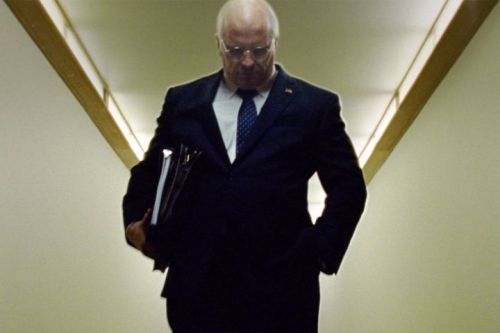
Christian Bale as Dick Cheney

“VICE” My rating: A- 

132 minutes | MPAA rating: R

In 2014 comedy writer/director Adam McKay (a longtime partner of Will Ferrell) gave us “The Big Short,” a look at the 2008 market meltdown that featured gonzo moments like Margot Robbie in a bubble bath explaining subprime mortgages.     “…Short” was nominated for best picture and took home the Oscar for screenplay adaptation.

It now is clear that “The Big Short” was a test run for the narrative techniques and off-the-wall attitude that come to full flower in “Vice,” an absolutely dazzling/incendiary screen bio of former Vice President Dick Cheney, the Darth Vader of the George W. Bush White House.

This funny/unnerving instant classic features a transformative Christian Bale (he might as well start clearing Oscar space on his mantel), a host of terrifically good supporting perfs from the likes of Amy Adams, Steve Carell and Sam Rockwell, and a seductive presentational style that’ll suck you in even if you hate the real Cheney’s guts.

An opening credit informs us that this is a true story, “or as true as it can be given that Dick Cheney is known as one of the most secretive leaders in history.  But we did our f**king best.”

In fact, writer/director McKay goes out of his way not to turn “Vice” into a ham-handed hatchet job.

For the film’s first half — as we watch Wyoming roustabout Dick (drinkin’, fightin’, D.W.I.s) straighten himself out for the woman he loves (Adams), start a family and dip his toe in the slipstream of Washington power-broking — you may find yourself admiring the kid’s drive and smarts.

By the film’s end — after Cheney has shanghaied the nation into a never-ending Middle Eastern war and done his level best to  legitimize torture — audiences will be wincing under the savagery of the McKay/Bale depiction of this consummate politician guided less by political principles than a Machiavellian appreciation of pure, raw power.

“Vice” does a pretty wonderful job of fleshing out and, yes, humanizing a potent figure who is described by one character here as “a ghost,” a man about whom most of us know nothing.

The film covers (in brief, arresting scenes) Chaney’s education under then-Rep. Donald Rumsfeld (Carell), who instilled in the kid a taste for the ruthless exertion of authority and brought him along when he joined the Nixon administration.

Eventually Cheny becomes the chief of staff to President Gerald Ford where he begins formulating the “unitary executive theory,” which maintains that the President, just because he is the President, can do pretty much anything he damn well wants.

Throughout this recitation we periodically  drop in on the Cheney clan, and it is as a family man that this Dick Cheney seems most human.  He’s lovable and playful with his girls; he and wife Lynne are ahead-of-their-time understanding when daughter Mary (Alison Pill) comes out as gay.

Repeatedly we see the big man — who has heart attacks with the kind of regularity more associated with heartburn — retreating to the relatively calm and harmony of a Wyoming trout stream. (Fishing becomes a metaphor for Cheney’s canny handling of friend and foe alike.)

Continue Reading »

Natalie Portman

“VOX LUX” My rating: B 

110 minutes | MPAA rating: R

One of the movies’ recurring themes — the pop/country/rock idol who makes great music despite (or perhaps because of)  personal demons — gets an innovative reworking in Brady Corbet’s “Vox Lux.”

The ever-surprising Natalie Portman is terrific as Celeste, a sort of musical mashup of Madonna, Gaga and especially Sia (who wrote the film’s original songs). But whereas those divas seem to more or less have their heads on straight, Celeste is always walking a fine line between musical brilliance and emotional meltdown.

Interestingly enough, Portman doesn’t appear on screen until halfway through the film.  Corbet’s screenplay opens with a horrific scene from Celeste’s youth — a school shooting that leaves our teen protagonist (Raffey Cassidy) with a bullet permanently imbedded in her neck (this explains her  collection of scar-hiding chokers).

Almost by accident, Celeste’s fame as a survivor of tragedy segues into a burgeoning career in music. Under the guidance of a savvy but fatherly manager (Jude Law) she begins recording songs with her older sister Eleanor (Stacy Martin) and touring the world. (The sisters have parents, yes, but they are seen only fleetingly.  Clearly, they’re not important to this yarn.)

Initially the girls behave like the good small-town Christians they are…but life in the fast lane takes its toll.  Celeste loses her virginity to the lead guitarist (Micheal Richardson) of a semi-psychedelic rock band.

Continue Reading »

Julia Roberts, Lucas Hedges

“BEN IS BACK” My rating: B

113 minutes | MPAA rating: R

Before it goes belly up in the third act, Peter Hedges’ “Ben Is Back” presents itself as one of the more insightful films about drug addiction.

Like that other contemporary drug drama, “Beautiful Boy,” this one focuses on the relationship between a parent and an addicted child. But whereas “Beautiful Boy” was presented from the POV of an adult, “Ben…” focuses heavily on the young user.

Indeed, Lucas Hedges (the writer/director’s son) is both heartbreaking and terrifying as the title character, who pops up at his family’s suburban New York home on Christmas Eve when he was supposed to be in rehab.

His mom, Holly (Julia Roberts), finds herself welcoming her long-lost son even as she scurries about emptying the medicine cabinets. She wants to believe Ben when he tells her that his drug counselor okayed this Christmas visit, but after thousands spent on recovery programs and repeated relapses, she’s not getting her hopes up.

Her first outing with her newly returned son takes them to the local cemetery, where she bluntly asks Ben where he wants to be buried.  Or does he prefer cremation?

Ben’s teenage sister Ivy (Kathryn Newton) is even more cynical. She as much as tells her brother that the family no longer needs his kind of trouble. (There are also a couple of very young step siblings, the result of Holly’s second marriage to Neal — played by Courtney B. Vance; his  deep pockets have financed Ben’s so-far-unsuccessful efforts to turn his life around.)

Still, Ben is so earnest and eager to please — playing with his stepbrother and stepsister, offering to do chores — that hearts melt a bit.

Hedges’ script is interesting in that it avoids actual drug use and the nuts and bolts of rehab, focusing instead on the human damage Ben has left behind.

Attending a local AA meeting, he meets a young woman to whom he used to sell drugs. She’s a wreck, and he feels at least partly responsible.

Continue Reading »