Few moviegoing experiences are as disheartening as the film that aspires to the whimsical and charming but instead falls flat on its boring face.
Welcome to “Christopher Robin,” Disney’s ill-conceived live-action (mostly) fantasy about the adult life of the little boy who used to play with Pooh, Piglet and the other animals in the Hundred Acre Woods.
Unlike last year’s “Goodbye Christopher Robin,” which was a loose biography of Pooh creator A.A. Milne and his son, Christopher Robin Milne, this new effort from director Marc Forster unfolds in an alternative universe in which Milne and the Pooh books don’t exist (although the movie opens with animated versions of the famous book illustrations by E.H. Shepard…so you can be forgiven if you’re confused).
In a prologue little Christopher Robin (his first name is Christopher, his last Robin) says goodbye to his toy companions as he prepares for boarding school. Pooh and the others — rendered in what appears to be a combination of puppetry and computer effects — are left behind to mourn the loss of their human friend.
In a montage we see the grown Christopher Robin (Ewan McGregor) meet and marry Evelyn (Hayley Atwell), go off to World War II and become a father to young Madeline (Bronte Carmichael). By now he’s all but forgotten his childhood companions; he’s up to his neck in troubles as a middle manager at a London luggage company on the verge of bankruptcy. Christopher is so consumed by business woes that he’s alienating his wife and child.
And then one day — tah DAH — Pooh uses a magic portal (in a tree) to come to London to look for his old friend. The harried businessman spends a day back in the Hundred Acre Woods, slowly getting back in touch with his childhood self.
Middle school means isolation, mortification and general angst. Such was the case even before cell phones and the internet upped the ante on peer pressure.
Bo Burnham’s “Eighth Grade” perfectly captures that indefinable sense of adolescent unease. You may find yourself looking away from the screen as his 14-year-old heroine undergoes yet another wince-inducing humiliation. This film is so true in its harrowing honesty, so aching in its inarticulate yearning that it is almost too much to bear.
But stick with it. With its savagely dead-on sense of humor, its unflinching depiction of pubescent peril and a star-making performance by young Elsie Fisher, the film slowly sucks us in, leaving us wiser, more sympathetic and superbly entertained.
The film follows Kayla (Fisher), a 14-year-old enduring her last week of eighth grade before summer break. She wants desperately to be somebody — from her bedroom she launches a chirpy daily videocast (“Hi, guys, it’s Kayla back with another video!?”) in which she dispenses advice to her fellow 8th graders. She suspects, though, that nobody is watching.
And there’s more than a little irony when she tells her possibly nonexistent viewers that it’s important to be themselves. As if she has a clue as to her own essence.
It’s not that the other kids are mean to Kayla. Most of them — like the deb-in-training Kennedy (Catherine Oliviere) — don’t even acknowledge her existence. That anonymity is both infuriating and suffocating.
All this has made Kayla a very prickly young lady, and she takes out most of her anger and anxiety on her single dad (Josh Hamilton), a chipper optimist whose transparent efforts to instill in his daughter hope and self-worth only fill her with eye-rolling contempt.
For his feature writing/directing debut Elijah Bynum has assembled an impressive cast (including “Call Me By Your Name’s” Oscar-nominated Timothy Chalamet) and delivered a stylish and great-looking movie.
Too bad it can’t overcome the script’s near-fatal shortcomings.
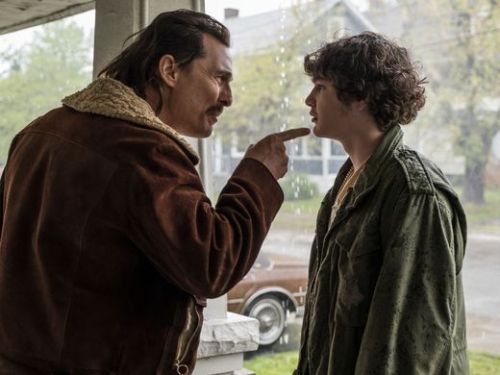
Basically this is a coming-of-age story, but while most such efforts mine the lighthearted and comedic, “Hot Summer…” veers into serious, even deadly territory.
Daniel (Chalamet) is a grumpy teen whose single mom sends him off to spend the summer with a (unseen) relative on Cape Cod. There the kid is exposed to the dual worlds of the rich vacationing “summer birds” and the blue collar townies.
Almost from the first frame Bynum announces he’s going to push the envelope. The opening sequences are narrated by a 13-year-old boy (we never get his name) who lives year-round on the Cape and describes (“I can’t swear to every last detail…”) how this particular summer (1991) saw the birth of a local legend.
Early on Daniel falls under the influence of Hunter Strawberry (Alex Roe), a sort of James Dean-ish heartthrob who wears a black leather jacket on hot summer days and still manages to look cool.
Hunter is a shady but charismatic character whom the local kids believe to have committed a murder (we get a montage of talking-head youngsters attesting to his awesomeness). That claim seems doubtful, but the local law certainly would love to nail him for peddling weed to the summer birds.
Hunter and Daniel contract with Dex, a local marijuana wholesaler (Emory Cohen), to distribute ever-bigger shipments of grass. Daniel is the instigator of this rapid expansion; he has cousins all over the East Coast who become his ground-level dealers.
Pretty soon Daniel and Hunter are rolling in green.
The latest “Mission: Impossible” is being hyped as possibly the greatest action film of all time.
Well, there’s no arguing that “Fallout” has some of the best conceived and executed action sequences ever, with star Tom Cruise appearing to risk life and limb to deliver the thrills audiences expect. (Of course, in this age of seamless CGI moviegoers can’t even be sure that a simple sunset is the real deal. Probably best to take the Cruise heroics with a grain of salt.)
Here’s the downside. In his effort to deliver bigger, better stunts (he’d already set the bar impossibly high with 2015’s “Mission: Impossible: Rogue Nation”) writer/director Christopher McQuarrie has jettisoned just about every other dramatic element.
Character development? Hah.
Coherent plotting? You need a flow chart and a PowerPoint demonstration to make sense of it all.
Emotional content? Gimme a break.
No, this latest “M:I” is essentially a perpetual motion machine careening from one splashy sequence to the next. The connective material — the moments when the film slows down enough to explain what’s going on or to establish who’s who — is actually kind of irritating. It’s like being told to eat your peas before you can have some ice cream.
“DON’T WORRY, HE WON’T GET FAR ON FOOT” My rating: B
114 minutes | MPAA rating: R
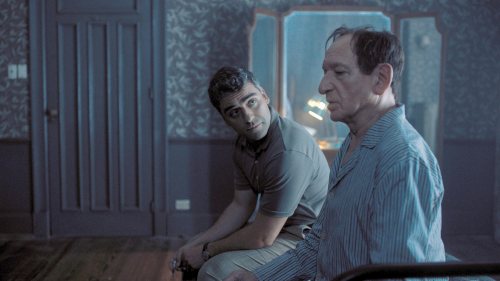
In “Don’t Worry, He Won’t Get Far on Foot” a seemingly hopeless alcoholic turns his life around after a car crash leaves him a quadriplegic.
Is it churlish of me to admit that I actually prefer the first part of the film — the drunken, obnoxious, grotesquely guzzling part — over the uplifting recovery-through-AA second half?
Gus Van Sant’s latest feature is the fact-based story of John Callahan, who with the one hand he could still partly control drew some of the blackest, funniest cartoons ever printed. The film’s title, in fact, is the caption of one of his scandalous creations: A posse of cowboys on horseback come across an empty wheelchair in the desert. “Don’t worry,” says the sheriff in charge, “he won’t get far on foot.”
Callahan, who died in 2010 at age 51, is portrayed by Joaquin Phoenix as a reprehensible asshole who — perhaps because of his traumatic infirmity — slowly discovers his own humanity and self-worth.
Certainly his pre-accident life was nothing to be proud of. A native of the Portland area, Callahan worked manual labor and spent every recreational hour sucking down the booze. The film suggests that at least part of his problem was that he was abandoned as a child by his mother — evidently an unmarried Roman Catholic girl who gave up her baby to the nuns. It was a betrayal that Callahan never got over…or perhaps he was just looking for an excuse for his destructive behavior.
He was also sexually abused as a child, although the film makes no mention of that.
Without actually showing the crash, Van Sant and his co-writers (Jack Gibson and William Andrew Eatman, adapting Callahan’s memoir) depict a day of furious barhopping by Callahan and his newfound drinking buddy Dexter (Jack Black). Rarely has unfettered, dedicated, puke-your-guts-out boozing been captured with such gleeful intensity. It’s appalling, certainly, but also weirdly attractive.
Callahan wakes up in an ER where an not-particularly-sympathetic MD gives him the bad news. He’ll probably never feel anything below the neck.
After months of rehab Callahan is introduced to a motorized wheelchair…which means he can now drive himself to the liquor store and pick up where he left off. Granted, it’s frustrating trying to rest a bottle in the elbow of one arm while using your only mobile hand to twist off the cap…but a guy’s gotta do what a guy’s gotta do.
There’s a manic, almost Keystone Kops intensity to Callahan’s use of his motorized wheelchair, which he drives at daredevil velocity, weaving in and out of street traffic. Now and then he overturns this mini-dune buggy and must be lifted back into the seat by a passerby. Even after getting clean, it’s obvious that he needs some sort of addiction…now speed has replaced alcohol as his drug of choice.
And few films are better at showing us than “Leave No Trace,” Debra Granik’s second feature (after 2010’s flabbergastingly good “Winter’s Bone”).
There’s little dialogue in this film, and most of that is of a matter-of-fact nature. Situations that other movies would take pains to explain here go unaddressed.
But far from diminishing the experience, this oral reticence makes “Leave No Trace” a rewardingly rich viewing experience. Nobody tells us what’s going on; we simply watch…and then we know.
As the film begins 15-year-old Tom (Thomasin McKenzie) and her father Will (Ben Foster) appear to be on a camping trip. They’re foraging for food, cooking over a campfire, sleeping under a tarp.
But at certain points Will announces that they’re having a drill. Dropping everything, Tom races into the thick forest undergrowth. If her father can find her, she’s flunked.
Clearly, this is no suburban father and daughter on a weekend retreat. The two are living in the woods, evading hikers and a groundskeeping crew of prison convicts. Periodically they go into town — they’re squatting in a park just outside Portland — where Will picks up his cocktail of psychotropic drugs from the V.A. and resells them to other veterans in a hobo town.
How did father and daughter end up hiding out in the woods? What happened to Tom’s mother? What is the nature of Will’s mental illness? (A big clue is the way he involuntarily flinches whenever he hears a helicopter.) And is he dangerous?
The screenplay by Granik and regular collaborator Anne Rossellini (based on Peter Rock’s novel My Abandonment) lets those questions hang. But no worries…everything we need to know about these fugitives is there if we pay attention.
What if you learned — as an adult — that you were one of three identical triplets? What if you could not only meet your long-lost siblings but become part of their lives?
Pretty neat, huh?
At first, yeah. But Tim Wardle’s doc “Three Identical Strangers” moves inexorably from “Gee wiz” to “Oh, shit.”
It begins with Bobby Shafran, now in his mid-50s, relating how he went off to college in 1980 and was surprised at how friendly everybody was. Total strangers patted him on the back and gave him the high five. Girls he didn’t know walked up and hugged him.
People he’d never met called him Eddy.
Turns out Bobby had a doppleganger, a guy who looked exactly like him and had attended classes a year earlier before dropping out. This guy, Eddy, was beloved by one and all. Bobby drove two hours to meet him.
“As I reach out to knock on the door, it opens, and there I am,” he tells us.
Eddy Galland was more than Bobby’s lookalike. Comparing notes they realized they had the same birthday. Both young men had been raised by adoptive parents who got them through the same Jewish adoption agency.
Newspaper reports followed…and the revelation that there was a third brother, David Kellman.
“Oh, my God, they’re coming out of the woodwork!” said one of the stunned adoptive mothers.
Not only did the brothers look exactly alike, they moved the same way, smoked the same brand of cigs (Marlboro), had identical tastes in music and women.
They became celebs, opened a trendy SoHo restaurant called Triplets, and were party hearty regulars at Studio 54 and other ’80s hot spots.
Great story, huh?
Don’t get too comfortable. As it unfolds “Three Identical Strangers” reveals a psychological experiment worthy of Dr. Mengele.
This shadowy long-term study, put into motion before the boys were born and terminated only with the publicity surrounding their unexpected reunion, apparently was meant to answer the question of whether we are driven more by genetics or by our individual upbringings.
To make it happen the researchers deliberately broke up newborn triplets and twins (the official explanation was that it was difficult to find adoptive parents for twins, much less triplets). Moreover, the boys each were placed in a family that already had an adopted daughter. (Why? Don’t know.) Their parents were not told that their new adopted sons were part of a multiple birth, although they agreed that the children would undergo periodic mental and physical testing.
The perfidies get even more ghastly when it’s revealed — thanks largely to an investigation by Pulitzer Prize-winning journalist Lawrence Wright –that the boys’ birth mother had mental issues. All three had troubled childhoods that required psychiatric counseling. Could they have inherited a form of manic depression?
What the hell was going on here?
“Three Identical Strangers” raises plenty of issues but cannot come up with many answers. All the research done in the study was given to Yale University with the understanding that it not be made public until 2066, by which time all the subjects would be dead. A final credit tells us that because of publicity surrounding the making of the documentary, the brothers finally are receiving some heavily redacted material from the archive.
What makes Wardle’s film so compelling is not just that it’s a fantastic story and an intriguing mystery, but that it raises profound issues, not only about medical ethics but about what makes us who we are. The boys were placed with three very different families — blue collar, middle class, elite — in order, it seems, to see how those environments might shape them.
The ways in which their three worlds either supported or undermined them, combined with their shared genetic inheritance, make for so some pretty deep thinking.
“…Identical Strangers” starts out as a romp. Before it’s over it has become a lamentation.
Brit actress Andrea Riseborough is a human chameleon.
She played Michael Keaton’s actress girlfriend in “Birdman,” Billy Jean King’s hairdresser and lesbian lover in “Battle of the Sexes,” and Joseph Stalin’s daughter Svetlana in “Death of Stalin.” In each of these supporting roles she was hard to recognize as the same actress.
Now Riseborough gets a leading role and, not unexpectedly, nails it.
In the title role of Christina Choe’s “Nancy” she delivers a performance that is simultaneously heartbreaking and scary.
Nancy is a pale, mop-headed weirdo who lives with her demanding invalid mother (Ann Dowd). More accurately, she lives on the Internet, always peering into her cel phone or computer screen.
A social misfit, Nancy only really feels like a person when she assumes a false identity and goes trolling for new friends/victims. One such individual is Jeb (John Leguizamo), whom she met on a site for parents mourning dead children. They arrange a face-to-face and Nancy (he knows her as Rebecca) shows up heavily padded to give the impression that she’s pregnant. Creepy.
She works as a temp, showing the other employees at a dental clinic faked photographs of herself touring North Korea.
When Mom dies Nancy is left to her own devices. She catches a TV news report about a couple whose little girl Brooke vanished 30 years ago. Forensic cops have used age progression software to create a “photo” of what the missing child would look like today…and Nancy is floored: “It’s like looking into a mirror.”
A harried mom, an eccentric child, and a scurrillous grandpa go on a road trip.
Stop me if you’ve heard this one.
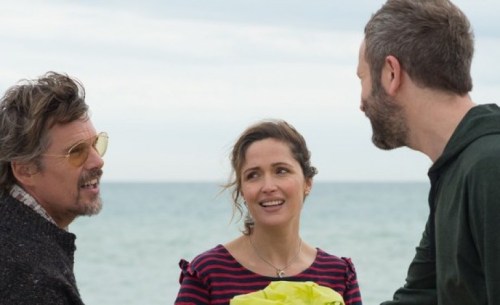
One could argue that “Boundaries,” Shana Feste’s peripatetic comedy, has most everything it needs — save for originality. Despite an exceedingly strong cast there’s an aura of been-there-done-that hanging over the enterprise.
We meet Seattle mom and party planner Laura Jaconi (Vera Farming) at her weekly visit to the shrink. She’s smart enough to recognize the forces that make her life a comedy of errors, but not smart enough to overcome them.
There are two sources for Laura’s predicament. First there’s her son Henry (Lewis McDougall), a geeky middle schooler who compensates for his outsider status by drawing nude portraits (from his imagination) of the people in his life. Henry is miserable at his public school and Laura wants to send him to a private operation… but that will take a lot of money.
Then there’s her octogenarian father, Jack (Christopher Plummer), who is being thrown out of his retirement community for secretly operating a marijuana growing business on the premises.
Basically Laura is saddled with two adolescents.
Arrangements are made to move Jack to the Los Angeles home of his youngest daughter, JoJo (Kristen Schaal). But the old man insists that they travel by car. Laura reluctantly agrees, unaware that the old coot has filled the trunk with weed. This will be his last delivery run to his long-time customers.
“Sicario” was one of 2015’s best films, a (mostly) South of the Border crime drama which posited that the war on drugs is not only unwinnable but destined to make the U.S. as complicit in evil as the cartels.
Also, it starred Emily Blunt (always a welcome thing) as an F.B.I. agent who discovers the hard way that in this conflict there are no good guys.
The Blunt-less “Sicario: Day of the Soldado” is a step down from the original (this was pretty much inevitable); nevertheless it works reasonably well as a high-tension crime thriller.
Scripted once again by Taylor Sheridan (“Wind River,” “Hell or High Water”) and directed this time around by Stefano Solima (the Italian TV crime drama “Gomorrah”), this entry reunites Josh Brolin and Benicio Del Toro as, respectively, CIA operative Matt Graver and his right-hand man, former cartel hitman Alejandro.
This time we don’t have to discover through a principled heroine that our government is willing to do all sorts of unpalatable things to secure our safety. Truth is, just about every character in the film is outright evil or seriously compromised.
Early on, Islamic terrorists blow up a big box store in Kansas City; the feds determine that the suicide bombers entered the U.S. as illegal immigrants crossing the Rio Grande, guided by underlings of the Reyes drug cartel.
Graver and Alejandro are assigned to start a war among the various cartels through a series of assassinations. They also set in motion a plan to kidnap Isabel Reyes (Isabela Moner), the teen daughter of the Reyes cartel’s leader.
Of course this skullduggery is off the books; the government bigwigs who order the mission (Catherine Keener, Matthew Modine) are all about deniability and any member of the team is expendable if it means keeping a lid on things.