Feeds:
Posts
Comments

Itzhak Perlman

“ITZHAK” My rating: B 

82 minutes | No MPAA rating

Less a biography than a personality study, “Itzhak” follows violinist Itzhak Perlman over several weeks.

For a classical music genius, he appears to be a pretty relatable guy.

When we first see him he’s navigating  a motorized scooter through the bowels of Shea Stadium (a polio victim, he can walk only with crutches). He’s wearing a Mets jersey and preparing to play the national anthem before the game.

Perlman appears to be as giddy about being among athletes as a 12-year-old kid. In fact, the Israeli-born musician is a baseball geek.

Joy and enthusiasm radiate from this film, largely because director Alison Chernick has such an overwhelmingly charismatic subject.  While the film does employ archival footage (like the 14-year-old Perlman’s American TV debut on Ed Sullivan’s Sunday night show) and a few instances of talking-head reportage, the film mostly eavesdrops on the man as he goes about the business of both music and life.

Very nearly as important to the film as Perlman is his wife, Toby, an adorably energetic and enthusiastic individual who admits that she proposed to her future husband.  They appear to be intellectual equals whose mutual fondness cannot be shaken even by rigorous criticism (Toby has no qualms about picking at performances which aren’t up to the high bar Itzhak has set for himself).

Whether sitting in with Billy Joel’s band or trading childhood stories with old friends, riveting audiences in the concert hall or holding a master class for young players, Perlman comes off as utterly approachable, friendly and pleased (not smug) when it comes to his life.

We should all be so lucky.

| Robert W. Butler

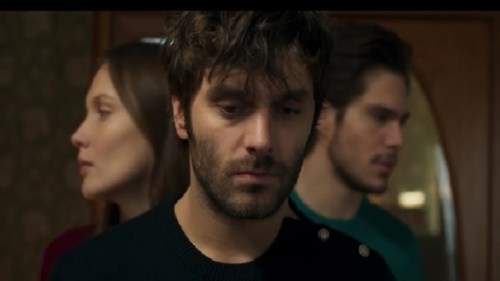
Ana Giradot, Pio Marmari, Francois Civil

“BACK TO BURGUNDY” My rating: B

113 minutes | No MPAA rating

The opening credits  of “Back to Burgundy” are so seductive that the rest of Cedric Klapisch’s latest film could be a mere afterthought.

Employing time-lapse photography (the gorgeous cinematography is by Alexis Kavyrchine), this sequence depicts scenes from a French vineyard as the seasons change.  It’s a knockout.

And despite some narrative speed bumps, the rest of the film is, too.

With his father dying, Jean (Pio Marmari) at last returns to the vineyard he fled a decade ago to travel the world.  He is greeted — with varying degrees of open arms and resentment — by his siblings. Juliette (Ana Giradot) is the family peace maker; Jeremie (Francois Civil) bitterly resents that Jean never came to their mother’s funeral four years earlier.

Papa’s will makes the three joint owners of the vineyard, meaning they must all agree on any financial transactions. The immediate problem is that to satisfy a huge  inheritance tax bill they probably will have to sell some or all of their land. The three will have just enough time to bring in one more harvest before making a decision.

On one level “Back to Burgundy” is practically a docudrama about wine production. Klapisch filmed over an entire year so as to record the seasonal  changes, and audiences will quickly catch on that wine production is not an exact science.

Inextricably tied to weather and moon cycles, a year’s harvest is basically a massive gamble based on chemistry, collected experience and guesswork. It gets even more complicated when several different grape varieties are involved, all planted in different locales, each with its own specific mini-climate.

One of the film’s most compelling sequences depicts the harvest, with dozens of young people showing up to pick the grapes over several weeks under (usually) sunny skies. The experience is topped off with an all-night going-away party fueled by wines from the vineyard’s  earlier harvests. There is much carousing, singing and snogging.

It’s all so damn romantic and appealing (Klapsich has displayed in films like “L’Auberge Espagnol” and “Russian Dolls” a knack for depicting handsome young people) that one is tempted to drop everything and sign up for a grape harvest. (Like canoe trips and trail rides, this is probably an undertaking more pleasurable in the contemplation than the actual participation.)

Continue Reading »

Yonaton Shiray

“FOXTROT” My rating: B+

108 minutes | MPAA rating: R

The Israeli film “Foxtrot” already has earned the condemnation of that country’s military for depicting an army coverup of civilian Arab deaths.

As is often the case when the military mind attempts to wrap itself around art, the authorities fail to grasp what’s really at stake.

“Foxtrot” is nothing less than an artful, absurdist and on some levels frustrating dissection of life in a paramilitary state in which the average citizen can feel besieged.  Whether it plays fair in depicting the actions of the Israeli army is impossible to say.  But the film is riveting for the emotional no-man’s land it explores.

It comes by its anxiety honestly. “Foxtrot” was inspired by a moment from writer/director Samuel Maoz’s own life.  Two decades ago after a family spat Maoz ordered his teenage daughter to take a public bus instead of a cab to school. When the bus line was hit by a suicide bomber, the filmmaker spent several agonizing hours before learning his child was on a different bus and safe.

So deeply was Maoz moved by the incident that 20 years later it inspired this film.

(B.T.W.:  Maoz frequently draws his films from his own life. His 2010 feature “Lebanon” was based on his own service in the Israeli army during the 1982 Lebanon war, and was told entirely from the POV of a gunner in a tank — precisely Maoz’s duty.)

Essentially “Foxtrot” is a tale told in three 30-minute segments.

In the first a knock on the door is answered by a middle-aged woman, Daphna Feldmann (Sarah Adler), who takes one look at the army officers standing in the hallway and, instantly understanding that they bring terrible news, screams and falls in a dead faint. (Behind her is a large abstract drawing/painting that looks like some visual manifestation of chaos theory…it won’t be the first time Moaz employs carefully designed physical settings or eerie overhead shots to reveal the inner state of his characters.)

In the next room her husband Michael (Lior Ashkenazi) sits stunned as the soldiers give his fallen wife a shot of sedative and carry her off to the bedroom.  They inform Michael that the couple’s son Jonathan has died while serving his country. They advise him to stay hydrated; periodically he’ll be texted reminders to drink a glass of water. (Clearly, the army has distilled this awful duty down to a cool, unemotional routine.)

All this unfolds with the camera zeroed in on Michael’s features…we only hear the soldier’s voices.

Soon the befuddled, shattered Michael is joined by his brother Avigdor (Yehudi Almagro), who offers to contact their relations. A young rabbi serving as an army chaplain explains the details of Jonathan’s impending military funeral. It’s all very official and remote.  There’s also an uncomfortable visit to Michael’s imperious and borderline senile mother to deliver the  bad news.

Throughout all this Michael’s anguish mutates into anger.  He demands to see Jonathan’s body; the authorities want a closed casket, and Michael  accuses them of putting rocks in the coffin instead of a corpse.  Continue Reading »

Charlie Plummer

“LEAN ON PETE” My rating: B+

121 minutes | MPAA rating: R

“Lean on Pete” will leave audiences emotionally wrecked.

This despite the miscasting of a couple of key roles.

At first glance the latest from Brit writer/director Andrew Haig (“45 Years,” “Weekend”)  may look like a-boy-and-his-horse story.  But no.  The equine Pete of the title is less a character than a symbol of everything that the movie’s young human protagonist lacks.

When we meet Charley (Charlie Plummer, last seen as John Paul Getty II in “All the Money in the World”) he’s living in borderline poverty with his loving but generally hapless father Ray (Travis Fimmel). Early on they discuss Ray’s latest squeeze over a breakfast of Fruit Loops (which are kept in the fridge to frustrate the roaches).

Charley: “I like her better than Marlene.”

Ray: “Marlene was smart for a stripper.”

Virtually by accident Charley falls in with Del (Steve Buscemi), who might best be described as a used car salesman of the horse set.  Del has a small stable of nags he runs at nickel-and-dime tracks around the Pacific Northwest. He puts Charley to work grooming the exercising the animals, and the kid soon picks up that Del isn’t above scamming or cheating to make a buck, leading occasionally to quick dead-of-night getaways.

Still, the kid loves working with the  horses, especially the aging Lean On Pete, who becomes  his personal favorite.

“You can’t think of them as pets,” warns Bonnie (Chloe Savigny), the young woman who is Del’s in-house jockey. “They’re here to race and nothing else.”

Indeed, Del is no sentimentalist when it comes time to cull the herd.  Thus when Charley, already reeling from a tragedy at home, learns that Lean on Pete is “going to Mexico” — Delspeak for being sold to the glue factory — the kid puts the horse in a trailer, revs up Del’s junker pickup truck, and heads out for parts unknown. Continue Reading »

Geoffrey Rush, Armie Hammer

“FINAL PORTRAIT” My rating: B 

90 minutes | MPAA rating: R

Genius marches to its own drummer, expecting mere mortals to keep time. And if we can’t maintain the pace, genius will  blithely leave us behind.

Stanley Tucci’s droll “Final Portrait” depicts a real-life encounter between genius in the form of artist Alberto Giacometti and a young man whose idol worship will come back to bite him in the posterior.

Based on James Lord’s 1965 memoir A Giacometti Portrait, the terse film, punctuated by deadpan comedic moments, depicts a 1964  incident in which Lord, an American journalist who often wrote about the art scene, agreed to pose for Giacometti in his Paris studio.  At the time the artist — known worldwide for his elongated sculptures — was concentrating on painting.

Lord is played by Armie Hammer as a handsome but bland young man, probably gay, who jumps at the chance to spent time in the presence of greatness. Giacometti, portrayed with rumpled self-absorption by Geoffrey Rush, says the sittings will take only a couple of days.

Maybe he honestly believes that. In any case, the three-day sitting turns into a three-week slog, with Lord dutifully showing up every day to sit while Giacometti paints, chain smokes, curses, repeatedly starts over and finds numerous opportunities to lay down his brush for alcoholic and sexual diversions. What started out as an art fan’s thrill turns into an existential dilemma.

Time after time Lord must cancel the plane tickets for his return to New York. He detects a recurring pattern in the artist’s  reluctance — refusal even — to finish a work, and begins playing mind games to nudge Giacometti toward completing the portrait.

All this unfolds in the artist’s studio, a cellar-like dustbin right out of “La Boheme” filmed in desaturated hues that cloak everything save human flesh in a gray pall.

And there are other players here. Like Giacometti’s brother Diego (Tony Shalhoub, almost unrecognizable), an artist in his own right who spends most of his time puttering around the edges of his older sibling’s environment and vaguely commiserating with Lord.

There’s Mrs. Giocametti (Sylvie Testud), who is not thrilled that her husband has become so obsessed with a local prostitute (Clemence Poesy) that he buys her a spiffy sports car.


Continue Reading »

Joaquin Phoenix

“YOU WERE NEVER REALLY HERE”  My rating: B- 

89 minutes | MPAA rating: R

A brutal character study encased in an overripe — some might say rancid — melodrama, Lynne Ramsay’s “You Were Never Really There” offers Joaquin Phoenix at his moodiest.

Depending upon your point of view, that will be either a warning or an enticement.

When we first meet Joe (Phoenix) he’s cleaning up a hotel room where something very nasty has occurred.  He’s wrapping a bloody hammer in plastic and rinsing gory items in the bathroom sink.  There are also insert shots of someone — it’s hard to say just who — struggling to breathe with their head wrapped in a plastic dry cleaning bag.

Joe — who has the graying beard and long hair of a ’60s Jesus freak and seems to be about 50 pounds overweight — is not, as you might think, a serial killer.  Nor is he a hit man, exactly.

His specialty is retrieving lost children — kids who have been snatched or sold into sex slavery. It’s hard to say whether he’s in it for the money, for the sake of the kids, or because it gives him a good excuse to go Neanderthal on some really despicable people.

Job completed and fee collected, he shuffles off to the Bronx house he shares with his invalid mother (Judith Roberts), with whom he shares a love/hate relationship.  There are moments of genuine  tenderness here.  There are also flashbacks to Joe’s tormented childhood; apparently he spent lots of time locked in a closet while Mom entertained.

Other brief blips from Joe’s past reveal him to be a veteran who fought somewhere in the Mideast. Continue Reading »

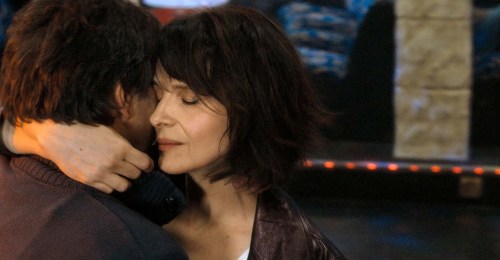
Diane Krueger

“IN THE FADE”  My rating: B+

106 minutes | MPAA rating: R

“In the Fade” may get a bit fuzzy around the edges, but its center is as solid as an anvil.

German actress Diane Kruger is utterly compelling  in writer/director Fatih Akin’s  tale of a woman attempting to come to terms with the terrorist killing of her husband and son. Even when the film threatens to bog down in courtroom cliches, Krueger’s fierce/fragile performance holds us in its grasp.

Small wonder the role won her best actress honors at last spring’s Cannes Film Festival. (“In the Fade” also won a Golden Globe as best foreign language film, which raises the question of why it hasn’t gotten a theatrical run here in Kansas City…but that’s another story.)

The picture begins with cellphone footage of the German prison wedding of convicted drug dealer  Nuri (Numan Acar) to party-girl hottie Katja (Kruger).

It then cuts to the couple’s post-prison life.  Years later we find them blissfully wed,  parents to six-year-old son Rocco (Rafael Santana), and operating a thriving small business in Homburg. Nuri’s criminal past is a distant memory. They appear to be model citizens. Continue Reading »

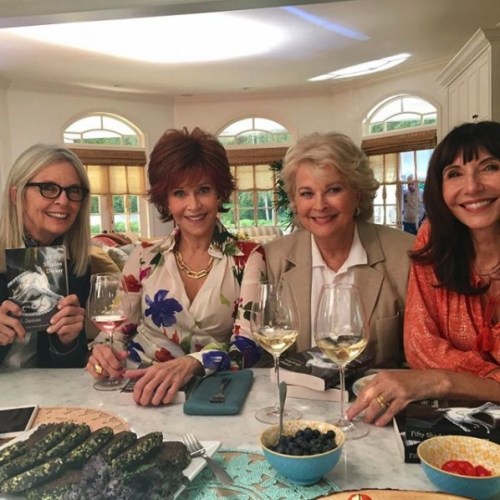
Celia Imrie, Imelda Staunton

“FINDING YOUR FEET” My rating: C 

111 minutes | MPAA rating: PG-13

I won’t say I hated “Finding Your Feet,”  the most recent in a string of films (“The Best Exotic Marigold Hotel,” “I’ll See You in My Dreams,” “The Hero”) depicting love amongst the geriatric set.

But I just barely tolerated it.

Despite a solid cast of veteran British thesps — Imelda Staunton, Timothy Spall, Celia Imrie, Joanna Lumley, David Hayman, John  Sessions — the latest film from director Richard Loncraine (“Brimstone & Treacle,” “Richard III,” “My House in Umbria”) shamelessly panders to its blue-haired target audience. In its own way it’s as derivative and contrived as a Frankie and Annette beach party movie — except you don’t want to see this cast in bikinis.

Sandra (Staunton) is stunned to discover that Mike, her titled husband of 40 years, has been having an affair for nearly that entire time. So it’s splitsville, not only from Mike but from Sandra’s privileged, cash-intensive (and politically conservative) lifestyle.

On the rebound she washes up at the door of her estranged sister, Bif (Imrie), a septuagenarian hippie whose life of adventure and close friendships are diametrically opposed to Sandra’s stunted outlook.

Continue Reading »

Bel Powley

“WILDING” My rating: C 

92 minutes | MPAA rating: R

Before it bogs down in overcooked horror film cheese, Fritz Bohm’s “The Wildling” pulls a clever narrative con job on its audience.

It’s one of those cases where you’re pretty sure of what the movie’s about until you realize you have it all wrong.

In a prequel Daddy (Brad Dourif) tends to his precious little girl, Anna. Except that there’s something odd going on here…Anna is never allowed to leave  her room and Daddy fills her with tales of the evil Wildling that lives in the woods outside their home and would like nothing better than to snatch and eat such a delightful child.

So, yeah, the kid grows up weird.  When Anna hits puberty Daddy starts giving her daily injections apparently meant to retard menstruation and other signs of maturation.

And then one day Daddy puts a gun to his head and BLAM. It’s pretty clear that he snatched Anna as a young girl and raised her in secret. Now he’s overcome by regret.

Discovered by neighbors who heard the shot, young Anna — now a young woman played by Bel Powley — is rescued by the authorities. The local chief of police, Ellen Cooper (Liv Tyler), takes the mysterious and befuddled girl (she’s never been outside her bedroom) into her own home with the intention of filing for full custody.

The sheriff’s  younger brother, Lawrence (Mike Faist), lives with them and befriends Anna, attempting  to guide her through the minefield of high school.

So the screenplay by Bohm and Florian Elder is all about this innocent learning to cope with real-world conflicts after a sheltered childhood, right? Continue Reading »

Jon Hamm

“BEIRUT”  My rating: B-

109 minutes | MPAA rating: R

“Beirut” is a decent LeCarresque thriller that doesn’t live up to its advance hype.

It’s O.K. Not great. It features  a solid central performance by Jon Hamm as a boozy former diplomat with a bad case of existential angst, and Moroccan locations that fill in nicely for the war-ravaged city of the title.

But too often this effort from writer Tony Gilroy (“Michael Clayton,” “The Bourne Legacy,” “Rogue One”) and veteran TV director Brad Anderson feels overly familiar. The plot, characters and situations offer a well-produced retread of material we’ve already seen many times before.

Gilroy’s screenplay begins in Beirut in 1972.  American diplomat Mason Skiles (Hamm) is presiding over a cocktail party in his residence overlooking the city known by many as the Paris of the Mideast.

Civil war is brewing, but Mason has dedicated his diplomatic skills to averting armed conflict among Lebanon’s native Muslims and Christians, not to mention the Palestinian refugees who are flooding the country and the Israeli military presence hovering at the  border.

It says much about Mason’s liberality that he is married to a Lebanese woman and the couple have taken in a teenaged Palestinian refugee named Karim.

In mere minutes, Mason’s world falls apart. CIA thugs show up to snatch Karim, having just discovered that the boy is the younger brother of a known terrorist. At the same time Karim’s sibling shows up to grab the kid. In the ensuing mayhem Mason’s wife is gunned down.

A decade later we find Mason back in the states using his negotiating skills to settle labor disputes. His heart really isn’t in his work, though. He’s a lush with nothing to live for.


Continue Reading »