Feeds:
Posts
Comments

“1945” My rating: B

91 minutes | No MPAA rating

The two men who get off the train outside a rural Hungarian town hardly seem threatening.

The older fellow has the white beard and black hat and coat of a pious Jew.  His younger companion (his son?) is also clad in black.

With the help of a porter they unload two crates — they look like small caskets — off the baggage car and onto a horse-drawn cart for the silent hour-long walk to town.

Nothing particularly threatening or suspicious about the pair, yet their presence sets off moral convulsions throughout the community.

Nobody is more wary than the town clerk, Istvan (Peter Rudolf), a mover and shaker preparing for the wedding that day of his not-particularly-impressive only son to a local peasant girl. His joy over the festivities is short-lived.

What gives? Continue Reading »

“ISLE OF DOGS” My rating: B

101 minutes | MPAA rating: PG-13

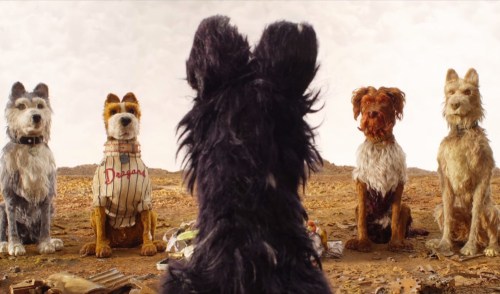
So much is going on in Wes Anderson’s “Isle of Dogs” that it’s hard to wrap one’s head around it.

Perhaps it’s best to let our eyes do all the work, for this is one astoundingly beautiful animated film.

Shot with the same stop-motion techniques as Anderson’s earlier effort, “The Fantastic Mr. Fox,” this new entry employs the filmmaker’s usual deadpan humor with gorgeous Japanense-inspired designs and a yarn about human/canine relations.

It’s part sci-fi, part “Old Yeller.”

In an introductory segment designed to look like Japanense screens and woodcuts and propelled by throbbing Japanese drumming, an unseen narrator (Courtney B.  Vance) relates how, after an outbreak of “dog flu” and “snout fever,” all canines in the city were banished by the cat-loving Mayor Kobayashi, head of the ruling Kobayashi clan.

The dogs were transported to an island of trash off the coast where they learned to dig through the refuse for sustenance.

But not all humans are anti-dog.  A few still long for the days of “man’s best friend”; a pro-pup scientist is even developing a cure for dog flu.

The plot proper (the screenplay is by Anderson, who developed the story with Roman Coppola, Jason Schwartzman and Kunichi Nomura) kicks in with the arrival of Atari, the ward of the Mayor who has stolen a plane and crash landed on the Isle of Dogs in search of Spots, his beloved guard dog, who was torn from him by the canine exodus.

The boy immediately teams up with a quartet of puzzled pooches (voiced by Edward Norton, Bob Balaban, Bill Murray and Jeff Goldblum) and the suspicious Chief (Bryan Cranston), who understandably nurses a bad case of anti-human sentiment. Continue Reading »

Nicki Micheaux, Ricardo Adam Zarate

“LOWLIFE”  My rating: B- 

96 minutes | No MPAA rating

Less interesting on a scene-by-scene basis than for its novel narrative arc, the aptly-titled “Lowlife” finds a surprisingly interesting way of telling a sleazy story.

The real star of director Ryan Prows’ feature debut is the screenplay by a small army of scribes (Tim Cairo, Jake Gibson, Shaye Ogbonna, Maxwell Michael Towson and Prows) who seem to have taken as their template the time-twisting format of Quentin Tarantino’s “Pulp Fiction.”

Basically we have three interlocking stories, told one after another, and all taking place on the same day and featuring the same characters.

It’s sort of like an Alan Ayckbourn play…say, “The Norman Conquests” trilogy, which offered three plays unfolding at the same time in different rooms of the same house.

In the first segment, “Monsters,” we are introduced to Los Angeles lowlife Teddy “Bear” Haynes (Mark Burnham), who beneath his tacky taco restaurant maintains a subterranean chamber of horrors where illegal aliens are dissected for their organs or impressed into sexual slavery.

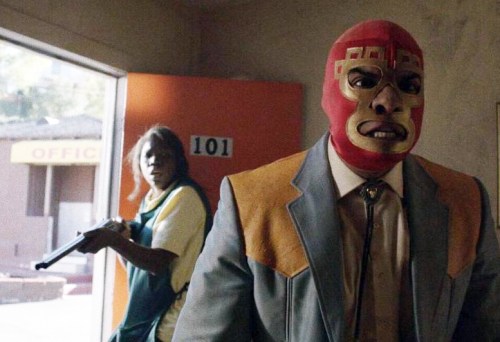
Teddys’ enforcer is El Monstruo (Ricardo Adam Zarate), who never removes the red luchador mask once worn by his late father, a wrestler who still has superhero status in the Hispanic community.  The current El Monstruo is a bit like the Hulk…he’s light on brain and big on brawn, and when angered goes into a murderous rage, blacking out and awakening amidst corpses and destruction.

But he has a soft spot for his unborn son, the next El Monstruo, who is currently in the belly of Kaylee (Santana Dempsey), his wife and Teddy’s adopted daughter.

The second episode, “Fiends,” is told mostly from the perspective of Crystal (Nicki Micheaux), the operator of a beat-up motel where much of the action takes place. Crystal’s husband Dan (King Orba) is dying of kidney disease; Teddy has convinced her that he can provide a fresh organ donated by the daughter she and Dan gave up for adoption years before, when they were dope fiends. Continue Reading »

Maryana Spivak

“LOVELESS” My rating: B 

127 minutes | MPAA rating: R

As if his Oscar-winning “Leviathan” didn’t take enough of  a withering look at contemporary Russia, writer/director Andrey Zvyagintsev now gives us “Loveless,” a film that lives up to its name in more ways than one.

It begins with 12-year-old Alyosha (Matey Novikov ) wandering through a forested park on his way home from school.  He’s in no hurry, and once we get to the apartment where he lives we can see why.

His parents, Boris (Aleksey Rozin) and Zhenya (Maryana Spivak), are in the last spasms of a hateful breakup.  Both have new lovers, and neither wants to see his/her style cramped by the presence of a pre-teen — especially one described by his own mother as “constantly whining.”

Of course, we can’t blame the kid for weeping in the privacy of his room, from which he can hear his parents discussing his future: first boarding school, then the army.  At least that way they won’t have to worry about taking heat from social workers.

As for their son:  “He’ll get used to it.”

What kind of people are these?  Well, that’s the questions “Loveless” addresses, even if definitive answers aren’t forthcoming.  One thing soon becomes clear…this isn’t young Alyosha’s story. He’s a peripheral player,  absent for most of the film.

Instead we follow Boris to his place of employment, a corporation run by a Christian fundamentalist who demands that his male employees all be family men — one desk jockey grimly jokes that the place operates under “Russian Orthodox Sharia law.”

We discover that Boris has impregnated his girlfriend (she’s young, insecure, and no doubt would feel threatened having Alyosha about).  Zhenya, meanwhile, is seeing a slightly older man who, if his apartment is any indication, is working his way up Russia’s oligarchical ladder.

These two are so absorbed with their own pursuits and pleasures that some time passes  before they realize that their son is missing. His teacher reports he hasn’t come to class for two days.

Continue Reading »

“READY PLAYER ONE” My rating: B
140 minutes | MPAA rating: PG-13

That most films based on video games suck mightily should come as no surprise…video games are all about dishing visceral thrills, not building dramatic momentum or developing characters.

This is why Steven Spielberg’s “Ready Player One” is such a remarkable achievement. Instead of attempting to wrestle the video gaming experience into a standard dramatic format, this surprisingly entertaining entry is really just one long video game, albeit a game with so much pop-culture name dropping that geeks will spend countless hours documenting all the visual and aural references.

Think “Tron” to the nth degree.

Don’t go looking for the usual plot developments or relatable characters. The strength of  “Ready Player One” lies in its ability to create an totally plausible fantasy world that operates by its own rules.  At times the audience’s immersion in this universe is total and totally transporting.

The screenplay by Zak Penn and Ernest Cline (based on Cline’s novel) unfolds in the year 2045.  Economic and environmental disasters have left the working class chronically unemployed.  They live in “stacks,”  mini-high rises made of mobile homes resting on metal frameworks. In this world video games are the opiate of the masses — when they’re not eating, sleeping or taking bathroom breaks, the citizenry are experiencing virtual realities through 3-D goggles.

This is the world of Wade (Ty Sheridan of “Mud,” “Joe” and the X-Men franchise), a shy teen whose on-line avatar is the game-savvy Parzival.  Wade/Parzival is a devotee of The Oasis, a massive video game developed by the late programming guru Halliday (played by Mark Rylance in flashbacks) and so complex and challenging that in the years since its inception no player has come close to beating it. But millions log in daily in an attempt to find three hidden keys that will unlock Halliday’s fantasy world and grant the winner ownership of the unimaginably wealthy Oasis empire.

The challenge attracts not just individual gamers like Parzifal and on-line buddies like the hulking giant Aech or the samurai warrior Daito.  The IOI corporation and its Machiavellian director Sorrento (Ben Mendelssohn) has its own army of players who compete for the prize.   The person — or business — that solves the game’s many puzzles will in effect become one of Earth’s dominant forces.

Continue Reading »

Toni Collette, Rossy de Palma, Harvey Keitel

“MADAME” My rating: C

91 minutes |No MPAA rating

Farce should be lighter than air. “Madame” seems to have a bowling ball in its pocket.

Created by filmmaker Amanda Sthers mostly as a vehicle for the appealingly eccentric Rossy de Palma (the one-time Spanish model who for a while was a staple of Pedro Almodovar comedies), “Madame” offers an upstairs/downstairs scenario in which, thanks to a case of mistaken identity, a housemaid gets the life of a princess.

Maria (de Palma) is the chief maid and housekeeper for wealthy American Bob (Harvey Keitel) and his trophy wife Anne (Toni Collette), who are spending the season in their Paris home.  On the night of a big dinner party the superstitious Anne realizes that there will be 13 sitting at the table.

Panicked, she orders the reluctant Maria to trade in her black-and-white domestic’s outfit for party duds and pose as one of the guests, bringing attendance up to a safe 14.  Just keep quiet and mysterious, Anne advises her terrified employee.

Instead a tipsy Maria charms everyone with a slightly off-color joke, attracting the attention of David (Michael Smiley), a bearded British art broker who is far less stuffy than the words “British art broker” would suggest.

Continue Reading »

“I KILL GIANTS” My rating: C  

106 minutes | No MPAA rating

Technical brilliance and narrative muddiness wrestle to a draw in “I Kill Giants,”  director Anders Walter’s feature debut after a career in shorts.

Based on the graphic novel by Joe Kelly (who wrote the screenplay) and Ken Nimura, “Giants” melds Spielbergian adolescent fantasy with “Donnie Darko” pessimism. The results look terrific but feel phony.

Barbara (Madison Wolfe) is a teen outsider whose eccentricities may have passed beyond the endearing to the pathological.

With her oversized spectacles, unkempt blond mop and fuzzy rabbit ears (does she know she looks like a pedophile’s wet dream of a Playboy Bunny?), she’s the very image of a young adult  oddball.  A dungeons and dragons geek, she spends her spare hours stalking the woods near her picturesque seaside home and creating poisons and folk art talismans in a hidden lab.

Barbara is convinced that it is her job to protect her town from the giants that roam the countryside.  She has created Rube Goldberg-ish snares for these hulking monsters, and carries in an overdecorated purse a war hammer with which to battle the intruders.

Kelly and Walter establish early on that this is no charming childhood fantasy.  Barbara believes every bit of her trauma-inducing giant-slaying scenario, and devotes her life to the cause.  As a result she is tormented by a classroom bully (Rory Jackson) and spends an inordinate amount of her day in the office of the understanding but frustrated school psychologist (Zoe Saldana).

Thing is, she’s very, very smart.  Barbara can out-insult both adults and her fellow students (with her stinging wit she oozes contempt for “normal” kids), describes her towering foes as “total dicks” and radiates the weary seen-it-all attitude of a veteran warrior suiting up for yet another bloody campaign.

Her self-imposed ostrasization is dented only by the arrival of Sophia (Sydney Wade), a recent British import to the community, who befriends Barbara in spite of the latter’s loner attitude.

Continue Reading »

Josh Hartnett, Shinobu Terjima

“OH LUCY!” My rating: B- 

95 minutes | No MPAA rating

“Oh Lucy!” begins on a Tokyo subway platform with a man throwing himself in front of a train.  It ends on the same platform with two very lonely people sharing a hug.

What goes on between those points is a bit difficult to describe.

Atsuko Hirayanagi’s film is a character study, certainly, with Shinobu Terjima giving a quietly touching, occasionally comic performance as a middle-aged, unmarried office drone whose life is turned upside down by an English lesson.

But “Oh, Lucy!” is also a road movie, much of which takes place in California. And it’s a romance, too.

Setsuko (Terjima) is in her late 30s and living a life of quiet desperation. She’s considered a loser at work and still smarts over the fact that her sister Ayako (Kaho Minami) stole and married the one man Setsuko ever loved.

That union didn’t last, but it produced Netsuke’s cute/flighty niece Mika (Shioli Kutsuna), a waitress in a cafe where the help all dress like French maids.

Early in the film Setsuko reluctantly agrees to take over the English lessons for which Mika signed a contract but now cannot pay. Her instructor, John (Josh Hartnett), has some weird ideas about teaching — he gives his students English names (Setsuko becomes Lucy), makes them wear wigs, and because he’s teaching “American English” insists that conversations be punctuated with regular hugs.

Even that much physical contact is enough to make the love-starved Setsuko swoon. She’s soon fantasizing about her new teacher.

But not for long. Turns out John and Mika were an item. Now they’ve run off to Los Angeles, with the two bickering sisters — mother and aunt — in hot pursuit.

Continue Reading »

Steve Buscemi as Nikita Khrushchev, Jason Isaacs as Zhukov

“THE DEATH OF STALIN” My rating: B+

 107 minutes | MPAA rating: R

Cold War-bred baby boomers may be perplexed to discover that Nikita Khrushchev  — the Soviet bigwig who infamously pounded his shoe on a desk at the United Nations and proclaimed that “We will bury you” — is the hero of “The Death of Stalin.”

Just goes to show: History makes for strange bedfellows.

Make no mistake: Khrushchev, played here by a balding, pudgied-up Steve Buscemi, is presented as a hustling, scheming political climber.  But compared to the forces he’s battling, he’s one of the angels.

Unfolding over several days in 1953, “The Death of Stalin” is history retold as a black comedy.  It was written and directed by Armando Iannucci, the Scottish filmmaker who in 2009 gave us the brilliant sendup of Bush-era idiocy, “In the Loop.”

If anything, “…Stalin” surpasses that effort with its toxic/weirdly entertaining mix of terror, paranoia and manic broken-glass satire.

Iannucci and his co-writers (David Schneider, Ian Martin, Peter Fellows) waste no time in laying out the miseries of Stalin-era USSR.  In a brilliantly edited opening sequence, we hopscotch around Moscow on a chilly March  night.

At Radio Moscow an official (Paddy Considine) freaks out when he gets a phone call from Stalin asking for a recording of that night’s live Mozart concerto. Problem is, the program wasn’t recorded.  The doors are barred, the nervous audience members told to return to their seats (“Don’t worry, nobody’s going to get killed”) and a guest conductor is snatched from his apartment in his pajamas to replace the original maestro, who has knocked himself unconscious by taking a header into a fire extinguisher.

The Radio Moscow man knows that people have been shot for less than failing to produce a recording for the glorious leader.

Meanwhile in the Kremlin, Stalin (Adrian McLoughlin) is busy hobnobbing with his security chief Beria (Simon Russell Beale), whittling down a list of “enemies” to be arrested and disposed of that very night.

“Cracks me up, this one,” Stalin chortles, pointing to one of the names.

Nearby, Communist Party leaders like Khrushchev, Malenkov (Jeffrey Tambor) and Molotov (Michael Palin) trade vodka shots are behaving like boorish frat boys, recycling war stories and trying not to piss off Stalin. (After each meeting with the head honcho, Khrushchev goes over every comment so as to avoid in the future any topics that Stalin finds distasteful.)

The next day Stalin is found lying on the floor, barely alive, the victim of a stroke.

His cohorts are paralyzed by indecision. They can’t even agree on whether to call in medical assistance: “All the best doctors are in the gulag…or dead.” Continue Reading »

“NOVEMBER” My rating: C+ 

115 minutes | No MPAA rating

“November” walked away with top cinematography honors at last year’s Tribeca Film Festival, and just minutes into this Estonian production you’ll understand why.

This is one astonishingly beautiful movie, a black-and-white evocation of a ghostly, semi-primordial past filled with haunting images. Director of photography Mart Taniel has created a visual masterpiece.

In other regards “November” is a rough slog.

Based on the book by Andrus Kivirahk — the biggest-selling novel by an Estonian writer in the last two decades — the film unfolds in a rural community in what appears to be the early 19th century. It’s a world of unwashed peasants, decaying hovels, mist-shrouded landscapes and everyday interactions between humans and the supernatural.

The novel was less a fully plotted story than a series of vignettes revealing the life (and afterlife) of a particular neighborhood over the course of one wintry month, and in transferring the narrative to the screen writer/director Rainer Sarnet has been unable to provide an emotionally engaging through story.

The film is a collection of sometimes arresting moments, but after a while the weirdness gets a bit numbing. In this regard it resembles the bizarre efforts of famed Chilean cult director Alejandro Jodorowsky (“El Topo”).

Continue Reading »