Feeds:
Posts
Comments

Nicolas Cage as Red in “Mandy”

“MANDY” My rating: A- (Hulu) 

121 minutes | No MPAA rating

“SYMPATHY FOR THE DEVIL”My rating: B- (Hulu)  

90 minutes | No MPAA rating

The prevailing wisdom is that Nicolas Cage will make any movie if the price is right, that you needn’t send him the script until the check has cleared.

And looking at his output over the last decade, that summation seems fairly accurate.  

For every noteworthy title on his resume (“Pig,” “Dream Scenario,” “The Unbearable Weight of Massive Talent”) there are a half dozen half-baked and utterly forgettable genre flicks (mostly revenge melodramas) that in a previous era would have gone straight to video.

Today, of course, they go straight to streaming.  

If the quality of Cage’s output is questionable, the quantity is staggering.  Since 2015 he has racked up more than 40 film credits, usually as the lead actor.  This would be regarded as Herculean for any performer, but Cage’s batting average is further enhanced by the fact that for nearly three of those years Hollywood was in a covid shutdown. 

Now I cannot claim to have seen all of Cage’s recent work (life’s too short, you know?) but I’ve been doing some surfing around the streaming services and have stumbled across a couple of titles that previously eluded me.

First off, from 2018, is “Mandy,” a revenge melodrama (check) that practically pulsates with human agony (thanks to Cage’s performance) while radiating a psychological/surreal intensity that is simultaneously seductive and repellant. 

This might be great filmmaking.  It might be trash. I could make a case for either.

The real star here is writer/director Panos Cosmatos, who creates a nightmare world rooted in the eccentric weirdness of Nicolas Winding Refn and accented with the surreal beauty of Lars Van Trier’s “Melancholia.” There’s even a nod here to Bergman’s “Persona.”

“Mandy” is crammed with laughable pulp fiction tropes, but even when it tosses in the odd playful  moment you’ll find yourself a prisoner of its somber intensity.

The setup:  Lumberjack Red (Nicolas Cage) lives in a comfy cabin in the north woods with his squeeze Mandy (Andrea Riseborough),

Linus Roache is Jeremiah, the bonkers head of a religious cult (he’s positively Koresh-ian) whose followers think only of satisfying his psychological and sexual needs.

Jeremiah spots Mandy on one of his drives and orders his minions to kidnap her. This they do, but not before torturing Red, whom they leave for dead.

They should have made sure.

There’s stuff going on here that just shouldn’t work…like a gang of bikers (are they human or demons?) whose costuming makes them look like the love children of “Hellraiser’s” Pinhead and “Pulp Fiction’s” Geek.

As the batshit crazy Jeremiah, Roache (who spent several seasons as a prosecutor on “Law & Order”) gets to dig into some mind-blowing bloviatory dialogue.  There’s a touch of Robert Mitchum’s killer preacher from “Night of the Hunter.” It’s totally unlike anything he’s ever done.

And that’s another unexpected thing. On top of its visual/aural splendors, “Mandy” has been fabulously well acted.  

The great Bill Duke makes a rare on-screen appearance as Red’s buddy, who keeps an impressive cache of weaponry in his mobile home. And as cult members the veteran actors Olwen Fouere, Richard Brake, Line Pallet and Ned Dennehy (you may not know the names but you’ll recognize the faces) give remarkably nuanced and unnerving performances.

But holding it all together is Cage.  It’s a pitiless performance…in one harrowing segment the camera zooms in on Red’s bloodied features and stays there for what seems like minutes as he screams in emotional (the love of his life has been taken) and physical pain (he awakens to find he’s been bundled in barbed wire and one hand has been nailed to the floor).

“Mandy” is exhausting and draining, but I’d happily watch it again.  

Nicolas Cage as The Passenger in “Sympathy for the Devil”

Then there’s “Sympathy for the Devil,” a 2023 drama in which Cage appears as a gun-toting killer who carjacks a suburban dad and forces him to cruise around nighttime Las Vegas.

When we first see Cage’s character (identified in the credits as The Passenger) he’s like the cartoon embodiment of Sin City’s underbelly.  With hair dyed to match the day-glo maroon of his tuxedo jacket and a Mephistophelean goatee, the guy comes off  like a cheesy stage magician who might keep a dead hooker in his car trunk. (He even forces his victim to participate in a card trick.)

The Driver (Joel Kinnaman) has just pulled into a hospital parking garage. His wife is upstairs giving birth to their second child — all he wants is to be at her side.

But, no, he’s forced at gunpoint to drive his captor out of town for…well, let’s not ruin anything.

Yuval Adler’s film is basically a claustrophobic two-hander.  There are encounters with other citizens — an unfortunate cop, the terrified travelers at an all-night highway diner — must mostly it’s just these two guys in a car surrounded by  the desert night.

Was the kidnapping arbitrary? A wrong place, wrong time thing? The Passenger is a smirking, taunting presence. The Driver claims there’s been a mistake, that he’s just a working jerk. 

But maybe there’s something in the pasts of these two that made this  evening inevitable?

Luke Paradise’s screenplay manages a magic trick of its own, turning the Passenger over time from a holy terror to a man with a painful past…which is how we end up sympathizing with this particular devil. (Viewers familiar with Cronenberg’s “A History of Violence” may guess where this is all going.)

Thanks to Cage it almost works.  The Passenger is a preposterous character who really doesn’t wash, psychologically speaking.  But watching Cage tear into this material it almost doesn’t matter.  The guy is out there sweating to turn straw into gold. In the end he turns that straw into brass, but it’s still a wonder to behold.

| Robert W. Butler
Harper Steele, Will Ferrell

“WILL & HARPER”  My rating: B+ (Netflix)

114 minutes | MPAA rating: R

“Will & Harper” is both a hugely emotional paen to friendship and a sobering/reassuring look at grassroots America.

It’ll have you sobbing one minute, furious the next.

The Will of the title is Will Ferrell, famous comic actor.  Harper is the former Andrew Steele, a long-time writer for “Saturday Night Live” who at age 61 decided to transition.

At the outset of Josh Greenbaum’s documentary, Ferrell recalls getting an email from Steele announcing her new status as a woman.  Farrell never saw it coming.

But Will Ferrell is a very good friend.  Knowing that as a man Harper had often driven across America, hanging out in seedy motels and nefarious watering holes, Ferrell suggested the two buds take a road trip. 

It would give them plenty of time to explore their new relationship while seeing how, if at all, Harper would be accepted  by the everyday folk being bombarded with anti-trans propaganda.

There’s good news and bad news. At an Oklahoma road house Harper is serenaded by a group of Native American men who employ a plastic tub as a tom tom to chant a welcoming song.  Awwww.

The next day, in Texas, the two travelers take center stage at a crowded highway restaurant.  Clearly, the local folk are impressed at having a celeb in their midst, but many fire off a slew of cruel anti-trans tweets aimed at the comic’s companion.

But perhaps the most devastating part of the journey is hearing Harper speak of the many years in which she fought against recognizing her true sexual identity. It’s sad and inspiring.

Which is not to say that “Will & Harper” is a downer.  Ferrell and Steele have earned their livings by making other people laugh, and their banter has plenty of drollery sprinkled among the truth nuggets.

I believe I’m a better person for having watched it.

Brad Pitt, George Clooney

“WOLFS” My rating: B (Apple+)

108 minutes | MPAA rating: R

It really doesn’t go anywhere, but you’ve gotta enjoy the ride provided by “Wolfs,” a lean, funny crime dramedy fueled by Tarantino-esque banter.

The premise of writer/director Jon Watts’ film:  Two mob cleaners (they are hired to discreetly remove evidence — like dead  bodies — after violent encounters) find themselves working on the same assignment.

It must be a mistake because these unnamed dudes (played by George Clooney and Brad Pitt) always work alone and are fiercely protective of their trade secrets. (They’re “lone wolfs.”)

Nevertheless, here they both are in an expensive hotel room to remove the body of a young man who, while cavorting with an older woman (Amy Ryan), bounced off the bed and into a glass coffee table.

These wolfs don’t play well with each other.  The older one (Clooney) is a brooding grump. The younger (Pitt) is a cocky wise ass.  

Oil and water.

And then there’s the vinegar. (Here comes a spoiler but I don’t know how to avoid it.)

That would be “the kid” (Austin Abrams), the supposedly dead body that returns to life mid-disposal.  He’s a goofy college student who got picked up by the cougar while running an errand for a friend…an errand that involves a backpack full of drugs.

Now the two fixers and the kid are trying to return the illegal pharmaceuticals to their criminal owners without getting killed.

But not before an awesome chase through NYC with the two wolfs pursuing the whacked-out kid, who is racing gazelle-like through a snowstorm in his tidy whities. 

Remember Nicolas Cage’s quest for baby diapers in “Raising Arizona”?  It’s that good.

The thorny plot twists of “Wolfs” may not stand up to close scrutiny, but viewer doubts probably won’t kick in until after the final credits.  For the most part the flick is just plain fun.

Natasha Lyonne, Elizabeth Olsen, Carrie Coon

“HIS THREE DAUGHTERS” My rating: B+ (Netflix)

101 minutes | MPAA rating: R

Getting married. Having a kid. Losing a parent.

These are three of the most impactful experiences in a human life. Azazel Jacobs’ “His Three Daughters” examines the third event through a pressure-cooker environment and three astonishing performances.

The daughters are Katie (Carrie Coon), Rachel (Natasha Lyonne) and Christina (Elizabeth Olsen). The siblings have gathered in the New York apartment of their father, who lies dying in his bedroom (we won’t actually see him until the final moments of the film).

Though all were raised by the same single dad, the women have radically different personalities.

Katie, the oldest, is a brittle, opinionated woman who tries to come off as helpful but actually is merely bossy. Katie has rarely visited her father in recent months but now wants to dictate how this whole business of dying will unfold. The problem, of course, is that death doesn’t operate on a convenient schedule.

Christina has a husband and young daughter back in Ohio. She’s painfully insecure, always sharing appallingly sappy phone calls with her kid and shying away from argument and controversy.

Rachel is the family bohemian. She’s been living with her father for years, taking care of him in his decline. She appears not to have a real job and frequently lets off steam with a joint or two, both life choices that infuriate the judgmental Katie.

“…Sisters” unfolds almost entirely in the living room and kitchen of the apartment, creating a claustrophobic intensity that magnifies the points of conflict among the women.

Every few hours a hospice worker (Rudy Galvan) checks in; at one point Rachel’s boyfriend (Jovan Adepo) shows up to give her a bit of moral support and to unload on Katie and Christina, whom he (rightly) believes have shirked their familial responsibilities while Rachel got stuck with the role of caregiver.

“His Three Daughters” could quite easily have been conceived as a stage play rather than a film. The dialogue is tight and polished and wastes little time in exposing the character’s conflicted essences. Sometimes it sounds a bit artificial and forced, but any misgivings are quiickly dispersed by the power and subtlety of the performances.

Most of the film is brutally realistic. But in the final moments, when we finally meet the women’s father (Jay O. Sanders), it becomes borderline metaphysical. I can’t say more without ruining the effect…let’s just say that despite often rubbing our noses in dysfunction, “His Three Daughters” leaves us with a whiff of hope.

| Robert W. Butler

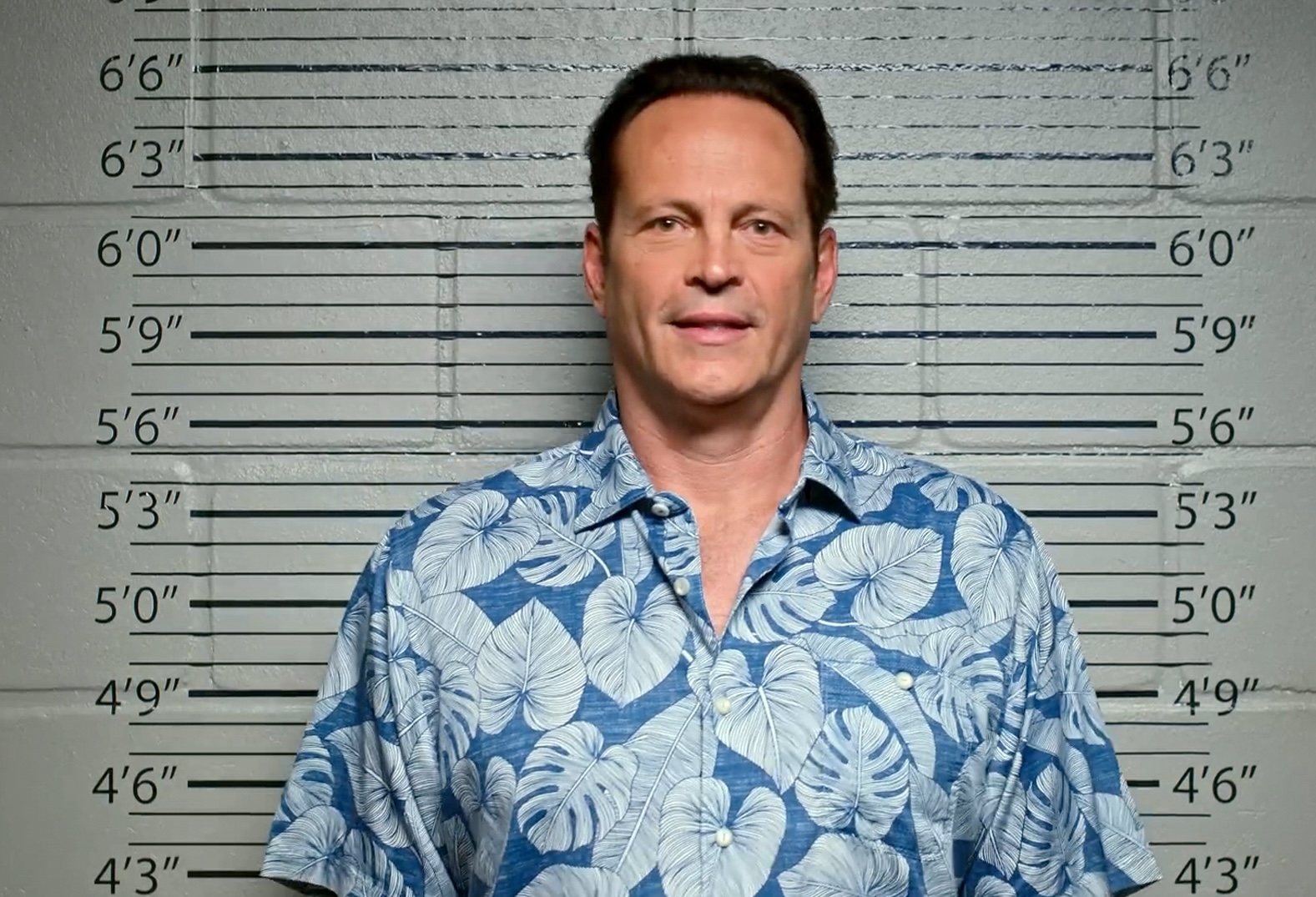
Vince Vaughn

“BAD MONKEY” (Apple +)

Vince Vaughn has been waiting more than 20 years for a role that would perfectly mesh with his droll, super-dry persona.  In “Bad Monkey” he finds it.

As disgraced Key West police detective Andrew Yancy, Vaughn seduces us with virtually every line of dialogue and deadpan expression.  He’s like a beach bum with a badge.

He’s surrounded by a cast of entertaining eccentrics  courtesy of novelist Carl Hiaasen, a former Miami Herald writer whose novels provide a wickedly jaundiced view of Florida’s human fauna.

Created by the great Bill Lawrence (“Scrubs,” “Ted Lasso”), this series opens with the discovery of a severed human arm snagged on a fishing line. The sets in motion Yancy’s quest to track down a missing con man and his scheming trophy wife. His search will take him from Key West to Miami to the Bahamas.

Satisfying from a mystery/comedy aspect, “Bad Monkey” also captures the captivating weirdness of the Sunshine State, that blend of redneck bohemia and big-money crassness mined so well in Hiaasen’s novels. 

Fleshed out with first-rate supporting players — among them Michelle Monaghan, Rob Delaney, Alex Moffat and Scott Glenn, just for starters — and you’ve got a show so good you don’t care if they ever solve the mystery.

Liev Schreiber, Nicole Kidman

“THE PERFECT COUPLE”(Netflix)

Okay, I get it.  Rich people are assholes.

 I’m just not sure I needed six hours of immersion in said asshole-ism .

“The Perfect Couple” is a murder mystery set on Nantucket Island during an obscenely expensive  wedding celebration.  At the end of the first episode, after a night of partying, one of the guests washes up dead on the beach.

The local police chief (Michel Beach) and a chijp-on-her-shoulder  detective (Donna Lynne Champlin) have plenty of suspects to suss out, and each of the ensuing five episodes centers on one  or two of the potential killers. 

The groom’s parents are the perfect couple of the title, though that’s a carefully curated illusion. The haughty/brittle Greer (Nicole Kidman) writes popular mystery novels, while hubby Tag (Liev Schreiber) smokes pot, lobs golf balls into the sea and spends wifey’s money on other women.

Their son the groom (Billy Howie) is actually a pretty decent guy; his bride-to-be  (Eve Hewson) is a middle-class girl uncomfortable with the ostentation in which she finds herself drowning.

The groom’s older brother (Jack Reynor) is a spoiled jerk and financial disaster; his preggers wife (Dakota Fanning)  is a social climber who puts up with her husband’s philandering because, well, he’s rich.

The maid of honor (Meghann Fahy) is a party girl; the best man (Ishaan Knatter) appears to be a surf bum but is actually a millionaire. And there’s a predatory and witheringly ironic French lady (Isabelle Adjani) who seems to have bedded most of the men in the wedding party.

There’s amusing interplay between the working-stiff cops and the nose-in-the-air suspects. But there are way too many superfluous subplots, digressions, red herrings and narrative dead ends. For much of the series I felt I was treading water…getting in my exercise but going nowhere.

Still, the performances are good (I especially dug Schreiber’s laid-back kept man) and the faces and figures attractive.

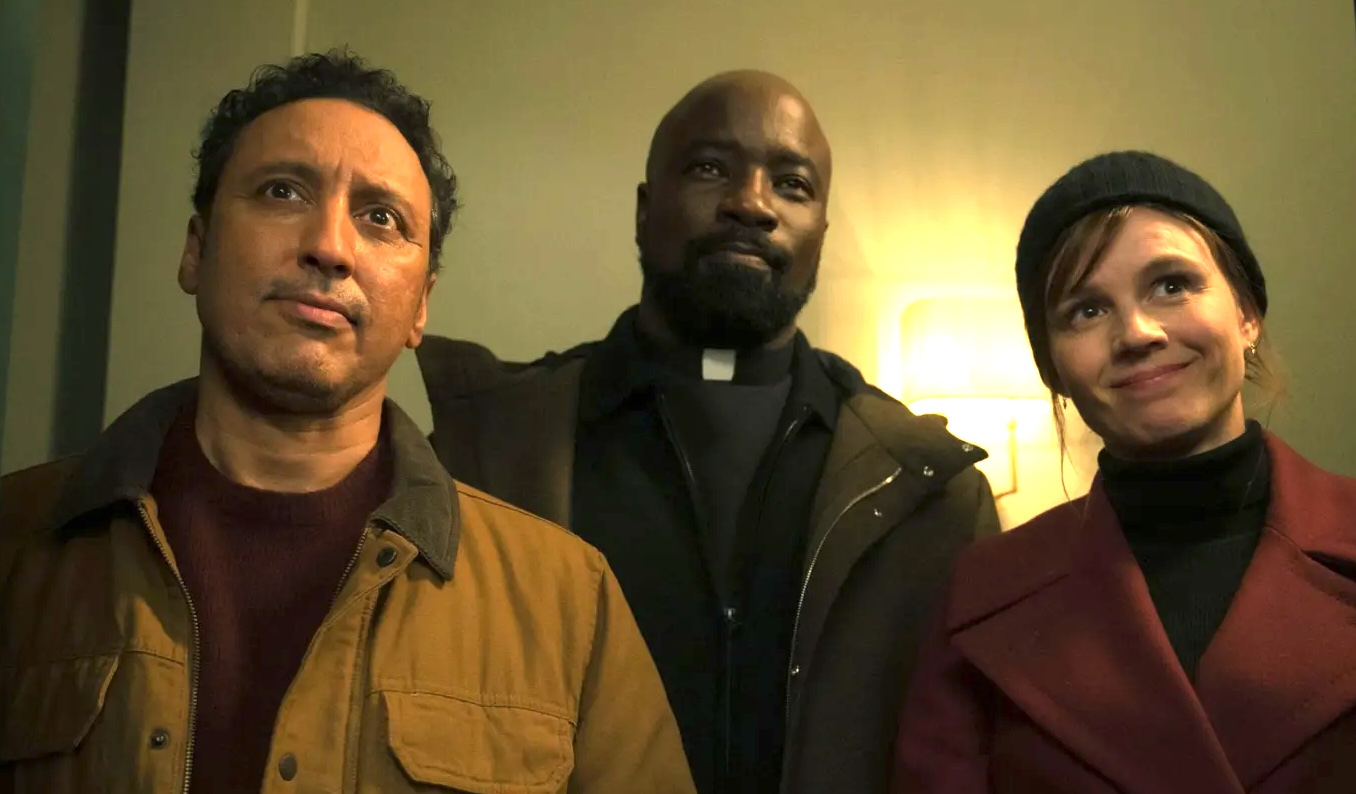
Aasif Mandi, Mike Colter, Katja Herbers

“EVIL” (Paramount +)

After three hugely satisfying seasons of “Evil” I’d like to hang out with series creators Michelle and Robert King. I mean, people who can effortlessly mix demonic possession and insouciant humor are bound to be fine dinner companions.

The series’s premise is simple yet deeply nuanced.  Three investigators are hired by the Roman Catholic Archdiocese of New  York to investigate reports of the supernatural.

They are seminarian David Acosta (Mike Colter), clinical psychologist and agnostic Kristen Bouchard (Katja Herbers) and lapsed Muslim and hardcore scientific rationalist Ben Shakir (Aasif Mandi).

There’s huge fun in watching the three play off each other…lots of good-natured banter as their conflicting world views collide (think Scully and Mulder plus one). And every week, of course, they have a new mystery to unravel, whether it’s a ghostly apparition, a fierce mutant pig or an ancient relic housing a malevolent spirit.

Creepy special effects and skin-crawling atmosphere aside, it’s the personal stories that really fuel the show.  Foremost is the simmering intensity between Colton’s priest-in-training and Herbers’ mother of four (or is it five?) that will have audiences simultaneously rooting for them to hit the hay together and dreading the repercussions.

There are numerous amusing supporting characters, especially Andrea Martin as a no-nonsense nun with the ability to see demons, Christine Lahti as Kristen’s cougar-ish mother and Michael Emerson as her boyfriend, a slimy psychiatrist heading a secret cabal of Satanists preparing for the birth of the antichrist.

And there are a whole mess of demons who’ll leave you torn between shuddering and giggling…who knew that Satan’s minions were disgruntled  working stiffs like the rest of us?

| Robert W. Butler

Kirsten Dunst, Cailee Spaeny

“CIVIL WAR” My rating: C+(Max)

109 minutes | MPAA rating: R

The journalistic challenges of covering a civil war have long fascinated filmmakers. 

Back in the ‘80s we had Oliver Stone’s “Salvador” and Roger Spottiswoode’s “Under Fire.”  More recently Rosamund Pike portrayed real-life photojournalist Marie Colvin in the excellent “A Private War.”

Alex Garland’s “Civil War” returns to the topic but with a major twist.  Instead of playing out in a Third World country, this yarn is set in the good ol’ U.S.A. during what can only be described as the second American Revolution.

This is both the film’s most intriguing element…and its most frustrating one.

Narratively it’s a big road trip.  Four journalists in a car with “Press” embossed on the doors set out from NYC to the nation’s capital, where the President and his supporters are making a last stand against the forces of the “Western Alliance,” a secessionist army manned mostly by Texans and Californians (talk about strange bedfellows!).

Our protagonists are photojournalist Lee (Kirsten Dunst), who is close to burning out on the horrors she has witnessed in her career; reporter Joel (Wagner Moura), a cynic determined to get what may be the last interview ever with the President; the seventysomething Sammy (Stephen McKinley Henderson), who’s clearly too old for this sort of enterprise; and baby-faced Jessie (Cailee Spaeny), just starting out in the biz and perhaps too eager to see action.

The unarmed newsmen journey through burned-out burgs and bucolic landscapes, both of which conceal untold dangers and numerous ways to die.  They spend a night in a crumbling football stadium now housing hundreds of refugees. They encounter vigilantes who are torturing suspected looters, disciplined military units and scarily undisciplined militia members.

Being neutral journalists they’re able to observe both sides in the fight.  Not that their press credentials can protect them from gun-toting morons who for the first time can swagger and kill with impunity. (An uncredited Jesse Plemons makes a brief but scarily memorable appearance as a morally unhinged partisan — though we can’t be sure which side he’s on.)

It’s a world-turned-upside-down scenario in which chaos reigns. Which army are we embedded with today? And the usual rules of war no longer apply.

Garland’s screenplay is a series of episodes, but there’s not much in the way of narrative. Mostly he’s interested in establishing a world in which everything that makes us feel secure has been turned inside out. To the extent that it depicts a society imploding into near-anarchy,
“Civil War” works pretty well.  It’s the sort of thing that could be set in any war-torn country.

Except that it’s not just any country.  It’s the United States of America. Garland seems poised to be make political points, to show how our current political dysfunction could lead to something far worse…but he never follows through.

TV and radio addresses by the President (Nick Offerman) show a leader keeping up the facade of success even as the world crumbles around him…there’s a vaguely Trumpian element to the character’s hyperbolic statements and resistance to facts.  But is this President of the right or the left?  Don’t know.

Nor do we learn anything about the political stance of the rebels besieging Washington. They’re described as secessionists, but there’s no mention of what drove them to that state or what kind of government they propose to establish.

Moreover, there are some big gaps in the film’s internal logic.  Our protagonists may be motoring through one of the most densely populated areas in America, but usually they’re the only car on the highway (though there are vast parking lots of abandoned or burned-out vehicles).  So where are all the people?

In the end “Civil War” dishes some good action sequences and a suffocating sense of danger, but never answers the big questions it sets up. 

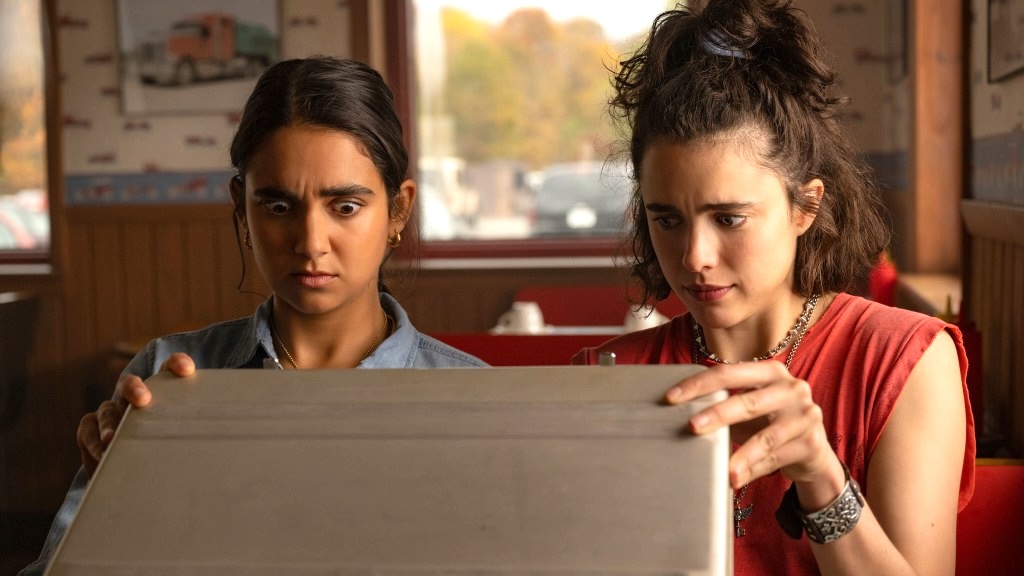
Geraldine Viswanathan, Margaret Qually

“DRIVE-AWAY DOLLS” My rating: B- (Prime)

84 minutes | MPAA rating: R

“Drive-Away Dolls” wants to be the great American lesbian road picture.

It almost gets there.

The latest from director Ethan Coen (here working without his usual partner, brother Joel) and co-writer Tricia Cooke is a raunchy, muff-gobbling comedy.  

Sorry if that last phrase offends, but it’s exactly the attitude on display. Imagine Andrew Dice Clay as a gay woman. “Drive-Away Dolls” is so in-yer-face blue that it’s kinda refreshing.

Taking top honors here is Margaret Quallly as Jamie, a drawling Texas lesbian with a a mouthful of rude down-home-isms and a fierce sexual appetite. She talks her straight-laced gal pal Marian (Geraldine Viswanathan) into taking a road trip down south…they sign up to deliver a car to its new owner several states away.

Except that they end up in a vehicle that is part of a criminal plot.  In the trunk is a briefcase with an arresting array of dildos (you know they will not go unused) and an old-fashioned hatbox holding a human head on ice (the noggin belongs to Pedro Pascal…gotta be the least-challenging role of his career).

In pursuit are a couple of bumbling thugs (Joey Slotnick, C.J. Wilson) who have their own Mutt and Jeff routine going on. 

The screenplay overflows with hard-core dyke humor (again, not being disrespectful…that’s just the dynamic on display) and the cast is crammed with brief comic appearances by familiar faces: Beanie Feldstein, Colman Domingo, Bill Camp, Matt Damon.

Trashy fun.

| Robert W. Butler

Aaron Pierre

“REBEL RIDGE” My rating: B (Netflix)

131 minutes | No MPAA rating

After “Rambo: First Blood” you’d imagine small town cops would think twice before  antagonizing a homeless military veteran possessing singularly deadly skill sets.

But, no.  Movie cops never learn. Especially the swaggering assholes that populate (in fiction, anyway) burgs like the one portrayed in “Rebel Ridge.”

This thriller (the title is fundamentally meaningless) offers a surprisingly thoughtful if viscerally devastating take on the “First Blood” scenario, giving us a nail biter that is also socially relevant.

Terry Richmond (a blindingly charismatic Aaron Pierre) is bicycling down a Louisiana highway, listening to heavy metal on his earphones…which is why he doesn’t hear the police siren behind him.

So right from square one he’s “refusing” to obey the orders of an officer.

Within minutes Terry is handcuffed and his backpack searched.  The two arresting cops (David Denman, Emory Cohen) discover more than $30,000 in cash.  Hmmmm….suspicious.

Terry  explains that he’s on the way to bail his cousin out of jail; to raise the funds he sold his car  and his stake in a restaurant.

The boorish cops  say the money may be the result of criminal activity, and so they confiscate it. And then let the incredulous and infuriated Terry go on his penniless way.

The opening moments of writer/director Jeremy Saulnier’s latest film are riveting.  Not only is Terry  legally robbed (“civil forfeiture,” as it is known,  is a much-abused practice that allows police to seize and keep any property they deem involved in a crime), but there’s the whole racial thing.  Terry is black; the cops are white.

Being a good citizen, Terry  wants to work through all the legal and proper channels. What he discovers is a police department (Don Johnson is the reprehensible chief) financed almost exclusively with the proceeds of civil forfeitures. The local court and its judge (James Cromwell) are in cahoots with the scheme.

Terry does find an ally in a young woman (AnnaSophia Robb) who works in the courthouse and has long suspected skulduggery. Together they team up in an effort to bring the bad guys down.

Turns out he has the wherewithal to do just that — as a Marine Terry taught hand-to-hand combat techniques.

With films like “Blue Ruin” (a brilliant thriller more interested in the emotional/ethical fallout of revenge than the act itself) and “Green Room” (members of a punk band are trapped in the dressing room of a neo-Nazi biker bar) Saulnier has proven adept at blending genre with provocative social sentiments.

“Rebel Ridge” is his most accessible effort to date.  It’s smart, tense, and yet it never devolves into a high-body-count fantasy.  It walks right up to the edge of overkill, but never crosses the line. 

Nathalie Emmanuel, Omar Sy

“THE KILLER” My rating: C (Peacock)

126 minutes | MPAA rating: R

John Woo’s “The Killer” feels uncomfortably like a parody of a John Woo movie.

All the trademarks of the Woo style are there, but they feel forced and phony. Even kinda silly.

The original “Killer” from 1989 was something of a cultural landmark, introducing a whole new audience to Hong Kong cinema, making an international star of leading man Chow Yun-Fat, and establishing Woo’s poetic/visceral approach to onscreen action.

So, why a remake? 

The big selling point, apparently, was switching the sex of the titular killer, a paid assassin having misgivings about career choices.

This killer, Zee, is played by Nathalie Emmanuel (“Game of Thrones”), an attractive young actress but not a typical movie glamorpuss…she’s able to get lost in the many  disguises and alternate personas her character employs to go about her bloody work.  She’s less compelling when wallowing in the off-duty angst that afflicts her character.

Zee has a handler (Sam Worthington) who years earlier rescued her from the streets and trained her in the art of assassination; he’s a father figure, but also kinda creepy.

Also a father figure but much more simpatico is a tailor (Tcheky Karyo) in whose shop our heroine finds respite from the pressures of the job.

The screenplay (by Woo, Brian Helgeland and Josh Campbell) roughly follows that of the original film, though this time around the setting is Paris (if nothing else, you can occupy yourself identifying the famous locations).

From the outset we know that Zee is having second thoughts about her job. She spends a lot of time in a deconsecrated church replete with dripping water and fluttering doves (throughout his career Woo has been obsessed with churches and doves); she regularly lights candles for her victims.

And as in the original our killer goes soft for a young woman (Diana Silvers) unintentionally blinded during one of Zee’s killing sprees. This puts her on a collision course with her shady employers, who view the now-sightless girl as a potential witness and want her dead.

(You might view this as a setup for a same-sex relationship, which would indeed be a novel twist in the Woo canon. But, no, Zee is asexual, her wardrobe of to-die-for outfits notwithstanding.)

There’s a whole second plot about a French detective (“Lupin’s” Omar Cy) on the trail of a heroin syndicate; like Dirty Harry he’s always being accused by his timid supervisors of going too far.  He starts out tracking down Zee , and ends up teaming with her.

Here’s the thing: “The Killer” is not only crammed with crime movie cliches, its tone is borderline operatic, as if big gestures could somehow compensate for the narrative overkill.

The action?  Yeah, it’s typical Woo, highly choreographed and utterly implausible. Almost cartoonish.

| Robert W. Butler

Joseph Quinn, Lupita Nyong’o

“A QUIET PLACE: DAY ONE” My rating: B (Paramount+)

99 minutes | MPAA rating: PG-13

The latest in the “Quiet Place” franchise is a harrowingly effective survival story, focusing as it does on the 24 hours after NYC is inundated with unseeing, all-hearing alien predators.

But writer/director Michael Sarnoski (who here shares screenplay credit with John Krasinski, who wrote, directed and starred in the two earlier installments) is going for something more.

For starters, the film opens in a suburban hospice populated with cancer victims waiting to die.  Among them is Sam (Lupita Nyong’o), a young woman who seems to be holding on mostly so she can share a few more moments with her beloved cat Frodo.

A rare field trip to the Big Apple is interrupted by an alien invasion. Anyone hoping to survive has to deal with a short learning curve…lay low, don’t make noises, stay near water (the creepy crawlers can’t stand the wet stuff).

Initially terrorized by the mayhem around her, Sam resolves to make her way to a pier on the East River where evacuation boats await.

She’s accompanied on this perilous trek by her pussycat and a traumatized young lawyer, Eric (Joseph Quinn), who over the course of the narrative goes from being a whimpering liability to a valuable ally…he risks his neck raiding an abandoned pharmacy to get the trans-dermal fentanol patches Sam needs for pain control.

“…Day One” delivers a scarily effective end-of-the-world ambience…viewers who initially take comfort in not having cancer suddenly find themselves in a world where imminent death seems all but assured.  It’s a disorienting shot of reality.

With her thin frame and big eyes Nyong’o makes for an absolutely convincing Sam. Quinn (here almost unrecognizable from his “Stranger Things” role as small-town Lothario Eddie Munson) makes a convincing metamorphosis from quivering wimp to man of action.

 And Schnitzel the cat’s performance as Frodo is, well, believably catlike.  The filmmakers haven’t tried to anthropomorphize the animal…he’s just a cat.

The special effects are convincing, but Sarnoski is smart enough to know that less is more.  We may not see much of the aliens, but we know they’re out there, making clicking noises and waiting for their human prey to reveal ourselves.

Margaret Qually, Jesse Plemons, Willem Dafoe

“KINDS OF KINDNESS” My rating: (Hulu)

154 minutes (MPAA rating: R)

“Weird” is a popular word in this election cycle. It certainly applies to Yorgos Lanthimos’s “Kinds of Kindness,” a triptych that feels like episodes “The Twilight Zone” and “Alfred Hitchcock Presents” viewed through a paranoid haze.

In a way it’s like a theatrical repertory company — a half dozen actors keep reappearing in different roles.

Two of the stories— the first and third — deal with individuals who have given up most of their free will to serve a cultish leader.

In “The Death of R.F.M.” (R.F.M. is a balding, bearded fellow who appears briefly in all three episodes but says almost nothing) Jesse Plemons plays Robert, an executive who literally lives for his boss, Raymond (Willem Dafoe).

Raymond provides Robert and his wife with a house and car. He gives them expensive if weird gifts (one of John McEnroe’s smashed tennis rackets). He also dictates what they eat and drink and when they have sex.

But when Raymond orders Robert to participate in what appears to be a murder (the titular R.F.M. is the intended victim), he declines.

And so is cast out of Eden.

The bookend episode, “R.F.M. Eats a Sandwich,” finds Plemons and Lanthimos regular Emma Stone (“Poor Things,” “The Favourite”) traveling the country in a souped-up purple muscle car.

They are members of a cult searching for a woman who, according to the prophecies of their leaders OMI and AKA (Dafoe and Hong Chau), has the ability to resurrect the dead.  (In this one R.F.M. is a corpse in a morgue.)

Margaret Qualley is particularly good here as twin sisters, a veterinarian with astounding healing abilities and her singularly twisted sibling.

The middle episode, “R.M.F. is Flying,” is my least favorite. Plemons stars as a husband whose oceanographer wife (Stone) is missing at sea.  

When she is finally rescued from a tiny island, he suspects that she isn’t really his wife (she now likes chocolate, which she previously hated, and her shoes no longer fit). To prove herself he demands ever more bizarre sacrifices. 

“Kinds of Kindness” (the title practically drips irony…there’s not much kindness on display here) has been impeccably made but isn’t particularly inviting on either an emotional or intellectual level.

There are moments of black humor, but rarely of the laugh-out-loud variety — more funny odd than funny ha-ha. There are lots of squirm-worthy sexual undercurrents and some in-your-face nudity.

And the musical score — of dissonant piano doodling and  droning Medieval chants — nicely reflects the film’s themes of psychosis and self-denying reverence.

Actually, streaming may be the perfect way to watch it. In a theater with a running time of three hours, “Kinds of Kindness” probably ran quickly out of steam. But on Hulu we can watch it in digestible (well, almost) one-hour chunks.

Joaquin Phoenix, Vanessa Kirby

“NAPOLEON: THE DIRECTOR’S CUT” My rating: B- (Apple+)

206 minutes | MPAA rating: R

Ridley Scott’s “Napoleon” was a major letdown.

Great battle scenes. Terrific production values.  But dramatically?  Nope.  

And things weren’t helped any by Joaquin Phoenix’s interpretation of Nappy as a military savant who in all other aspects is borderline autistic.

Now we have an expanded version 45 minutes longer than the original.  And it’s a better movie. But still not a great one.

It’s hard to say sometimes exactly what is new here…in many instances it’s no more than a couple of additional shots and lines of dialogue dropped into existing scenes. 

But early on we get a look at what Josephine (Vanessa Kirby) endured before meeting Napoleon.  After the execution of her husband in the Reign of Terror, she is sent to prison where she learns some grim truths about what a woman must often do to survive.  

Josephine gets a crash course in staying alive from a fellow inmate (Ludivine Sagnier, whose performance was completely cut from the theatrical release)…it’s a sobering experience and helps explain the future Empress’s often witheringly sardonic outlook and general fatalism. 

Also getting more screen time is Sinead Cusack as our hero’s scheming mother.  In a blackly comic scene she sends the childless Emperor off to sleep with a virgin, hoping it will result in a pregnancy that proves Josephine, not Napoleon, is incapable of having children. 

Some minor characters— like the Russian Tsar Alexander (Edouard Philipponnat) — have their stories fleshed out.

But the film’s highlights remain the battle sequences.

And what about Phoenix’s Napoleon?  Well, this longer version does expand upon his relationship with Josephine (desperately ill at ease with most women, he adored her enough to tolerate her sarcasm and melancholy).  This extended cut also employs more voiceover narration to explore the relationship through the couple’s correspondence.

But the big question nagging “Napoleon” isn’t laid to rest in this version.  That being: His military triumphs notwithstanding, how could such a socially inept, introverted, essentially unlikeable figure have gained the confidence of his countrymen and been made Emperor?  

(I still wonder if the whole movie isn’t an elaborate Trumpian parody.)

Maybe we’ll learn the answer in the next Supercharged Director’s Cut.  Yes, Ridley Scott has a four-hour-plus version of “Napoleon” that, according to the few who have seen it, is the stuff of legend.

We shall see.

| Robert W. Butler

Anya Taylor-Joy, Tom Burke, Chris Hemswoth

FURIOSA: A MAD MAX SAGA”  My rating: B (Max)

148 minutes | MPAA rating: R

For millions of Marvel geeks around the globe Chris Hemsworth will always be Thor, superhero/god/party animal.

His best performance, though, may very well be as the heavy in “Furiosa: A Mad Max Saga.”  

In this prequel to “Mad Max: Fury Road” Helmsworth plays Dementus, the latest in a long line of desert-roving barbarian gangster-kings who for four decades have populated writer/director George Miller’s post-apocalyptic landscape.

The difference is that Helmsworth’s Dementus — while just as brutal as any of these other troglodytes  — seems to have been a PhD candidate before the collapse of civilization.

He’s witty. Erudite. Appreciates irony and sarcasm. 

In short, he’s a hoot.

Of course, “Furiosa” isn’t really his story.   As played by Charlize Theron in “Fury Road,” Furiosa was a sort of female trucker/gladiator with one metal arm, a shaved head and a feminist’s disdain for the testosterone-fueled circumstances in which she finds herself.  This latest film chronicles her early years.

It begins with Furiosa as a young girl (Alyla Browne) living in a rare green paradise.  She’s kidnapped by marauders led by the muscled Dementus; when her mother is savagely executed after a failed rescue attempt, the girl starts laying plans for revenge.

It’ll take 20 years and the first hour of the movie before the role is taken over by Anya Taylor-Joy, who is given almost no dialogue but gets a lot out of her androgynous slow burn.

To be honest, I found the first 20 or so minutes of “Furious” to be a bit sub-standard.  The crude, one-dimensional villains are interchangeable; even the stunt work and special effects struck me as unconvincing.

But after a while things improve (or I finally clicked into the movie’s wavelength) and “Furiosa” comes to life with several extended action sequences that’ll have viewers rubbing their eyes in disbelief.

Several characters from “Furiosa” appear here in slightly younger incarnations (they’ve got great names like Fang, Smeg, Scrotus and Rictus); new to the scene is Tom Burke as Praetorian Jack, a leather-clad teamster who teaches our heroine how to drive those iconic big rigs.

“Furiosa” is a very elaborate revenge melodrama. But it’s done with such visual and, surprisingly, verbal aplomb that I could happily watch it again.

Kevin Costner

“HORIZON: AN AMERICAN SAGA – CHAPTER 1”  My rating: B- (Max)

181 minutes | MPAA rating: R

Only weeks after it flopped at the box office, the first of Kevin Costner’s four “Horizon” films is streaming.  It’s not bad.

Which isn’t to say it’s good. Not yet, anyway.

Watching Part I of “Horizon” is like reading the first few chapters of a novel and then losing your copy. It introduces characters and sets up potential developments…but feels scattershot and incomplete.

May I suggest that it never should have been planned as a theatrical release, that it would be much better served (and easier to digest) as 12 one-hour episodes on some streaming service?

Well, here’s what we’ve got so far.

The Horizon of the title is a town in Arizona. As the film begins in the late 1850’s a surveyor and his family are laying out the parameters of their proposed burg.  The local Apaches have other ideas.

Indeed the action highlight is a nighttime raid on Horizon — little more than a collection of tents — that leaves all but a handful of settlers dead and scalped.  

One of the few survivors is the newly widowed Frances Kittredge (Sienna Miller), who after the raid must be dug out of a collapsed escape tunnel from her family’s cabin. Her rescuer is Lt. Trent Gephart of the U.S. Cavalry (Sam Worthington); a romance may be in the works.

Another plot thread:  Old hand Hayes Ellison (Costner) finds himself protecting a young prostitute (Abbey Lee) and an infant who are being sought by the child’s murderous stepbrothers (Jon Beavers, Jamie Campbell Bower).

Meanwhile a wagon train wends its way across the prairie, with the wagon master (Luke Wilson) frustrated by a young woman from the East (Ella Hunt) whose entitled attitude threatens the survival of the entire party.

A teenage boy who lived through the opening massacre (Hayes Costner, the director’s son) ends up riding with a seedy bunch of scalp hunters led by a scuzzy killer (Jeff Fahey). Their M.O. is to raid Indian villages while the warriors are off on hunts; each scalp can be redeemed for cash.

Finally, we spend some time with Apaches warriors (Owen Crow Shoe, Tatanka Means) who disagree on how to deal with the white tide breaking over their lands.

That’s a lot of narrative elements, none of which come close to being resolved in this initial three-hour movie.  New characters are introduced with head-spinning regularity (Jena Malone, Danny Huston, Will Patton, James Russo); we barely get to know any of them.

This means what while “Horizon” is crammed with visual wonders (the cinematographer is J. Michael Muro) it has very little feeling beyond the terror of an unpleasant death.

Only a couple of times does the script (by Costner, John Baird and Mark Kasden) strike a satisfying emotional note.  One of these is delivered by Michael Rooker, the heavy of countless movies and T.V. shows, who has a brief, quietly heartbreaking moment as a crusty-but-kind Army sergeant recounting the death of one of his offspring.

As director, Costner gives us many a pretty picture but not a lot of narrative coherence.  He borrows freely from the John Ford playbook — there’s a community dance (a staple of just about every Ford Western), an army outpost and dozens of flat-topped mesas that evoke the Monument Valley outcrops so iconic from “The Searchers” and other titles.

But there is simultaneously too much story here…and not enough.

At this point Costner has already finished the second film and is working on the other two.  Indeed, “Horizon – Part I” ends with five minutes of scenes from the upcoming installments.

I’m looking forward to seeing them in quick succession. Perhaps then Costner’s master plan will become clear.

| Robert W. Butler

Ryan Reynolds, Rob McElhenney

“WELCOME TO WREXHAM” (Hulu):

I’ve long been aware of the buzz surrounding “Welcome to Wrexham,” the documentary series that follows Yank actors Ryan Reynolds and Rob McElhenney as they navigate their recent ownership of a Welsh soccer club.

But I’m not much of a sports enthusiast and, anyway, soccer?

Well, color me convinced.  Like its fictional counterpart, “Ted Lasso,” “…Wrexham” is only superficially about sports. Its real subject is the human condition, especially the need to be part of something bigger.

Over three seasons (I hear a fourth is on the way) we see the Wrexham soccer club — the oldest in the world — rise from the ashes of long-festering mediocrity to become a force to be reckoned with.  In part this is due to an influx of cash from the two new owners, equally important is the enthusiasm of Wrexham fans.

The city of Wrexham — once a center of mining and brewing — has been in long decline. A winning team not only gives the locals Monday morning bragging rights but provides an economic kick in the arse that promises to lift the region out of the doldrums.

Okay, that sounds too wonky to be enjoyable. Here’s the thing: Reynolds and McIlhenney are a hugely amusing  duo (actually they make only periodic visits to the U.K., but show up in every episode, if only via Zoom), but what makes the show so brilliant is the way it eavesdrops on the lives of the locals.

The pub owner. They guy who runs the video rental store. The girl on the spectrum whose heartfelt enthusiasm for the team makes her a local celeb. The semi-pro photographer with crowd phobia who specializes in documenting what goes on outside the stadium on game day.

There are the players themselves, whose few moments of glory on the pitch are backed by weeks of grueling practice, debilitating injuries and the same sort of domestic issues common to people in all corners of life.

There are the employees of the club. My fave is Humphrey Ker, an owlish, bearded executive who exudes comical world-weariness. (I call him Eyore.) It is Humphrey’s job to explain to soccer-clueless American viewers the sport’s labyrinthine machinations.

Series director Bryan Rowland casts a wide net.  One entire episode is devoted to the subject of soccer hooligans…young men (usually) who view the matches as an excuse to engage in  bloody brawling with the opposing team’s fans.

Several half-hour segments celebrate the accomplishments of the club’s unpaid women’s team, whose members are arguably more successful than the guys.

Anyway, after watching “…Wrexham” I will never again look down my nose at the small-town folk who live for Friday night high school football.  Now I get it. 

Tobi Bamtefa, Jeremy Renner

“MAYOR OF KINGSTOWN”( Paramount+):


“Mayor of Kingstown” — yet another Taylor Sheridan-penned series — is like a mashup of the prison drama “Oz” sprinkled with the fixer mentality of “Ray Donovan.”

In other words, it’s suspenseful, grotesquely violent and matter-of-factly profane.

Jeremy Renner (quite excellent) stars as Mike McLusky, whose family has long been the power behind the scenes in the fictional city of Kingston, Michigan. With the murder of his older brother, ex-con Mike finds himself assuming his sibling’s role as fixer-in-chief. 

People come to him with problems that cannot be taken to the authorities; he finds solutions. Sometimes the solutions are legal.

As a former jailbird Mike knows his way around the prisons that are Kingstown’s main industry.  From beyond the walls (and sometimes inside them) he keeps tabs on the various prison gangs,  tracks the movement of drugs and other contraband, tries to mediate between inmates and the guards.

Two relationships make “Mayor of Kingstown” particularly memorable.  First there’s Mike’s sometimes shaky alliance with drug lord Bunny Washington (Tobi Bamtefa), a character half crook and half philosopher king.  

Then there’s Iris (Emma Laird), a baby-faced call girl sent by a criminal mastermind (Aiden Gillen) to seduce Mike; instead he ends up becoming her surrogate father and protector — although not even a cloistered nun could fail to see the unfulfilled sexual tension between the two.

The setup is perfect for a classic hooker-with-a-heart-of-gold romance; it’s to the show’s credit that it doesn’t go there.

Toss into the mix Dianne Wiest as Mike’s mom (who teaches inmates at a women’s prison), Sheridan regular Hugh Dillon (as a seriously compromised detective), and Taylor Handley (as Mike’s policeman baby brother) and you’ve got an engrossing crime melodrama.

Keeping it all held together is Renner, whose Mike is a roiling cauldron of moral contradictions.

Rob Lowe, John Owen Lowe

“UNSTABLE” (Netflix):

Gotta be honest…relatively few comedies make me laugh out loud.

“Unstable” does. A lot.

Rob Lowe is having the time of his life playing Ellis Dragon, an  inventor and tech mogul  (think a less loathesome Elon Musk) whose usual idiosyncrasies have gone into hyperdrive with the death of his wife.

The only thing keeping Ellis even halfway grounded is his son Jackson (Lowe’s real-life son John Owen Lowe), who reluctantly comes for a visit and ends up being sucked into his Dad’s business and personal dramas.

(Father and son Lowe pretty much created the show, coming up with an idea that would allow them to work together.)

“Unstable’s” primary dynamic is between the rich, privileged eccentric who can indulge his every whim, and the straight-man son who only wants to live his own life. 

They’re surrounded by wonderful characters: Sian Clifford (she was the sister in “Fleabag”), oozing Brit emotional reticence as Ellis’ second-in-command; Aaron Branch, Rachel Marsh and Emma Ferreira as nerdy lab rats; and finally Fred Armisen as Ellis’ shrink, whom the wacko billionaire has imprisoned in the basement.

Anyone remember the short-lived sitcom “Better Off Ted”? “Unstable” offers the same gleefully jaundiced view of the American workplace, populated with wise-cracking individuals.

Full disclosure: There are two seasons of “Unstable” and in the second the series has fallen into the rut of repeating itself.  But watch Season One…and refrain from drinking anything during the show to avoid involuntary spit takes.

| Robert W. Butler

Austin Butler, Jodie Comer

“THE BIKERIDERS” My rating: C (Peacock)

116 minutes | MPAA rating: R

A staggering amount of talent has been squandered in “The Bikeriders.” 

Everywhere you look in this film there are familiar faces capable of great performances.  And behind the camera is the (usually) superb director Jeff Nichols (“Take Shelter,” “Mud,” “Loving,” “Midnight Special”).

Why, then, must we settle for half-baked armchair psychology and dramatic indifference?

Nichols here adapts Danny Lyon’s 1968 book, a collection of photos and interviews that were the result of four years the author devoted to documenting a Chicago motorcycle club.

The book has long been revered for its insights into the outlaw mentality of working-class men living on the edge of a society whose precepts they disdain.

Well, the film captures the bikers’ alienation (which after a while becomes wearisome), but never finds an effective narrative voice.  

Part of the problem is its structure. Most of the yarn is told in flashback.

In the early 1970s Lyons (Mike Faist) decides to follow up on the men he wrote about. Since most are unavailable (many are dead) he interviews one of the gang’s “old ladies,” Kathy (Jodie Comer), who married the charismatic James Dean-ish Benny (Austin Butler).

Comer here falls back on a ridiculous accent (she sounds like the lovechild of Cyndi Lauper and Snooki of “Jersey Shore”) to describe her whirlwind romance and her longstanding doubts about these boy/men and their self-absorbed toxic masculinity.

Among the bikers are the club’s brooding founder and president Johnny (Tom Hardy), the scruffy Zipco (Michael Shannon), the bug-eating Cockroach (Emory Cohen), the loyal lieutenant Cal (Boyd Holbrook), and a late arrival, the California biker Funny Sonny (Norman Reedus).

“The Bikeriders” features much of the partying and fighting but none of the fun we got from the old Roger Corman biker movies of the late ‘60s. It’s dour and sour.

Yeah, there’s some pleasure to be had from the period music and costuming. But if you can’t care about the characters, what’s the point?

Matt Damon, Casey Affleck

“THE INSTIGATORS” My rating: B- (Apple +)

101 minutes | MPAA rating: R

If Carl Hiassen had cut his writing teeth in Boston instead of Florida, he might have given us “The Instigators,” a caper flick about a couple of hapless doofuses involved in a heist gone wrong.

Written by Chuck MacLean and actor Casey Affleck (who also stars) and directed by Doug Liman (“The Bourne Identity,” “Swingers,” “Edge of Tomorrow”), this is an amiable action effort that refuses to take itself too seriously.

Rory and Cobby (Matt Damon, Affleck) are perennial losers (they’re just not very smart) who out of desperation agree to an audacious robbery planned by a couple of local criminal movers and shakers (Michael Stuhlbarg, Alfred Molina). 

The idea is to crash the election-night celebration of the town’s spectacularly corrupt mayor (Ron Perlman) and make off with several hundred thousand dollars in “campaign contributions” (actually bribes).

Of course nothing goes as planned. Our boys find themselves on the lam both from the authorities (an uncredited Ving Rhames plays the Mayor’s personal cleanup batter) and from a killer (Paul Walter Hauser) dispatched by their criminal bosses.

And along the way they pick up Rory’s psychiatrist (Hong Chau). Is she a hostage or there for therapeutic reasons?  Not even she seems to know for sure.

Anyway, there’s a good deal comic banter between Damon and Affleck as two schlubs in way over their heads, and several effective action sequences which manage to keep a light tone despite the mayhem. 

Ryan Gosling, Emily Blunt

“THE FALL GUY” My rating: C+(On demand)

126 minutes | MPAA rating: PG-13

Color me disappointed.

On paper “The Fall Guy” sounds damn near perfect…two of my faves (Ryan Gosling, Emily Blunt) in a romantic comedy about a movie stunt man,  his director/love interest and the search for a missing movie star.

But David Leitch’s film (the screenplay is by Glen A. Larson and Drew Pearce), is mostly meh. I’m not sure whom to blame.

Veteran stunt guy Colt Seavers (Gosling) literally breaks his neck doing stand-in work for egotistical action star Tom Ryder (Aaron Taylor-Johnson).  During his long hospitalization Colt becomes estranged from his girlfriend, cinematographer Jody Moreno (Blunt).

Now Jody is making her directing debut with a big Tom Ryder sci-fi epic. She’s too stubborn to ask old beau Colt to join the team, but her sneakily manipulative producer (Hannah Waddingham) has no such qualms.

And no sooner has Colt come on the set than he learns that the megastar Tom Ryder has vanished.  He’s told to sleuth out the mystery.

So  you’ve got a sort of detective story unfolding on a movie set, and that is intertwined with a romance as Colt and Jody gingerly find their way into each other’s good graces.

Well, it should work.  Two great stars, lots of insider jokes about the movie biz, some behind-the-scenes Hollywood insights…

But no, sorry. Not this time.

| Robert W. Butler

Jessie Buckley, Olivia Colman

“WICKED LITTLE LETTERS” My rating: B- (Netflix)

100 minutes | MPAA rating: R

“Wicked Little Letters” is so crammed with familiar faces from Brit film and television that it’s a bit like reading the Equity membership list.

As it turns out, all that U.K. talent is what keeps the film from sliding into a morass of uneasily shifting tones. Or more accurately, the film suffers from neck-twisting tonal shifts but the great acting keeps us hanging in there.

Purportedly based on a real incident (I have my doubts) this effort from writer Jonny Sweet and director Thea Sharrock unfolds in the picturesque oceanside burg of Littlehampton in the years after World War I.

The first familiar face to greet us is the great Olivia Colman, here portraying the middle-aged spinster Edith Swan.

Edith lives with her parents, the domineering Edward (Timothy Spall!!!)  and his long-suffering wife Victoria (Gemma Jones).  She is shy, pious, unworldly, cowed by her father and oozes a goodie-two-shoes attitude that makes you want to slap her up the side of the head.

Here’s the problem.  Edith has been receiving filthy notes from an anonymous persecutor.  This mystery creep dishes sexual crudeness and personal insults in language that could make a longshoreman blush.  

Mother Victoria is quite undone by this onslaught of vileness; father Edward demands that the local police find the perpetrator.

Suspicion almost immediately falls on the family’s next door neighbor, Rose Gooding (Jessie Buckley), a foul-mouthed, hard-drinking Irish war widow (or so she says) with a young daughter (Alisha Weir) and a live-in boyfriend (Malachi Kirby).  

Until recently Rose and Edith had a sort of friendship (Edith sees it as her Christian duty to reach out to her hell-raising neighbor), but they’ve drifted apart.  And then the wicked little letters began arriving.

The screenplay covers a lot of ground.  There is, of course, Rose’s legal predicament.  Charged with libel, she faces a year in prison and the loss of her child.

Then there’s the rampant chauvinism in which the film’s menfolk are steeped.  Papa Edward is only the most obvious example.  The police are sexist swine — we get an eye- and earful through the experiences of Gladys  (Anjana Vasan), the town’s sole female officer, who slowly becomes convinced of Rose’s innocence.

When the officials decline even to look for other suspects, Gladys teams up with a couple of local ladies (Joanna Scanlan, Eileen Atkins) to secretly sleuth out the situation.

What they find…well, no sense giving too much away (even though most viewers will see it coming).  Let’s just say that beneath the thin veneer of stiff-upper-lip propriety that dominates all aspects of British life there bubbles a cauldron of repressed sexuality and wanton rebellion that just has to assert itself.

Categorizing “Wicked Little Lies” is problematic.  At times it’s broadly satiric, even silly…and then it dips into gut-wrenching melodrama as it examines the plight of the wrongly-accused Rose.  The two attitudes are never reconciled — director Sharrock does a terrific job of creating a believable setting, but can’t find a way to pull all the pieces gracefully together.

| Robert W. Butler