Feeds:
Posts
Comments

“HAROLD AND LILLIAN: A HOLLYWOOD LOVE STORY”  My rating: B+

94 minutes | No MPAA rating

If Harold and Lillian Michelson had been, say, an accountant and a waitress, the story of their long marriage would be compelling enough.

But as fate and luck would have it, these two East Coast natives found their calling in Hollywood. In a town filled with egos and eccentricities, they embodied the sort of rock-solid relationship that set a high bar on Tinseltown matrimony.

This unusual (yet amazingly down to earth) couple emerge as quiet heroes in Daniel Raim’s fascinating, informative and inspiring “Helen and Lillian: A Hollywood Love Story.”

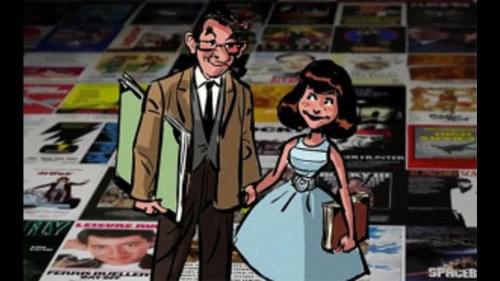
Harold was a storyboard artist and later an art director and production designer. Lillian ran her own research library, amassing a vast collection of books on just about everything that could be used by filmmakers to research their projects.

As the years passed they raised three sons (one of them autistic) and became  touchstones of sorts for other movie folk. They were decent, kind, hard-working and unbelievably talented.

“You felt you were with the best of Hollywood as it can be as a lifestyle,” said one colleague. (That explains why the makers of the animated “Shrek” based the characters of the king and queen on the Michelsons.)

Harold went from advertising art to movie storyboarding with Cecille B. DeMille’s “The Ten Commandments.”  In filmed interviews (he died a decade ago) Harold says he never met DeMille. He just looked at the script, made pen and charcoal drawings of what each shot might look like on the screen, and sent them up the chain of command.

Nevertheless, when you compare the finished film with Harold’s drawings you realize that DeMille and Co. were pretty much copying what Harold had given them, right down to the type of camera lens required for a specific shot.

Remember the famous shot in “The Graduate” in which a nervous Benjamin Braddock (Dustin Hoffman) is framed by the triangle of Mrs. Robinson’s (Anne Bancroft) thigh and calf?  That was Harold Michelson’s idea.

“The Graduate”

Also the sequence in which Benjamin dives into a swimming pool and surfaces to throw himself on a floating air mattress…which instantly becomes Mrs. Robinson on a hotel bed.

There’s a reason most movie storyboards go missing, says one Hollywood insider. No director wants to admit the best visual ideas in his film came from the storyboard artist.

Mel Brooks, for whom Harold storyboarded “Spaceballs,” recalled that his ideas were the difference between just OK and terrific. Harold produced “little goodies that made you look like a great filmmaker.”

Danny DeVito, a longtime friend and collaborator (and a producer of this doc), says of the process: “You’re directing through sketches.”

Continue Reading »

“BRIGSBY BEAR”  My rating: B+

100 minutes | MPAA rating: PG-13

Describing a film as “sweet” is tantamount to giving it the kiss of death (when it comes to movies we’re a sweet-aversive culture), but there’s no other word to describe the oddball beauty of “Brigsby Bear.”

Balancing lightweight comedy, melancholy undercurrents and an ultimately uplifting message, Dave McCary’s feature directing debut (after several shorts and many segments of “Saturday Night Live”) in some ways resembles such innocents-on-the-loose titles as “Being There” and “Edward Scissorhands.”

Our protagonist is James (“SNL’s” Kyle Mooney), who has spent his entire life in a bomb shelter with his parents (Mark Hamill, Jane Adams) after the outside world has turned toxic. At least he thinks they’re his parents.  Shortly after the film begins he learns that he was kidnapped as a newborn and has been raised in isolated secrecy.

Now the puzzled and perplexed James has been “rescued” and returned to the suburban home of his natural parents (Matt Walsh, Michaela Watkins) and spunky younger sister Aubrey (Ryan Simpkins). They’re eager to make him welcome (well, maybe not Aubrey so much) but there are plenty of adjustment problems.

James has only known two other humans his entire life, and now he’s told they’re criminals of the worse sort. The existence he knew was a total sham. He knows nothing about contemporary society, about pop culture, about the latest trends in language or social behavior.

Continue Reading »

Elizabeth Olsen, Aubrey Plaza

“INGRID GOES WEST” My rating: B

87 minutes | MPAA rating: R

Nobody does nuts like Aubrey Plaza.

Oh, she can play “normal” if required (TV’s Parks and Recreation”), but she really shines when the lets her crazy flag fly, as exemplified by her mental inmate in TV’s “Legion,” her suburban zombie in “Life After Beth” and her scary Medieval nun in the recent “The Hours.”

So Plaza is right at home in “Ingrid Goes West,” writer/director Matt Spicer’s very black comedy about an unhinged celebrity stalker.

As the film begins our heroine crashes a wedding and sprays Mace in the bride’s face.  (We later learn that the two women are strangers, but that Ingrid has been following the nuptial preparations on Instagram and is incensed at not being invited.)

When next we see Ingrid she’s being discharged from a mental facility. Shortly thereafter her mother dies, leaving Ingrid with $60,000.  She decides to relocate to Los Angeles so that she can be closer to a woman she has been obsessing over via social media.

Taylor (Elizabeth Olsen) is a perky, self-centered cutie who has become a celeb by displaying so much of her life on the Internet.  Like a Kardashian, she’s famous mostly for being famous. She has no discernible talents (she might find a gig as a personal shopper, though everything she bought would reflect her tastes rather than those of a client).

Continue Reading »

Catherine Deneuve, Catharine Frot

“THE MIDWIFE” My rating: B 

116 minutes | No MPAA rating

Two of France’s greatest actresses square off for the first time in “The Midwife,” delivering a quiet drama that engrosses without resorting to big “actorly” moments.

Claire (Catherine Frot, so terrific in last year’s “Marguerite”) is the title character of Martin Provost’s film, an employee at a Paris maternity clinic that soon will be shuttered to make way for a big corporate-run hospital.  She’s offered a job with the new outfit, but can’t abide the impersonal atmosphere of quota-run medicine. Which is a big problem…her work is the great joy of her life.

Mostly she lives a solitary, monkish existence. Her college-age son (Quentin Dolmaire) has quietly drifted away (there’s no mention of his father). And Claire is so health-conscious that she’s given up meat and wine (why live in France if you’re going to eat like an ascetic?).

Enter Beatrice (Catherine Deneuve), an aging party girl who has returned to France after years of jet setting. Back when Claire was a teen her father — a swimming champion — had an affair with Beatrice that broke up his marriage. After a few months Beatrice abruptly ended that relationship to gadabout the globe.

Now she’s come back to Paris to reconnect with the love of her life…only to be told by Claire that after being abandoned by Beatrice her brokenhearted father killed himself.

As far as Claire is concerned, after delivering that information she owes Beatrice nothing.  But the older woman reveals that she is dying of a brain tumor — not that she’s going to let a little thing like that cut into her lifestyle of good food and wine, smoking and gambling.

“The Midwife” is basically the story of how the vivacious, hard-living and unapologetically selfish Beatrice slowly transfers some of her values to the good, gray Claire.

That widening of Claire’s narrow horizon extends to a sweet affair with a truck driver (Olivier Gourmet) whose vegetable patch abuts her own.

There are no acting fireworks here.  Writer/director Provost has given us a drama that mostly adheres to the quiet rhythms of real life.

But these two effortlessly luminous actresses make the story compelling.

| Robert W. Butler

Jeremy Renner, Gil Birmingham

“WIND RIVER” My rating: B

*113 minutes | MPAA rating: R

With his screenplays for “Sicario” and “Hell or High Water” Taylor Sheridan joined the ranks of our best storytellers of the contemporary American West.

He cements that reputation — though not without a couple of minor missteps — by writing and directing “Wind River.”

Set on the sprawling Wind River Indian Reservation in mountainous central Wyoming, this snowbound mystery is triggered by the death of an 18-year-old Arapaho girl. Apparently she ran for several miles barefoot through a blizzard before succumbing to sub-zero temperatures. But what — or who — was she running from?

Her body is discovered by Cory Lambert (Jeremy Renner), a hunter for the wildlife service whose job is to eliminate wolves, cougars and other predators dining on domestic livestock. Soon he’ll be tracking down two-legged predators.

On one level “Wind River” is a buddy movie pairing the woods-smart Cory with Florida-reared Jane Banner (Elizabeth Olsen), an FBI agent dispatched to investigate what appears to be a murder on tribal land. He knows every snowfield and ravine within hundreds of square miles; she shows up without so much as a pair of long johns.

But as seems always to be the case with a Sheridan film, just as important as the mystery is the milieu in which it’s set.

In this case it’s a world of natural beauty and aching poverty, dying traditions and doped-up  youth. Here white assumptions collide with Native American realities. Resentments and prejudices can surface at any time.

Renner’s Cory is the perfect guide through these conflicting cultures. Born nearby and as comfortable in a cowboy hat as a fur-lined parka, he’s divorced from an Arapaho woman with whom he has a young son. In short, he’s a man with one foot planted in the white world and the other in Indian country.

Sheridan’s screenplay provides plenty of thumbnail portraits of colorful characters. Continue Reading »

“WHOSE STREETS?” My rating: B+  

90 minutes | MPAA rating: R

The 2014 killing of unarmed Michael Brown by a Ferguson MO police officer was a watershed moment in American race relations, spawning the Black Lives Matter movement and creating widespread resistance among African Americans to social, economic and law enforcement inequality.

It’s one thing to talk about these issues.  It’s another to live them.

After  the Brown shooting,  filmmakers Sabaah Folayan and Damon Davis took their cameras to the streets of Ferguson to record the aftermath: protests, looting, rioting (whether by protestors or police depends on your political outlook) and grass roots organizing.

The result is “Whose Streets?”, an incendiary 90 minutes that doesn’t even attempt a conventional evenhanded analysis of the situation.

Folayan and Davis’ film jumps feet first into the action, recording events in the streets in the immediate aftermath of the shooting and, as months go by, examining the growing resistance within the black community.

“Whose Streets?” wants us to feel African American outrage and dismay. It does’t analyze it. It doesn’t provide commentary or counterpoint. It simply observes.

And in doing so this documentary allows viewers to feel  what it’s like to be a black person in Ferguson.

Continue Reading »

Alia Shawkat

“PAINT IT BLACK” My rating: C+

94 minutes | MPAA rating: R

With a title like “Paint It Black” you don’t expect a barrel of monkeys, nor do you get one with actress Amber Tamblyn’s directing debut.

Indeed, “Paint It Black” is a self-consciously artsy downer; not even a last-shot glimmer of hope is likely to rouse audiences out of their glum funk.

Which is not to say the film is terrible.  It’s got some terrific acting and creative visuals. But it lacks the emotional substance to make us care.

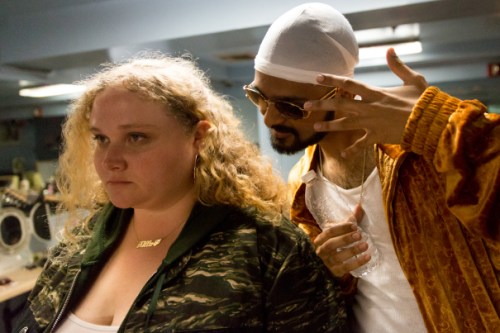
Current indie “it” girl Alia Shawkat stars as Josie, an artist’s model, black-out alcoholic and punk music groupie in pre-cell phone ’80s Los Angeles.

Early in the film (the screenplay is by Ed Dougherty and Tamblyn, adapting Janet Fitch’s novel) Josie receives news that her boyfriend Michael, who disappeared some time earlier, has committed suicide in a cheap hotel room.

In flashbacks we see how they met (she posed for nude studies in the class where he was an art student).  Their relationship, depicted in silent (save for music) snippets scattered throughout the film, is presented using Hallmark card visual shorthand (we see them discovering a junked upright piano, painting it together in their living room, spooning in bed etc.) .

They seem happy enough, though what a late-night carouser like Josie sees in the squeaky-clean Michael (Rhys Wakefield) is a mystery. Truth is, because he has only a few words of dialogue in the entire film, we get almost no sense of his personality.

Which makes Josie’s post-mortem obsession with Michael all the more unfathomable.

Turns out Josie isn’t the only one with Michaelmania.  His mother Meredith (the great Janet McTeer), a famous concert pianist, is also driven to the edges of madness by her grief and fury at having had to share her boy with this other woman.

The meeting of the two women is memorable — at Michael’s funeral Meredith tries to strangle Josie in front of the casket and a mortuary full of shocked mourners. Later Meredith raids the apartment where Josie and Michael lived, stealing all of his drawings, journals and personal effects.  Josie retaliates by sneaking into Meredith’s hilltop mansion and stealing back as much of the loot as she can carry.

We’re poised to see the story become a possibly violent test of wills between two women. But it never gets that far.

Continue Reading »

“TURN IT AROUND: THE STORY OF EAST BAY PUNK”  My rating C+ (Opens Aug. 12 at Screenland Tapcade)

155 minutes | No MPAA rating

Exhausting but nevertheless energetic, “Turn It Around: The Story of East Bay Punk” contains more information  than most of us will never need to know about the rise of punk music in the San Franscisco area.

Corbett Redford and Anthony Machitiello’s polished documentary is clearly an act of love. They bring to the table an encyclopedic knowledge of the scene, the bands and players who made the music, the promoters who gave them places to perform, the underground media types who chronicled  and promoted the movement.

Narrated by none other than the great Iggy Pop, this massive opus (2 hours, 35 minutes) mixes clever animation, talking heads, old performance footage and vintage graphics to lay out the tale.

Over in posh San Francisco the fading hippie movement was still wallowing in its own musical decline (in this telling Fillmore Ballroom promoter Bill Graham comes off as a hopeless tool of the establishment). But across the bay in Berkeley and in a host of nondescript working-class cities the kids were creating their own sound, inspired by the British punk movement but with its own indelible American stamp.

The music was driving and relentless (guitar solos were sneered at) and the lyrics embraced teen angst and fierce opposition to the system. Any system.

The film does capture the us-vs.-them attitude that prevailed among young punk purveyors and  fans, and there’s just enough of the music on the soundtrack to give you a sense of the chaotic, liberating scene.

Drawbacks? Well there are maybe three dozen interviewees, ranging from minor players to major figures (Jello Biafra, Billy Joe Armstrong), and while it’s amusing to witness the plump middle age into which so many of  these snarling rebels have slid, most of them are limited to, like, two sentences of on-camera talk before something else fills the screen.

The audience for “Turn It Around” mostly will be limited to hard-core punk fans. But they will not be disappointed.

| Robert W. Butler

Brie Larson

“THE GLASS CASTLE” My rating: C+

127 minutes | MPAA rating: PG-13

There are a few moments when “The Glass Castle” threatens to come to emotional life.

But they pass.

Heaven knows there’s a compelling story here.  Based on Jeannette Walls’ best-selling memoir of a wildly unconventional upbringing and a troubled maturity, this film describes a girlhood dominated by fiercely nonconformist parents who are always just a step ahead of the cops and the child services people. (This was a theme explored, with more success, in last year’s “Captain Fantastic.”)

But despite offering a hair-raising depiction of how not to raise children, Destin Daniel Cretton’s film plays more like a freak show — with one display of parental insanity following another — than the deeply moving drama it obviously aims to be.

New York City, 1989.  From a taxi window gossip columnist Jeannette Walls (Brie Larson, an Oscar winner for “Room”) spots a distressing and deeply personal vignette: An unkempt woman scrounges through a dumpster while her man rages at the passing traffic.

They are Rose Mary (Naomi Watts) and Rex (Woody Harrelson), Jeannette’s parents, who are squatting in an abandoned building and living hand to mouth.

This triggers a series of flashbacks to Jeannette’s nomadic and impoverished childhood and especially her relationship with Rex, a possibly brilliant man who is all ideas and no follow-through, a mean alcoholic and a charismatic ranconteur.

Rex is the kind of guy who, lacking money for Christmas presents, takes his kids outside to pick a star for their very own. (Awww.)  He’s also borderline abusive, teaching his terrified daughter to swim by throwing her in the deep end of the pool.

Rose Mary is only marginally more centered. She devotes herself to painting (without ever improving, apparently) and has no time for mundane stuff like feeding her offspring.  Continue Reading »

“STEP” My rating: A-

83 minutes | MPAA rating: PG

We live in demoralizing times.  All the more reason to check out “Step,” a spectacularly engaging documentary about youth, challenge and triumph.

Amanda Lipitz’s film (amazingly, her first) centers on the step team at the Baltimore Leadership School for Young Women, an institution designed to give at-risk girls and a shot at a rewarding future.  The institution takes pride in sending every one of its graduates on to a higher institution of learning.

Step is a competitive event in which young persons — predominantly African Americans — put on performances involving complex and often high-speed footwork, gymnastics and chanting.  The lyrics often reflect social issues. These routines are performed accapella — no musical backing — although the awesome sound of a dozen or more feet stomping out an irresistible beat is hypnotic in a most musical way.

It’s like a mashup of glee club and ROTC drill squad — minus the rifles and fueled by funk, sass and optimism. One participant describes it as  “making music with our bodies.”

“Step” follows a group of senior girls — the original class at BLSYW when it opened several years back — as they prepare for their last year of step competitions. That sounds like a formula for your basic sports documentary, but Lipitz casts a much wider net.  By film’s end we’re treated to a rich emotional experience that will leave more than few audience members groping for a Kleenex.

Three of these young women become the focus of the film.

The most charismatic is Blessin, a star-in-training who founded the step team and oozes charisma.  With an apparently inexhaustible collection of wigs and an outsized personality that takes over any room, she’s a force to be reckoned with. (The Marilyn Monroe poster in her bedroom says something about her aspirations.) Brimming over with confidence and energy (outwardly, anyway), Blessin could sell refrigerators to Eskimos.

She’ll need every bit of her drive, beauty and determination, for like most of her fellow students Blessin faces daily challenges that could easily derail her path to success. Her mother is loving but plagued by depression and anger issues — sometimes she can’t find the will to get out of the house to participate in counseling sessions about her daughter’s future.

And then there’s the issue of money. Like virtually all of her teammates, Blessin hasn’t the cash for a college education. Some sort of scholarship is her only hope. But a bad case of senioritis — marked by dropping grades and a quietly demanding boyfriend — makes that an iffy proposition.

Continue Reading »