Half Dickensian epic, half heart-wrenching domestic drama, “Lion” tells a real-life story so unlikely that it stretches credulity.
But it happened.
In 1986 five-year-old Saroo (Sunny Pawer, in one of the most astonishing performances by a young child ever captured on film) was living with his widowed mother and two siblings in a rural area of central India. His mother worked as a laborer (she literally lifted rocks all day); Saroo and an older brother stole lumps of coal from passing trains, trading them for food.
On one nighttime outing, Saroo was separated from his brother and found himself locked inside an empty passenger train being driven more than 1,000 miles to Calcutta to be decommissioned.
Little Saroo didn’t know his family’s last name or the town he hailed from. Worse, he spoke only Hindi, while the Calcuttans spoke Bengali.
For months the child lived on the street — begging, stealing, avoiding capture by criminals seeking child prostitutes. After several close calls Saroo found himself in an orphanage where, miraculously enough, he was paired with an Australian couple, John and Sue Brierley (David Wenham, Nicole Kidman).
Relocated to middle-class comfort in Tasmania, the lost boy seemed to have washed up in paradise. Not even the addition to the family of his troubled adopted brother, Mantosh — like Saroo an Indian orphan but with severe emotional and social issues — could seriously erode the fairy-tale quality of Saroo’s good fortune.
(By the way, John and Sue seem pretty good candidates for sainthood.)
Two-time Oscar winner Denzel Washington has never given — and may never again give — a performance as deep and revelatory as he does in “Fences.”
This screen adaptation of August Wilson’s 1987 Pulitzer-winning drama — directed by Washington — offers the ideal match of performer and part, allowing the actor to sink his teeth into a role so perfectly balanced in subtlety and grandiosity as to reduce most film acting to the level of cardboard cutouts.
The dialogue is rendered in a sort of mid-century black urban dialect, but the effect is nothing short of Shakespearean. In its power and complexity “Fences” feels like an African American “King Lear.”
Set in the late 1950s in a black neighborhood of Pittsburgh, Wilson’s drama centers on Troy Maxson (Washington), a man fiercely determined to keep his dignity while fighting his own set of demons.
A minor star of baseball’s Negr0 leagues, Troy was too old to benefit from Jackie Robinson’s integration of the majors, and that missed opportunity still rankles him. Now he works as a city trash collector and is noisily wrangling for a position as a truck driver, a gig usually restricted to whites. Troy sees that discriminatory policy less as a social injustice than as a personal affront.
Smooth talking but essentially combative, Troy nurses old hurts that gnaw at his manhood. He can be outwardly friendly and garrulous, a raconteur and an entertainer. But he can turn on a dime if the wrong button is pushed, and then his belligerent, dark side flashes. Troy invariably has a loquacious argument to justify his transgressions, but push him too hard and the dominating and intimidating side of his personality steps up to slap down his critics.
Wilson’s screenplay (actually it’s his stage play, with the addition of just one line of dialogue) provides Troy with an assortment of friends and family members who serve as his audience and occasional victims.
His wife Rose (a stunning Viola Davis) is a friendly, outgoing woman who has learned how and when not to push her explosive spouse. Often they seem true equals; at other times it’s obvious that Rose must walk on eggshells around her man. Continue Reading »
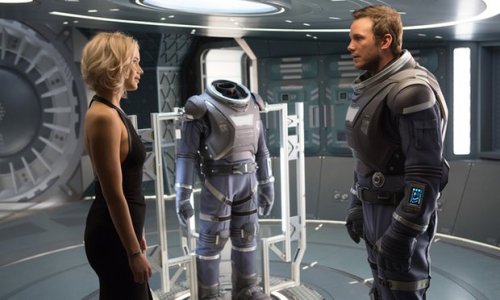
The problems plaguing the futuristic “Passengers” can be crystallized in the film’s mutating marketing campaign.
For months the film’s trailer has sold a story about a century-long intergalactic space flight during which two passengers — played by Jennifer Lawrence and Chris Pratt — awaken prematurely from hibernation.
Faced with a lifetime with just each other (their thousands of fellow travelers will slumber on for another 90 years), these two must fashion a new existence for themselves — Adam and Eve in their own mechanical Eden.
This week a new “Passengers” ad campaign hit our TV screens. It’s selling the film as a sci-fi romantic comedy.
Am I the only one who smells desperation?
In truth, “Passengers” is more interesting than either approach suggests. But having established a crushing moral conundrum as its premise, the filmmakers don’t know what to do with it.
Jim (Pratt) is among 5,000 passengers and 250 crew members snoozing their way to a colonized planet on the other side of the galaxy. He awakens from his slumbers to be told by hologram guides that the ship has arrived at its destination.
Except that the arrival is actually 90 years in the future, and Jim has the vast ship to himself. His sole companion is a robot bartender (Michael Sheen) programmed only for small talk.
Like Robinson Crusoe, Jim is overwhelmed by loneliness. His beard and hair grow shaggy. Though he is a mechanical engineer, he cannot put himself back to sleep or interfere with the ship’s automatic functions.
Even an SOS sent back to Earth will require 55 years for a response.
And then, another passenger, the beautiful Aurora (Lawrence) awakens in a way I won’t spoil, but the issues it raises spoil the movie. Continue Reading »
Gotta give Natalie Portman props for climbing out on a limb.
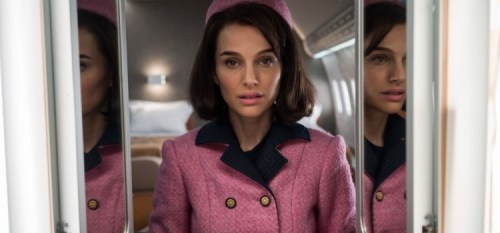
In “Jackie” the Oscar winning actress (for “Black Swan”) takes on the iconic role of Jackie Kennedy.
It’s one of those damned-if-you-do, damned-if-you-don’t deals: Try too hard to hit all the familiar notes and you get an impersonation, not a performance. But stray too far from the public image and audiences no longer relate.
Well, Portman has the Jackie audio-visuals down — the hair, the pink pillbox hat, those breathy/halting vocal patterns. And if she doesn’t give us a definitive study of who this woman was (do any of us really know the answer to that one?) she provides a compelling center for a often gripping film.
The screenplay by Noah Oppenheim (who earned his political bona fides as a producer for “Today” and “Hardball with Chris Matthews”) unfolds in the week after J.F.K.’s assassination as the new widow sits down to a series of interviews with a journalist (unnamed but clearly based on White House insider Theodore H. White) played by Billy Crudup.
Jackie’s motives are fuzzy. She wants to get her side of the story out, but puts all sorts of off-the-record restrictions on which of her statements can be made public. Perhaps she’s simply looking for an impartial listener against whom she can bounce conflicting emotions that range from profound grief to rage. (She asks her interviewer if he’d like her to describe the sound of a bullet tearing through her husband’s skull.)
Around that core setting this film from Chilean director Pablo Larrain offers a series of impressionistic moments from one of the most traumatic weeks in American history. For those too young to have experienced those dark days of November, 1963, the film captures the anguish, fear and outrage unleashed by the murder of a President.
There are also flashbacks to seminal moments in Jackie’s past, particularly the famous live TV tour of the White House. Only this time we’re allowed to eavesdrop on what went on during the commercial breaks…according to “Jackie,” the First Lady was terrified of the whole enterprise, with her fears coming through in a brittle, vaguely anesthetized vocal delivery.
The film’s depiction of the assassination is hair-raising. We’ve been there dozens of times in other movies, but never from the point of view of Jackie, cradling her husband’s smashed head in her lap as chaos erupts around her.
And the machinations that followed the killing as the nation prepared to lay their leader to rest tell a story many of us have never heard. Fearing a broader conspiracy might still be in play, the Secret Service nixed the idea of a slow funeral procession to Arlington National Cemetery. But that’s precisely what Jackie demanded and got — a tribute to her dead husband that made potential targets of the new President, her own family and numerous world leaders.
That steely will is new to the public perception of Jackie, and suggests a stronger, more assertive personality than we expect.
There are things in “Jackie” that don’t work — particularly Peter Sarsgaard’s portrayal of Robert Kennedy. He doesn’t look or sound like the man he’s portraying, and those discrepancies take us out of the picture.
“Collateral Beauty” starts out as an imaginative riff on that old chestnut “A Christmas Carol.”
Alas, it ends by leaving the audience feeling used and abused.
The latest from director David Frankel (“The Devil Wears Prada,” “Marley and Me,” “Hope Springs”) stars Will Smith as Howard, the poet/guru of a boutique advertising agency who, in the aftermath of his child’s death, has become a vacant-eyed wraith.
Howard still comes to the office, but he no longer services clients or gives New Age-y pep talks to the staff. Now he devotes his energy to building elaborate domino constructions which he then destroys in gravity-fueled chain reactions.
His partners in the firm — Whit (Edward Norton), Claire (Kate Winslet) and Simon (Michael Pena) — are frantic. With Howard in a funk their business is circling the drain…it’s looking like all they’ll be getting for Christmas are unemployment checks.
So they come up with a desperate — and, BTW, wildly unethical — plan. Learning that Howard has been mailing agonizing letters to Death, Love and Time (you’ve got to wonder what the Post Office does with them), they hire three struggling actors to portray those very concepts.
The idea is to have these “spirits” pop in unexpectedly on Howard. Hopefully these confrontations with the Great Unknown will push him out of his shell of grief and misery.
Hmmm. What possibly could go wrong with an elaborate metaphysical ruse thrust upon a severely depressed individual?
The actors (they’re members of the Hegel Theater Company, which suggests they have struggles of their own) take the job because they need the cash — they’re about to lose the lease on their theater.
The leader and mother hen of the bunch is Brigitte (Helen Mirren), who will embody Death. Amy (Keira Knightley) will approach Howard as Love. Raffi (Jacob Latimore) will perform the role of Time.
Brigitte, played by Mirren as amusing font of actorish ego and process, thinks this could be the performance of her lifetime: “He’s reaching out to the cosmos for answers. We get to be that cosmos.”
Brigitte is such an old ham than when her colleagues question the morality of the gig, she eagerly volunteers to play all three roles.
From practically its first frame “La La Land” announces that it’s not going to be your routine movie experience.
In one long, impossibly complicated moving shot, several hundred motorists — stranded by a traffic jam on an L.A. freeway — spontaneously break into dance, boogying on their car roofs, leaping, prancing and singing the new song “Another Day of Sun.”
Yes, it’s a musical.
Damien Chazelle, the 31-year-old auteur who displayed his love of both cinema and jazz with 2014’s stunningly intense”Whiplash,” here attempts nothing more than to take on the long tradition of Hollywood musicals.
“La La Land” is a bittersweet romance, a valentine to jazz and our collective memories of classic movies, and a sterling example of state-of-the-art filmmaking. Small wonder it received a leading seven Golden Globe noms and is a front-runner for Oscar’s best picture.
Our guy is Sebastian (Ryan Gosling), a Miles-and-Coltrane-loving jazz pianist who dresses in ’50s retro Sinatra style, drives a pristinely restored land-shark convertible and dreams of running his own club.
For now, though, he miserably plinks out Christmas carols at a supper club, incurring the owner’s wrath by embellishing familiar tunes with bebop digressions.
“I’m letting life hit me until it gets tired,” he rationalizes.
Our girl is Mia (Emma Stone), an aspiring actress who pours java at a coffee shop on the Warner Bros. lot. Mia throws herself into dispiriting auditions, where her heartfelt emoting is often rudely interrupted by the casting director’s cellphone and gofers delivering lunch.
As with Fred Astaire and Ginger Rogers, they meet cute, dislike each other, meet again and click, their deepening relationship encapsulated in a couple of brilliantly choreographed (by “So You Think You Can Dance’s” Mandy Moore) numbers: an exuberant dance on a hillside drive in Griffith Park at sunset, and a gravity-free after-hours pas de deux in the park’s famous observatory. Continue Reading »
After nearly 40 years of Wookies, Jedis and Imperial storm troopers, am I finally over the whole “Star Wars” thing?
The sad truth is that I was underwhelmed — sometimes flat-out bored — by “Rogue One,” the latest addition to the “SW” universe.
And here’s the thing…it’s not a bad movie. Certainly not bad like the three George Lucas-driven prequels were.
“Rogue One” is reasonably well acted and technically flawless. Moreover, it’s an attempt to make a more adult, racially-diverse “Star Wars” film, a stand-alone tale that is darker both thematically (it’s like an intergalactic Alamo where everyone goes down fighting) and visually.
Nevertheless, “Rogue One” is emotionally lifeless. I didn’t care.
Director Gareth Edwards and the producers and writers have worked so hard to hit familiar buttons of “Star Wars” mythology that the resulting film feels generic, as if it were directed by a committee rather than a single visionary individual.
The plot, for those who have been living in the spice mines of Kessel, follows the efforts of a team of rebel spies to steal the plans for the Death Star, an enterprise that will result in the destruction of said moon-sized weapon by Luke Skywalker in the original “Star Wars” movie.
Our heroine is Jyn (Felicity Jones), whose scientist father Galen (Mads Mikkelsen) was taken from her to develop the Death Star. After years of crime and imprisonment, Jyn is given an opportunity by the Rebel Alliance. She will be part of a team tasked with finding Galen and getting those precious plans.
They’re a mixed bag of idealists and pragmatic warriors.
Foremost among them is Cassian (Diego Luna), the ostensible head of the team who, unbeknownst to Jyn, as been secretly ordered to assassinate her father, lest his genius bring the Death Star to completion.
Chirrut (Donnie Yen) is a blind swordsman who relies on The Force to battle enemies. A pretty obvious nod to a subgenre of samurai films, he’s got a grouchy partner (Wen Jiang) who fights with a monstrous hand cannon.
Bodhi (Riz Ahmed) is a pilot who knows his way around the Empire’s military outposts.
Best of the bunch is K-2SO (voiced by Alan Tudyk), a towering droid made by the Empire but reprogrammed to serve the Rebel Alliance. Apparently K-2SO also was given a microchip for sarcasm and irony, which he exercises regularly at the expense of his human cohorts. Continue Reading »
Tom Ford’s “Nocturnal Animals” is a fascinating failure.
But even if it doesn’t quite work, it remains so ambitious, so daring that it overshadows other films considered “successful” simply because they aim so much lower.
Ford, the celebrated fashion designer whose first feature directing effort was “A Single Man” back in 2009, wastes no time bitch-slapping his audience. Under the opening titles of “Nocturnal Animals” Ford gives us slo-mo footage of obese women dancing. They’re naked except for marching band kepis and thigh-high drum majorette boots.
These images are part of the latest exhibit in a trendy LA art gallery operated by Susan (Amy Adams), a cooly coiffed and clothed woman who lives in a multi-million-dollar minimalist glass house overlooking the city.
Susan is rich — she’d be richer, but her faithless hubby Hutton (Armie Hammer) has managed to blow a big chunk of their nest egg — and her inner life seems about as sterile as her modernist home. After all, what kind of person keeps a bowl of real artichokes on the counter of her spotless, soulless kitchen? It’s not like anyone’s going to grab one up for a quick snack.
“I feel guilty not to be happy,” she laments. Poor little rich girl.
Susan’s outwardly comfy, inwardly anguished world makes up one of three levels of reality explored in Ford’s movie.
Out of the blue she receives a manuscript from her first husband, Edward, whom Susan hasn’t seen in 19 years. It’s a soon-to-be-published novel accompanied by a note that suggests Susan was at least in part the inspiration for the story.
Flattered, Susan takes advantage of a week without her husband (Hutton is off to New York with his latest girlfriend) to dive into Edward’s novel. The story that unfolds becomes “Nocturnal Animals'” second layer of reality.
In this book within a movie we find Tony (Jake Gyllenhaal), his wife (Isla Fisher) and teenage daughter (Ellie Bamber) driving across West Texas in the dead of night. They fall victim to a gang of young rednecks led by the scary Ray (an almost unrecognizable Aaron Taylor-Johnson), and soon the family members are fighting for their lives. Continue Reading »
Doesn’t life provide us with enough grief? Do we have to buy movie tickets to experience more of it on the big screen?
It’s an understandable sentiment … and completely wrong in the case of “Manchester by the Sea.”
Brilliantly written and directed by Kenneth Lonergan (“You Can Count on Me”) and featuring a major-league lead performance from the ever-surprising Casey Affleck, this riveting, soul-wrenching feature is about how we deal — or don’t — with grief.
Yeah, it’s heavy. It’s also unexpectedly funny, deeply moving and almost unbearably wise when it comes to the labyrinthine workings of the human heart.
We first encounter Lee Chandler (Affleck) on the job at a Boston-area apartment complex. In return for handyman chores — hauling trash, blowing out drains — he’s allowed to live in a monkish cellar room. Lee is a prickly sort who often rubs tenants the wrong way. At night he drinks until it’s time to instigate a barroom brawl.
Clearly, something’s eating at this guy.
When word arrives that Lee’s older brother, Joe, has died of a heart attack, he reluctantly returns to the Massachusetts fishing village of his youth to settle affairs. There Lee discovers that he has been named as the guardian of Joe’s 16-year-old son, Patrick (Lucas Hedges).
He’s totally unprepared.
Lonergan’s screenplay is a sort of psychological mystery that alternates scenes of Lee in the present — struggling with the horny teen for whom he is now responsible, encountering faces from his youth — with his troubled past, depicted in flashbacks that drift in and out without warning.
In these scenes from Lee’s earlier life we see him working a fishing boat with his brother (Kyle Chandler) and get glimpses of his home life with wife Randi (Michelle Williams) and three small kids.
He’s friendly, even borderline jolly.
Clearly something traumatic occurred between then and now. Continue Reading »
It has great cinematography. Deep connections between humans and animals. And a ton of female empowerment.
All good.
Still, “The Eagle Huntress” is troubling when it comes to documentary authenticity: Chunks of this “nonfiction” picture feel as if they were re-staged for the camera.
Set in the mountains and rolling plains of Mongolia, Otto Bell’s doc follows 13-year-old Aisholpan, the daughter of the nomadic herder Nurgaiv. Like countless generations before him, Nurgaiv puts food on his family’s table by capturing and training golden eagles that act like highly skilled hunting dogs.
It’s a father-to-son tradition that is about to get a swift kick in the keister. Aisholpan — with her doting father’s cooperation — is determined to own and train her own eagle. Moreover, she plans on competing in a sort of raptor rodeo that attracts participants from hundreds of miles.
So this sweet, totally inoffensive youngster is about to weather not only the rigors of eagle hunting but the disapproval of the patriarchal society into which she was born.
After an introductory segment that explains the eagle hunting tradition (“Star Wars” actress Daisy Ridley provides the narration) and some of the details of Aisholpan’s life (she attends a boarding school in a regional town and only gets home on the weekends) the film captures the efforts of Aisholpan and her father to descend down a cliff face on ropes to snatch a baby eaglet from its aerie.
The idea is to grab a young bird when it’s strong enough to survive outside the nest but not yet able to fly. (Though it’s not explained in the film, this was the first scene shot by Bell and his crew, who fortuitously visited Nurgaiv’s campsite on the very day the father and daughter were planning the adventure.)
This is followed by months of bonding and practice, a visit to the big eagle festival — where Aisholpan and her bird stun the competition — and on to a winter hunt that will prove once and for all whether this teenage girl has the right stuff. Continue Reading »








 Butler's Cinema Scene