Feeds:
Posts
Comments

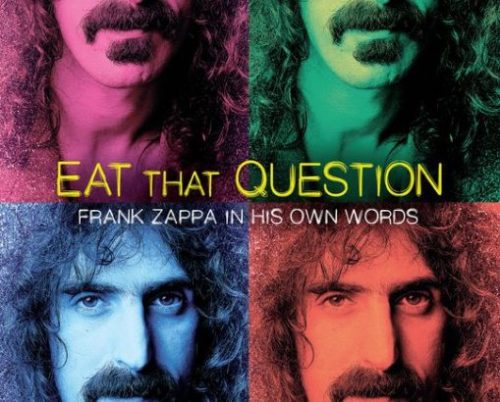
Eat-That-Question-Frank-Zappa-in-His-Own-Words-509x410“EAT THAT QUESTION: FRANK ZAPPA IN HIS OWN WORDS” My rating: B+

93 minutes | MPAA rating: R

Rock legend Frank Zappa once observed that while he might be a household name, most people had never heard a bar of his music or knew why he was famous.

Nearly a quarter century after his death from prostate cancer, things haven’t changed all that much.  Zappa — founder, composer and lead guitarist for the Mothers of Invention — still has die-hard fans (present company included), but he’s off the radar of most millennials.

“Eat That Question” has the power to change that.

A documentary about Zappa could go in a dozen different directions.  Filmmaker Thorsten Schutte has chosen to concentrate almost exclusively on what Zappa had to say about himself and his music in dozens of filmed interviews.

Oh, there are snippets of live performances — enough to convince even the tone deaf of Zappa’s adventurous explorations of musicial styles ranging from doo-wop to classical, of his guitar skills and of the extraordinarily high degree of musicianship he  demanded of his players.

But mostly this is Zappa talking — and what a talker he was!

It begins with Zappa telling a interviewer that being interviewed is an artificial situation “two steps removed from the Inquisition.”

What’s amazing, given the stupefying cluelessness of many of the media types who grill Zappa (one calls him “Mephistophelian”), is the weary tolerance he exhibits, allowing his dry wit to now and then comment on the vapidity of the whole process.

(It should be noted here that Schutte’s film provides a mostly positive view of Zappa, a man quite capable of behaving like an asshole — asshole-ism and genius not being mutually exclusive qualities. The cast members of “Saturday Night Live” have voted Zappa their least favorite guest host of all time…no small thing given that Steven Seagal was also in the running. Well, Zappa didn’t suffer fools gladly, and he wasn’t about to cave to some network executive’s idea of humor.)

He was a social commentator whose lyrics gnawed away at what he saw as the vapidity of contemporary American culture. He wasn’t overtly political — he was way too much a rugged individualist to wave the banner for any organized cause — but Zappa was in his own way a great moralist.

Yeah, he often used naughty language and adolescent sex jokes and crude humor. But what used to be shocking now seems pretty mainstream. The messages he sent — especially his contempt for religion and a misleading mass media — are as vital as ever. (In one TV interview Zappa predicted that America was rapidly heading toward a right-wing theocracy.)

Continue Reading »

sausage-party-post1“SAUSAGE PARTY”  My rating: B

90 minutes | MPAA rating: R

The animated “Sausage Party” is so thick with puerile sexuality that a viewer must choose between bailing on the whole experience or embracing it in a spirit of unfettered adolescent humor.

I  mean, here’s an R-rated movie about a hot dog named Frank (Seth Rogen) who dreams that Brenda (Kristen Wiig), the bun he has worshipped from afar, will open up and allow him to nestle his full length in her soft, spongy interior.

Other characters include a lesbian taco with a Mexican accent, a bottle of tequila that talks like a wise old Indian chief, a neurotic jar of honey mustard, a box of grits and even a used condom. Then there’s  Lavosh — a Middle Eastern wrap — who is always exchanging insults with a Jewish bagel. The villain of the piece is the megalomaniac Douche (yes, a feminine hygiene product).

These characters are brought to life by a Who’s Who of voice talent that includes Salma Hayek, Bill Hader, David Krumholtz, Danny McBride, Craig Robinson, Jonah Hill, Edward Norton, Michael Cera, Paul Rudd and James Franco.

Narratively “Sausage Party” feels likes something a bunch of stoners dreamed up at 2 in the morning (duh).

It’s July 3 in the supermarket, and all of the products sitting on the shelves are pumped because so many of them will be “chosen” by the “gods” (i.e., human shoppers) and taken out of the store to what they are sure will be a paradisiacal eternity in the Great Beyond. They  celebrate their imminent liberation in a rousing song (music by Alan Menken).

Frank and his fellow wieners (they’re crammed in eight to a package) have been gazing lustfully at a nearby package of buns (six to a package…go figure), awaiting the day they will be joined in the hereafter,  “where all your wildest and wettest dreams come true.”

Continue Reading »

%%%, Mel Gibson

Erin Moriarty, Mel Gibson

“BLOOD FATHER”  My rating:  C+

88 minutes | MPAA rating: R

“Blood Father” is a comic book crime thriller — pulpy and superficial.

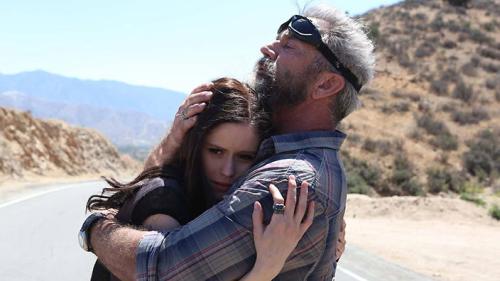
Yet it also features an arresting (if not precisely compelling) performance from Mel Gibson as a weary ex-con who suddenly finds his estranged teenage daughter violently thrust back into his life.

We first encounter Gibson’s John Link at an AA meeting in a windswept desert burg. He runs a tattoo business out of his rusting mobile home, pees weekly into a cup for his parole officer and with the help of his sponsor (William H. Macy) tries to stay clean after a lifetime of excess and crime.

Enter 17-year-old Lydia (Erin Moriarty), the child he hasn’t seen since her infancy.  Lydia has run away from home, gotten involved with Jonah (Diego Luna), the jerk scion of a family running a Mexican drug cartel, and is now on the run from her boyfriend and his murderous associates.

She’s spoiled, arrogant, and stupid.

In fact, with the exception of Macy’s character, there’s not a genuinely likable figure in Peter Craig and Andrea Berloff’s screenplay (an adaption of Craig’s novel). If Gibson’s Link eventually emerges as semi-heroic, it’s only because our options are limited. And because Gibson was born to play this sort of character.

Needless to say, Lydia’s presence brings down all sorts of woes on Link, who to protect his daughter must go on the run, thus breaking his parole. And that’s not even counting the bodies that start piling up.


Continue Reading »

Logan Lehman, Sarah Gaddon

Logan Lerman, Sarah Gaddon

“INDIGNATION”  My rating: B

110 minutes | MPAA rating: R

As a producer and/or writer of most of Ang Lee’s films, James Schamus has established a reputation for intelligent —  even intellectual — filmmaking.

Now the CEO of Focus Features has made his directing debut, and as you’d expect from the man who wrote an entire book about one of the most confounding and polarizing films ever — Carl Theodore Dreyer’s emotionally arid “Gertrude” — it is brainy, challenging and not a little perplexing.

“Indignation” is based on Philip Roth’s 2008 novel, and a more faithful adaptation can hardly be imagined. Even to the point of duplicating things in the novel that have little hope of working on film.

Logan Lerman (“The Perks of Being a Wallflower,” “Fury”) is Marcus, a New York Jew who has landed a scholarship to Winesburg College in Ohio.

The year is 1951 and as long as he remains a student in good standing, Marcus can avoid the draft that is gobbling up his childhood friends for Korean cannon fodder. Staying in school is, for all intents, a life insurance policy.

But he finds Winesburg’s middle-American ethos and white Protestant outlook disconcerting. For starters, Marcus is assigned a dorm room with the only other two Jews  on campus who aren’t members of the Jewish fraternity.  These three individualists — one is probably gay, the other antisocial — form their own little ghetto.

And then there’s the weekly chapel requirement, which demands that all students show up to hear the campus chaplain drone on about Jesus.

Here’s the thing about Marcus.  Though he knows relatively little of the real world — he’s a virgin, he’s never worked outside his father’s butcher shop — he’s a borderline genius. And with that comes a degree of arrogance and, well, indignation at the way he’s being treated.

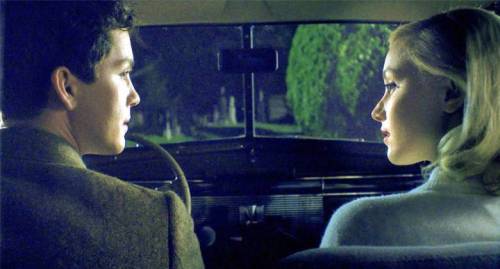
Things look up when he meets blonde coed Olivia (Sarah Gadon), whom he takes to a fancy dinner (Escargot! This son of a kosher butcher has never dreamed of such excess) and who rewards him afterward with a matter-of-fact blow job.

Marcus is so stunned, his moral compass so bent by this experience that he immediately ends the relationship.  Although he can’t resist standing outside her dorm late at night trying to find Olivia’s window.

Continue Reading »

inno“THE INNOCENTS” My rating: B+

115 minutes | MPAA rating: PG-13

Religious faith, political ideals, ignorance, charity, war, extreme human cruelty…there’s hardly a big topic that isn’t touched on in “The Innocents,” writer/director Anne Fontaine’s terribly sad and quietly riveting film set in rural Poland in the months after the end of World War II.

In the dead of night Mathilde (Lou de Laage), a French Red Cross nurse working with the survivors of German POW camps, is summoned to an ancient convent. There she discovers one of the holy sisters in labor.

The Mother Superior (Agata Kulesza) resents that an outsider has arrived to witness the order’s shame. She would prefer to have the patient die in childbirth. God’s will, and all that.

Nevertheless, Mathilde swears to keep the secret and performs a Caesarian section. Later the convent’s Number Two, Sister Maria (Agata Buzek), explains that the Mother Superior fears that the ignorant local populace would shun the nuns if word of the birth got out. It could mean the end of the convent.

One can only imagine how the locals would react if they knew that at least seven of the sisters are pregnant, and that virtually every resident — including Mother Superior — was raped repeatedly by Russian soldiers who seized the neighborhood nine months earlier.

“They should have killed us,” one of the sisters laments.

Set in a bleak winter landscape and filmed with a washed-out palette in which flesh tones provide the main source of color,  “The Innocents” uses this situation to study the various ways in which we deal with the injustices of an often-cruel world.

Mathilde, for example, is an atheist and a Communist (ironic, given that she narrowly escapes being gang raped by a squad of Soviet troops at a roadblock). But she is also a humanist and a healer, so she risks nighttime returns to the convent, which is quickly becoming a primitive maternity ward.

Continue Reading »

eqmaxresdefault“EQUALS” My rating: B-

101 minutes | MPAA rating: PG-13

The dystopian future depicted in Drake Doremus’ “Equals” is on one level pretty attractive.

The people are mostly young, well fed and moderately good looking. Everyone wears white clothing and works and lives in uber-modern buildings of glass, plastic and concrete. There appears to be no crime.

Also, no joy. This civilization — formed after a war that left most of the Earth a smoking ruin — views emotion as a sickness or perhaps a crime. Citizens are bombarded with public service announcements alerting them to the symptoms of SOS — “switched-on syndrome” — in which they will begin to be overcome by emotions.

It’s like a being told you have AIDS…as the disease progresses the sufferers will become ever more unstable. Eventually they will be institutionalized and destroyed. Many choose suicide.

Early in “Equals” Silas (Nicholas Hoult) is diagnosed with an early stage of the disease. His coworkers are understanding but cautious…he won’t be required to wear a face mask, but his work station will be set apart from theirs.

He senses that a co-worker, Nia (Kristen Stewart), may also have SOS. Slowly they are drawn to commit the ultimate sin: A love affair.

Continue Reading »

Viggo Mortensen

Viggo Mortensen

“CAPTAIN FANTASTIC” My rating: B- 

118 minutes |MPAA rating: R

There’s something phony…or at least seriously muddled…at the heart of “Captain Fantastic.”

Which doesn’t keep it from being intermittently entertaining and even borderline charming.

Matt Ross’ dramedy stars Viggo Mortensen as Ben Cash, the hippie-dippie/drill instructor Dad to six kids he’s rearing deep in the woods of the Pacific Northwest.

A typical day for these youngsters — they range in age from 5 to 17 — consists of rigorous physical exercise, survival training, hand-to-hand combat and some serious hitting the books. (And I do mean books…there’s no Internet or electricity out in the bush.)

They bathe in streams, grow food in a greenhouse and hunt the local wildlife, and at night hold family jam sessions around the campfire (Ben plays a mean guitar, not to mention the bagpipes).

Ben is what you might call a left-wing survivalist. He’s convinced of the immorality and uselessness of most modern society, and has trained his kids to parrot his views. The family doesn’t celebrate Christmas; the big day on their calendar is Noam Chomsky’s birthday, which Ben marks by presenting each of his offspring with their own very wicked-looking hunting knife.

They’re like a military unit, moving in perfect harmony whether running down a deer or shoplifting groceries.

Just because they’re growing up in the boonies doesn’t mean the Cash kids are intellectually deprived.  The  youngest of them can recite the Bill of Rights and the Declaration of Independence, and the 12-year old is reading Middlemarch. The oldest, Bodevan (George MacKay), has a handful of acceptance letters from Ivy League schools; he’s trying to decide when to inform his father of this latest triumph (since it will mean leaving the fold).

Where is Mom, you ask? We never see her — alive, anyway. We learn that she’s been gone for several months for hospital treatment. And the bulk of the film consists of the clan’s road trip to Albuquerque to attend her funeral.

The opening scenes of “Captain Fantastic” are kind of idyllic — if you can ignore the fact that Ben is raising a brood  largely unequipped to deal with contemporary society.

But once the family members find themselves dealing with the outside world — in the person of Matt’s sister-in-law (Kathryn Hahn) and her husband (Steve Zahn) and his wife’s very rich, very opinionated, and (one suspects) very Republican father (Frank Langella) — we realize just what fish out of water they are. Continue Reading »

Matt Damon as Jason Bourne

Matt Damon as Jason Bourne

“JASON BOURNE” My rating: C+

123 minutes | MPAA rating: PG-13

It’s good to see Matt Damon back in action.

“Jason Bourne” marks his return to the renegade spy franchise after sitting out 2012’s “The Bourne Legacy” (in which Jeremy Renner played a fellow super assassin).

But let’s get real: This installment is less a continuation of the saga than a recycling of stuff we’ve already seen.

To say it’s superficial is giving it too much credit.

Writer/director Paul Greengrass (who helmed Nos. 2 and 3 in the series, “The Bourne Supremacy” and “The Bourne Ultimatum”) doesn’t even make a token effort at original plotting or character development. Nobody in this film has an inner life.

What he concentrates on to the exclusion of all else is movement.

The film is one long chase around the globe (Greece, Iceland, D.C., Berlin, London, Las Vegas) captured in jittery handheld camerawork and rapid-fire cutting. Is there one shot here that runs for as much as five seconds? Don’t think so.

At first it’s exciting. The movie radiates energy like a pubescent boy on a three-day Red Bull binge.

After a while it becomes numbing.

We encounter our fugitive hero on the Greece/Turkey border, where he has a gig as a street fighter. Basically he beats up other pugilists for money. It’s ugly work, but it keeps Bourne off the grid.

Enter former CIA agent Nicky Parsons (Julia Stiles), who has turned on her former employers and has now discovered evidence of the origins of the Treadstone superspy program — including a revelation about the crucial role played by Bourne’s late father.

But back in Virginia, CIA director Robert Dewey (Tommy Lee Jones, looking ever more like a 3-D topographical map of Arizona) is on the hunt for our man. Dewey is putting the final touches on a sixth-generation version of Treadstone and doesn’t want a wild card like Jason Bourneout there to spill the beans.

He employs the talents of cyber analyst Heather Lee (Alicia Vikander) to track down Bourne. Soon Heather comes to believe that maybe Bourne isn’t such a bad guy after all (although her long game is hard to pin down).

But Bourne still must contend with another assassin, known only as “The Asset” (Vincent Cassel), who carries his own grudge against our hero. Continue Reading »

Jesse Eisenberg, Kristen Stewart

Jesse Eisenberg, Kristen Stewart

“CAFE SOCIETY” My rating: B-

96 minutes | MPAA rating: PG-13

It’s tough getting a handle on Woody Allen’s “Cafe Society.”

It’s not a drama, certainly. Its approach is too tangential and distant for any sort of emotional intensity.

But it’s not exactly a comedy, either. Despite a few chuckles there’s a noted paucity of laugh lines, and those bits of dialogue that do register are noteworthy not for their hilarity but rather for their weary resignation. (“Life is a comedy written by a sadistic comedy writer.”)

And despite being set in 1930s Hollywood, it has none of the nostalgic warmth of “Radio Days,” Allen’s memorable reverie about growing up in NYC in the glory days of radio.

So what does “Cafe Society” have going for it?

Well, good performances from Kristen Stewart and Blake Lively, spectacularly good cinematography from Vittorio Storaro (“Apocalypse Now,” “The Last Emperor”) and detailed production design courtesy of Allen’s frequent collaborator Santo Loquasto.

As the picture begins young Bobby Dorfman (Jesse Eisenberg) has fled his suffocating home in the Bronx (Jeannie Berlin and Ken Stott are his bickering parents) to tackle life in wide-open Los Angeles. He hopes to get a job from his uncle Phil (Steve Carell), a Hollywood agent who drops celebrity names with the frequency with which the rest of us use words like “a” and “the.”

Phil is so busy (or self centered) that he keeps Bobby cooling his heels for weeks. (It must be noted that unlike your usual Allen protagonist, someone who’s hugely clever and bent on a career in the arts, Bobby is pretty much an average guy.)

Finally Phil sees the kid and assigns his girl Friday, Vonnie (Stewart), to show his nephew around Tinsel Town.

Between gawking at the homes of the stars the two youngsters hit it off. But unbeknownst to Bobby, Vonnie is having an affair with a married man. This is no small roadblock to their relationship.

Continue Reading »

xxxxxx

Julian Dennison

“THE HUNT FOR THE WILDERPEOPLE”  My rating: B-

101 minutes | MPAA rating: PG-13

Kiwi filmmaker Taika Waititi had a classic cult hit with 2014’s “Things We Do in the Shadows,” a hilarious faux documentary about a pack of inept bickering vampires living in a rickety urban home. With its talking-head technique and absurdist attitude it was a close cousin to the comedies of Christopher Guest (“Best in Show,” “Waiting for Huffman”).

For his followup, “The Hunter for the Wilderpeople,” Waititi is channelling Wes Anderson, especially Anderson’s sublime “Moonrise Kingdom.”  If you’re going to pattern yourself on a recent film, that’s a pretty good one to emulate.

Ricky (Julian Dennison) is a rotund, sullen 13-year-old juvenile delinquent. He’s been a ward of the state most of his life and now he’s out of options. Having run away from countless foster homes, he’ll be on his way to a prison if his latest placement doesn’t work out.

As the film begins he’s being deposited on the farm of Bella (Rima Te Wiata) and Hector (Sam Neill), a married couple living in glorious isolation deep in a fantastic landscape of jagged mountains, jungle and winding streams. Paula (Rachel House), the brusque social services lady who delivers him, doubts that Ricky can be turned around…but at least this far from civilization there’s a limit to how much harm he can do or how far he can go.

Bella, a talkative woman desperate for motherhood (and quite capable of killing a wild boar with a knife), does her best to make a home for this resentful wild child. Her husband Hector, a bearded survivalist type, is unimpressed by this surly interloper with a gangsta/rapper wardrobe.

Wapiti’s screenplay s boils down to an extensive chase. After an initial adjustment period, Ricky softens and starts to get comfortable with life in the sticks. Hector  still isn’t crazy about this wise-ass city kid, but they become partners in crime and soon are hiding in the woods and living off the land while an ever-growing army of cops, park rangers, bounty hunters and others try to bring them in.

Like an Anderson movie, “Wilderpeople” features titled chapters (“A Real Bad Egg,” “Another Door,” “Broken Foot Camp”) and daring tonal shifts, going from physical comedy to heartstring-tugging emotion, social satire to a celebration of innocence to a tactile emersion in a gorgeous natural world.

Continue Reading »