Feeds:
Posts
Comments
Christian Bale, Natalie Portman

Christian Bale, Natalie Portman

“KNIGHT OF CUPS”  My rating: C-

118 minutes | MPAA rating: R

There lurks in “Knight of Cups” the makings of a pretty good travelogue.

But on most other counts the latest feature  from the increasingly irritating Terrence Malick shows him firmly stuck in the same prison of self parody that doomed his last outing, the unromantic romance “To the Wonder.”

Malick, of course, is the low-profile cinematic genius who back in the ’70s gave us “Badlands” and “Days of Heaven,” then moved on to offbeat period pieces (“The Thin Red Line,” “The New World”) before delivering his ultimate statement, 2011’s memorable (for all the right reasons) “The Tree of Life.”

“Knight of Cups” is ostensibly a Hollywood insider tale, a sort of “La Dolce Vida” look at feckless, amoral living among the beautiful people.

In fractured, impressionistic style it follows a screenwriter named Rick (Christian Bale), as he engages in romantic wanderings, professional and family issues, and hedonistic pastimes.

That description makes the film sound coherent. It isn’t.

Malick eschews conventional narrative construction and character development in favor of sweeping, swooning handheld cinematography of Los Angeles, Las Vegas and the desert by frequent collaborator Emmanuel Lubezki (“Gravity,” “Birdman,” “The Revenant”). His characters almost never actually speak lines, except in the form of vacuous party chatter. Instead we hear their innermost thoughts, whispered in voiceover.

As for the story…what story?

Rick goes through a series of lovers, all of them willowy beauties whose personalities are best summed up by their pre-Raphaelite tresses. Presumably he has sex, although there’s nothing remotely romantic or erotic going on here (Malick has never done sexy).
Continue Reading »

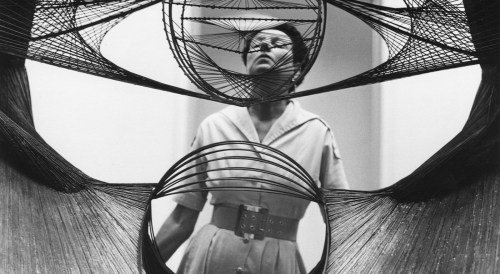
Peggy-Guggenheim_web_3

“PEGGY GUGGENHEIM: ART ADDICT” My rating: B (Opens Jan. 22 at the Tivoli)

96 minutes | No MPAA rating)

She never wielded a brush or a hammer and chisel, yet Peggy Guggenheim (1898-1979) was one of the most important art figures of the 20th century.

Born into a fabulously wealthy family — although her fortune was a mere pittance compared to that of most of her relatives — Guggenheim grew up in an environment awash with dysfunctional eccentricity. She seems to have failed in most of the so-called normal aspects of life (notably marriage and motherhood) but she had something few others possessed: a eye for recognizing great outsider art before anyone else did and the drive to push that art into the mainstream.

Lisa Immordino Vreeland’s “Peggy Guggenheim: Art Addict” is the first full-length documentary devoted to this fascinating woman who was instrumental in the success of artists like Jackson Pollack, Wassily Kandinski, Jean Arp, Max Ernst, Mark Rothko, Constantin Brancusi and many others.

The film benefits greatly from its reliance on a series of audiotaped interviews Guggenheim submitted to shortly before her death. Never before released to the public, these tapes allow her to more or less narrate her own life story.

She came from a clan of Jewish immigrants who grew from peddling to banking, amassing huge fortunes. Peggy’s father died on the Titanic. Her uncle would become the namesake for NYC’s landmark Guggenheim Museum. Murder, madness and tragic death seemed to stalk the family.


Continue Reading »

Writer/director/star ** and avatar girlfriend

Writer/director/star Benjamin Dickinson and avatar girlfriend (Alexia Rasmussen)

“CREATIVE CONTROL” My rating: B-

97 minutes | MPAA rating: R

“Creative Control” is set in a near future of rapid technical advances. Human nature, though, hasn’t had a chance to catch up.

The impressive if sometimes muddled effort from director  Benjamin Dickinson (who also co-wrote and stars) centers on David, the creative director at a New York advertising firm.

The film’s world looks a lot like ours, except for some telling details.  The Soho district streets appear pretty much the same, as do most fashions. But inside David’s workplace, computers are now nothing more than translucent slabs of plastic that sit on desks and are operated by flicking one’s fingers across the screen.

As the film begins David — a tense guy in a high stress job — is drifting away from his yoga-instructor girlfriend Juliette (Nora Zehetner). She’s mellow and he’s…well he’s kind of Woody Allen-ish neurotic.

He finds escape in the new product his firm has been hired to debut. It’s a computer in the form of a pair of eyeglasses.  Called Augmenta, this system pretty much makes virtual reality a reality.  Whatever your mind can think, Augmenta can make it happen right before your eyes.

For David it’s an opportunity to fantasize about Sophie (Alexia Rasmussen), the clothing designer squeeze of his best friend Wim (Dan Gill), a womanizing high fashion photographer.

With Augmenta David can not only conjure up a Sophie avatar in his head, he can augment her body to make her his dream girl right down to the last freckle.

Is this cheating? Adultery? Rampant chauvinism?

More to the point, what happens now that David cannot separate the real Sophie from the manufactured one he sees through the Augmenta specs?

“Creative Control” bites off a bit more than it can comfortably masticate. It simultaneously satirizes the ad game, our increasing dependence on electronic stimulation, and the sort of relationship foibles that have long been a staple of Manhattan-based romantic comedy. Moreover, there’s not much warmth here — David is a rather pathetic fellow whom we view strictly from the outside. (It might have gone smoother if Dickinson had chosen a more charismatic actor to carry the show.)

But the film is ruthlessly sardonic. And it’s been filmed in glorious widescreen black and white (the cinematographer is Adam Newport-Berra) with only a hint of color in some of David’s wilder imaginings.

| Robert W. Butler

Sally Field

Sally Field

“HELLO, MY NAME IS DORIS”  My rating: B-

95 minutes | MPAA rating: R

“Hello, My Name Is Doris” shouldn’t work.

But it has Sally Field front and center, and the two-time Oscar winner demonstrates that she’s still got it even when the movie around her does not.

Doris (Field) is a 60-something spinster who, as “Hello…” begins, is burying the mother she has lived with her entire life. In fact, Doris has never spent a night anywhere but in the modest Staten Island home where she grew up.

In lieu of social lives, they were hoarders. Now Doris’ brother and sister-in-law are eager to clean out the house and sell it while the market is booming. The thought of living anywhere else terrifies our heroine.

At least Doris isn’t a total hermit. She has a job as an accountant at a Manhattan clothing design company, where she’s the weird old lady hardly anybody talks to. Her bizarrely colorful fashion sense (among other affectations, she always has a huge bow in her hair) produces much eye rolling among her younger, hipper co-workers.

Except that the newly arrived art director, John (Max Greenfield of TV’s “New Girl”), sees something interesting in this introverted lady who wears two pairs of eyeglasses simultaneously (because it’s cheaper than buying bifocals).

A little friendly attention sends Doris into fantasies of being swept off her feet by this attractive young fellow. And with the assistance of the granddaughter of her one friend (Tyne Daly), she trolls the Internet for info about her dream lover. Continue Reading »

Melissa Rauch

Melissa Rauch

“THE BRONZE”  My rating: C-

118 minutes | MPAA rating: R

I spent much of “The Bronze” wondering what drugs (or combination of drugs and alcohol) might make it as funny as it thinks it is.

This staggeringly raunchy (yet overwhelmingly morose) comedy from Melissa Rauch (a regular on TV’s “The Big Bang Theory,” she stars and wrote the screenplay with her husband,  Winston Rauch) centers on Hope, a small town shrew who for more than a decade has been milking her limited fame as a bronze-medal-winning Olympic gymnast.

Hope retains the blonde bangs and ponytail that were her trademark as an adolescent athlete. She never goes out unless she’s wearing a red, white and blue star-spangled warmup suit to remind local residents that a giant walks among them.

She has her own designated parking space on Main Street. She gets free food at the local restaurant. For goods that cost money there’s the cash she steals from letters in the mailbag of her dad (Gary Cole), an employee of the  U.S. Postal Service.

Hope is profane,  hateful, conceited, mean-spirited, drunk, doped-up and entitled.

All that would be okay if she were also hysterically funny, but most of the laughs in this film either miss the mark or have such sharp edges that it’s like swallowing ground glass.
Continue Reading »

**, Mary Elizabeth Winstead, John Goodman

John Gallagher Jr., Mary Elizabeth Winstead, John Goodman

“10 CLOVERFIELD LANE” My rating: B

105 minutes | MPAA rating:PG-13

Intensely claustrophobic and impeccably acted, “10 Cloverfield Lane” is a mind-messer of a thriller with a forehead-slapping payoff.

In the wordless opening sequence, a young woman (Mary Elizabeth Winstead) packs her bags and flees her apartment, leaving behind a wedding ring and a ring of keys.

She’s cruising through the Louisiana countryside at night — listening to radio reports of a catastrophic electrical blackout along the Gulf Coast — when she’s involved in a bone-jarring accident.

Michelle (that’s her name) awakens in a musty cinderblock room, her leg in a splint and a chain limiting her mobility. Enter big beefy Howard (John Goodman), who explains that he pulled Michelle from the wreckage of her car and brought her here, to a bunker beneath his farmhouse. She should be thanking him for saving her life.

According to Howard, the world has come to an end. He’s not sure if it’s the result of nuclear or chemical war. Maybe it’s the doing of the Russians. Or possibly space aliens. (The film’s title, a reference to the 2008 found-footage alien invasion flick “Cloverfield,” should put canny viewers on alert.)

In any case, the air above ground is deadly and Howard announces that they’ll be holed up here for at least a year or two.  But not to worry — he’s been planning for this day for a long time. The bunker has enough supplies and equipment to easily keep three people alive.

Oh, yeah, there’s a third resident of the bunker.  Emmett (John Gallagher Jr.) is a mildly goofy good ol’ boy about Michelle’s age who for the last decade or so has been hired by Howard to work on the bunker.  At the first sign of trouble he showed up at Howard’s door. He seems like a doofus, but he may have more going on than can be gleaned at first examination.

Emmett assures the panicked Michelle that despite Howard’s ever-present sidearm and rampant paranoia, their host is an OK guy.

Continue Reading »

Alfred Hitchcock, Francois Truffaut

Alfred Hitchcock, Francois Truffaut

“HITCHCOCK / TRUFFAUT” My rating: B+ (Opens Feb./ 27 at the Tivoli)

79 minutes | MPAA rating: PG-13

By now it’s an article of faith among film lovers that Alfred Hitchcock was far more than a mere maker of suspense movies.

He was a true cinema genius who used the medium to plumb the depths of his own soul, his phobias, his impish sense of humor.

There’s no shortage of film-themed documentaries that have dealt in some way with Sir Alfred and his career, but “Hitchcock / Truffaut” introduces a new element by allowing Hitch to comment on his movies.

In 1965 French NewWave filmmaker Francois Truffaut sat down with his idol in an office at the Universal Studios in Hollywood. For an entire week they talked movies, aided by a translator.  The result was Truffaut’s classic 1966 book Hitchcock by Truffaut. 

Fifty years later the audio recordings that were the basis for that book have been utilized by filmmaker Kent Jones for this documentary. Continue Reading »

as young

Noble Torres as young Karamakate

“EMBRACE OF THE SERPENT” My rating: B (Opens March 11 at the Tivoli)

125 minutes | No MPAA rating

Mixing elements as diverse as “Apocalypse Now,” “Aguirre, Wrath of God” and the hallucinogenic “El Topo,”  the Columbian-lensed “Embrace of the Serpent” is less a conventional narrative than a sort of head trip that audiences are invited to inhabit for two hours.

Shot in ravishing widescreen black and white and propelled by a natural soundtrack so intense you feel you’re stranded in a South American jungle, Ciro Guerra’s films tells the story of two river journeys 40 years apart.

In the years before World War I Theo (Jan Bijvoet), a German scientist and explorer, shows up in the jungle camp of Karamakate (Nilbio Torres), an astonishingly handsome young  shaman who has lived most to this life in solitude.   Theo is dying of a jungle fever and Karamakate, who claims that he is the last surviving member of his tribe, agrees to paddle this white man upstream to the land of his childhood,  where there exists a flower whose curative powers are Theo’s only hope for survival.

That journey alternates with another river journey taking place four decades later. This time Karamakate, now an old man (and portrayed by Antonio Bolivar)  accompanies an American scientist (Brionne Davis) in retracing that journey. They are searching for that same medicinal plant, although the American’s motives may be more mercenary than scientific.

Continue Reading »

Fred Andrews

Fred Andrews

When 62-year-old Fred Andrews died on Feb. 24 after a five-year battle with cancer, he left behind more than the nationally recognized film festival he created from scratch.

He also passed on to those who knew him a lesson in perseverance. “Can’t” was not part of his vocabulary.

In 1997, Andrews founded the Kansas City Filmmakers Jubilee, which since has merged with the Kansas City International Film Festival.

You’d expect a guy who founded a film festival to be some sort of cineaste. A film professor, perhaps, or a filmmaker.

Andrews was neither (though in the weeks before his death he completed a documentary about Kansas City barbecue and music). He was a big, bearded guy in jeans and plaid shirt who did tech work for Sprint.

Andrews was a film lover, but not in an academic or intellectual sense. He knew next to nothing about film theory, film production or film criticism.

He was just a guy who got a thrill from going to the movies, which is why he volunteered to work with the Kansas City Film Society.

There Andrews met local filmmakers, an underground army of aspiring moviemakers toiling in obscurity, working day jobs and devoting their weekends to capturing their dreams on film. They relied on volunteer casts and crews and financed their low-budget efforts by hook or by crook, all in the hope that someone would see their work.

“They all told me that their biggest need, other than money, is an audience,” Andrews would say. “I thought that was something we could help them with.’’

So he got to work organizing the first Jubilee, which ran for one weekend and featured 23 entries from local film and video artists.

By the second year the number of films exhibited had tripled, and Andrews had enlisted partners like the Film Society, the Independent Filmmakers Coalition, UMKC Continuing Education Arts & Sciences and the Kansas City Art Institute

By the fourth year the fest had ballooned into a nine-day extravaganza. Not only did filmmakers from all over the globe fly into town to show their movies, but the Jubilee offered seminars on cinema technology and financing geared to the needs of struggling filmmakers. Continue Reading »

Tina Fey...embedded

Tina Fey…embedded

“WHISKEY TANGO FOXTROT” My rating: B-

112 minutes | MPAA rating: R

Despite Tina Fey’s name above the title, “SNL’s” Lorne Greene as a producer, and a trailer that makes it look like a barrel of yuks, “Whiskey Tango Foxtrot” is not exactly a comedy.

Oh, there are some great laughs here. But this film from writer/directors Glenn Ficarra and John Sequa (“I Love You Phillip Morris,” “Focus,” “Crazy, Stupid, Love”) aims for bigger targets and generally hits them.

Based on journalist Kim Barker’s memoir of reporting on the Afghan war, “Whiskey Tango…” is about a more-or-less complacent American gal who gets bitten by the bug of high-intensity, risk-taking journalism.

As the film begins TV news writer Kim Baker (Fey) hasn’t a clue what she’s doing in the war zone that is Afghanistan. She’s naive about Muslim culture (particularly as it applies to mingling the sexes). She’s embedded with a unit of Marines who politely tolerate her ignorance (she discovers that a “wet hooch” is a tent with a shower), though they gradually warm up to her.

And she succumbs to the party atmosphere that explodes every booze-filled night as Western journalists — virtual prisoners in their frat house of a Kabul compound — let off steam through mass misbehavior.

Continue Reading »