Feeds:
Posts
Comments

Posts Tagged ‘Bill Nighy’

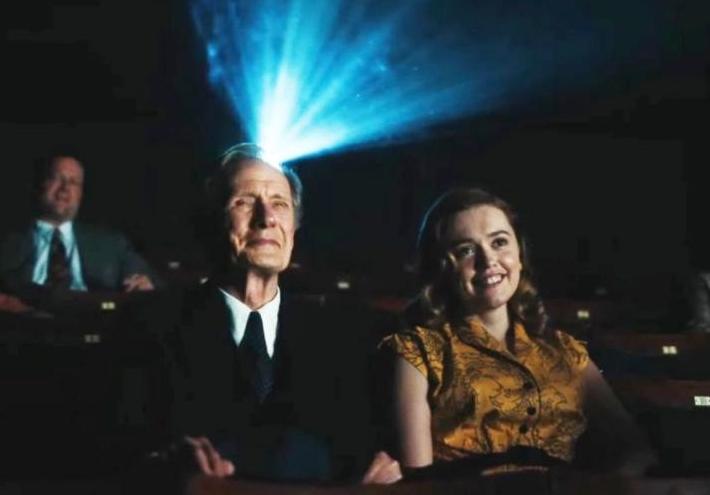
Bill Nighy, Thomasin McKenzie, James Norton

“JOY: ” My rating: B (Netflix)

115 minutes | MPAA rating: PG-13

I wasn’t expecting much from “Joy.” I knew one of the stars was the always-watchable Bill Nighy, and that the subject was the development of the in vitro fertilization technique in the 1970s.

Maybe I was in for a docudrama or dry medical procedural?

I wasn’t prepared for the sneakily effective emotional journey cooked up by first-time feature director Ben Taylor and scenarists Jack Thorne, Rachel Mason and Emma Gordon.

“Joy” works so well for a couple of reasons. First, the screenplay focuses less on the scientific challenges facing physician/researchers Bob Edwards and Patrick Steptoe (James Norton, Nighy) than on the cultural backlash their work elicited.

Today IVF is opposed by many who associate it with abortion. A mother is implanted with just one of several of her eggs fertilized in the lab; the rejects may be destroyed. If you believe that every fertilized egg is already human, then that’s murder.

Fifty years ago, though, the opposition to IVF was based on the notion that “test tube babies” would be born with defects that would make their lives a living hell. Voices in the media, the church, the political arena and even the medical establishment compared the work of Edwards and Steptoe to that of the fictional Dr. Frankenstein. The doctors were accused of playing God.

As a result they did most of their work in a remote clinic away from prying eyes. Not precisely off the grid, but close.

Also, the filmmakers were incredibly wise in focusing the film on a third member of the team, Jean Purdy (Thomasin McKenzie), a young nurse whose official title was lab technician but whose pivotal role in IVF wasn’t recognized for decades.

When we first meet her Purdy appears to be all business, not particulxarly warm. But exposed to the desperation of the young women who come to Edwards and Steptoe looking for a miracle, she becomes more than a nurse or researcher. She becomes a friend, a confidant, a cheerleader, a shoulder to cry on.

Only later do we realize that she is motivated at least in part by her own inability to have children.

And because of her work Purdy finds herself ostracized by her church and community and disowned by her rigidly moralistic mother (Joanna Scanlan).

McKenzie, who was so effective as a teenage survivalist in “Leave No Trace” and had a strong supporting perf in “Jojo Rabbit,” is just about perfect here. She’s attractive without being at all glamorous, and she excels at allowing her character’s inner life to percolate through that stiff Brit carapace.

By the time “Joy” is over (the title isn’t explained until the last moment, and it’s sob-inducing revelation) you’ll be deeply invested in the story and its real-life characters.

Danielle Deadwyler, John David Washington

“THE PIANO LESSON” My rating: B (Netflix)

125 minutes | MPAA rating: PG-13

It features near-flawless performances and a script based on a Pulitzer Prize-winning play.

So why didn’t “The Piano Lesson” work for me? Or why did it only work part of the time?

Produced by Denzel Washington, starring his son John David Washington and directed and co-written by yet another son, Malcolm Washington, this production is a family affair.

Which is fitting, since August Wilson’s play centers on a family and the different ways in which its members deal with (or attempt to reject) their shared history.

The piano of the title is a family heirloom, quite literally paid for with the blood of ancestors.  

In pre-Civil War Mississippi a plantation owner named Sutter sold members of the enslaved Charles family to buy the upright piano for his wife. Subsequently portraits of the sold slaves were carved into the instrument’s wood by a remaining family member.

In 1911 the piano was stolen by Charles family survivors and it now sits in the Depression-era Pittsburgh home of Doker Charles (Samuel L. Jackson), where it will generate a family crisis.

Doker’s nephew Boy Willie (Joh David Washington in the most astonishingly nuanced performance of his career) has driven up from Mississippi hoping to sell the rarely-played piano. He’ll use the money to buy land long owned by the Sutter clan, now up for sale thanks to the mysterious death of the last Sutter, who fell down a well.

Boy Willie’s plan is fiercely opposed by his sister Bereniece (Danielle Deadwyler). It’s not the loss of a musical instrument she minds (she refuses to play, though her young daughter sometimes doodles on the keyboard); it’s the thought of giving up her last connection to her ancestors.

Also, she suggests Boy Willie may have murdered the last Sutter to get his land. She even claims to have seen a dead white man — Sutter’s ghost — haunting the upstairs hallway.

Though director Washington makes a few attempts to open up the acton  “The Piano Lesson” is mostly talk — talk that reveals the various outlooks of a mixed slate of characters (the cast is rounded out by Ray Fisher, Corey Hawkins and Michael Potts). Everyone is excellent.

Here’s where I think things went sour:  In Wilson’s play Sutter’s ghost is talked about but never seen. He’s offstage…provided, of course, that he even exists outside the characters’ imaginations.

But in the movie we see him.  He even gets into a physical brawl with Boy Willie, amd it threatens to derail the entire narrative. Instead of a figurative haunting we get a literal one.

Now it’s a ghost story. I don’t believe that’s what Wilson had in mind.

Cailee Spaeny and friend

“ALIEN ROMULUS” My rating: C (Hulu)

118 minutes | MPAA rating: R

Going in I suspected that “Alien Romulus” would be a budget-basement spinoff from the long-running monsters-in-space franchise.

You know…cheap f/x, tacky production values, a straight-to-video approach. When Ridley Scott directs (“Alien,” “Prometheus”) you expect top-of-the-line everything…except, perhaps in the script department.

But “Alien Romulus” looks great, and even has been designed with tongue firmly in cheek to reflect on earlier (and much better) episodes. The plot may be one “Alien” cliche after another, but the physical production is solid.

Directed and co-written by Fede Alvarez, this is a teens-vs-aliens movie.  On a mining planet a handful of wage slaves plot to hijack an abandoned spaceship and get the hell out of Dodge.

What they don’t realize is that the ship, the Romulus, houses a breeding lab for those nasty, acid-blooded critters.  After losing most of its crew to the aliens the ship’s operator, the infamous Weyland-Yutani Corporation, pulled out. The idea was to let gravity suck  the ship into the rings that circle the planet, destroying it and its deadly cargo.

But our adolescent heroes know none of that, though once on board they’ll learn quickly. 

There are no “names” in the cast.  You may recall Cailee Spaeny as the wannabe journalist in “Civil War.” And David Jonsson has a plum role as a replicant (they still prefer the term “artificial human”) whose levels of intelligence and empathy vary depending upon what computer chip is clicked into a slot on his neck.

The real hero here is production designer Naaman Marshall, who has a whole lot of fun recreating the world of the first two Alien films from way back when, right down to the retro/crude graphics on the ship’s computer screens.

Oh…and did I mention that the late Ian Holm has been digitally resurrected? He appears as a worse-for-wear replicant clearly manufactured in the same batch as Ash from the original 1979 “Alien.”

| Robert W. Butler

Read Full Post »

Bill Nighy

“LIVING” My rating: A- (Theaters)

102 minutes | MPAA rating: PG-13

Just about every element of “Living” works perfectly…which one half expects given that it’s a Brit remake of the brilliant Akira Kurosawa film “Ikiru (To Live).”

To that 1952 humanist triumph (about a gray civil servant whose life finds focus only when he faces death), screenwriter Kazoo Ishiguro and director Oliver Herman add a funny/sad study of a singularly English form of emotional constipation. There are actually some chuckles in this tale of a man with a fatal disease.

And the fact that the man in question is portrayed by the great Bill Nighy kicks “Living” into the emotional stratosphere. Nighy has won an Oscar nomination for his work here…I’ll be rooting for him to take home the golden boy.

“Living” opens with vintage color footage of post-war London, then cuts to a suburban train platform populated by identically-clad office workers (three-piece suits, bowler hats, briefcases and umbrellas) on their way to their jobs in the city. Director Herman has a good time framing and choreographing their movements to remind us of the zombie proles in Fritz Lang’s “Metropolis.”

We are introduced to Wakeling (Alex Sharp), a new hire at the public works office overseen by Nighy’s Mr. Williams. The kid learns quickly that the office is a place of Scrooge-ish joylessness; he and his colleagues are expected to shuffle much paperwork while accomplishing very little.

Woe be the citizen who enters this daunting bureaucratic maze, as Wakeling discovers when assigned to assist three housewives seeking to have a children’s playground built in the rat-infested bomb crater near their tenement.

Early on the sepulchral Williams visits a physician’s office where he gets bad news. The normally uncommunicative widower considers revealing his grim diagnosis to his live-in son and daughter-in-law, but can’t quite bring himself to open up.

Instead he plays hooky for the first time in his life. Rather than commuting to his desk Williams takes the train to a seaside resort where he is befriended by a rather seedy young intellectual (Tom Burke) and led on a Nighttown-style tour of disreputable cellars, jazz venues and strip-tease shows. It may be the closest thing to a holiday the stiff scarecrow has allowed himself in decades.

Back in London he befriends a young woman (Aimee Lou Wood) who recently left his employ; it is slowly dawning on Williams that while he is surrounded by other people, he actually knows none of them.

Bill Nighy, Aimee Lou Wood

“Living” effortless adapts the unusual narrative of the Kurosawa film — the second half is devoted to Williams’ co-workers reflecting on how he chose to spend his final months — and we’re once again reminded of the original’s stroke of genius, the ways in which it mines emotions without stooping to stridency or heavy-handed bathos.

That savvy sense of restraint also permeates Nighy’s performance. His Williams at first presents as a human chalk stick — dry, white and brittle. Small wonder his newfound female friend describes him as “dead but not dead.”

But little by little we see the character grow aware of sensibilities that have been long dormant. Some actors would aim for the big moment, but Nighy gives a performance of astonishing subtlety. He knows a little goes a long way; he can make us feel more with a straight face than other players could evoke with howls and breast beating.

The resulting movie is a quiet triumph and an unexpected paradox: a feel-good film about dying.

| Robert W. Butler

Read Full Post »

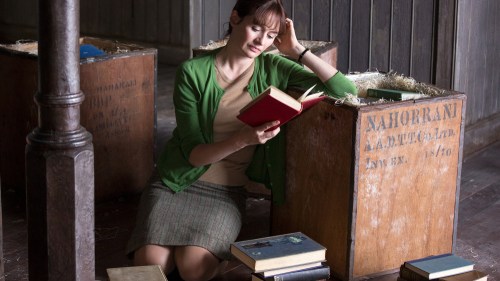
Emily Mortimer

“THE BOOKSHOP” My rating: B

113 minutes | MPAA rating: PG

“The Bookshop” is an insidious bit of bait and switch.

As it starts out a viewer is confident that he or she is entering familiar territory.  In 1959 a war widow opens a bookshop in  picturesque British coastal town.

So this is going to be a feel-good movie about the power of literature to illuminate gray lives, right? And the lady storeowner will undoubtedly find romance with one of the locals…maybe a handsome fisherman?

Also, our  heroine sells controversial books like Nabokov’s Lolita. So the film will depict the conflict between the local blue noses and everybody else’s right to read, eh?

Uh, no.

Isabel Coixet’s film, adapted from Penelope Fitzgerald’s novel, is much darker than that.  Here the common man is something less than noble and the good guys shouldn’t expect to win.

All might have gone swimmingly had Florence Green (Emily Mortimer) not chosen as the site of her new book shop the long-abandoned  Old House, a historic structure fallen on hard times. She buys the place at bargain prices, installs shelves and orders crates of books.

She hires Christine (Honor Kneafsey), the child of local laborers, as her after-school assistant.

And she cultivates the attentions of the  eccentric  town hermit, Edmund (Bill Nighy), a voracious reader living in a slowly decaying mansion. He’s this movie’s version of Miss Havisham.

(more…)

Read Full Post »

Gemma Atherton, Bill Nighy

“THEIR FINEST” My rating: B-

117 minutes | MPAA rating: R

What is it with filmmakers making movies about making movies?

“Their Finest,” the latest from Danish director Lone Scherfig (“Italian for Beginners”), takes that admittedly amusing self-absorption and pumps it up with World War II-era nostalgia and nascent female empowerment.

In Blitz-ravaged London, copywriter Catrin Cole (Gemma Arterton) lands the gig of a lifetime.  She’s hired by the Ministry of Information’s Film Division to write a feature film — one that is both “authentic and optimistic” — that will embody Britain’s can-do spirit in the face of Hitler’s juggernaut.

The film is intended as pan-Atlantic propaganda that will show war-wary American audiences that Britain is more than supercilious aristocrats, that it’s a nation of everyday men and women fighting heroically for survival.

Catrin finds her subject in the real-life experiences of two spinster sisters who stole their drunken uncle’s boat and became part of the mass evacuation of British troops from Dunkirk in France.

Though she already has a significant other (Jack Huston, playing an unsuccessful painter of glum cityscapes), Catrin finds intellectual stimulation (and other sorts as well) in her new writing partner, Tom Buckley (Sam Claflin). He’s one of those seen-everything cynics who nevertheless knows exactly how to manipulate an audience (“Film is real life with the boring stuff cut out”).

Together they figure out how to cajole a fading matinee idol  (Bill Nighy, playing the sort of jaded egomaniac he does so well) into taking the seemingly inconsequential role of the drunken uncle. Somewhat more perplexing is how they are to satisfy the Ministry by creating a character for a non-acting American  (Jake Lacy) who has been flying missions for the R.A.F.

(more…)

Read Full Post »

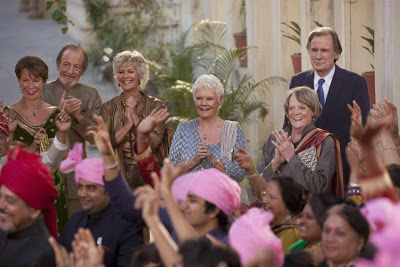
The usual suspects reunite

The usual suspects reunite

“THE SECOND BEST EXOTIC MARIGOLD HOTEL”  My rating: C-

122 minutes | MPAA rating: PG

Ideally, a sequel gets made because there’s more to explore in the story or characters.

Most often, though, the sole motive is money.

And you can hear the spare change clanking incessantly beneath the dialogue of “The Second Best Exotic Marigold Hotel.”

The first film was a sleeper hit, thanks to its stellar British cast (Maggie Smith, Bill Nighy, Judi Dench), the exotic Indian setting and its amusing blend of expatriate adventure and cheeky septuagenarian sexuality.

It never added up to much, but it went down easily, especially with the gray-haired crowd that rarely gets to see itself portrayed with any sort of dignity on the big screen.

But though this follow-up was made by the same people — director John Madden, screenwriter Ol Parker and the returning players — all the charm seems to have evaporated. It’s a paint-by-numbers effort.

The screenplay gives each of the retiree residents of the Marigold Hotel [added:] in Jaipur a crisis to overcome — usually a romantic one. Contrasting against those late-life liaisons are the impending nuptials of young hotel operator Sonny Kapoor (Dev Patel) and his beloved Sunaina (Tina Desai).

Fortune hunter Madge (Celia Imrie) has two well-heeled Indian gentlemen on tap but can’t decide which one to marry. Nighy’s Douglas is smitten with Dench’s Evelyn, but he’s too shy to jump and she won’t commit.

Bon vivant Norman (Ronald Pickup) fears that he has inadvertently put out a mob hit on his girlfriend, Carol (Diana Hardcastle).

Muriel (Maggie Smith) grumpily lectures Americans on how to make tea and quietly nurses her concerns when a medical checkup doesn’t go as planned.

These subplots circle a larger story.

(more…)

Read Full Post »