Feeds:
Posts
Comments

Posts Tagged ‘Colman Domingo’

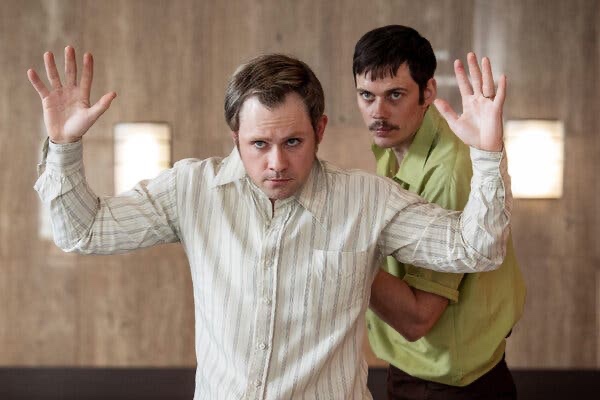
Dacre Montgomery, Bill Skarsgard

“DEAD MAN’S WIRE” My rating: B (In theaters)

105 minutes | MPAA rating: R

The ghost of “Dog Day Afternoon” haunts Gus van Sant’s “Dead Man’s Wire,” a criminal yarn about one man’s fight against basically everybody.

Like Sidney Lumet’s 1975 classic, “Dead Man…” is based on a real event, yet another case of life one-upping art.

One morning in 1977, Indianapolis resident Tony Kiritsis (Bill Skarsgard) walked into the headquarters off the Meridian Mortgage Company.  He was a familiar face; the friendly girl at the front desk paid no attention to the long, narrow box Tony carried.

Maybe she figured it contained rolled up blueprints.  After all, Tony was a long-time customer who had borrowed money to design and build a shopping center on property he owned on the edge of town.

Nope.  Inside was a shotgun fitted with a wire loop at the muzzle.  Once in the executive offices Tony confronted Richard Hall (Dacre Montgomery), son of the company’s owner.  He slipped the wire noose around Richard’s neck and informed him that any movement would automatically discharge a full load of buckshot into his head.

Then Tony started working the phones, determined to inform the world of the wrongs he had suffered at the hands of the Hall family — especially Richard’s father M.L. (Al Pacino), who was off on a vacation.

The standoff unfolded over several days. Tony talked a local radio DJ (Colman Domingo) into serving as his spokesman and p.r. agent.  Meanwhile the cops — especially hardboiled detective Michael Grable (Cary Elwes) — tried to satisfy Tony’s impossible demands while avoiding mayhem that would be televised nationally.

Austin Kolodney’s screenplay walks a fine line between real tension and oddball humor.  Tony may be crazy, but he talks a good talk, and there flashes of absurdism throughout.  

The key to Skarsgard’s performance is his ability to make us identify with Tony (haven’t all of us felt ripped off at some time by a big impersonal institution?) even as we squirm at the dangerous situation he’s created. 

He’s nicely matched by Montgomery, whom you may recognize from “Stranger Things.” Initially Dick is just a quaking blob of fear, but gradually the character’s survival instinct kicks in and he presents himself as a sort of collaborator.

And Pacino is delightfully hateful as a financial bigwig who would rather sacrifice his own son than cough up the restitution Tony is demanding.

Throughout Van Sant exhibits a master’s hand in modulating the film’s pacing and emotional tones.  

Timothee Chalamet

“MARTY SUPREME” My rating: C+ (In theaters)

149 minutes | MPAA rating: R

Is it possible to love a performance while borderline hating the movie that surrounds it?

In the case of Timothee Chalamet and “Marty Supreme” the answer is perplexed yes.

“Marty Supreme” is director Josh Safdie’s followup to “Uncut Gems,” a film I compared to being screamed at for two hours by an irate New York cab driver. Once again I left more exhausted than exhilarated.

This may be a minority opinion.  My critical brethren seem to adore the very things that turned me off.  Well, you know…horse races.

The screenplay by Sadie and Ronald Bronstein is based (very loosely) on the career of Marty Mauser, a working class New Yorker who in the early 1950s was a rising star in the world of table tennis.

As played by Chalamet, Marty is a juggernaut of ambition and selfishness.  He’s a pretty good Ping Pong player, but his real skill seems to be that of con man and canny manipulator. (Also, he has acne, spectacles and a skinny mustache that makes him look uncomfortably like a very young Robert Crumb.)

As the film begins Marty is working in a his uncle’s shoe store, sleeping with  old (and married) childhood friend  Rachel (Odessa A’zion) and scheming to fly to London for a big ping pong competition.  He’ll lie, cheat, steal…whatever it takes.

Once across the pond he impresses the sport’s fans with his paddle skills; his arrogant personality, on the other hand, keeps him in hot water.  Refusing to bed down at the cheap hotel he’s provided, he cons his way into a suite at the ritziest joint in town.

There he spots one-time movie goddess Kay Stone (Gwyneth  Paltrow) and kicks his seduction machine into high gear.  It’s typical of Marty that while he’s schtupping Kay he’s drumming up financial backing from her vaguely scary deep-pockets husband (“Shark Tank’s” Kevin O’Leary in a way more than adequate acting debut).

 Aside from Marty’s singleminded ambition there’s not much plot here…or rather too many plots.  “Marty Supreme” is always shooting off on some crazed tangent.  

There’s a subplot in which Rachel claims to be preggers by Marty (he’s not happy) and claims she’s being beaten by her husband (Emory Cohen).  In another a lost dog becomes a pawn in a very bloody custody battle.  Marty and a colleague become Ping Pong sharks, descending on suburban towns to challenge the local talent while betting heavily on themselves. They narrowly avoid getting lynched.

There’s murder and mayhem.  (Penn Jillette is virtually unrecognizable as a shot-gun toting, in-bred rural creep.) Close calls.  

And through it all Marty remains unrepentantly self centered.  Chalamet gives a breathless performance — which is a problem because the film never slows down enough to let us catch our breath.  It’s just one instance of bad behavior piled on another.

And this goes on for 2 1/2 hours! Some long films fly by.  This one just kept throwing the same heavy beats over and over again. 

| Robert W. Butler
Read Full Post »

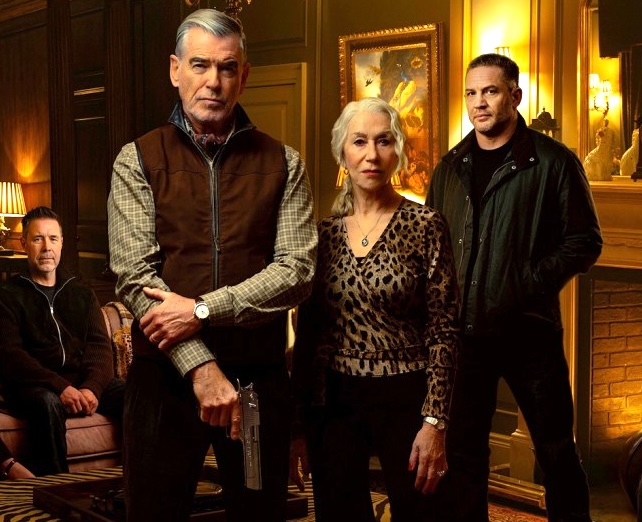
Paddy Considine, Pierce Brosnan, Helen Mirren, Tom Hardy

“MOBLAND’’  (Paramount )

When it comes to reprehensible behavior and mindless violence, American criminals seem positively enlightened compared to the mayhem-dishing psychos inhabiting British series like “Gangs of London” and, now, “Mobland.”

In “Mobland” the seemingly omnipresent Tom Hardy plays Harry, the stoic but ruthlessly effective lieutenant to the Harrigans, one of London’s two major crime syndicates.

Hardy, who is watchable in even iffy material, here gets the most out of Harry’s slow-burn personality. This is a guy who seems calm even when spraying a machine gun in a war for supremacy in London’s illicit drug trade.

But the real acting meat goes to Pierce Brosnan as Conrad Harrigan, the arrogant, emotionally loose-canon boss of the clan, and especially Helen Mirren as his wife Maeve, a scheming Lady Macbeth with a gloriously foul mouth and a chess master’s talent for duplicitous scheming. Emmys seem obvious.

Toss in Paddy Considine as their tormented son, Anson Boon as  his homicidal spoiled-brat teenager and Joanne Froggatt as Harry’s kept-in-the-dark wife, and you’ve got a pedigreed supporting cast.

Keep your eyes open for brief but telling perfs from the likes of Janet McTeer and Toby Jones.

Wagner Moura, Brian Tyree Henry

“DOPE THIEF”(Apple +)

Is there any role Brian Tyree Henry can’t play?

He’s impressed as a perplexed rapper in TV’s “Atlanta,”  been a heavy in actioners like “Bullet Train” and showed his humanistic side in “Causeway” and “The Fire Inside.”

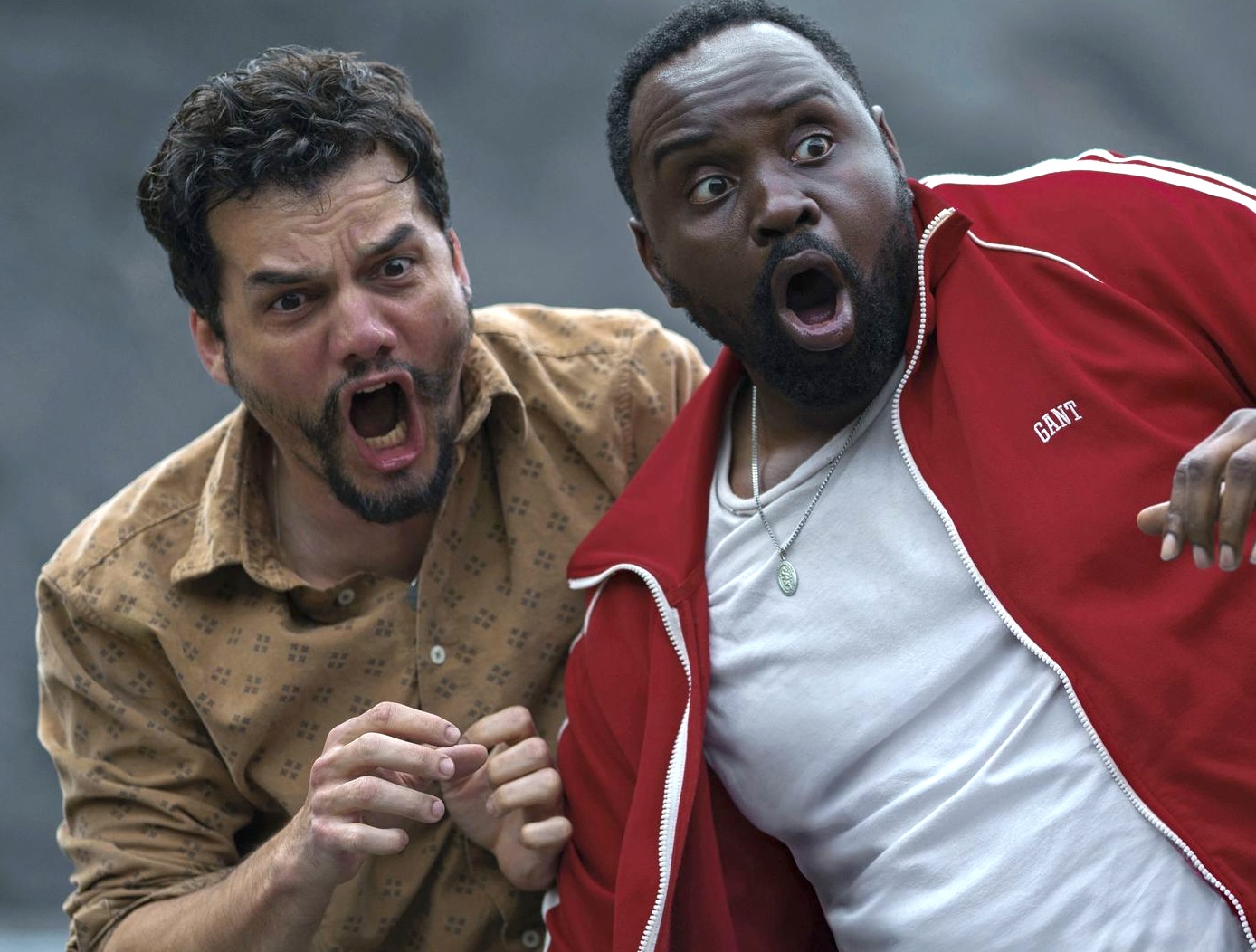
He massages all those facets into his lead performance in “Dope Thief,” a crime drama that also serves as a touching bromance.

Ray Driscoll (Henry) and his buddy Manny (Wagner Moura) are ex cons who now earn a living by posing as DEA agents and ripping off drug houses.  It’s the perfect crime, since their victims aren’t about to go to the authorities for redress.

Perfect until, that is, their latest score results in a shootout. Turns out their target was actually part of a federal sting operation.  Among the dead is a government agent; surviving but badly wounded is DEA agent Mina (an excellent Marin Ireland), now determined to track down the guys responsible for killing her partner.

And that’s not even mentioning the white supremacist motorcycle gang who were the original target of the sting and now seeking to recover their cash.

“Dope Thief” alternates between high drama and some satiric comedy, not always making the transition gracefully.  But Henry and Moura are weirdly compelling as two guys in way over their heads, with Moura’s character burdened by a bad case of conscience.

And you’ve gotta love Kate Mulgrew as Ray’s chain-smoking, casino-crawling mother (or is it stepmother?)

Alexej Manvelov, Matthew Goode, Leah Byrne

“DEPT. Q” (Netflix)

Based on Danish author Carl Adler-Olsen’s series of crime novels, “Dept. Q” takes his yarn about a squad of police misfits and plops them down in Scotland.

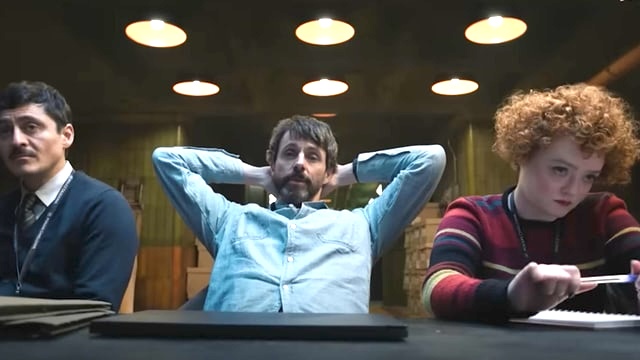
Matthew Goode, whom I usually associate with fairy genteel roles, here is having almost too much fun as scuzzy, scraggly Carl Morck, a police detective with a Scroogish personality who, to keep him out of his colleagues’ hair, is given his own cold case unit operating from the dank basement of police headquarters.

Though a fierce loner, Carl finds himself saddled with other officers from the department’s roster of losers. 

Alexej Manvelov is borderline brilliant as Akram, a quiet, seemingly gentle refugee from Syria whose kindly exterior hides a disturbing knowledge of torture techniques.  Leah Byrne is Rose, a Kewpie doll of a cop out of the loop since accidentally killing a citizen during a high-speed chase. And Jamie Sives is Hardy, Carls’ old partner now paralyzed after a shooting but still able to man a computer.

This first season is dedicated to the search for a prosecuting attorney (Chloe Pirrie) who has been missing for four years.  Periodically the action shifts from Carl and  his crew to a remote location where the woman has been enduring a hellish imprisonment.

Though there are parts of the yarn that seem underdeveloped or even superfluous (I’m thinking Carl’s contentious relationship with his angry motherless stepson and his mandated sessions with a shrink played by Kelly Macdonald — who may in upcoming seasons turn into a love interest), the central crime and its slow unravelling makes for compulsory viewing.

Erika Henningsen, Steve Carell, Tina Fey, Colman Domingo, Will Forte, Marco Calvani

“THE FOUR SEASONS”(Netflix)

This spinoff from Alan Alda’s 1981 feature film is a quiet delight.

The movie followed a group of middle-aged friends through four vacations, each set in one of the four seasons (with musical accompaniment featuring Vivaldi’s ever-popular “Four Seasons”).

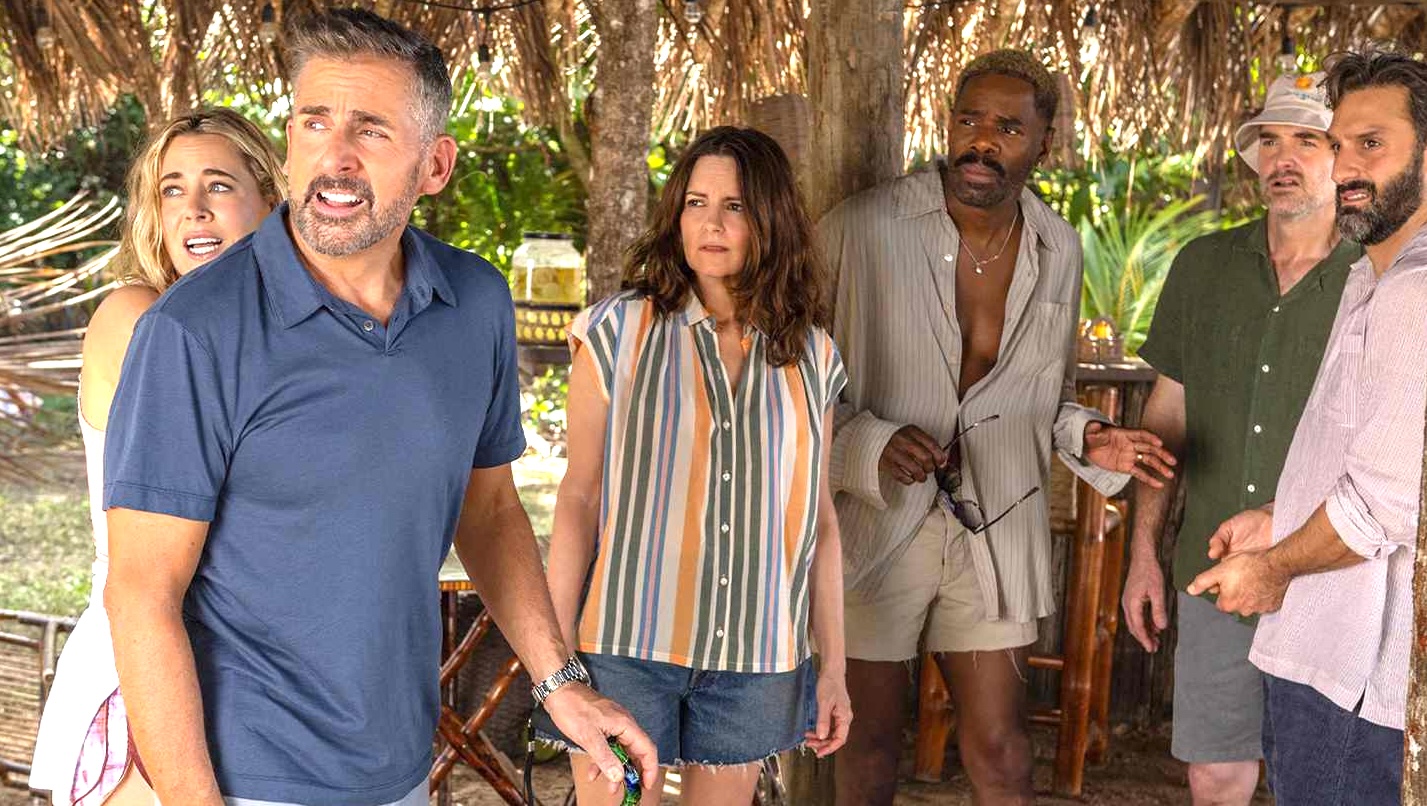
Tina Fey and Will Forte are Kate and Jack, long married but starting to see cracks in the relationship.  The flamboyant Italian Claude (Marco Calvani) and the workaholic Danny (Colman Domingo) are a gay couple going through their own issues.

And then there’s Nick and Anne (Steve Carell, Kerri Kinney), who shock their friends with a divorce.  Things get really uncomfortable when Nick starts showing  up for group gatherings with Ginny (Erika Henningsen), a dental hygienist half his age.

Like the film, this eight-part series is consistently funny while tackling some pretty serious themes about marriage, infidelity, the middle-aged blahs  and how the hell you’re supposed to support both members in a failed marriage.

| Robert W. Butler

Read Full Post »

Taranji P. Henson

 “THE COLOR PURPLE” My rating: B- (In theaters)

 140 minutes | MPAA rating: PG-13

Good but not great, the new musical version of “The Color Purple” is a largely faithful adaptation of Alice Walker’s Pulitzer-winning novel.

But what does it say that while watching it I was constantly reminded of Steven Spielberg’s 1985 non-musical version? Weirdly enough, the original film feels fresher to me than this new iteration. 

The reason for this can be summed up, I believe, in two words: Whoopi Goldberg.  Goldberg was so fantastically good, so consummately entertaining as the long-suffering Celie  in the original that by comparison the musical’s Celie — “American Idol” winner Fantasia Barrino  in her feature film debut — seems a bit meh.

Not bad, just meh. This Celie is always having things happen to her; she is more a pawn of fate than a discernible personality.

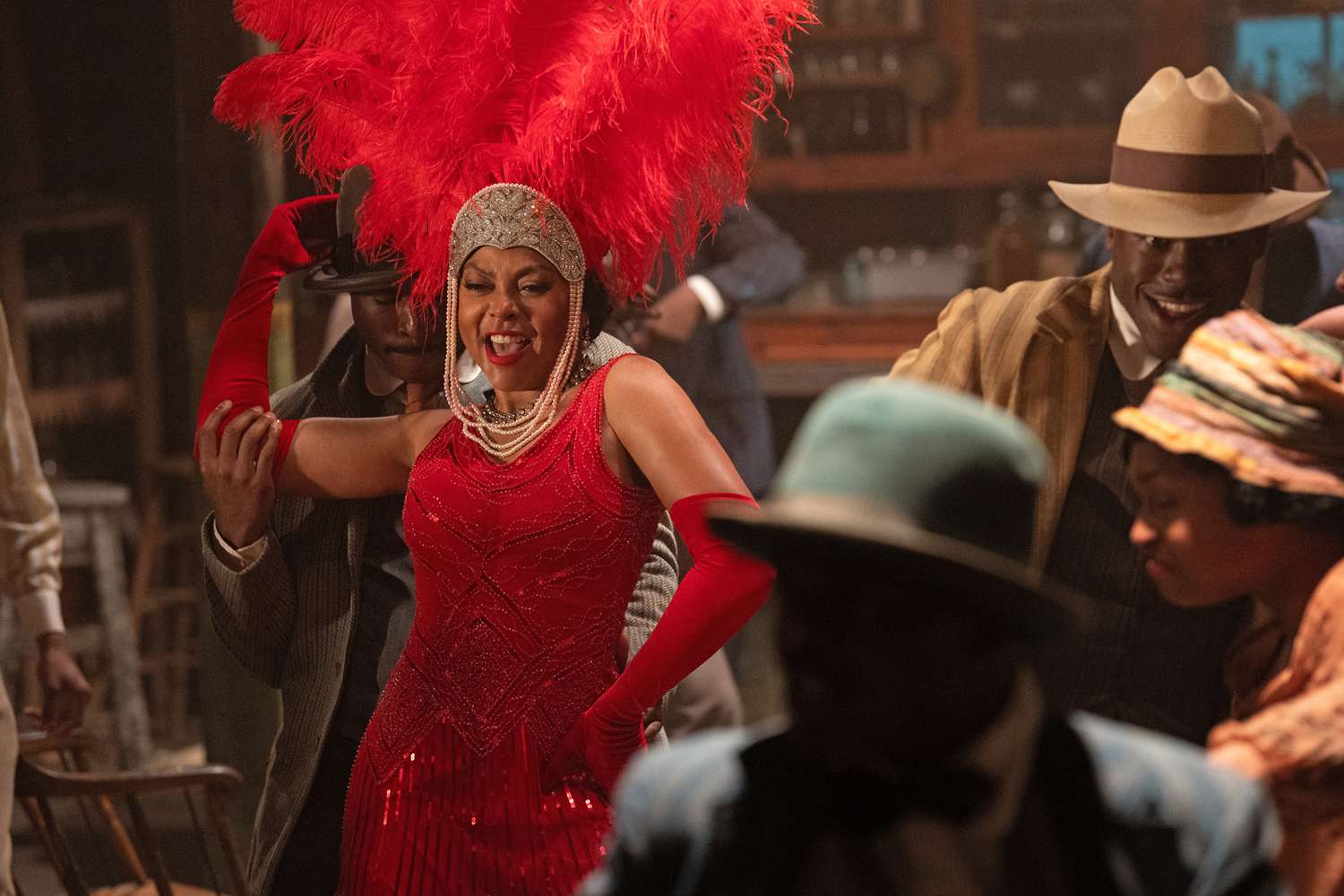
That’s not an issue with other members of the virtually all-black cast: Tara P. Henson’s Shug Avery,  a lusted-after bluesy songstress, or Colman Domingo’s Mister, a study in toxic/stupid chauvinism, or Danielle Brooks’ Sofia, who tragically learns that her strong-willed independence is problematic in a white man’s world.

The story covers nearly a half century and Kris Bowers’ songs reflect most of the salient black musical styles of the era, from solo-guitar Delta blues to work chants, big band blues shouting, gospel, cakewalks and proto-soul. These numbers work fine within the framework of the story, but none struck me as particularly earworm-worthy. I didn’t go home humming them.

The production values offered by director Biltz Bazawule and his design staff are first-rate, as is the staging of most of the musical numbers. They are the film’s highlights.

In its final moments this “Color Purple” hit some of the emotional notes I’d been looking for…it took a while to get there.


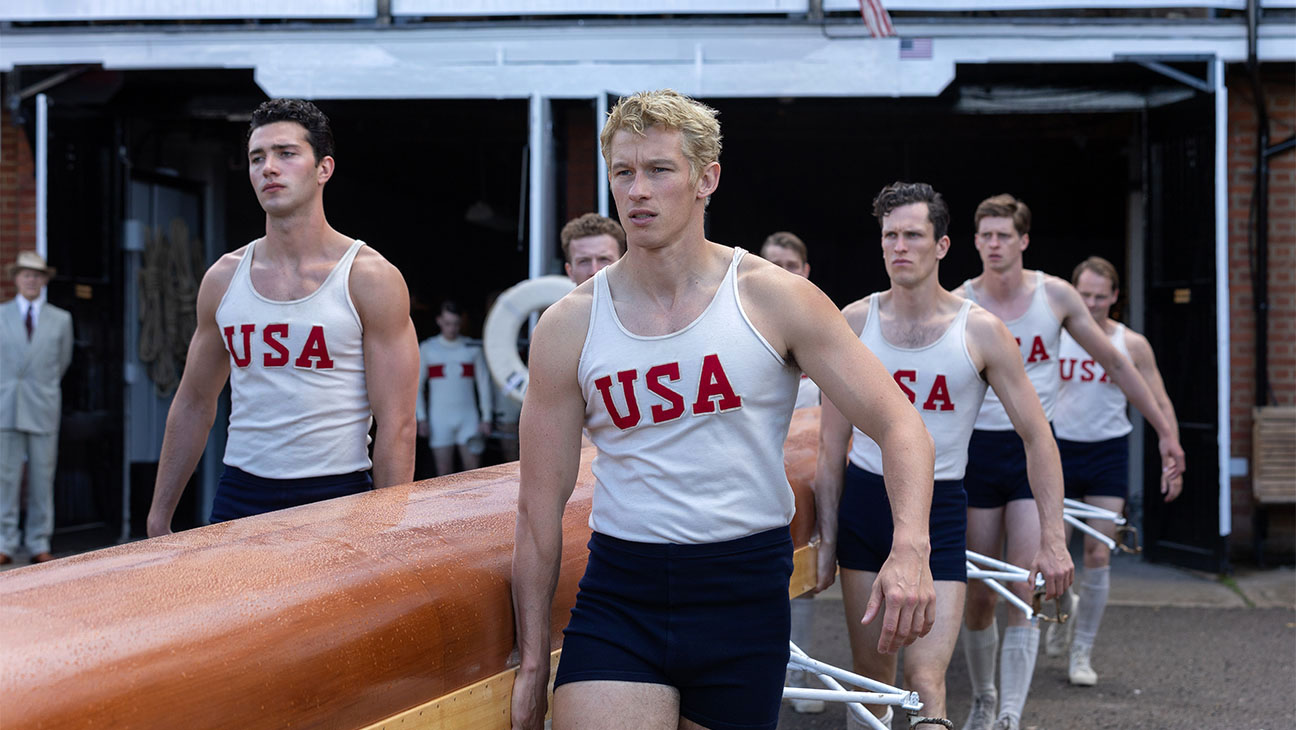
Callum Turner (center)

”THE BOYS IN THE BOAT” My rating: B (In theaters)

124 minutes | MPAA rating: PG-13

Let’s admit upfront that George Clooney’s “The Boys in the Boat” is a superficial drama densely packed with sports-movie cliches.

This makes it no less enjoyable.

For one thing, the cliches — training montages, a romantic subplot, the “big game” — are applied to the world of crew racing, the details of which most of us are ignorant.

So the film — a slightly fictionalized version of Daniel James Brown’s best-seller —immerses its audience  in an exotic sport in which individual excellence and ambition must be subservient to the group effort.  

When you’re rowing with eight other guys you do NOT want to stand out. It means you’re the broken cog in the well-oiled machine.

Mark L. Smith’s screenplay is set in the months leading up to the 1936 Berlin Olympics. Our nominal hero is Joe Rantz (Callum Turner), a pennyless University of Washington student who lives in a  burned-out car in a Depression-Era homeless encampment in Seattle; he tries out for crew simply because it offers its rowers three squares a day and a roof overhead.

We learn the punishing sport along with Joe and his crewmates, most of whom never are developed beyond a first impression.   Only a couple stand out. 

Coxswain Bobby Moch (Luke Slattery) is a small guy capable of bullying/coaxing his muscled rowers to greatness. (Since coxswains don’t row, every pound they add to the load is a liability.) And there’s Don Hume (Jack Mulhern), the crew’s strongest member but so painfully shy his friends aren’t sure he can speak.

Somewhat more fleshed out is Coach Al Ulbrickson (Joel Edgerton), desperate to end his reputation as an also-ran in the crew world, and perhaps George Pocock (Peter Guinness), the old fellow who designs and builds the boats and becomes a sort of philosophic mentor to Joe.

There is considerable inspirational speechifying, and many an observation about rowing being more poetry than sport.

But if the characters are barely developed, the boys’ David-and- Goliath story and the care with which Clooney and Co. recreate the crew world are utterly captivating.

Cheer yourself sick.

Suleika Jaouad, Jon Batiste

AMERICAN SYMPHONY” My rating: A- (Netflix)

104 minutes | MPAA rating: PG-13

Jon Batiste is a brilliant musician.

He’s an even better person.

That’s the takeaway from “American Symphony,” a documentary that originally was to chronicle Batiste’s efforts to write an orchestral piece but became about something far greater.

I knew going in that Matthew Heineman’s film would follow two tracks.  

First, there is Batiste’s creative journey in writing and performing “American Symphony,” an opus not only for orchestra but for jazz musicians, operatic singers, chanting Native Americans, Hispanic folk artists…it’s a real kitchen sink approach.

And then there’s the second plot, centering on Batiste’s wife Suleika Jaouad, a musician and essayist who found herself battling the leukemia she had originally beaten years earlier.

The portrait of Batiste that emerges here is that of a deeply spiritual man who embraces compassion as a lifestyle, who after a day of rehearsing and arranging for his work’s debut at Carnegie Hall would spend the night at the bedside of his wife.

Watching I kept asking myself if under the same circumstances I could be so patient, caring and supportive.

Doubtful.

It’s not like Batiste is an incarnation of Rebecca of Sunnybrook Farm.  He gets exhausted.  He admits to periods of depression. We see him having a texting session with his psychoanalyst.

But his innate goodness somehow always comes to the fore.

I cried easily and often watching “American Symphony,” a testament not only to human creativity but to humanity’s capacity for love. 

It’s one of the best cinematic gift we’ll get this Christmas.

| Robert W. Butler

Read Full Post »