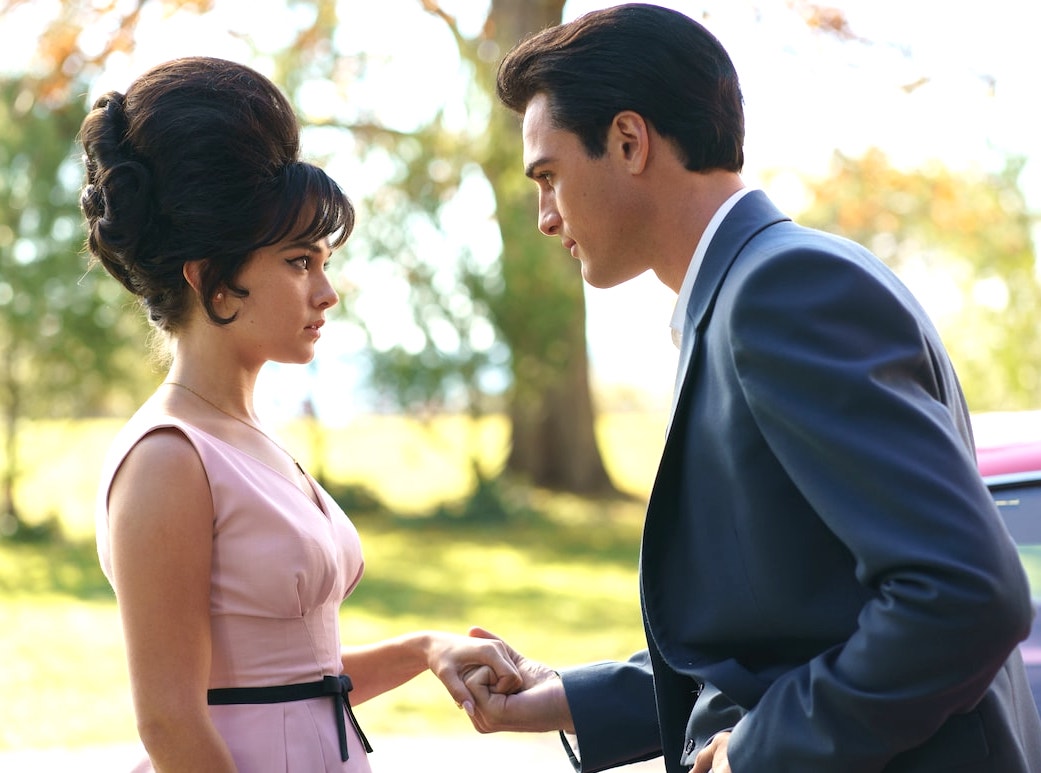
The star-crossed saga of Elvis and his child bride Priscilla Beaulieu has been retold so often that Sofia Coppola’s “Priscilla” will hold few surprises for Presley-holics.
What the film does offer is a dreamlike take on a teenage girl swept off her feet by the Earth’s most famous man. (Coppola and Sandra Harmon’s screenplay is based on Priscilla Presley’s memoir; Presley was a producer of the film.)
It was a romance destined to fall apart. The initially charming rock star became increasingly controlling and, after Priscilla gave birth to a baby girl, turned his back on the marital bed in favor of frat-house partying with his notorious “Memphis Mafia” of good ol’ boys.
In the title role Cailee Spaeny undergoes a remarkable physical and emotional transformation over the course of the film. Though virginal (Elvis wouldn’t consummate the relationship until marriage), her Priscilla isn’t entirely naive about the pitfalls in her path. In a sense “Priscilla” is a study of her painfully blossoming emotional maturity.
Brit actor Jacob Elordi doesn’t attempt an Elvis imitation so much as an approximation…and it pretty much works. Note that we don’t see Elvis performing any of his hits; instead the film’s soundtrack is heavy on other late-‘50s artists.
Michelle Williams
“SHOWING UP” My rating: B (For rent on various streaming services)
107 minutes | MPAA rating: R
Filmmaker Kelly Reichardt once again finds the perfect voice for her cinematic minimalism in Michelle Williams, here almost unrecognizable as a drabbed-down middle-aged artist.
When not performing administrative drudge work at an urban art school, Williams’ Lizzy devotes herself to her sculptures — foot-high ceramic statues of women caught in moments of expansive movement or somber contemplation. To the extent that the film has a plot, it’s about Lizzy preparing for a one-woman show at a small local gallery.
Mostly we eavesdrop on her life. She lives alone with a cat. (Is she straight? Gay?) Her best friend and landlord Jo (Hong Chau, an Oscar nominee for “The Whale”) is a fiber artist who is as outgoing and vivacious as Lizzy is dour and brooding.
Lizzy’s divorced mother is also her boss; her father (Judd Hirsch) is a well-regarded (and egotistic) potter, now retired. There’s also a schizophrenic brother (John Magaro) favored by their parents as a genius, though he’s unable to hold a job.
What we get here is a portrait of a woman as gray as the colorless clothes she favors, but nevertheless devoted to creating art, even though she’ll never make a living off it. At least she’s showing up.
And as much as “Showing Up” is a personality study, it is also an astonishingly lived-in depiction of a world whose inhabitants are devoted to creating. Anyone familiar with an art school environment will find the film almost a documentary experience.
Sixty years on it may be difficult for young people to truly fathom the earth-shaking phenomenon that was Elvis Aaron Presley.
Now, thanks to Biz Luhrmann’s monumental “Elvis,” a new generation can relive the madness and wonder of the early years of rock ‘n’ roll.
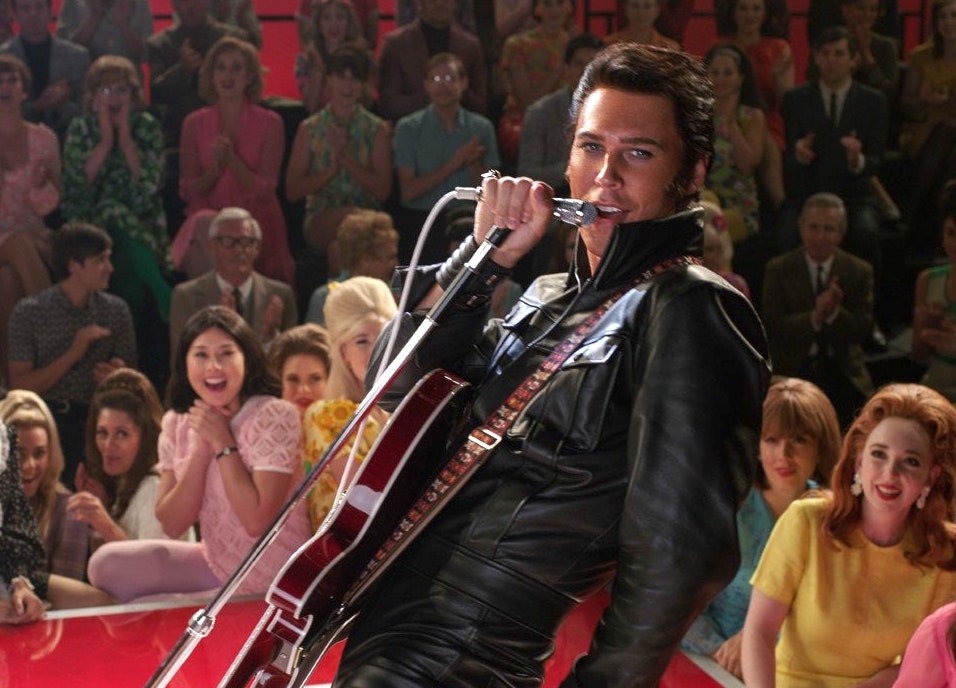
At its best “Elvis” is a kinetic fever-dream fantasia on rock’s most enduring icon, with newcomer Austin Butler portraying The King in such convincing style that there are moments when I wasn’t sure if I was watching an actor or old footage of the real man.
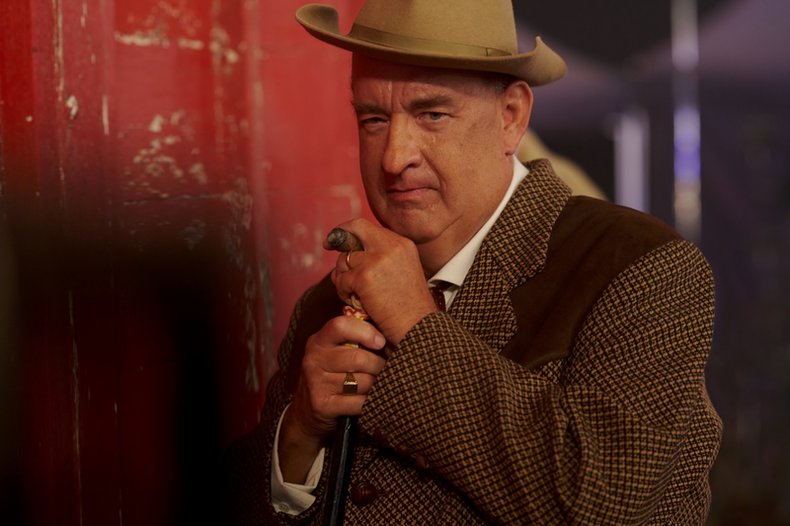
At other times the film presents as an overlong saga that bogs down in the unchanging relationship between Elvis and his creator/nemesis, Colonel Tom Parker, played by a prosthetics-heavy Tom Hanks as a sort of mumbling Jabba the Hutt.
Presley’s story is not without controversy. He was a natural performer whose sexual charisma flowed effortlessly, but he also seems to have been lazy, self indulgent and weak willed. He played other people’s songs (did he write any of his hits?) and was accused of hijacking the work of black performers. In latter years he was an addict whose bloated form had to be squeezed into those sequined jumpsuits.
But do not expect a revisionist approach in the screenplay by Luhrmann, Sam Bromell and Craig Pearce. If anything the film is borderline hagiographic (enough so that it carries glowing endorsements from Elvis’ former wife and daughter). What criticism it dishes is aimed squarely at Parker, who boosted his client’s career with brilliant marketing innovations like a Las Vegas residency and satellite concerts while, we’re told, smothering Elvis’ creative impulses through micromanagement.
Remember, this is a Baz Luhrmann movie, one that exploits all the tricks the Australian has perfected over a quarter century of Rococo filmmaking: swooping camera work, insistent rapid-fire editing, variations in film and video stock, animation…the complete contents of Luhrmann’s noggin seem to be splashed across the big screen. It’s such a staggering display that questions and objections fall by the wayside.
“Elvis” works best in its first half, when we get caught up in the giddy, dizzying whirlwind of first-generation rock. We see Elvis as a boy torn between the gutbucket blues he hears in a Mississippi roadhouse and the Gospel celebrations witnessed in a revival tent.
To those fertile elements young Elvis introduced a pelvis-pumping sexual braggadocio. It may have been a calculated act (initially he’s a bit embarrassed by it all), but by God did the girls (and not a few of their mothers) ever respond. These moments are sexy, funny and utterly captivating…after all these jaded years it still seems wholly fresh and original.
“Elvis” is narrated by Colonel Parker…who was neither a colonel nor a Parker but rather a Dutch con artist (he proudly proclaims himself a “Snow Man”) who entered the U.S. illegally and managed to live much of his life off the grid, promoting country music shows. Hanks adopts a near-indecipherable European accent (quite a shock if you’re expecting a good-ol’-boy drawl) that must work its way around an ever-present cigar.
So on top of this being the story of Elvis, we get a heaping helping of Parker apologetics, with the Colonel defending himself from charges that he kept Elvis from realizing his full potential. (For instance, Elvis never realized his dream of a world tour because Parker vetoed the idea. At the time nobody realized that the Colonel didn’t have a passport and couldn’t get one without facing deportation.)
And that’s a problem because Hanks’ Parker is a repellant character. I wanted to spend less time with him and more with Elvis.
More to the point, the Colonel is an unreliable narrator, self-serving and sly. (Luhrmann has fun cinematically name-dropping in the opening scene, referencing Orson Welles’ “Citizen Kane” as Parker suffers a heart attack in his memorabilia-crammed home — briefly we see that event through the cloudy atmosphere of a snow globe).
Tom Hanks as Colonel Tom Parker
Basically this is a two-character drama. Oh, there are plenty of peripheral characters — Elvis’ parents (Helen Thomson, Richard Roxburgh), his child bride Priscilla (Olivia DeJonge), not to mention fellow musicians like Little Richard (Alton Mason), Big Mama Thornton (Shonka Dukureh),Sister Rosetta Thorpe (Yola), Hank Snow (David Wenham) and B.B. King (Kevin Harrison Jr.).
But most of these characters are little more than window dressing (or, in the case of the black performers, a way of deflecting charges of cultural appropriation). Aside from Elvis and the Colonel, nobody here seems to have a whole lot of gravitas.
Which means there’s much resting on the young shoulders of Butler. Well, out of costume the kid doesn’t look all that much like Elvis but manages — with the help of makeup and wigs — to absolutely nail Presley’s onstage essence, from the gyrating hips to the slightest cock of his cocky head. Like I said, there are moments — especially a late scene in which an on-his-last-legs King croons “Unchained Melody” to a legion of fans) when Luhrmann seems to be cutting between original Elvis footage from 50 years ago and newly filmed material with Butler. Which is which? Damned if I know.
It’s a high wire act. Butler must suggest the darker side of Elvis, must make a nod to the drugs and women and dissipation without undermining the film’s worshipful attitude toward the man’s capacity to entertain and enchant. In a weird way “Elvis” is as important for what it leaves out as what it keeps in, but through it all Butler somehow keeps this big ship steady through sheer force of his screen persona.
It’s a phenomenal movie debut.
Hanks no doubt captures the essence of the Colonel, but I found myself on edge every time the big creep appears.
So to sum up: Butler is a great Elvis. Luhrmann’s kitchen-sink style mostly proves the perfect way to present the King’s story. But in its final third the film runs out of steam…more importantly, when it’s not recreating one of those iconic concert moments “Elvis” becomes emotionally muted, perhaps the result of the filmmakers’ efforts to present its legendary subject in the best possible light.
It’s not a whitewash, exactly, but it comes close.

 Butler's Cinema Scene