That’s the inescapable lesson of Ridley Scott’s “The Dog Stars,” an overcooked adaptation of Peter Heller’s end-of-the-world novel.
On the printed page “Dog Stars” is apocalypse on an intimate scale, fueled not by big action moments but by a creeping sense of loss. But Mark L. Smith’s screenplay pumps things up in an effort to please the lowest common denominator and the results have more in common with your average zombie flick than, say, Cormac McCarthy’s The Road.
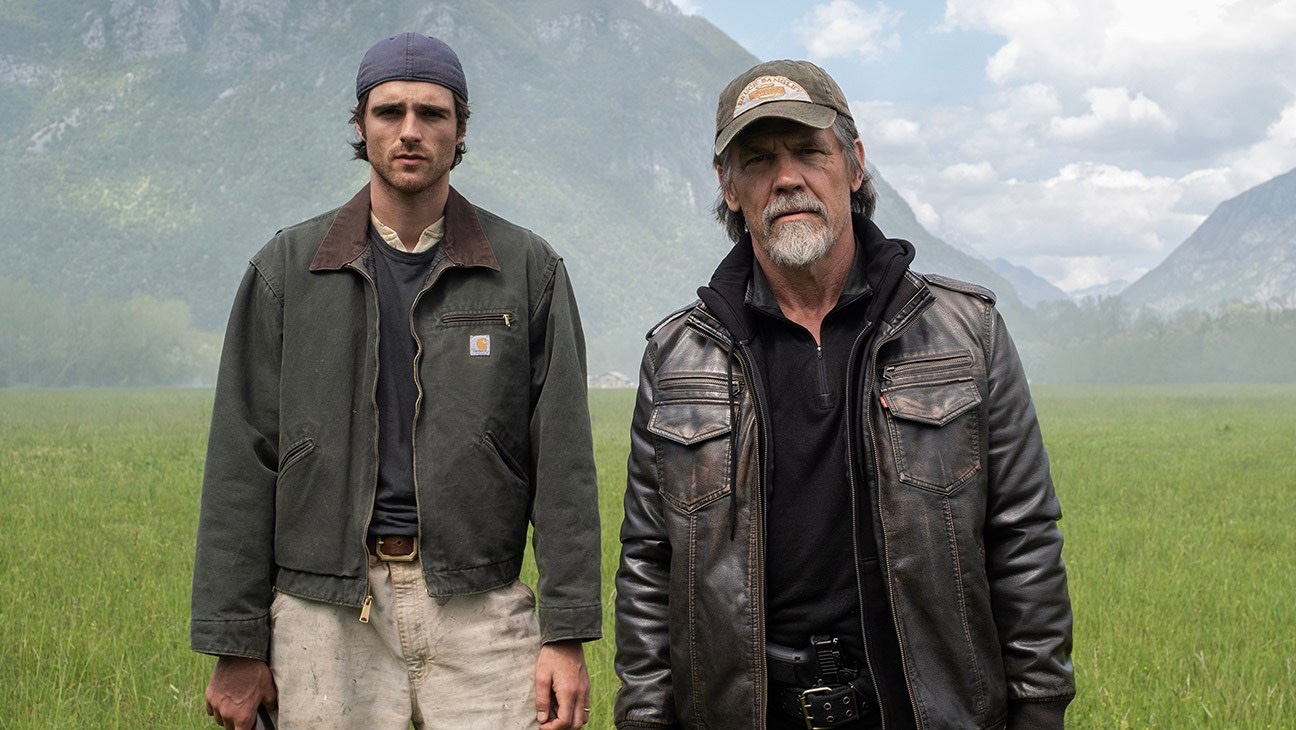
Ten years after a pandemic has wiped out most of humanity, Hig (Jacob Elori) and Bangley (Josh Brolin) eke out a living on an abandoned airstrip in the foothills of the Rocky Mountains.
Hig is a pilot who has managed to keep one Cessna running; he periodically flies into what’s left of Denver to collect food and other necessities. He seems to be a decent guy. Hig loves his dog and visits a Mennonite community in a nearby valley to deliver food and medicine.
Bangley, on the other hand, is a long-time survivalist (no doubt he’s ex-military) who thrives on isolation. Early on he uses his long-range rifle to kill a couple of teens who have wandered into his domain. His approach is to shoot first and question the corpses later.
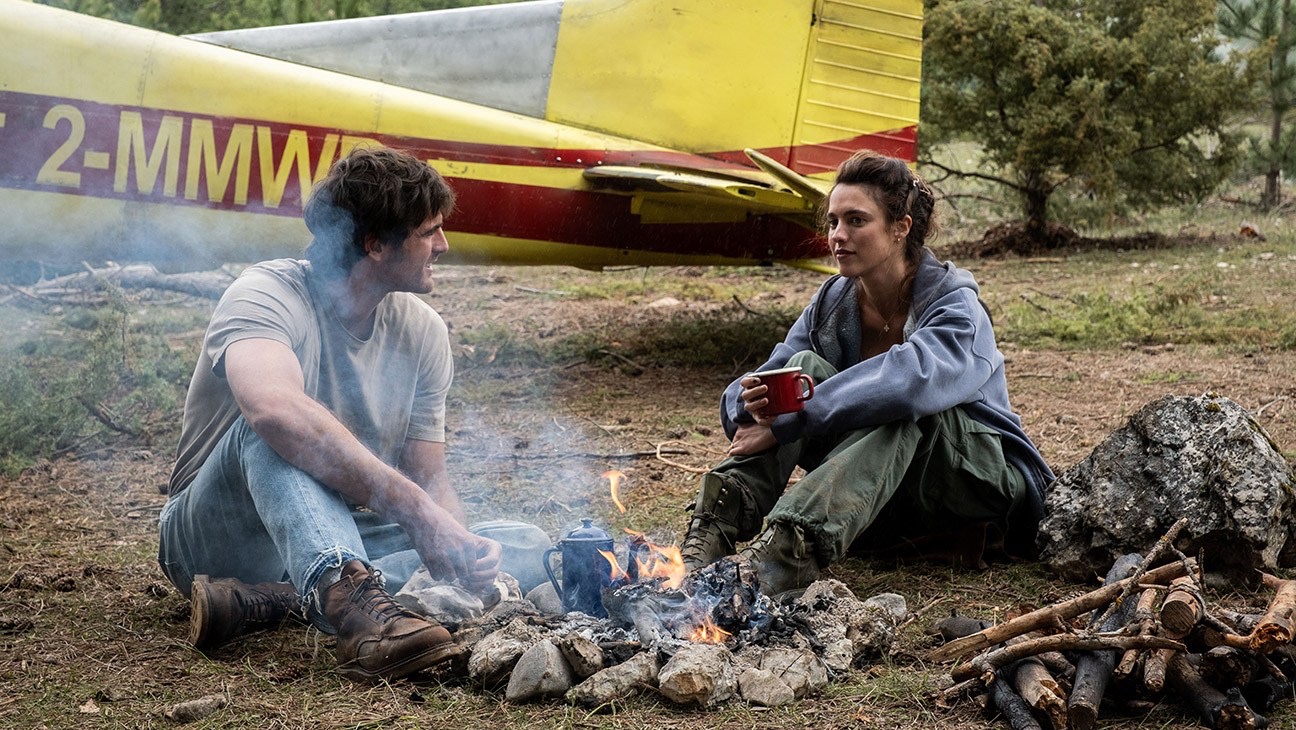
The plot centers on Hig’s determination to reach Grand Junction after hearing a broadcast from that town’s airport. Forced down by engine trouble, he stumbles upon a father and daughter (Guy Pearce, Margaret Qualley) who have been living peacefully deep in the mountains. The old man is suspicious of this interloper but the woman sees in Hig a last chance for a more-or-less normal existence.
The film’s first half is actually pretty good. Then things go downhill fast.
Screenwriter Smith suddenly changes gears. All that melancholy moodiness is tossed out on its ear in favor of two huge action sequences. In one Hig and his newfound friends must outrace a mounted band called the Scavengers to his newly-repaired airplane. Meanwhile Bangley undergoes a siege by a small army of tattooed berserkers.
Jacob Elori, Margaret Qualley
Things get even more ridiculous when Hig and his new comrades set down in Grand Junction to find the place a fiefdom presided over by the bonkers Darlene (Allison Janney in scenery-chewing overdrive), who wears a spotless airline hostess outfit from the 1970s (love the pillbox hat) and has developed an unconventional diet for her doped-up minions. (Use your imagination.)
At one point we’re supposed to believe that three hand grenades have the destructive power of a small thermonuclear device.
“The Dog Stars” at least looks good, thanks to Erik Messerschmidt’s cinematography — though Italy’s Dolomite Mountains don’t really look much like the American Rockies.
Acting honors go to Brolin for his tough-minded, utterly unsentimental Bangley, whose brusque approach to every action provides the film’s only brief flashes of humor.
For the first hour or so Guillermo del Toro’s new (and let’s face it, ultimate) version of “Frankenstein” left me a bit cold.
It’s been brilliantly designed and photographed but emotionally…kinda meh.
Turns out I just had to show a little patience. For once the Creature comes to life, so does the movie.
Indeed, our sympathies lie with none of the human characters…least of all Oscar Isaac’s Victor Frankenstein, the ruthless and ego-driven medical genius bent on reanimating dead corpses.
No, this “Frankenstein” belongs to Jacob Elordi’s Creature…and please note that he will not be described here as “the Monster.” For this stitched-together superman exhibits more pure humanity than any of the “normal” folk around him. It’s a performance that transcends the scars and death-blue pallor of the Creature’s skin to reveal, well, a beautiful soul.
Expect an Oscar nomination for Elordi, a screen heartthrob and sexual icon (“Saltburn,” the Max series “Euphoria”) who here shows unpredictable depths of loneliness, love, rage and compassion.
Del Toro’s adaptation of Mary Shelley’s novel begins at the end. The crew of a sailing ship trapped in the Arctic ice take aboard a frostbitten man being pursued by a terrifying giant. This is Victor Frankenstein, and to the Captain (Lars Mikkelsen) he relates his tale.
We see the boy Victor dealing with his icily controlling and intellectually cruel father (Charles Dance); this helps explain why as an adult Victor is a bit of a medical oddball, convinced of his own brilliance and openly contemptuous of his colleagues.
Victor’s ambitions know no bounds, and with the help of a rich benefactor (Christoph Waltz) — who it turns out has his own twisted motives — our man gets to work sorting through the bodies left on a recent battlefield (the setting is 1850s Europe), looking for pieces that can be sewn together and animated with a jolt of lightening.
When not impersonating God, Victor expresses a bad case of the hots for Elizabeth (Mia Goth), the fiancé of his brother (Felix Kammerer). Clearly he observes few moral boundaries.
Oscar Isaac
That becomes even more clear in his relationship with the Creature. He keeps his nearly naked (and weirdly erotic) creation chained in the castle basement, where he berates the poor unfortunate for lacking the mental acuity to match his physical power.
It is Elizabeth who breaks through, treating the Creature with kindness and unlocking his emotions and intellect. But exasperated by what he views as a failed experiment, Victor attempts to destroy his creation in a massive conflagration.
Turns out the Creature cannot die, as much as he might wish for it. The second half of the film finds the Creature joining Victor and the captain aboard the ship to explain why he’s been pursuing the semi-mad doctor over land, sea and ice.
It is in the Creature’s backstory that we find grace notes of beauty and longing. The highlight is his “adoption” of a farm family. Hiding in their idle gristmill he emerges at night to leave presents of dead game and firewood at their door. They call their mysterious and unseen benefactor “the spirit of the woods.”
The Creature’s real education begins when the blind grandfather is left alone and befriends this stranger, teaching him to read (how a blind man teaches someone to read is a poser, but I’m not complaining) and opening up his intellect to literature, history and philosophy.
Maddened by the knowledge of both his “otherness” and his inability to end his miserable existence, the Creature decides on revenge. He’ll pursue Victor halfway around the world for a final confrontation between father and son.
The old “Bride of Frankenstein” attempted to humanize the Monster (the blind hermit had a brief but telling scene), but the dominant themes of that classic were horror and camp. Here del Toro goes for an emotional and spiritual catharsis. That might seem a stretch for what is essentially a horror movie, but damned if he doesn’t pull it off.
In the end we’re left not so much with lingering terror as a disquieting sadness.
Well done.
Julia Garner
“WEAPONS My rating: B (HBO Max)
128 minutes | MPAA rating: R
A long tantalizing tease capped by a what-the-hell ending pretty much describes every horror movie I’ve seen in recent years.
It’s no different with “Weapons,” writer/director Zach Cregger’s followup to his brutally effective creepfest “Barbarian.”
The film opens with spectacular imagery…at exactly the same moment one fall night, nearly two dozen elementary school students rise from their beds and in their pajamas race away from their homes with arms stretched at a weird angle…it’s simultaneously scary and beautiful.
Turns out all the missing children were from the class taught by Justine (Julia Garner). Only one little boy, Alex (Cary Christopher), shows up at school the next day.
The others seem to have vanished without a trace.
The authorities are baffled. The parents frantic…and then vengeful. They turn on Justine, accusing her of being behind the disappearances/abductions. She’s told to go on hiatus until things settle down.
Cregger’s screenplay tells the story from several different perspectives. First there’s Justine, whose long-dormant drinking problem gets kicked back into high gear. There ‘sthe local cop (Alden Ehrenreich) who is part of the search and has a sexual relationship with Justine.
Archer (Josh Brolin) is one of the parents, driven to acts of desperation by the loss of his son.
Marcus (Benedict Wong) is the principal, trying to keep a lid on the town’s boiling emotions.
Austin Abrams is a young drug addict pulled into the mystery.
And finally there’s little Alex, whose home life harbors a dark secret.
Amy Madigan
About two-thirds of the way through the film we meet Alex’s Aunt Gladys (a nearly unrecognizable Amy Madigan), who’s just come to town and wears a gosh-awful orange wig that makes her look like a septagenarian Bette Davis after an all-night rave. Gladys is bleakly funny and not a little creepy — you just know she’s got something to do with the mass vanishing.
With its elements of the Pied Piper legend plopped down in contemporary suburbia, “Weapons” certainly grabs our interest and keeps us guessing as to what’s going on. If the final reveal is a bit underwhelming, Cregger seems to think so, too, because at the last moment “Weapons” shifts from slow-creep dread to over-the-top physical comedy.
Even if the big explanation is a fairy-tale head-slapper, most of “Weapons” is extremely watchable and quite involving.
The star-crossed saga of Elvis and his child bride Priscilla Beaulieu has been retold so often that Sofia Coppola’s “Priscilla” will hold few surprises for Presley-holics.
What the film does offer is a dreamlike take on a teenage girl swept off her feet by the Earth’s most famous man. (Coppola and Sandra Harmon’s screenplay is based on Priscilla Presley’s memoir; Presley was a producer of the film.)
It was a romance destined to fall apart. The initially charming rock star became increasingly controlling and, after Priscilla gave birth to a baby girl, turned his back on the marital bed in favor of frat-house partying with his notorious “Memphis Mafia” of good ol’ boys.
In the title role Cailee Spaeny undergoes a remarkable physical and emotional transformation over the course of the film. Though virginal (Elvis wouldn’t consummate the relationship until marriage), her Priscilla isn’t entirely naive about the pitfalls in her path. In a sense “Priscilla” is a study of her painfully blossoming emotional maturity.
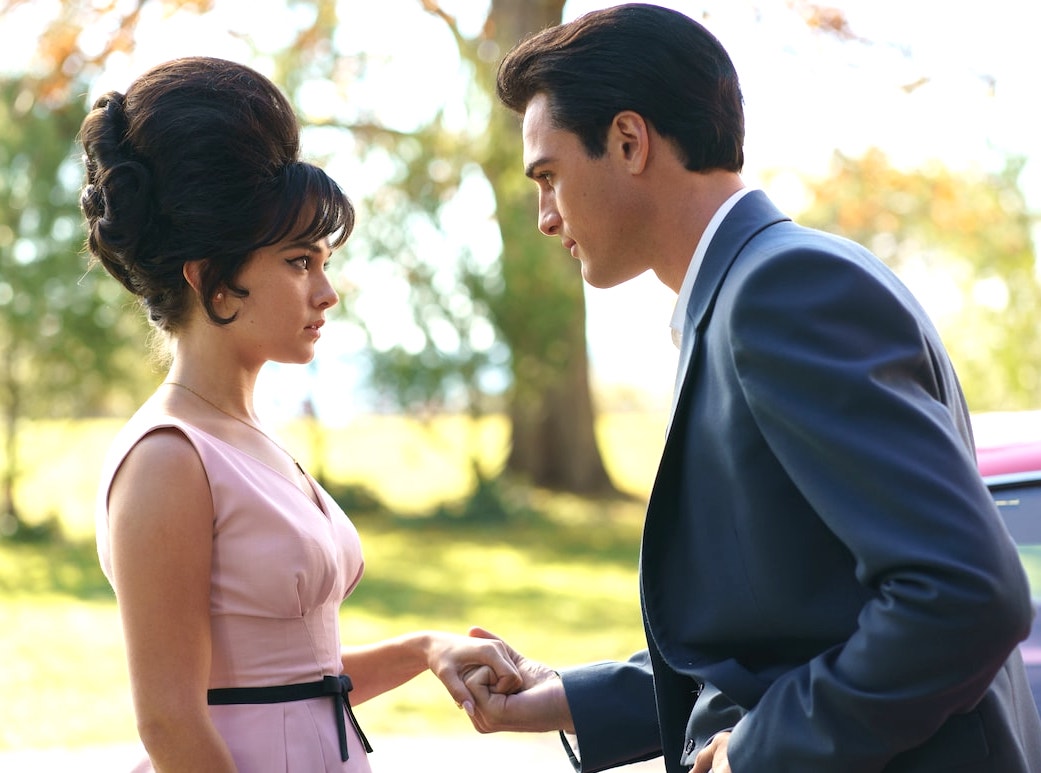
Brit actor Jacob Elordi doesn’t attempt an Elvis imitation so much as an approximation…and it pretty much works. Note that we don’t see Elvis performing any of his hits; instead the film’s soundtrack is heavy on other late-‘50s artists.
Michelle Williams
“SHOWING UP” My rating: B (For rent on various streaming services)
107 minutes | MPAA rating: R
Filmmaker Kelly Reichardt once again finds the perfect voice for her cinematic minimalism in Michelle Williams, here almost unrecognizable as a drabbed-down middle-aged artist.
When not performing administrative drudge work at an urban art school, Williams’ Lizzy devotes herself to her sculptures — foot-high ceramic statues of women caught in moments of expansive movement or somber contemplation. To the extent that the film has a plot, it’s about Lizzy preparing for a one-woman show at a small local gallery.
Mostly we eavesdrop on her life. She lives alone with a cat. (Is she straight? Gay?) Her best friend and landlord Jo (Hong Chau, an Oscar nominee for “The Whale”) is a fiber artist who is as outgoing and vivacious as Lizzy is dour and brooding.
Lizzy’s divorced mother is also her boss; her father (Judd Hirsch) is a well-regarded (and egotistic) potter, now retired. There’s also a schizophrenic brother (John Magaro) favored by their parents as a genius, though he’s unable to hold a job.
What we get here is a portrait of a woman as gray as the colorless clothes she favors, but nevertheless devoted to creating art, even though she’ll never make a living off it. At least she’s showing up.
And as much as “Showing Up” is a personality study, it is also an astonishingly lived-in depiction of a world whose inhabitants are devoted to creating. Anyone familiar with an art school environment will find the film almost a documentary experience.