Feeds:
Posts
Comments

Posts Tagged ‘Ethan Hawke’

Michael Shannon

“DEATH BY LIGHTNING”(Netflix)

Historical drama gets no better than “Death by Lightning,” a recreation of one of the more obscure but weirdly resonant moments in our national history.

Based on Candice Millard’s superb history Destiny of the Republic, this retelling of the assassination of President James A. Garfield in 1881 has been spectacularly well acted and produced.  It almost perfectly captures the same emotional and intellectual notes that made the book so memorable.

And it does it all in just four one-hour episodes.

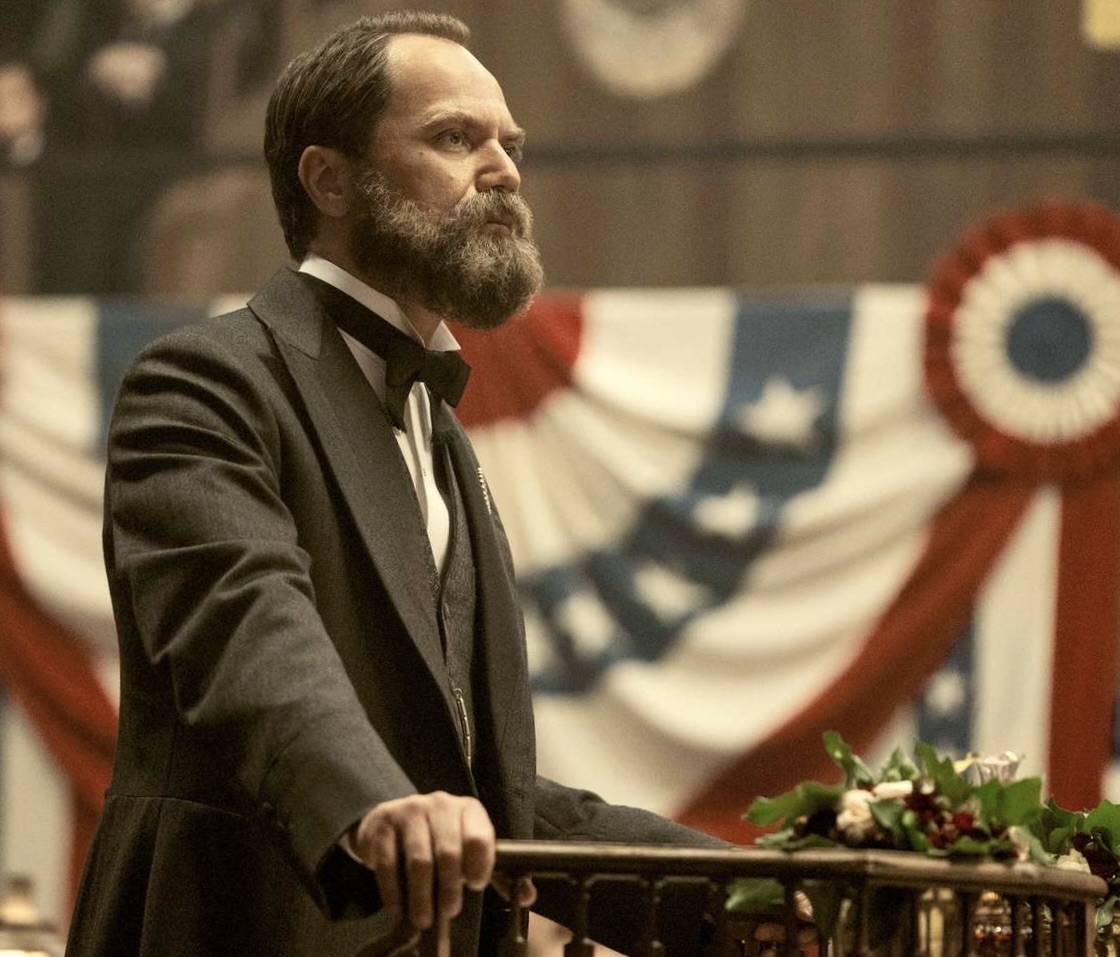
It begins with Senator Garfield (Michael Shannon) leaving his Ohio farm for the 1880 Republican National Convention in Chicago . His hope is to prevent the renomination of incumbent president Ulysses S. Grant, the figurehead of a spectacularly corrupt administration.

In a twist of fate that seems more fairy tale than fact,  it is Garfield himself who ends up the party’s nominee.  It’s not that he seeks the presidency…but he’s the only candidate the warring anti-Grant delegates all can get behind. 

In the process he makes an enemy of Grant supporter Roscoe Conkling (Shea Whigham), the U.S. senator from New York whose control of that state’s ports holds the American economy in a stranglehold.  Conkling is a savvy pol…he’s also willing to employ pure thuggery to get his way.  The comically boozy Chester Arthur (Nick Offerman) provides the muscle behind Conkling’s manipulations.

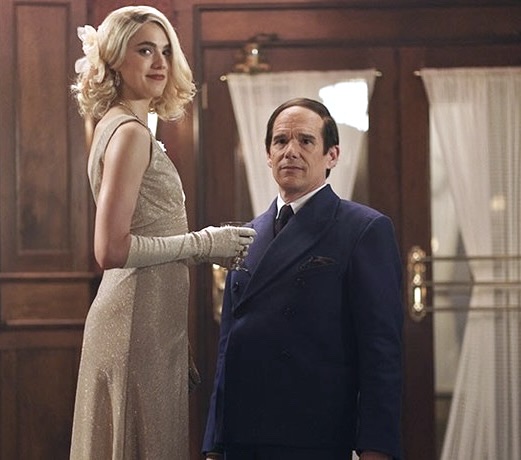
Garfield knows he cannot win without New  York.  So he does the unthinkable…he chooses as his running mate the hapless Arthur; basically it’s an end run around Conkling’s plan to sit out the election and pick up the pieces later.

The rise of Garfield runs parallel to the story of Charles Guiteau (Matthew Macfadyen), a failed lawyer and hustler with serious mental issues.  Guiteau fantasizes that his support was vital in getting Garfield elected, and now he wants a reward.  And when his pathetic entreaties are rejected, he plots to kill the President.

Matthew Macfadyen

As was the case with Millard’s book, this series leaves viewers ruminating over what might have been.  In his three months as President, Garfield embraced a progressive agenda.  A Civil War veteran, he reached out to  African American leaders, especially black soldiers whose sacrifices were overlooked.  He laid plans to replace the spoils system with a non-partisan Civil Service.

I doubt we’ll see better acting this year than what’s delivered here by Shannon and Macfadyen.

Shannon probably has the tougher job, given that Garfield was low-keyed, modest and generous.  Not exactly a personality to set off dramatic fireworks. Yet the actor finds the heroic in Garfield’s calm reasonableness. Especially telling are the scenes with the Garfield family (Betty Gilpin is terrific as Mrs. Garfield), which bring to mind the domestic image of Abraham Lincoln and his brood.

The upshot is a genuine sense of loss.

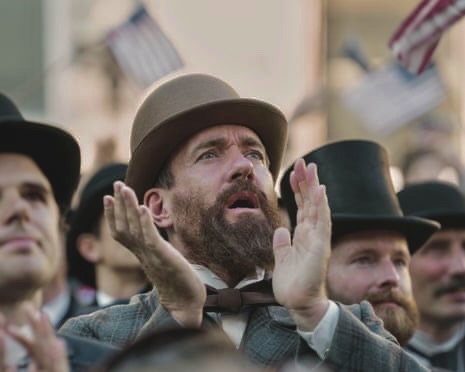
Macfadyen, on the other hand, gets to play a crazy man…but with restraint.  The key to his Guiteau is the disarming “normalcy” of his presentation.  The guys often sounds reasonable but behind the fancy words there’s a crippling desperation at war with rampant narcissism.  In any conversation there comes a moment, a tell if you will, that suggests something is seriously wrong with this guy. Maybe you can’t quite put a finger on it, but that creepy feeling on the back of your neck is inescapable.

The fourth and final episode unfolds in the aftermath of the assassination attempt. Garfield lingered in agony for a month while inept physicians tried to locate the bullet for extraction…even calling upon inventor Alexander Graham Bell to employ a primitive metal detector.

Weirdly enough, the reform movement Garfield put into motion survived him, thanks to an unlikely proponent we won’t name here.

Now this is all pretty heavy stuff, but director Matt Ross and writer/creator Mike Makowsky often put a bleakly funny spin on the material.  The brutal cronyism of Conkling and Arthur gets the full satiric treatment (the parallels between their machinations and those of our current President are inescapable) and the characters often employ ear-burning language.  I doubt that statesmen of the 19th century were that open with their profanity, but in dramatic terms it works…most of the really vile pronouncements come from the show’s heavies.

Even the smallest roles are deftly handled.  Among the supporting players are Bradley Whitford, Vonnie Curtis-Hall, Paula Malcomson and Zeljko Ivanek.

When it’s all over, “Death by Lightning” leaves us marveling at the decency of good men and the unpredictability of fate.

Ethan Hawke

“THE LOWDOWN” (Hulu)

I love, love LOVE this show.

Lee Raybon (Ethan Hawke) is a shabbily-clothed freelance journalist whose search for truth always has him in hot water with Tulsa’s movers and shakers.

In this funny and weirdly moving series from Sterlin Harjo (the man who gave us “Reservation Dogs”)  Lee sets out to prove that the suicide of one of the local gentry is actually murder.

He runs up against the dead man’s brother (Kyle Maclachlan), who’s running for governor; the scheming widow (Jeanne Trijpplehorn), a neo-Nazi cult  and a whole bunch of corrupt power  brokers.

All while trying to keep his struggling used book store afloat and delivering questionable parenting to his teenage daughter (Ryan Kiera Armstrong). 

Plus Lee gets beat up.  A lot.

This sprawling noir comedy (think Jim Thompson on laughing gas) is crammed with eccentric and memorable characters, and the players (among them Keith David, Tracy Letts, Tim Blake Nelson, Killer Mike, Tom McCarthy, Peter Dinklage, John Doe and the late Graham Greene) take full advantage of the possibilities. Rarely have so many scene stealers been assembled in one place.

I was borderline bereft when “The  Lowdown” reached its eighth and final episode.  But I’ll tell you what…I’m gonna plop down and watch it all over again.

| Robert W. Butler

Read Full Post »

Mahershala Ali, Ruth Scott, Julia Roberts, Ethan Hawke

“LEAVE THE WORD BEHIND” My rating: B- (Netflix)

138 minutes | MPAA rating: R

The latest from writer/director Sam Esmail, creator of TV’s mind-twisty “Mr. Robot,” has been getting equal parts love and hate from Net-dwellers. 

 I’m stuck in the middle.

It’s an end-of-civilization movie, sort of, with a family from the Big Apple (Mom and Dad are Julia Roberts and Ethan Hawke) retreating to a rental home on Long Island for a little R&R, only to find the world falling apart around them.

Cell phones stop working. Cable TV goes out. The Internet is down.

There’s still running water and electricity…but for how long?

And then there’s the huge oil tanker that has run aground on a nearby beach and the passenger airplanes that are dropping out of the sky.

The highways are impassable (in one haunting scene dozens of driverless Teslas pile up in the roadway in a suicidal demolition derby) and the local deer seem to be suffering from a mass psychosis.

Emotions accelerate when the owner of the rental house (Mahershala Ali) shows up with his surly college-age daughter (Ruth Scott). Mom immediately becomes suspicious of these interlopers, especially since Ali’s high-powered businessman brings with him vague reports of a mass terrorism event.

What’s it all about? Keep guessing. Like Hitchcock’s “The Birds,” which it resembles on many levels, “Leave the World…” isn’t about providing answers. Its emphasis is on the reactions of the characters, who respond to undefined threats by turning on one another.

To say that the film delivers an ever-tightening sense of dread is an understatement.  The acting is about as good as what you’d expect from such a high-powered cast, but I was especially taken with Farrah Mackenzie as the couple’s daughter, a tweener with the face of a 35-year-old and a need to see the final episode of “Friends” that transcends even the end of the world.

Joel Fry, Roy Kinnear

“BANK OF DAVE” (Netflix)

107 minutes | PG-13

Dave Fishwick is the real-life George Bailey (the character played by James Stewart in “It’s a Wonderful Life”).  

More than a decade ago Fishwick, who runs several van and recreational vehicle dealerships in northern England, decided to create a small bank for local residents whose loan applications had been rejected by the established financial institutions.

Over the years Fishwick had found that whenever he loaned money to needy citizens, they invariably paid him back. Often with interest although Fishwick, a wealthy fellow, didn’t ask for that.

So why not make it official?

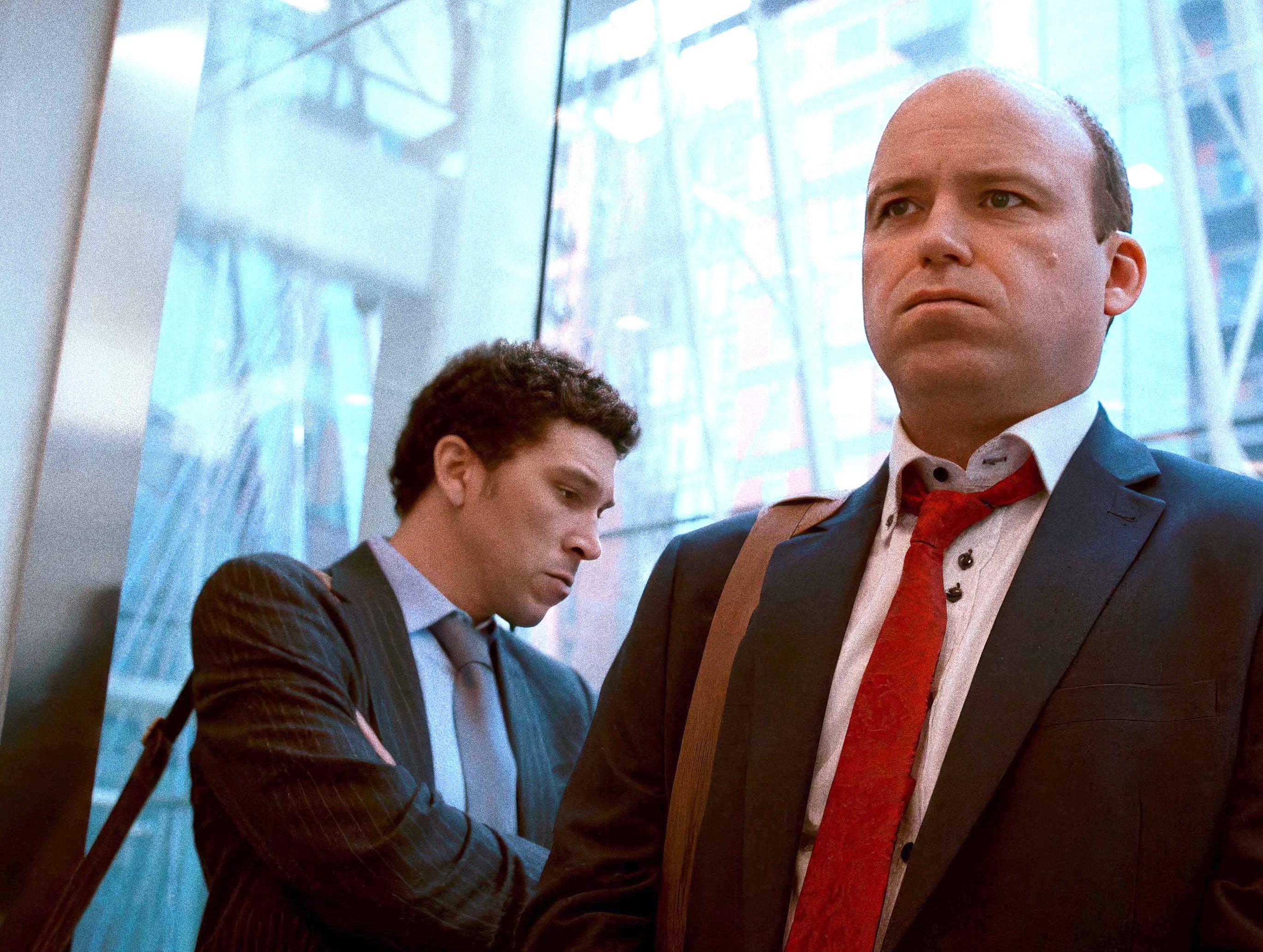
“Bank of Dave” stars Roy Kinnear as the irrepressible and astonishingly altruistic Dave, and Joel Fry as the young London attorney who comes to the boonies to help him overcome the many legal hurdles in his path.

Because the world of British banking was, until Dave Fishwick, a closed shop. No new bank charters had been approved in more than 150 years, and the powers that be — represented here by Hugh Bonneville as a titled (and entitled) elitist — didn’t want a guy like Dave offering an alternative to their tight-fisted and probably corrupt monopoly. They were ready to play dirty.

Fishwick’s story was the subject of a three-episode Brit documentary back in 2012. Now, under Chris Foggin’s workmanlike direction, this David-and-Goliath fictitious version delivers a whole lot of feel-good.

There’s a subplot in which the lawyer falls for an idealistic M.D. (Phoebe Dynevor), lots of  colorful locals who ooze community and a self-help ethos, and even an appearance by Def Leppard, the famous hair metal rockers who gave a free concert to raise startup money for the Bank of Dave. 

None of this is terribly surprising dramatically, but “Bank of Dave” sucks you in.

Sandra Huller

“ANATOMY OF A FALL” My rating: B+  (Rent on Prime, Apple+, etc.)

151 minutes | MPAA rating: R

A man plummets to his death from an upper story of his house.  His wife is charged with his murder.

That’s the setup examined with procedural detail in “Anatomy of a Fall,” but this description barely scratches the surface of writer/director Justine Triet’s methodical drama.

The body of Samuel Maleski (Samuel Theis) is discovered by his vision-impaired son Daniel (Milo Machado Graner) lying below a balcony of the family’s chalet in the French Alps.  

The cause of death is a blow to the head, but whether Samuel suffered the injury in the fall or was struck on the noggin before going down cannot be determined. There’s a chance this was a suicide.

The authorities, though, charge Samuel’s wife Sandra (Sandra Huller) with his murder. 

At least half the film unfolds in a courtroom where Sandra’s attorney (and one-time flame) Vincent (Swann Arlaud) struggles to counter the grim portrait of his client painted by the aggressively, red-gowned prosecutor (Antoine Reinartz).

It’s not like the state doesn’t have a lot to work with. 

Sandra is a German whose grasp of French is tenuous enough that she asks that the trial court to be conducted in English. So that’s pissing off the jingoists in the courtroom.

She’s a successful novelist who may have borrowed/stolen the idea for her last book from her husband. She is admittedly bisexual. 

Most damning of all, Sandra is emotionally aloof. Is she an unfeeling cold fish? Or is she simply reluctant to air her innermost feelings for public consumption?

On the other hand, Samuel was despondent over his own failed career and his responsibility in the unexplained accident that led to young Daniel’s blindness. He was toying with his meds. He may have attempted suicide by pills a few weeks earlier.

In the film’s most dramatic passage the prosecution plays a recording of a family argument made by Samuel shortly before his death (we see it unfold in flashback). It’s brilliant stuff, with Samuel arguing from his emotional viewpoint and Sandra rebutting with cool (and infuriating) rationality.

A verdict is finally reached, but even then we’re left wondering just what happened.

The acting is off the charts.  Huller (“Toni Erdmann” and the upcoming “The Zone of Interest”) exudes sexual, moral and emotional ambiguity. It’s not like we like her, but we are definitely invested.

Young Garner is astonishingly fine as the blind son, while a border collie named Messi gives a jawdropping perf as Snoop, the family pooch.  The dog is so good that director Triet often films from his vantage point just a couple of feet above the floor.

 | Robert W. Butler

Read Full Post »

Joanne Woodward, Paul Newman

“THE LAST MOVIE STARS” (HBO MAX)

As the title suggests, HBO MAx’s “The Last Movie Stars,” is about Hollywood.

But even more, it’s about marriage.

Actor Ethan Hawke, here donning his directing cap, fashioned this six-part documentary series at the request of the family of movie royalty Paul Newman and Joanne Woodward. 

The famous couple’s children revealed that some 30 years ago their father began interviewing just about everyone the Newmans knew: directors, fellow actors, housekeepers, family members, close friends.…even the first wife Newman left for Woodward.

 Those interviews were captured on audio tapes which Newman (who died in 2008) subsequently burned (no explanation of why). But transcriptions of the sessions still exist.

Would Hawke like to use that written material to create a doc on the couple?

Well, YEAH.

“The Last Movie Stars” may be unique among show-biz documentaries for its innovative narrative approach.

A good chunk of the series is Zoom footage of Hawke (like everyone else, stuck at home during the pandemic) talking with the actors who would provide the voices of the interview participants. 

Initially this struck me as self-indulgent…the whole thing carries the whiff of how-I-made-a-documentary.  But before long it became apparent that by having Newman and Woodward’s fellow actors comment on their lives and films, we were getting an invaluable look into the couple’s professional world…an insider’s look.

(For the record, George Clooney reads Newman’s words while Laura Linney voices Woodward’s.  Other participants include Sam Rockwell, Billy Crudup, Steve Zahn, LaTanya Richardson Jackson, Sally Field, Rose Byrne, Mark Ruffalo…and that’s just scratching the surface.)

There are, of course, a ton of clips from the actors’ films, with special emphasis on the ones in which they played opposite each other (their last such collaboration was the Kansas City-lensed “Mr. and Mrs. Bridge”). 

What you soon realize is that Woodward was a great actor, while Newman was a great star (indeed, in some of the old color footage the actor’s eyes are so stunningly blue that you find yourself looking for signs of digital enhancement.)

“Mr. and Mrs. Bridge”

Whereas Woodward appears to have arrived on screen fully formed and a master of the medium, Newman took a while to find his acting chops.  In the meantime his physical beauty and unforced sex appeal would keep the roles coming.

So, yes, we get a lot of clips from films like “Hud,” “Hombre,” “Cool Hand Luke,” “Paris Blues,” “The Stripper,” “The Long Hot Summer,” “Butch Cassidy and the Sundance Kid” — enough to make you want to seek out those treasures for fresh viewings.

But behind the glitz “The Last Movie Stars” is about a man and a woman who managed, against the odds, to stay married for half a century in a business notorious for chewing up and spitting out relationships.

How did they persevere?  As the doc shows, it wasn’t always the idyllic partnership the fan magazines depicted.

Although the series hints (so delicately that you might miss it if you step out for a glass of water) that Newman had an extramarital dalliance our two,  the man didn’t take seriously his sex symbol status.  He was ironic and self-effacing, thankful to be accepted by a woman whom he considered his superior professionally and personally. 

At one point Woodward banned him from the house for a period of weeks. He did penance by sleeping in his car in the driveway.

Meanwhile Woodward (who at age 93 is suffering from dementia) could be ruthlessly honest about putting her work on hold to raise the couple’s three children (and to be stepmother to Newman’s three kids from his first marriage).  She had to play the “little woman: while  her husband’s career — both as actor and race car driver — steamed ahead unchecked.

Woodward actually tells one TV interviewer that if she had it to do over again, she doesn’t know if she’d have children.

Even so, the testimony of her offspring and of family friends suggest that she was a terrific mother who never let those misgivings get in the way of her parental obligations.

In the end, “The Last Movie Stars” becomes an engrossing emotional experience.  One might question whether the series needed to be six hours long, but over time you find yourself sucked into the lives of these two.

In the last episode it is revealed that after he received a diagnosis of terminal cancer, Newman secretly crept into the attic and placed in his wife’s Christmas stocking the last present he would ever give her, a present she would not discover until months after his passing.

I’d call that love.

| Robert W. Butler

Read Full Post »

Catherine Deneuve

“THE TRUTH” My rating: B

106 minutes | MPAA rating: PG

The character played by Catherine Deneuve in “The Truth” is reprehensible.

Except that she’s played by Catherine Deneuve, which means her reprehensibleness is actually kind of awesome.

In the latest from  Hirokazu Koreeda (a Japanese director making a French movie…talk about cross-cultural pollination) Deneuve plays Fabienne Dangeville, a great beauty of the French cinema who, now well ensconced in her 70s, has just published a memoir called “La Verite” (“the Truth”).

Fabienne has been a star for so long, has spent so much of her life being fawned over, that she has an iron-clad if overinflated sense of her own wonderfulness.  She expects people to cater to her every whim, and has a wickedly sharp tongue with which she lacerates friend and foe alike.

Imagine a Maggie Smith character coupled with world-class sex appeal.

Koreeda’s screenplay follows Fabienne on two fronts.  Professionally she’s taken a supporting role on a low-budget science fiction film starring young actress Manon Lenoir (Manon Clavel), who’s being touted as the next Fabienne Dangeville. You can imagine Fabienne’s dim view of that assertion.

On a personal level, Fabienne is dealing with a visit from her semi-estranged daughter Lumir (Juliette Binoche), a New York-based screenwriter who’s returned to her childhood home with her actor husband Hank (Ethan Hawke) and their precocious bilingual daughter Charlotte (Clementine Grenier).

When little Charlotte exclaims that Grandma’s house looks like a castle, Lumir glumly notes, “Yes, and there’s a prison just behind it.”  True.  The family manse abuts a maximum security facility, and it’s pretty obvious that in Lumir’s mind the two properties are interchangeable.

(more…)

Read Full Post »

Ethan Hawke, Noomi Rapace

“STOCKHOLM” My rating: B- 

92 minutes | MPAA rating: R

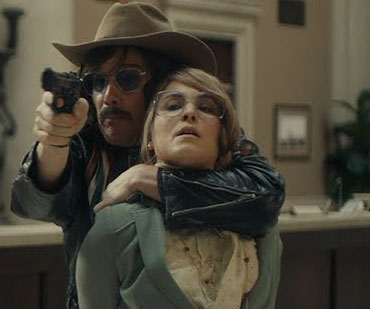
On a sunny day in 1973 a man wearing a ridiculous disguise — black leather jacket with a Texas flag on the back, cowboy boots and hat, long-haired wig and sunglasses — walks into a Stockholm bank, pulls a machine gun from his bag, has everyone lie down and tunes a portable radio to a Bob Dylan song.

So begins Robert Budreau’s “Stockholm,” a riff on a real 1973 incident in which a couple of not-terribly-bright lowlifes held a handful of bank employees hostage for several days before finally being overwhelmed by the cops.  To survive their ordeal the hostages bonded with their captors…a situation now described by the term “Stockholm syndrome.”

The idiot in the cowboy getup is Kaj, and he’s portrayed by Ethan Hawke with a curious sort of dim-bulb charisma. Waffling between cockiness and panic, he demands that the authorities free his best bud Gunnar (Mark Strong) from prison and deliver him to the bank.

Kai also wants $1 million and a Ford Mustang getaway car…he specifies that it be just like the one Steve McQueen drove in ” Bullitt.”

(more…)

Read Full Post »

Benjamin Dickey as Blaze Foley

“BLAZE” My rating: B- (Opens Sept. 28 at the Tivoli, Screenland Armour and Glenwood Arts)

128 minutes | MPAA rating: R

Ethan Hawke’s “Blaze” is unlike any other music biz film biography I can think of. Its closest competition in its nontraditional approach would  be 2015’s “Miles Ahead” with Don Cheadle playing the great jazz trumpeter in a narrative-tossed-salad retelling.

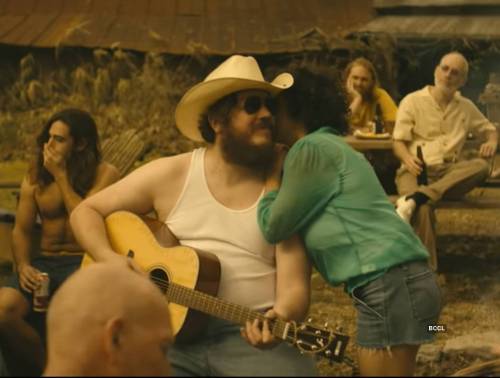
The ostensible subject of “Blaze” is Blaze Foley, a Texas musician and songwriter who hung out with country/folk music’s “outlaw” wing until his untimely death by gunshot in 1989 .

Hawke’s film (he  directed and adapted the memoir by Foley’s wife Sybil Rosen) follows no particular chronology. It’s all over the place. As a framing device he has given us a radio interview with fellow folkie Townes Van Zant (Charlie Sexton); scenes from Foley’s life play out as Van Zant provides a running commentary.

Foley (Ben Dickey) is a bearded, burly good ol’ fella.  He can be charming in a down-home way. He can also be a drunken maniac.

A Foley concert might be sublime, or it might be a slog, given the musician’s tendency to rap endlessly when the customers only wanna hear some tunes.  A few of his songs were recorded by the likes of Willie Nelson, Merle Haggard, Lyle Lovett and John Prine, but he was never a household word or a major player.

(more…)

Read Full Post »

Ethan Hawke, Rose Byrne, Chris O’Dowd

“JULIET, NAKED” My rating: B+

105 minutes | MPAA rating: R

The drolly amusing “Juliet, Naked,” isn’t my favorite film based on work by Nick Hornby (that would be the sublime “Brooklyn”) but it’s right up there with “About a Boy” and “High Fidelity.”

And like the latter, it’s a comedy/drama that pivots on a guy obsessed with rock music.

Duncan (Chris O’Dowd) teaches pop culture at a small British community college. He’s the kind of geeky prof who, for a course on HBO’s
“The Wire,” supplies his students with a glossary of American inner city words and phrases. You can imagine him leading serious  classroom discussions about the etymological roots of “mofo” and “ho.”

His biggest crush, though, is on a marginal American singer/songwriter named Tucker Crowe whose LP “Juliet”  holds the 43rd place on at least one list of great heartbreak albums.

Duncan loves “Juliet” and scarfs down every bit of information he can find about Tucker Crowe, who vanished a quarter century ago.  Duncan is also the proprietor of a Tucker Crowe web site where he trades theories with other Crowe disciples and writes rambling blogs about how Tucker is the J.D. Salinger of alt rock.

In short, Duncan is perfectly ridiculous. (Not that we can’t relate. Most of us have our little hard-to-explain musical fixations: Richard Thompson. Eric Andersen. The Beau Brummels.)

Anyway, Duncan’s live-in girlfriend Annie (Rose Byrne) has just about had it with the whole Tucker Crowe thing.  When an early stripped-down demo recording of the songs on “Juliet”starts circulating on the Internet, Annie writes a withering (and anonymous) review of what is being called “Juliet, Naked.”

(more…)

Read Full Post »

Ethan Hawke

“FIRST REFORMED” My rating: B+

113 minutes | MPAA rating: R

“First Reformed” doesn’t always work, but even as a partial failure it packs more mind- and soul-shaking punch than any other film yet released this year.

This simultaneously beautiful and desolate drama from Paul Schrader isn’t shy about borrowing from its antecedents, foremost among them Ingmar Bergman’s early ’60s religious trilogy (“Through a Glass Darkly,” “Winter Light,” “The Silence”) and Robert Bresson’s 1951 “Diary of a Country Priest.”

But thanks in large part to what may be Ethan Hawke’s finest performance, “First Reformed” finds its own voice, one that uncomfortably weighs conformity against concern for God’s creation.

Our protagonist, Reverend Toller (Hawke), is pastor of First Reformed Church in a picturesque New England Town.

Established before the American Revolution, First Reformed has hardly any parishioners; its doors are kept open through the financial support of a local megachurch whose ambitious and charismatic preacher (an excellent Cedric the Entertainer) views it as a curiosity, a sort of historic religious theme park.

It’s immediately obvious that Toller has hit bottom. A former military chaplain, he urged his son to enlist; when the boy died in combat Toller’s wife left him.

Now he spends his days writing sermons nobody hears and scribbling in a journal — he calls it “a form of prayer” –that he hopes will provide insight into the tailspin that has become his life (“When writing about oneself one should show no mercy.”)

Physically he’s slowly becoming a wraith, thanks to digestive issues — cancer? — which limit him to a diet of bread and broth.

Occasionally, though, he actually does a bit of ministering. He’s approached by a young parishioner, Mary (Amanda Seyfried), who requests counseling for her husband Michael (Philip Ettinger).  Mary is pregnant and Michael wants her to abort the baby.

(more…)

Read Full Post »

Sally Hawkins

“MAUDIE” My rating: B 

115 minutes | MPAA rating: PG-13

Simultaneously a biopic about an eccentric outsider artist and a politically incorrect love story, “Maudie” isn’t exactly warm and fuzzy.

Director Aisling Walsh’s study of Nova Scotia painter Maud Lewis  — the Canadian equivalent of Grandma Moses — is both inspiring and troubling.

Inspiring because the naive Maud overcame crippling arthritis to develop her primitive yet poetic visual style, and troubling because of her marriage to a man who, at least early in their relationship, was guilty of both physical and psychological abuse.

Good thing, then, that Walsh and screenwriter Sherry White have for their stars the terrific Sally Hawkins and Ethan Hawke, whose performances transcend our usual notions of marital right and wrong.

When we first meet Maud (Hawkins) in the late 1930s, she is a prisoner of her domineering aunt and her indifferent older brother.  Thanks to the arthritis from which she has suffered most of her life, the thirtysomething Maud moves slowly and clumsily; her unimpressive physical presence leads many to assume she’s mentally incapacitated as well.

Hardly.  Though poorly educated, Maud has a biting wit and fierce sense of self.  When she learns that crusty local bachelor Everett Lewis (Hawke) is advertising for a housekeeper, she declares herself a free woman and goes after the job.

Basically she ends up working for room and board for a laborer who was reared in an orphanage, has minimal people skills and is often ruled by his volcanic temper. She puts up with his cruelty because she has nowhere else to go…and because she realizes she’s smart enough to manipulate this angry ignoramus, eventually marrying him.

(more…)

Read Full Post »

Ethan Hawke and canine costar

Ethan Hawke and canine costar

“IN A VALLEY OF VIOLENCE” My rating: C

104 minutes | MPAA rating: R

Notwithstanding the participation of two major stars — Ethan Hawke and John Travolta — Ti West’s “In a Valley of Violence” is a toss off,  an indifferent diversion at best.

It’s a mashup of Sergio Leone Spaghetti Western elements — an animated credit sequence that mimics that of “The Good, the Bad and the Ugly” and an ersatz Morricone soundtrack of tympani, Indian flutes and electric guitars — and oater cliches somewhat bent by eruptions of oddball humor.

Paul (Hawke) is a lone rider headed to Mexico in the company of his dog, an adorable mutt.  Everybody who sees the pooch wants to know if it does tricks. “She bites,”  is Paul’s sullen reply.

John Travolta, Ethan Hawke

John Travolta, Ethan Hawke

In an all-but-abandoned former mining town Paul slows down for a bath and a shopping spree in the general store.  But he runs afoul of Gilly (James Ransone), the pushy, trigger-happy deputy and son of the local marshal (Travolta).

After leaving the burg Paul is waylaid by Gilly and his fellow deputies, who do bad things to him and his dog.  Left for dead, Paul gets his shit together and heads back to town for revenge.

There are some small pleasures here.  Travolta’s Marshal is a loquacious sort out of a Tarantino film, and he at least has the decency to be embarrassed by his idiot offspring. Taiga Farming plays a teen-age hotel maid who becomes our hero’s confidant; Karen Gillan is her prettier spoiled sister.

The film looks good but, really, West’s “High Noon”-ish plot is way too familiar and the abrupt tonal changes — bloody sadism to goofy silliness — are less intriguing than irritating.

| Robert W. Butler

Read Full Post »

Older Posts »