Feeds:
Posts
Comments

Posts Tagged ‘Amanda Seyfried’

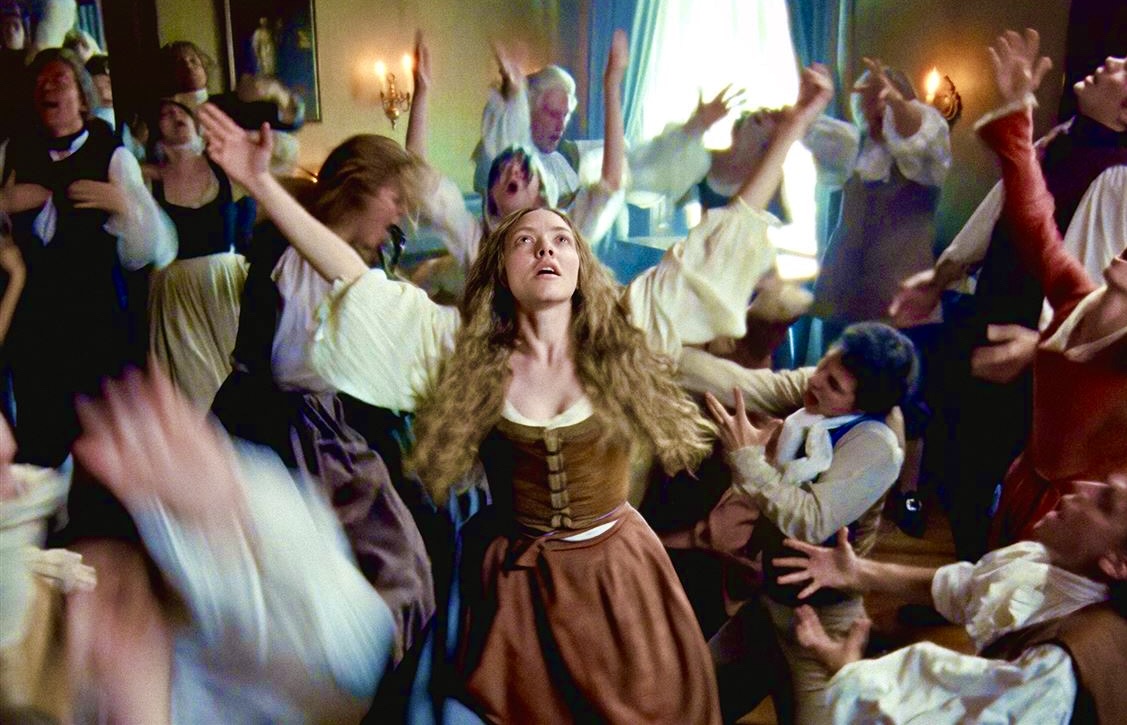
Amanda Seyfried as Shaker saint Ann Lee

“THE TESTAMENT OF ANN LEE” My rating: B (Hulu)

136 minutes | MPAA rating: R

Mainstream Hollywood rarely knows what to do with religion…unless it’s some sword-and-sandal silliness.

But Mona Fastvold’s “The Testament of Ann Lee” provides a sometimes brilliant evocation of ecstatic states while never commenting editorially on the truth (or falsehood) of its subject’s beliefs.

In the process it gives Amanda Seyfried the role for which she may some day be best known.

Ann Lee (Seyfried) was a British woman whose search for religious certainty led her to the Shaker movement, an offshoot of the Quakers in which dance and movement were essential to the spiritual quest. She left England for America in the years just before the Revolution, bringing with her a small band of followers who regarded her as an incarnation of Jesus. Over  years they established several communal settlements in New England, farming and manufacturing utilitarian but beautiful items of furniture that are still popular.

At one point the Shakers had nearly 5,000 members…a remarkable number given that total avoidance of sex was central to Lee’s ministry.  The church fed its ranks by adopting orphaned children who, upon reaching maturity, were allowed to decide whether to stay or seek a life in the larger world.

As scripted by director Fastvold and her husband Brady Corbet (their last outing was the spectacular “The Brutalist”), this is in many ways a straightforward historic biography.  

We follow Ann’s early life, her marriage to a blacksmith (Christopher Abbott) and the tragic deaths of their four children (a huge factor in creating her views on abstinence), her gradual rise to become a spiritual leader, her preaching partnership with her brother William (Lewis Pullman) and her determination to find a respite from persecution in the New World (only to discover that thuggish assholes are to be found just about everywhere).

It’s all been mounted with an almost documentary sense of time and place.

But here’s the twist:  in the many scenes of Shaker worship the film can only be described as a musical.

The congregants dance and sing in a reverential frenzy.  Like the whirling dervishes of Islam’s Sufi sect, the Shakers in this film seek transcendence through sound and movement, and just by observing we  can get a contact high from their shared exctasy. This is an astounding thing to say of an American feature film…simply watching it is a semi-spiritual experience.

Director Fastvold has said in interviews that while the songs and dance movements are based on real Shaker worship practices, they’ve been sweetened for this cinematic retelling. So while they may not be 100 percent authentic, they do achieve a heightened awareness in the viewer…heck, this looks like a worship service that might actually be fun.

At the core of it all is Seyfried’s performance, which makes Ann fully human even as she says and does things that many of us find, well, hugely eccentric. Apparently Ann Lee had no room for doubt, and there’s none in Seyfried’s work here. She exudes sincerity, reverence and a calm benevolence.  It’s remarkable.

Keeping “The Testament of Ann Lee” from being a near masterpiece are pacing problems.  The last third of the film drags a bit…to the point that viewers not naturally inclined to spiritual rumination may lose interest.

For the rest of us though, it’s a thought- and emotion-provoking experience.
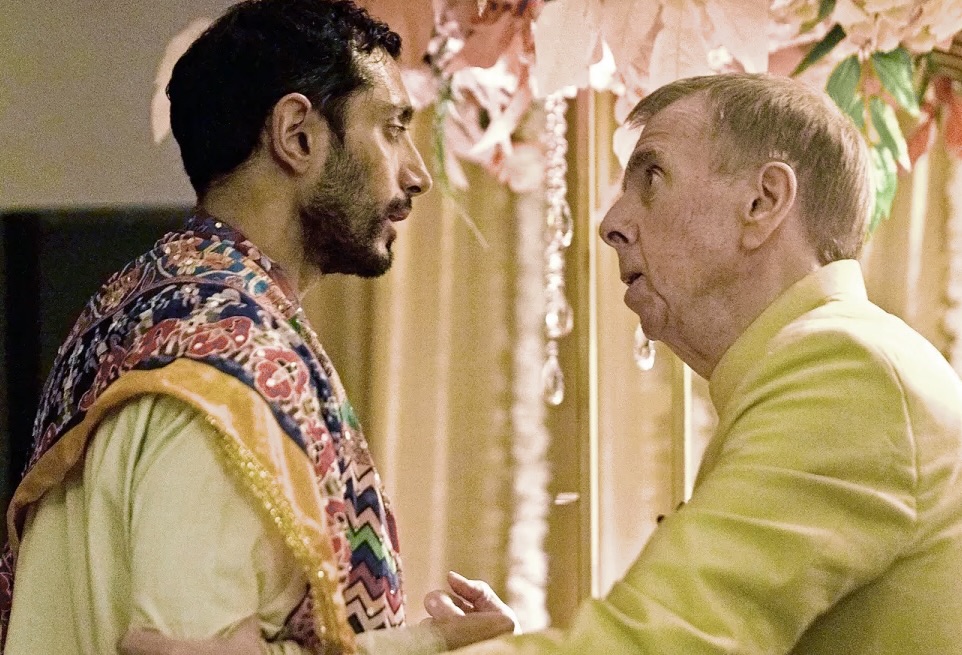
Liz Ahmed, Timothy Spall

“HAMLET” My rating: B (In theaters)

114 minutes | MPAA rating: R

“Hamlet” can survive just about any amount of directorial tinkering.  What you can’t screw with are Shakespeare’s words and the necessity of having a charismatic leading man as your Hamlet.

The new version of the tragedy from Brit director Aneil Karia works most of the time.  All the familiar monologues are intact (if sometimes arranged in a different chronology) and in Riz Ahmed we have a fiercely emotional Hamlet who may very well be sliding into madness.

This “Hamlet” is a modern dress interpretation (Ehthan Hawke starred  in another modern version in 2000) and set in London’s South Asian community.  Elsinore in this retelling is not a royal palace but the name of a massive real estate development company founded by Hamlet’s papa.

As the film begins a crew of male friends and family are preparing the magnate’s body for a traditional Hindi cremation.  Hamlet (Ahmed) has been studying abroad and is appalled to learn that not only is his uncle Claudius (Art Malik) taking over the company, but he intends to wed Hamlet’s mother Gertrude (Sheeba Chaddha).

Michael Lesslie’s adapted screenplay puts Hamlet’s precarious mental state front and center…even to the point of reducing the roles of other characters.  This is particularly true in the case of Polonius (Timothy Spall), who in this version is not an amusing pedant but rather a grimly ruthless enforcer for the company. His daughter, the fragile Ophelia (Morfydd Clark, most recently seen as Galadriel in the “Rings of Power” miniseries) and son Laertes (Joe Alwyn) haven’t quite been boiled down to walk-on perfs, but it’s a near thing.

Hindu dancers perform the play-within-the-play

The good news is that director Karia uses the unique setting to good advantage.  For instance, in his encounter with his father’s ghost Hamlet and his father converse in Hindi (with English subtitles). And in a small masterstroke, the famous play-within-a-play ploy which Hamlet uses to expose his uncle’s crimes is now performed by a troupe of Indian dancers whose half-trad, half-Bollywood showcase is one of the film’s highlights.

Ultimately, though, it all boils down to our Hamlet, and Ahmed more than holds his own.  This actor oozes intensity and physical presence (remember his Oscar-nominated turn turn as a deaf drummer in “The Sound of Metal”?) and here he channels it into one of drama’s seminal roles.

| Robert W. Butler
Read Full Post »

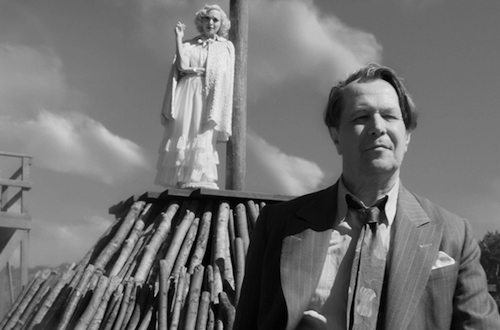
Amanda Seyfried as Marion Davies, Gary Oldman as Herman Mankiewicz

“MANK” My rating: A-

131 minutes | MPAA rating: R

David Fincher’s “Mank” is both a work of genius and a foolhardy gamble, a backstage-Hollywood epic that, for maximum effectiveness, requires its audience to be intimately familiar with Orson Welles’  “Citizen Kane.”

Great. I watch “Kane” a couple of times a year; I’ve even played it on slo-mo so as to appreciate every little nuance of its visual splendor (though one needs to set aside a full 12 hours for that act of devotion).

But I’m not sure how your average 2020 moviegoer is going to react to Fincher’s effort, since “Mank” is literally crammed to the gills with visual, aural and thematic references to “Kane.”

For this viewer, at least, it is two hours of cinematic heaven.

As presented in the screenplay by Fincher’s late father, Jack Fincher, “Mank” is not about the filming of “Citizen Kane” or about the controversy generated by the finished film. (In fact, I’m not sure the words “Citizen Kane” are even uttered here until the last five minutes.)

Rather it centers on the writing of the screenplay in 1940. Orson Welles, the boy wonder director of “Kane” (Tom Burke, who sounds like Welles even if he doesn’t much look like him), is here little more than a walk-on character.

The film’s “hero” is Herman Mankiewicz (Gary Oldman), a Hollywood screenwriter who has worn out his welcome at the studios thanks to his boozing and bitterly dismissive attitude toward Tinseltown’s power structure.

As played by Oldman, Mank is adept at wrapping his verbal poison pills in the soothing charm of a born  ranconteur. He’s just this short of being openly contemptuous of his studio bosses, but even they cannot hate him.

Although he is a miserable SOB, there’s something about Mank that inspires devotion and loyalty. His wife (Tuppence Middleton) — known universally as “Poor Sara” —  wearily cleans up after his boozing and insane gambling habit.

Now Mank’s been hired by Welles — the wiz kid’s been given carte blanche by RKO to make his first movie — to come up with a screenplay about a newspaper tycoon inspired by real-life media mogul William Randolph Hearst.  Mank, nursing a broken leg, has been installed in a bungalow in remote Victorville CA, far away from temptation.

He’s accompanied by producer John Houseman (Sam Troughton), who is to edit his daily pages, and by a somewhat stiff British lady (Lily Collins) who is expected to see to his physical care and keep him off the sauce…although before long he’s made her his collaborator in mischief.

(more…)

Read Full Post »

Kevin Bacon, Avery Essex

“YOU SHOULD HAVE LEFT” My rating: C+ (Amazon Priime)

93 minutes | MPAA rating: R

Written and directed by David Koepp and starring Kevin Bacon, 1999’s  “Stir of Echoes” was a ghost story that stuck with you.  Twenty years away from my only viewing of that movie, I still get goosebumps thinking about it.

Koepp and Bacon reteam for “You Should Have Left,”  a haunted house yarn that, alas, has nothing like that staying power.

The setup is  familiar: Family seeks to leave their troubles behind by pulling up roots and renting a house where weird things start happening.

The backstory provided by Koepp’s screenplay offers plenty of familial woes percolating beneath a seemingly placid exterior.

Financial guru Theo (Bacon) has a pretty trophy wife, Susanna (Amanda Seyfried), who is a couple of decades his junior. They live in Hollywood where she is an actress.

They have an adorable daughter, Ella (Avery Essex), who loves her Daddy something fierce.

Daddy, though, has issues.  For one, he’s sensitive about being so much older than his wife (people want to know if he’s Susanna’s father). He’s having a hard time handling his simmering jealousy, especially when he visits a movie set on the same day Susanna has to perform an intimate romantic scene with another actor.

Moreover, Theo is still trying to live down the scandal surrounding the death of his first wife, who drowned in the bathtub in a drug haze. To this day  lots of folks think Theo murdered her.

So you can hardly blame him for hauling the family off to the UK where the couple have rented a big place in the Welsh countryside.  It’s a very modern, austere home built on the foundations of an old farmhouse where bad things may have happened…at least according to the vaguely threatening locals. (more…)

Read Full Post »

Ethan Hawke

“FIRST REFORMED” My rating: B+

113 minutes | MPAA rating: R

“First Reformed” doesn’t always work, but even as a partial failure it packs more mind- and soul-shaking punch than any other film yet released this year.

This simultaneously beautiful and desolate drama from Paul Schrader isn’t shy about borrowing from its antecedents, foremost among them Ingmar Bergman’s early ’60s religious trilogy (“Through a Glass Darkly,” “Winter Light,” “The Silence”) and Robert Bresson’s 1951 “Diary of a Country Priest.”

But thanks in large part to what may be Ethan Hawke’s finest performance, “First Reformed” finds its own voice, one that uncomfortably weighs conformity against concern for God’s creation.

Our protagonist, Reverend Toller (Hawke), is pastor of First Reformed Church in a picturesque New England Town.

Established before the American Revolution, First Reformed has hardly any parishioners; its doors are kept open through the financial support of a local megachurch whose ambitious and charismatic preacher (an excellent Cedric the Entertainer) views it as a curiosity, a sort of historic religious theme park.

It’s immediately obvious that Toller has hit bottom. A former military chaplain, he urged his son to enlist; when the boy died in combat Toller’s wife left him.

Now he spends his days writing sermons nobody hears and scribbling in a journal — he calls it “a form of prayer” –that he hopes will provide insight into the tailspin that has become his life (“When writing about oneself one should show no mercy.”)

Physically he’s slowly becoming a wraith, thanks to digestive issues — cancer? — which limit him to a diet of bread and broth.

Occasionally, though, he actually does a bit of ministering. He’s approached by a young parishioner, Mary (Amanda Seyfried), who requests counseling for her husband Michael (Philip Ettinger).  Mary is pregnant and Michael wants her to abort the baby.

(more…)

Read Full Post »

Amanda Seyfried, Shirley MacLaine, AnnJewel Lee Dixon

“THE LAST WORD”  My rating: C+ (Opens March 24 at the Glenwood Arts, Cinemark Palace and AMC Barrywoods)

108 minutes | MPAA rating: R

Any film that sends you out to your car humming The Kinks’ “Waterloo Sunset”cannot be dismissed out of hand.

Still, an aura of uneasy familiarity clings to “The Last Word,”a dramedy  that plays like a second-class “A Man Called Ove” from a female perspective.

Shirley MacLaine portrays 81-year-old Harriet, a grouchy, judgmental woman who radiates disdain for the lesser mortals around her.

Harriet is, of course,  a variation on the character MacLaine has played so often (“Guarding Tess” and “Bernie,” for starters) that she could do it in her sleep.

Sensitive about both her mortality and her legacy, Harriet pulls strings to have the local newspaper’s obituary writer, Anne (Amanda Seyfried), write her death notice in advance.  She even provides a list of acquaintances Anne should interview.

Problem is, not one of these individuals has anything good to say about Harriet.  According to Anne,  the old lady “puts the bitch in obituary.”

At this point Stuart Ross Fink’s screenplay starts turning squishy.  To restore her image, and so that Anne will have something positive to put in the obit, Harriet becomes mentor to the foul-mouthed Brenda (AnnJewel Lee Dixon), an at-risk African American child who is so precocious and self-possessed that she hardly seems at risk at all.

Harriet also volunteers to work as a deejay at a local community radio station, snowing the station manager (Thomas Sadoski) with her knowledge of obscure ’60s pop and even orchestrating a romance between the fellow and obit-writer Anne.

Late in the proceedings she takes Anne and Brenda on a road trip for a long-delayed reunion with her grown daughter (Anne Heche).

None of this is in the least bit original — though it’s been carefully calculated to squeeze the tear ducts for a bathetic sendoff.

The good news is that MacLaine keeps finding new angles on what long ago became one of her stock characters.

That and the strong supporting cast assembled by director Mark Pellington (Philip Baker Hall, Tom Everett Scott, Gedde Watanabe, Sarah Baker), who find ways to make more of the material than it deserves.

| Robert W. Butler

Read Full Post »

Diane Keaton, John Godoman

Diane Keaton,  farting dog, John Goodman

“LOVE THE COOPERS”  My rating: D+ 

97 minutes  | MPAA rating: PG-13

In “Love the Coopers” the dysfunctional family holiday movie gets big-name treatment. The results are exceedingly unlovely.

It’s not just that director Jessie Nelson’s Christmas-themed comedy tries to shock us with raunch and cynicism before going all squishy soft in the last reel.  Lots of pretty decent films (“Bad Santa,” “Home for the Holidays,” “The Family Stone”) have assumed the same trajectory.

It’s that Steven Rogers’ screenplay is so blatantly unfeeling, cobbling together standard-issue ideas and characters for a sort of Pavlovian-inspired emotional release.

“Love the Coopers” (the title invokes memories of the inexplicably beloved “Love, Actually,” and like that earlier film gives us several interlocking stories) takes place mostly in a picturesque suburb outside Pittsburgh PA.  Here quaint homes, a steady snowfall and lush woodlands evoke a Norman Rockwell atmosphere.

Emotionally, though, there is no peace in the valley.

For starters, after 40-some years of marriage Sam and Charlotte Cooper (John Goodman, Diane Keaton) are calling it quits. They will break the news to their assembled clan after “one last perfect Christmas.”

Happy holidays, everybody.

Several plots eventually meet around the Coopers’ dinner table.

Daughter Eleanor Cooper (Olivia Wilde) is so reluctant to see the rest of her family  that she settles into the airport bar for some fortification. There she meets Joe (Jake Lacy), a soldier on leave who is charming despite being a Republican.

In an agonizing montage Eleanor and soldier boy engage in a comic ballet on an airport moving sidewalk. It is so gosh-awful “cute” theaters should lay in a supply of insulin.

(more…)

Read Full Post »

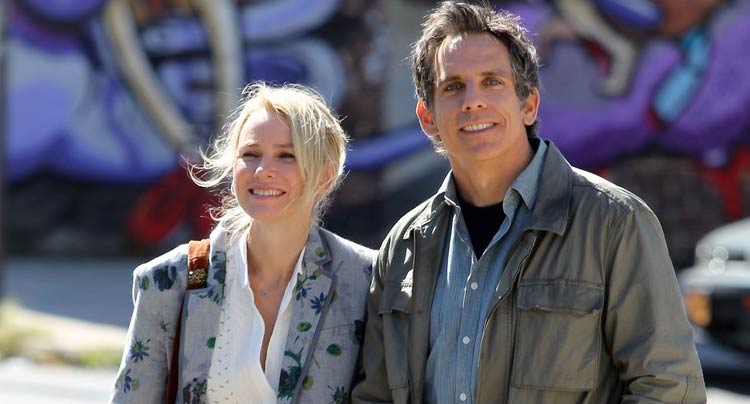
Naomi Watts, Ben Stiller

Naomi Watts, Ben Stiller

“WHILE WE’RE YOUNG”  My rating: C+

97 minutes | MPAA rating: R

There may have been a time when we aged — if not gracefully — at least appropriately.

But in a society where youth is worshipped and Botox is a household word, how does one come to terms with getting older?

That question is at the heart of “While We’re Young,” writer/director Noah Baumbach’s latest comedy — albeit a dour comedy that could have used a lot more more laughs.

Ben Stiller and Naomi Watts star as Josh and Cornelia, 40-something New Yorkers out of sync not just with youth but with their own peers. While their friends are now fully invested in parenthood and career paths, Josh and Cornelia have managed to avoid most of the trappings of middle age.

Adam Driver, Amanda Seyfried

Adam Driver, Amanda Seyfried

He’s a documentary filmmaker who has spent the last decade futzing around with a project about a grizzled philosopher (Peter Yarrow of folk music fame) that he’ll probably never finish and that nobody will want to see. She’s the producer for her father, a legendary grand old man of documentaries.

They’ve no children, no car, no mortgage.

But their biological clocks are accelerating — he’s got arthritis and she’s conflicted over her inability to have a baby. Mortality is rearing its ugly head.

Enter Jamie and Darby (Adam Driver, Amanda Seyfried), a young married couple auditing Josh’s documentary film class at a New York City university. Jamie endears himself to the filmmaker by claiming his life was changed by Josh’s early (and only successful) documentary.

TO READ THE REST OF THIS REVIEW VISIT THE KANSAS CITY STAR‘s WEBSITE AT http://www.kansascity.com/entertainment/movies-news-reviews/article17831633.html

Read Full Post »