A new film by Yorgos Lanthimos (“The Lobster,” “The Killing of a Sacred Deer,” “The Favourite,” “Poor Things”) comes with a promise.
It’ll be fascinating. Terrifically well acted. And very weird.
“Bugonia” more than lives up to that standard, being a sort of extended “Twilight Zone” episode that starts off being about conspiracy obsessions, turns to a battle of wills, and finally goes completely off the cliff into LaLa Land.
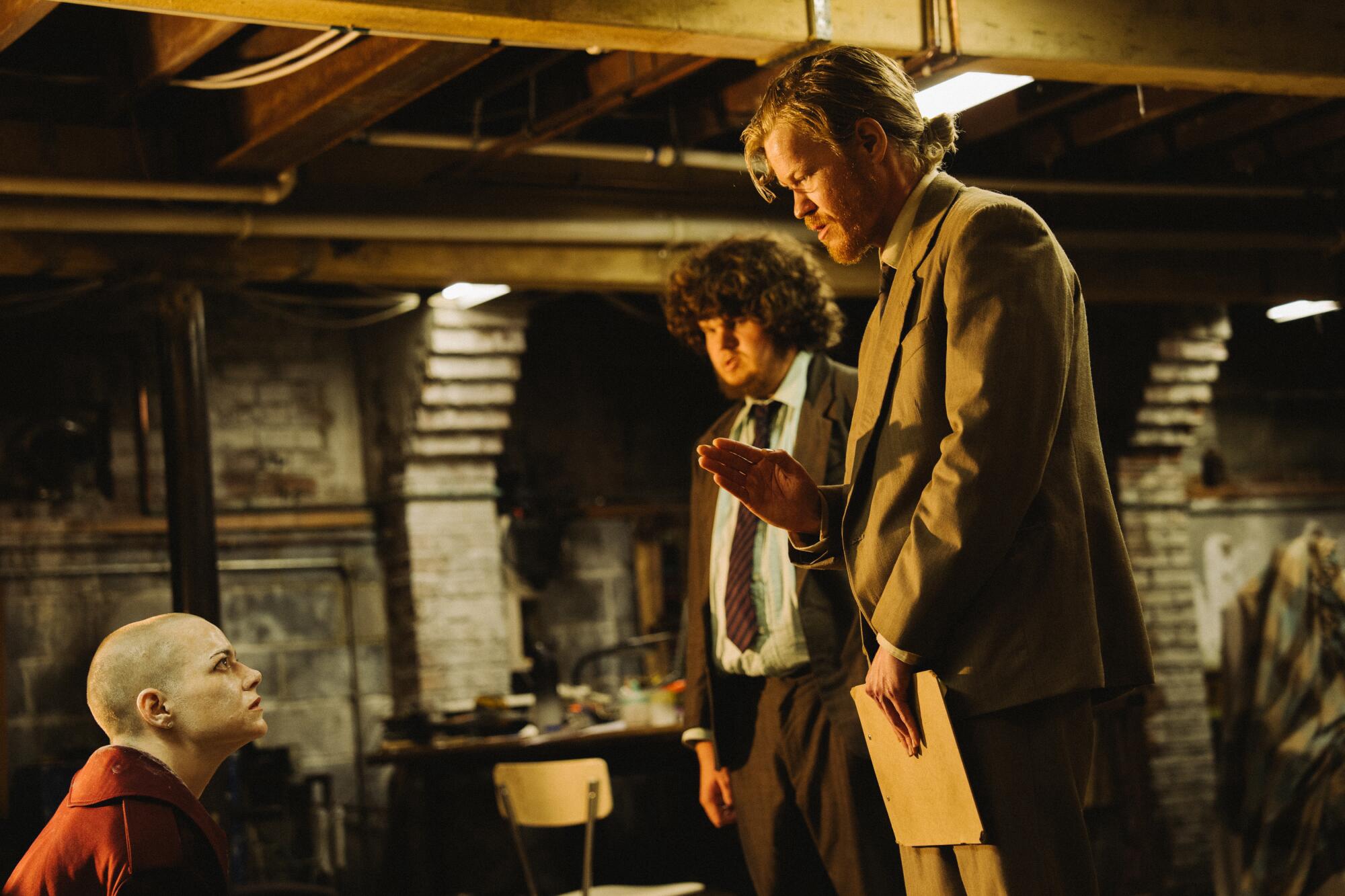
Here’s the setup: Corporate wonder woman Michelle (Lanthimos regular Emma Stone) is kidnapped by Teddy (Jesse Plemons) and his childlike cousin Don (AidanDelbis) and held prisoner in the basement of the semi-rural home where they raise bees.
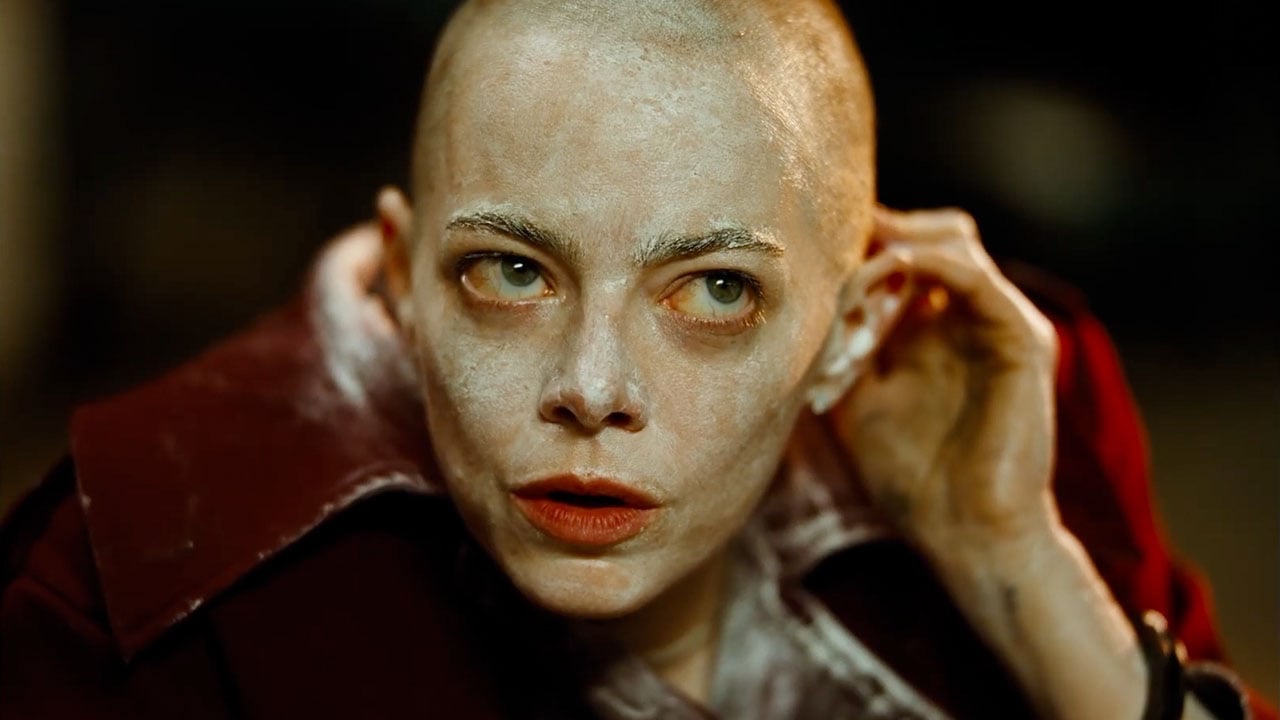
When Michelle awakens from the knockout drug administered by her captors she finds herself chained. Weirder still, she’s now hairless and covered with a pasty-white lotion.
Teddy, clearly the brains of the outfit (which may not be saying much), begins interrogating Michelle. Turns out he’s convinced she’s the vanguard of an alien invasion of Earth. Teddy’s conspiracy theory is an incredible collection of lunatic ideas, including the notion that the aliens use hair as a transmission device to contact their fellows. Thus Michelle’s shaved skull.
Emma Stone, Aidan Delbis, Jesse Plemons
Michelle, who is well versed in the art of employee manipulation, tries to talk Teddy out of this madness. When that doesn’t work she plays on the emotions of Don, who is increasingly uncomfortable with their captive’s distress (turns out actor Aidan Delbis is himself on the spectrum, which only makes his performance that much more believable).
With Stone and Plemons we may have the year’s best acting duel, a battle of will and wits in which it’s hard to take a side, given that Michelle is a veritable font of corporate/capitalist contempt and Teddy is well on his way to bonkersdom.
And underlying it all is an escape yarn. How will Michelle get out of this predicament?
Thematically “Bugonia” (the title refers to an ancient myth about bees being able to spontaneously generate from the carcass of a bull) is a marvelous balancing act. It’s suspenseful and anxiety-riddled, yet shot through with satiric moments. A real emotional roller coaster.
And the ending…holly crap. No point in ruining the surprise, but “Bugonia” takes us places we’ve never been before.
“A QUIET PLACE: DAY ONE” My rating: B (Paramount+)
99 minutes | MPAA rating: PG-13
The latest in the “Quiet Place” franchise is a harrowingly effective survival story, focusing as it does on the 24 hours after NYC is inundated with unseeing, all-hearing alien predators.
But writer/director Michael Sarnoski (who here shares screenplay credit with John Krasinski, who wrote, directed and starred in the two earlier installments) is going for something more.
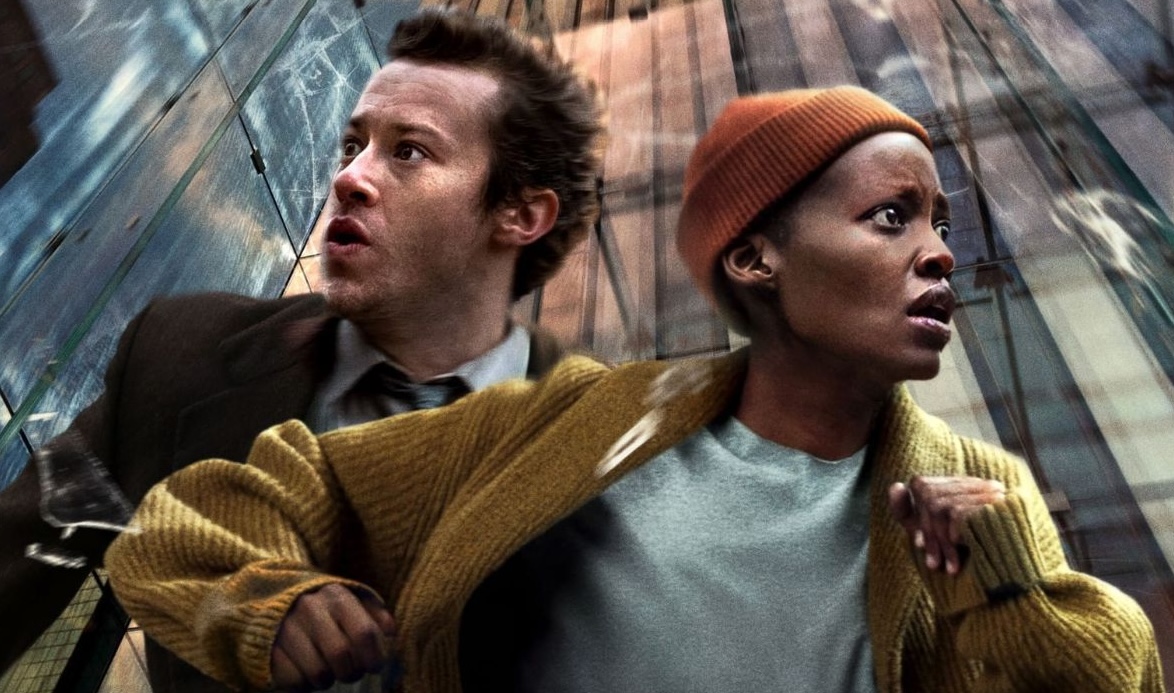
For starters, the film opens in a suburban hospice populated with cancer victims waiting to die. Among them is Sam (Lupita Nyong’o), a young woman who seems to be holding on mostly so she can share a few more moments with her beloved cat Frodo.
A rare field trip to the Big Apple is interrupted by an alien invasion. Anyone hoping to survive has to deal with a short learning curve…lay low, don’t make noises, stay near water (the creepy crawlers can’t stand the wet stuff).
Initially terrorized by the mayhem around her, Sam resolves to make her way to a pier on the East River where evacuation boats await.
She’s accompanied on this perilous trek by her pussycat and a traumatized young lawyer, Eric (Joseph Quinn), who over the course of the narrative goes from being a whimpering liability to a valuable ally…he risks his neck raiding an abandoned pharmacy to get the trans-dermal fentanol patches Sam needs for pain control.
“…Day One” delivers a scarily effective end-of-the-world ambience…viewers who initially take comfort in not having cancer suddenly find themselves in a world where imminent death seems all but assured. It’s a disorienting shot of reality.
With her thin frame and big eyes Nyong’o makes for an absolutely convincing Sam. Quinn (here almost unrecognizable from his “Stranger Things” role as small-town Lothario Eddie Munson) makes a convincing metamorphosis from quivering wimp to man of action.
And Schnitzel the cat’s performance as Frodo is, well, believably catlike. The filmmakers haven’t tried to anthropomorphize the animal…he’s just a cat.
The special effects are convincing, but Sarnoski is smart enough to know that less is more. We may not see much of the aliens, but we know they’re out there, making clicking noises and waiting for their human prey to reveal ourselves.
Margaret Qually, Jesse Plemons, Willem Dafoe
“KINDS OF KINDNESS” My rating:(Hulu)
154 minutes (MPAA rating: R)
“Weird” is a popular word in this election cycle. It certainly applies to Yorgos Lanthimos’s “Kinds of Kindness,” a triptych that feels like episodes “The Twilight Zone” and “Alfred Hitchcock Presents” viewed through a paranoid haze.
In a way it’s like a theatrical repertory company — a half dozen actors keep reappearing in different roles.
Two of the stories— the first and third — deal with individuals who have given up most of their free will to serve a cultish leader.
In “The Death of R.F.M.” (R.F.M. is a balding, bearded fellow who appears briefly in all three episodes but says almost nothing) Jesse Plemons plays Robert, an executive who literally lives for his boss, Raymond (Willem Dafoe).
Raymond provides Robert and his wife with a house and car. He gives them expensive if weird gifts (one of John McEnroe’s smashed tennis rackets). He also dictates what they eat and drink and when they have sex.
But when Raymond orders Robert to participate in what appears to be a murder (the titular R.F.M. is the intended victim), he declines.
And so is cast out of Eden.
The bookend episode, “R.F.M. Eats a Sandwich,” finds Plemons and Lanthimos regular Emma Stone (“Poor Things,” “The Favourite”) traveling the country in a souped-up purple muscle car.
They are members of a cult searching for a woman who, according to the prophecies of their leaders OMI and AKA (Dafoe and Hong Chau), has the ability to resurrect the dead. (In this one R.F.M. is a corpse in a morgue.)
Margaret Qualley is particularly good here as twin sisters, a veterinarian with astounding healing abilities and her singularly twisted sibling.
The middle episode, “R.M.F. is Flying,” is my least favorite. Plemons stars as a husband whose oceanographer wife (Stone) is missing at sea.
When she is finally rescued from a tiny island, he suspects that she isn’t really his wife (she now likes chocolate, which she previously hated, and her shoes no longer fit). To prove herself he demands ever more bizarre sacrifices.
“Kinds of Kindness” (the title practically drips irony…there’s not much kindness on display here) has been impeccably made but isn’t particularly inviting on either an emotional or intellectual level.
There are moments of black humor, but rarely of the laugh-out-loud variety — more funny odd than funny ha-ha. There are lots of squirm-worthy sexual undercurrents and some in-your-face nudity.
And the musical score — of dissonant piano doodling and droning Medieval chants — nicely reflects the film’s themes of psychosis and self-denying reverence.
Actually, streaming may be the perfect way to watch it. In a theater with a running time of three hours, “Kinds of Kindness” probably ran quickly out of steam. But on Hulu we can watch it in digestible (well, almost) one-hour chunks.
Joaquin Phoenix, Vanessa Kirby
“NAPOLEON: THE DIRECTOR’S CUT” My rating: B-(Apple+)
206 minutes | MPAA rating: R
Ridley Scott’s “Napoleon” was a major letdown.
Great battle scenes. Terrific production values. But dramatically? Nope.
And things weren’t helped any by Joaquin Phoenix’s interpretation of Nappy as a military savant who in all other aspects is borderline autistic.
Now we have an expanded version 45 minutes longer than the original. And it’s a better movie. But still not a great one.
It’s hard to say sometimes exactly what is new here…in many instances it’s no more than a couple of additional shots and lines of dialogue dropped into existing scenes.
But early on we get a look at what Josephine (Vanessa Kirby) endured before meeting Napoleon. After the execution of her husband in the Reign of Terror, she is sent to prison where she learns some grim truths about what a woman must often do to survive.
Josephine gets a crash course in staying alive from a fellow inmate (Ludivine Sagnier, whose performance was completely cut from the theatrical release)…it’s a sobering experience and helps explain the future Empress’s often witheringly sardonic outlook and general fatalism.
Also getting more screen time is Sinead Cusack as our hero’s scheming mother. In a blackly comic scene she sends the childless Emperor off to sleep with a virgin, hoping it will result in a pregnancy that proves Josephine, not Napoleon, is incapable of having children.
Some minor characters— like the Russian Tsar Alexander (Edouard Philipponnat) — have their stories fleshed out.
But the film’s highlights remain the battle sequences.
And what about Phoenix’s Napoleon? Well, this longer version does expand upon his relationship with Josephine (desperately ill at ease with most women, he adored her enough to tolerate her sarcasm and melancholy). This extended cut also employs more voiceover narration to explore the relationship through the couple’s correspondence.
But the big question nagging “Napoleon” isn’t laid to rest in this version. That being: His military triumphs notwithstanding, how could such a socially inept, introverted, essentially unlikeable figure have gained the confidence of his countrymen and been made Emperor?
(I still wonder if the whole movie isn’t an elaborate Trumpian parody.)
Maybe we’ll learn the answer in the next Supercharged Director’s Cut. Yes, Ridley Scott has a four-hour-plus version of “Napoleon” that, according to the few who have seen it, is the stuff of legend.
I’m not sure that “The Power of the Dog” totally adds up, but its individual equations are often so riveting as to carry us along on a wave of pure creativity.
Based on Thomas Savage’s late-60s novel, the latest from writer/director Jane Campion (“The Piano”) is less a conventional Western than an incisive dissection of four distinct and often contradictory personalities.
It’s also one of the year’s most visually splendid efforts, so spectacularly framed and shot (by Ari Wegner) that at times it takes on the depth of a masterwork painting.
Bachelor brothers Phil and George Burbank (Benedict Cumberbatch, Jesse Plemons) own a sprawling Montana ranch in the 1920s. Their substantial wood-paneled home, crammed with expensive furniture and a world-class collection of stuffed wildlife, speaks of massive riches.
And yet the brothers seem indifferent to their wealth. Phil is the brains and muscle of the outfit, a lanky cowboy who calls the shots and — despite an Ivy League education — is most comfortable on horseback. He and George inherited the ranch, but Phil learned how to run it at the feet of a near-mythical character called Bronco Henry, who has been dead for some years.
George is, well, kind of useless. He’s a round-faced cipher who dresses like a banker even on a cattle drive; he has pretty much handed the reins to Phil, who openly addresses him as “Fatso.”
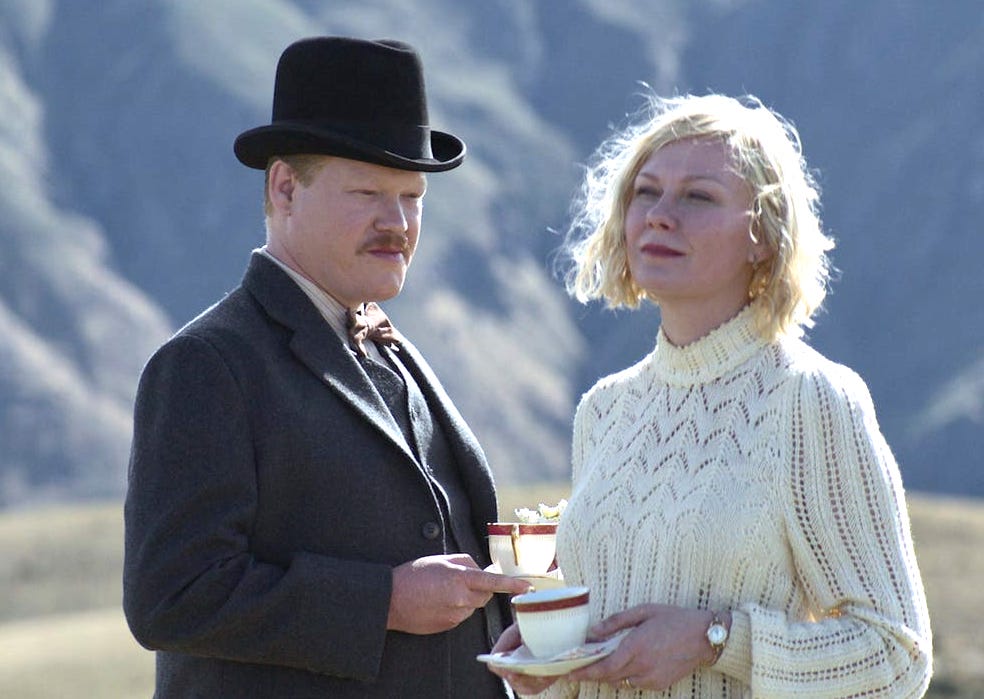
Jesse Plemons, Kristen Dunst
Conflict arrives with George’s unexpected marriage to Rose (Kirsten Dunst, Plemmons’ real-life spouse), operator of a boarding house in the small rail center where the Dunbars deposit their herd.
Phil openly accuses Rose of being a gold digger.
Adding even more tension is Rose’s teenage son Peter (Kodi Smit-McPhee), an impossibly thin, lanky kid with an artistic bent (he fashions exquisite flowers from scraps of paper). Phil immediately labels Pete a “Nancy boy” and takes sadistic pleasure in tormenting the newcomer, inviting the other cowpokes to get in on the fun.
It doesn’t take a psych degree to see that the effeminate Peter is stirring up Phil’s own long-suppressed homoerotic tendencies. Yet “The Power of the Dog” is far from a traditional coming-out tale.
While there’s genuine sweetness in the thick George’s love of his new wife; that’s not enough to keep Rose from seeking solace in a bottle. A Montana ranch is lonely for a woman; Phil’s sneering putdowns make it even worse.
Meanwhile young Peter slowly emerges as the most complex character in sight. Far from trying hide his “otherness,” he flaunts it. His posture, his manner of talking, his clothing choices…all seem to be calculated as a silent affront to the cowboy machismo surrounding him.
In the film’s latter stages it almost seems as if the hard-hearted Phil is undergoing a positive transformation. He slowly takes Peter under his wing, teaching him to ride and rope, and is pleasantly surprised to discover that he and the boy may be on the same aesthetic and philosophical wavelength.
But that is only the setup for a betrayal so devastating that it turns inside out what we think we know about at least two of these characters.
“Power of the Dog” is not a copacetic experience; it seethes with anger and unhqppiness.
But it unfolds in an environment of austere beauty. It was filmed in Campion’s native New Zealand, and the nearly bare hills and brown palette create a Western landscape unlike anything I’ve seen before.
The performances are pretty much off the charts, especially from Cumberbatch and Smit-McPhee — the former a bully who slowly reveals his sensitive side, the latter a seeming sissy who in reality harbors a methodical and implacable core of steel.
Like the famed Disneyland ride that inspired it, “Jungle Cruise” is jammed with instantly forgettable silliness; moreover the whole thing is 100 percent synthetic.
Just like a theme park attraction, this sprawling effort from director Jaume Collet-Serra embraces a sort of movie-set phoniness, a phoniness that is only accentuated by a near-complete reliance on CG scenery and action. Is anything we see on screen real?
Happily the film has as its stars the imminently watchable Emily Blunt and Dwayne Johnson (with able assists from Paul Giamatti, Jack Whitehall and Jesse Plemons), so when your eyes start to glaze over from all the computer eye candy there are at least a couple of real human faces to focus on.
The screenplay (credited to Michael Green, Glenn Ficarra, John Requa, John Norville and Josh Goldstein) takes as its template — for good and bad — the “Pirates of the Caribbean” movies. But that’s just the start…some wiseass college film student will undoubtedly cough up a thesis picking out all the movie and pop cultural references sprinkled throughout.
There’s also a bit of meta at work here. In recent years the theme park Jungle Cruise has come under fire for its White Man’s Burden approach to the third world, and the movie slyly comments on all this.
When we first encounter Amazon riverboat captain Frank Wolff (Johnson) he’s leading gullible tourists (the setting is the early 20th century) on a cruise that features encounters with wild animals (actually Frank has trained them) and spear-waving cannibals (Frank’s scurrilous rivertown buddies in feathers and warpaint).
Frank is clearly based on Humphrey Bogart’s perf in “The African Queen” (check out the little cap) with a dash of Han Solo “me first-ism”…he’s a charming cad who loves a good pun and cheerfully insults his clientele. He’s also deep in arrears to local mogul Nilo (Paul Giamatti…think Jabba the Hutt).
Enter Lily Houghton (Blunt), a scientist who with her effete sibling MacGregor (Whitehall, looking very much like a fetal Brendan Fraser) has come to South America to find a legendary tree whose flowers possess miraculous healing powers. Lily is a sort of female Indiana Jones, dismissed by the larger scientific community because she is, well, a girl. She’s determined to prove herself.
Jesse Plemons
Also, she wears men’s trousers. Captain Frank decides to call her “Pants.”
Yes, there’s a lot of love/hate bickering reminiscent of the Bogie/Kate Hepburn relationship in “African Queen.” It’s never as clever as that earlier film, but at least it’s out there trying.
Things get complicated with the appearance of Prince Joachim (Plemons), a Prussian martinet who arrives on the scene in a U-Boat (that’s right…a submarine in the Amazon River) and proceeds to revive ghostly, decaying Spanish conquistadors who have been entombed for centuries by a native curse. Now they and their leader, Aguirre (Edgar Ramirez), are sent out to intercept Frank and Lily.
Supernatural shenanigans ensue.
There are also killer waterfalls, hostile natives living in treetop villages (just like Ewoks) and computer-generated wildlife (snakes, bugs, even a pet jaguar Frank keeps below deck).
Through it all Frank and Lily exchange insults; brother MacGregor freaks out over the lack of amenities and confesses that he’ll never marry (uh, yeah, we got that early on).
There’s about enough charm and usable plot here for a lighthearted 90-minute romp. Alas, “Jungle Cruise” clocks in at more than two hours, which means that for a good quarter of its running time viewers will be checking their watches.
Al Pacino as Jimmy Hoffa; Robert DeNiro as Frank Sheeran
“THE IRISHMAN” My rating: B
209 minutes | MPAA rating: R
Martin Scorsese’s much-anticipated “The Irishman” is a good movie.
Not a great one.
It’s been described as the filmmaker’s ultimate gangster epic, yet it feels less like a conventional celebration of tough-guy ethos than a slow (3 1/2 hour’s worth), mournful meditation on sins unacknowledged and unforgiven.
In fact, Scorsese seems to have gone out of his way to avoid the sort of eye-catching set pieces (like the long nightclub tracking shot from “GoodFellas”) that marked many of his earlier efforts. “The Irishman” is almost ploddingly straightforward.
Steve Zaillian’s screenplay follows the title character, real-life contract killer Frank Sheehan (Robert DeNiro), from his early days as a truck driver with a taste for theft to his residency in an old folk’s home.
(Now seems a good time to comment on the much-ballyhooed CG “youthening” of the actors…it’s so good you don’t even think about it. No waxy skin tones or blurry edges — damn near flawless.)
The bulk of the movie, set in the ’50s and ’60s, chronicles Frank’s association with the Teamsters and his friendship with union president Jimmy Hoffa (Al Pacino), who in a phone call introduces himself to Frank with the statement: “I heard you paint houses.” That’s code for acting as a hired assassin, a role Frank will perform for Hoffa and others for a quarter century.
The film centers on a long 1975 car trip in which Sheehan and his mentor, crime family boss Russell Bufalino (Joe Pesci), and their wives drive from Philadelphia to Detroit, ostensibly to attend the wedding of a colleague’s daughter. At various stages in the journey Frank’s memory is jogged to recall past exploits. He doesn’t realize until late in the trip that Russell has another agenda — the assassination of Jimmy Hoffa who, after serving a four-year sentence in federal prison, is now upsetting the apple cart by attempting to reclaim the presidency of the Teamsters Union.
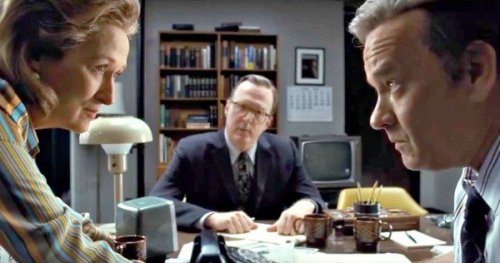
Steven Spielberg’s powers as a storyteller are so secure that not even the miscasting of one of “The Post’s” two leads can do much damage to the narrative.
This sprawling effort — it begins with a firefight in Vietnam and winds down with a firestorm over the Second Amendment — hits the ground running and rarely slows down for a breath. It’s like a Spielberg master class in taking a complicated story and telling it cleanly and efficiently.
And like other major movies about real-world journalism — “All the President’s Men” and “Spotlight” especially — “The Post” could hardly be more timely. With a president who shows every indication that he’d love to roll back freedom of the press, this film is so relevant it hurts.
The subject, of course, is the 1971 scandal over the Pentagon Papers. That massive study, commissioned by LBJ’s Secretary of Defense Robert McNamara, looked at American involvement in Vietnam going back to the Truman administration. It revealed that the experts had always known a land war in Vietnam was unwinnable — but had plowed ahead anyway, sacrificing billions of dollars and countless lives on what amounted to political face-saving.
The papers showed that the Johnson administration had systematically lied to the public and to Congress so as to continue the war.
McNamara suppressed the study; the public only learned of its existence when one of its authors, Rand Corporation analyst Daniel Ellsberg (Matthew Rhys), made an illegal copy of the top secret document and passed it on to The New York Times.
Today The Washington Post sits at or near the top of American newspapers (thanks to its reporting on the Watergate Scandal in 1972-’73). But in 1971 The Post was at best a regional paper…and not a very good one.
Its new editor, Ben Bradlee (Tom Hanks), was pushing it toward greatness, but still felt himself outclassed by the journalistic aces at The Times. He was particularly concerned about rumors that The Times was about to scoop The Post (and every other news outlet) with a major story.
That big story was the Pentagon Papers. No sooner had the first in a series of articles been published than a federal judge — at the behest of the Nixon administration — enjoined The Times from printing additional material.
Bradley’s Post, however, was under no gag order. Working back channels Bradley got his hands on another copy of the papers and prepared to publish even more revelations on the pages of The Post.




 Butler's Cinema Scene