Feeds:
Posts
Comments

Posts Tagged ‘mark ruffalo’

pilgrim’s progressEmma Stone

“POOR THINGS” My rating: B+ (In theaters)

141 minutes | MPAA rating: R

Yorgos Lanthimos’ “Poor Things” delivers such a unique vision, so elaborate a palette of visual wonders, so much wickedly sly humor that one is willing to forgive a padded running time and a draggy third act.

Although its literary sources are obvious enough (“Frankenstein” is a biggie; so is
“Candide”) the film’s wondrously weird sense of self is unlike that of any movie I can think of.

And it gives Emma Stone, the star of Lanthimos’ “The Favourite,” the role of a lifetime.

Here she plays Bella, a grown woman who behaves like an infant. 

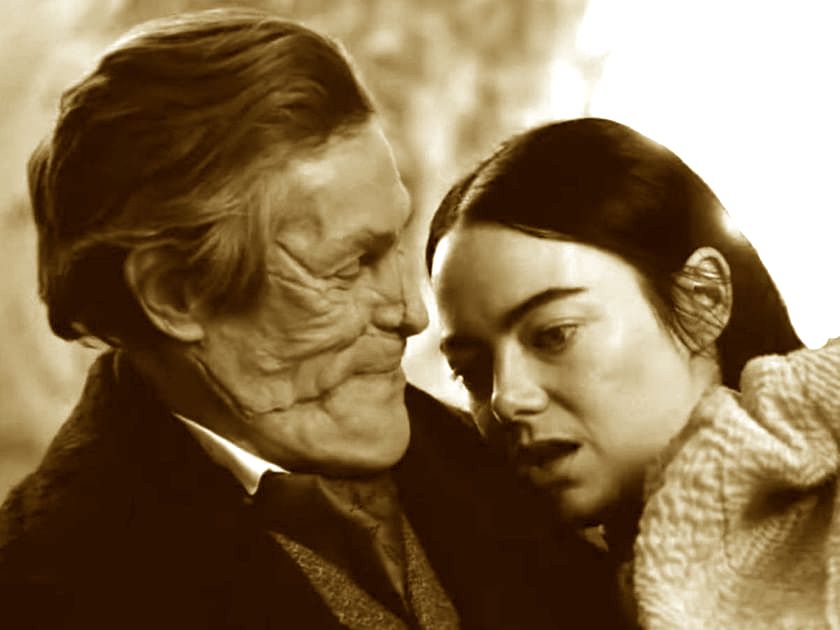
“Her mental age and body are not quite synchronized,” explains Godwin Baxter (Willem Dafoe), the hideously scarred eccentric whose home/laboratory is populated with bizarre animal hybrids (like a duck with a dog’s head). 

Godwin — Bella addresses  him as “God” — views  his ward as both his daughter and as an experiment.  He will educate this blank slate, raise her to be a reflection of his own genius.
Willem Dafoe, Emma Stone

He tolerates her childlike misbehavior (Bella routinely smashes dishes and plates just for the thrill of noisy destruction), having determined that she has an incredibly high learning curve.

In just a matter of weeks she goes from syntax-twisted baby talk to more-or-less full sentences.

Sometimes she stares in birdlike fashion off into space (reminds of Elsa Lanchester as the Bride of Frankenstein); at other times she devotes all her faculties to examining (and often destroying) some new object in God’s cluttered abode.

Now would be a good time to mention the astounding production design courtesy of Shona Heath and James Price.  “Poor Things” begins in London circa 1900 and later moves to the Continent, but historical accuracy is jettisoned in favor of a sort of Gaudi-inspired steampunk ethos.  The picture is filled with weirdly shaped and decorated rooms, bizarre ships (both seagoing and aerial), and city environments that ooze fanciful theme park artificiality.  

The sumptuous photography by Robbie Ryan (“American Honey,” “The Favourite”) embraces both crisp black and white and pastel-infused color, and his frequent use of wide-angle lenses captures a visual warp that nicely echoes the gnarly subject matter.

The great joy of “Poor Things” lies in watching Stone’s Bella blossom into her own person.

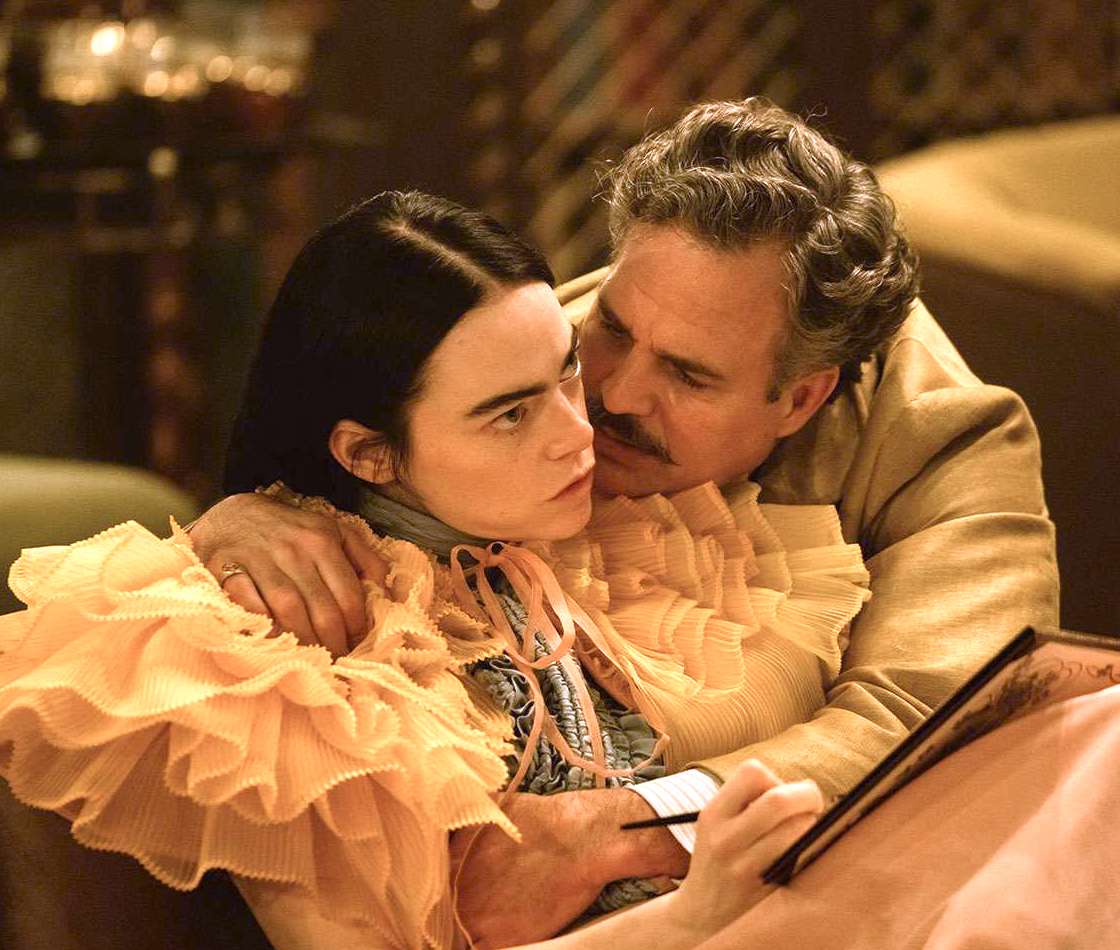
She’s abetted along the way first by Max (Rami Youssef), a sincere medical student hired by God to be Bella’s companion, teacher and possible husband, and later by  unprincipled lawyer Duncan Wedderburn (Mark Ruffalo), who spirits Bella away for a European debauch and introduces her to the wonders of sex. (Or, as she calls it, “furious jumping.”)

(Ruffalo’s comic performance falls just short of mellerdramer mustache-twirling; his depiction of Duncan’s selfish pomposity is hugely amusing, and almost makes me forget his terrible turn in “All the Light We Cannot See.”)

Bella learns and grows. Initially she moves with the jerky tentativeness of a newborn colt; before long she’s doing a funky dance of her own creation. Her vocabulary blossoms.
Emma Stone, Mark Ruffalo

What doesn’t change is her singular outlook.  Her intellect rockets right past societal norms. She has no filter and so invariably utters the truth in situations which call for discretion.

She even develops a sense of empathy and is distraught at the plight of the urban poor she discovers on her sojourn (this passage is a nifty parody of the Buddhist legend in which the privileged Prince Siddhartha ventures from his palace to discover for the first time the plight of his aged and diseased subjects).

Eventually her adventures lead to a stint in a Paris brothel where she succinctly identifies what each customer needs (men are so pathetically transparent) and delivers with a minimum of fuss, becoming rich in the process. (It’s not that Bella is immoral; she’s utterly amoral.)

Eventually the yarn returns to London where we learn of Bella’s origins and her life as the wife of a thuggish noble (Christopher Abbott).  Happily, her world-expanding experiences have prepared her to deal even with the most rampant and institutionalized chauvinism.

For its first 90 or so minutes “Poor Things” is like a birthday party in which every minute delivers a new present to unwrap. It’s a cinematic feast that just keeps on giving.

But things start to bog down in the Paris section…Lanthimos aims for raunchy laughs, with lots of nudity and cartoonish coupling (the easily offended should steer clear). But after a while the film starts to repeat itself. Yeah, yeah, we get it. Men are swine or arrested adolescents. The effect could be had in a fraction of the time it’s given here.

In fact, “Poor Things” would benefit hugely from some tightening. Less is more.

Nevertheless, the movie is a fantastic achievement. And you leave with a newfound sense of respect for the artistry and adventurousness of Emma Stone.

| Robert W. Butler

Read Full Post »

Mark Ruffalo

“DARK WATERS” My rating: B+ (Opens wide on Dec. 6)

126 minutes | MPAA rating: PG-13

If in the New  Year America’s landfills are suddenly overflowing with discarded cooking paraphernalia you can blame “Dark Waters,” Todd Haynes’ fact-based examination of how DuPont, in developing Teflon, pretty much poisoned the world.

This legal procedural follows a decade long effort by Robert Bilott, an attorney whose firm counts DuPont as one of its major clients, to determine why first the cattle and later the people living around Parkersburg, West Virginia, began exhibiting bizarre birth defects, horrendous tumors and unexpectedly high death rates.

This isn’t the first time that Haynes have gone off on an environmental tangent. in 1995’s “Safe” he examined the plight of a woman who is literally allergic to just about aspect in modern life. But “Dark Waters” is unique in that it is the most straightforward, unambiguously non-artsy film in a directorial career marked by titles like “Far from Heaven,” “Velvet Goldmine” and “I’m Not There.”

In fact, the artsiest thing in the movie is its gray/blue palette…surely the sun sometimes shines in West Virginia?

Bilott, played with quiet intensity by Mark Ruffalo, is a big-city lawyer whose job is to defend chemical companies.  Then he’s approached by farmer Wilbur Tennant (Bill Camp), an acquaintance of his grandma, who demands that the high-priced attorney investigate the death of more than 100 of his cows after they drank from a stream on his land.

The Tennant property  abuts a decades-old DuPont waste storage facility; almost from the get-go Bilott (and those of us in the audience) knows where this is going. The problem is proving it.

Matthew Michael Carnahan and Mario Correa’s screenplay (adapted from Nathaniel Rich’s magazine article) simultaneously focuses on Billot’s long search for answers and his personal journey, using what’s he’s learned representing chemical giants to go after them.

At the same time his singleminded devotion to the case threatens his marriage to Sarah (Anne Hathaway) and his job at a big Cincinnati law firm, where the partners (led by Tim Robbins)  only give him leave to pursue the Dupont matter in the hopes of getting a piece of a massive settlement.

(more…)

Read Full Post »

Mark Ruffalo, Imogene Wolodarsky, Ashley Aufderheide

Mark Ruffalo, Imogene Wolodarsky, Ashley Aufderheide

“INFINITELY POLAR BEAR” My rating: C+

90 minutes | MPAA rating: R

There are moments in “Infinitely Polar Bear” that feel so true and right that you just know they were lifted directly from the life of filmmaker Maya Forbes.

Starring Mark Ruffalo and Zoe Saldana, the picture is based on Forbes’ childhood, when for several months she and her younger sister were raised by their mentally troubled father while their mother earned an MBA.

When it comes to depicting the ups and downs of a person with bipolar disorder, this movie is right on target.

But  Forbes has been unable to fashion these incidents into a compelling narrative. For all the authenticity of its situations, “Infinitely Polar Bear” (that’s the girls’ code for their father’s bi-polar issues) is an emotionally muted and frustrating experience.

Cameron Stuart (Ruffalo) is a loving dad, if an unreliable provider.  The black sheep son of Boston Brahmins, he is unable to hold a job and supports his wife Maggie (Saldana) and his daughters Amelia (Imogene Wolodarsky) and Faith (Ashley Aufderheide) with a monthly stipend provided by his rich grandma.

That’s just enough money to pay for a cheap apartment and food for the table.

Maggie, who has the patience of a saint, somehow copes with Cameron’s mood swings.   Sometimes he is crazily active, seizing on some event or activity and devoting himself to it with religious zeal.  This is why the apartment looks like hoarder central, littered with greasy bicycle parts and other projects that never quite get completed.

(more…)

Read Full Post »

Kiera Knightley, Mark Ruffalo in "Begin Again"

Keira Knightley, Mark Ruffalo in “Begin Again”

“BEGIN AGAIN” My rating: B (Opening July 2 at the Glenwood Arts)

104 minutes | MPAA rating: R

“Begin Again” is only half the movie that “Once” is.

But it should still be enough to jump start the career of filmmaker John Carney.

“Once,” of course, was Carney’s 2006 art house hit about a tentative romance between a Dublin street busker and a Polish immigrant. This mini-budget wonder, largely improvised and featuring an astounding soundtrack written by the two “stars” (Glenn Hansard, Marketa Irglova), introduced the Oscar-winning song “Falling Slowly.” It was a new kind of intimate musical, and a bittersweet romance of epic proportions. (It has gone on to become a hit on Broadway).

But the ensuing years have not been kind to writer/director Carney, who used his newfound fame to make two instantly forgettable features: the clumsy visitor-from-another-planet comedy “Zonad” (2008), which was released in the US only on home video, and the supernatural thriller “The Rafters” (2012), which as far as I can tell has been seen by practically no one.

Which brings us to “Begin Again,” an effort to recapture some of the magic of “Once.”

It’s about music. It’s about love.

And it’s actually not bad.

(more…)

Read Full Post »

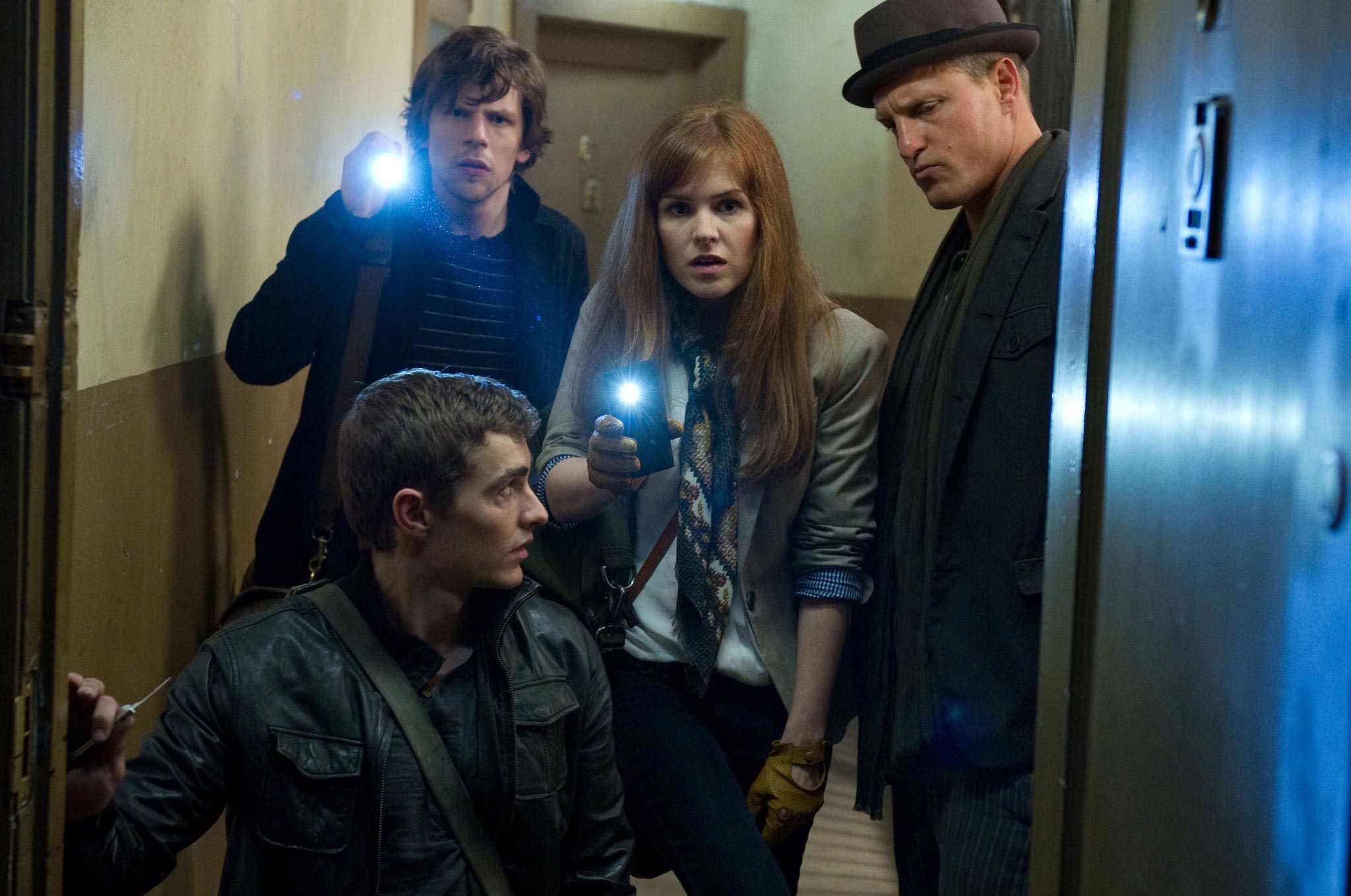
Now-You-See-Me-01“NOW YOU SEE ME” My rating: C (Opening wide on May 31)

116 minutes | MPAA rating: PG-13

Big, slick and determined to wow us with its amazingness, the magic-themed caper film “Now You See Me” is less a David Copperfield spectacular than a fumbled bit of sleight-of-hand as performed by “Arrested Development’s” Gob Bluth.

The movie starts falling apart as soon as it begins. “Now You See Me” isn’t about the characters and it certainly isn’t about stage magic. It feels like something the screenwriters (Ed Solomon, Boaz Yakin, Edward Ricourt) cooked up on a dare, vying to establish the most outlandish, complicated yarn possible.

What they’ve produced is a towering house of cards that any two-year-old could knock over.

At the outset of Louis Leterrier’s film we’re introduced to four struggling street magicians, each of whom has a magic specialty.  Daniel  (Jesse Eisenberg) is a cocky card manipulator and illusionist. Henley (Isla Fisher) is an escape artist. Jack (Dave Franco…James’ brother) is an accomplished pickpocket. Merritt (Woody Harrelson) is a mentalist/hypnotist.

These rivals are recruited by a mysterious, unseen individual to form a big Las Vegas magic act, the Four Horsemen.

On their opening night the Horsemen “teleport” a French vacationer to the vault of his bank in Paris, where millions in Euros are sucked up into an air vent and end up fluttering over the delighted audience back on the Strip.

(more…)

Read Full Post »