Feeds:
Posts
Comments

Posts Tagged ‘Tilda Swinton’

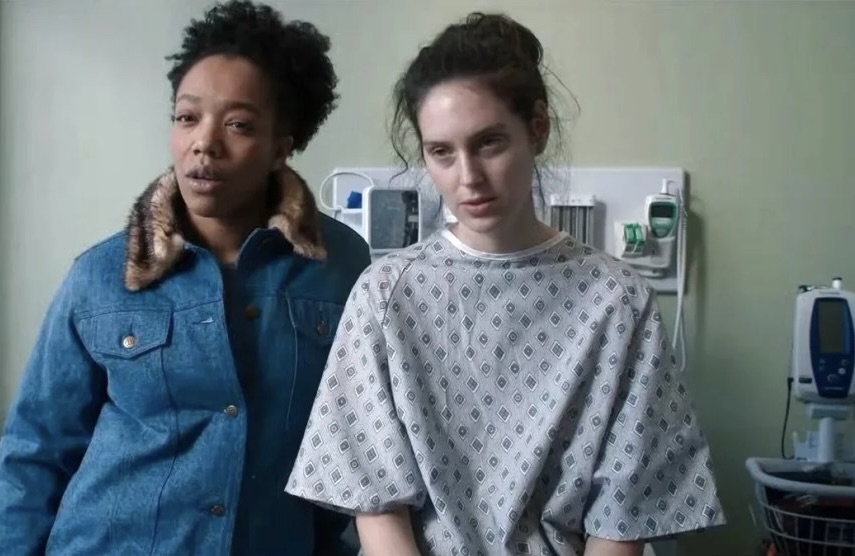
Naomi Ackie, Eva Victor

“SORRY, BABY”  My rating: A- (HBO Max)

103 minutes | MPAA rating: R

Every once in a while you encounter a film so achingly on target that you instinctively realize that it had to be torn from someone’s personal experience.

So it is with “Sorry, Baby,” Eva Victor’s hauntingly beautiful film about the aftermath of a sexual assault.

The words “sexual assault” will be enough to scare off many viewers.  But while Victor’s semi-autobiographical film (she wrote, directed and stars in it) addresses trauma, it’s more about the healing aftermath.

It starts unremarkably enough with our protagonist, Agnes (Victor), being visited by her old college roommate, Lydia (Naomi Ackie).  They’re several years out of school, but while Lydia has moved to the big city and settled down (she’s gay,  not that it’s a big deal) Agnes has hung around their New England college town.  In fact, she’s now a bigwig in the English Department.

These opening scenes radiate the easy familiarity of old friends reconnecting. But soon the talk drifts back to their senior year and an unpleasant incident. In a flashback we view Agnes’ interaction with Decker (Louis Cancelmi), one of her professors.  He seems like a standup guy…until he isn’t.

Victor wisely refrains from showing the assault.  Instead we get a long shot of the teacher’s home, where the two are meeting to discuss her thesis. Agnes goes inside, and the unmoving camera records the home’s facade as the sun dims, night falls, and lights go on inside. Apparently several hours have passed before Agnes stumbles out, walks to her car and drives away in a fog of humiliation and disbelief.

In a balancing act for the ages, Victor seasons this traumatic incident with satiric flashes.  When she meets with school officials to discuss the incident, she’s told that it’s not their problem.  Decker turned in his resignation just before the assault.  This news is delivered by a couple of women administrators whose clumsy efforts at sympathy are undermined by their panicked sense of institutional preservation.

“Sorry, Baby” rises and falls with Victor’s performance.  Her Agnes is tall, gawky and unremarkable (though, weirdly enough, by film’s end I saw her as beautiful).  She’s intellectually solid but emotionally tentative.  She often masks her feelings with oddball comments and an ironic aura.

Not that she doesn’t get some solid help from the other players.  Ackie is the best friend everyone wishes they had.  Lucas Hedges shines as the vaguely nerdy neighbor with whom the post-assault Agnes has a sweetly goofy love affair.  And veteran actor John Carroll Lynch nearly steals the film as a  sandwich shop operator who takes a grieving Agnes (whom he has never met before) under his caring wing.

The world can be cruel.  But simple decency  goes a long way.
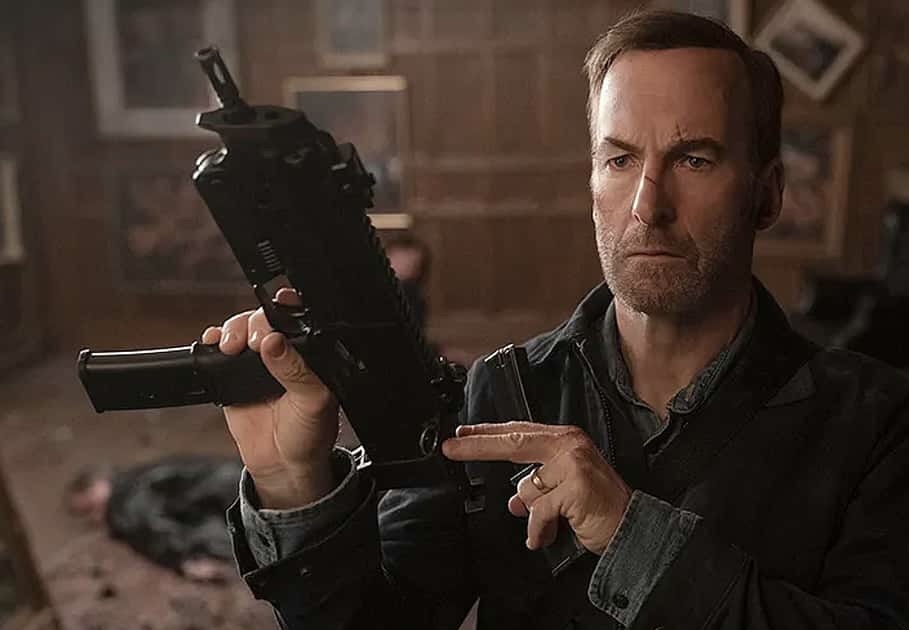
Bob Odenkirk

“NOBODY 2” My rating: C+(Peacock)

89 minutes | MPAA rating: R

“Nobody” (2021) was an unexpected sleeper, a hyperviolent, darkly funny yarn about a nondescript family man (Bob Odenkirk) whose secret job is that of assassin.

Now we’ve got a second installment and it’s pretty much the same thing all over again…minus the sense of discovery that made the first film so enjoyable.

Imagine “National Lampoon’s Vacation” mated with “Pulp Fiction.”  Odenkirk’s Hutch Mansell takes the family (Connie Nielsen is the Missus) to the cheesy amusement park he enjoyed as a boy.  

Except he finds the place now is a front for a drug operation run by a sociopathic grand dame (Sharon Stone) and administered by a corrupt local sheriff (John Ortiz).

Much mayhem ensues.  

Except this time the brew of comedy and over-the-top violence falls to the law of diminishing returns.  (Although I did enjoy the addition of Christopher Lloyd as Hutch’s father, himself a retired black ops type.)

Colin Farrell

“BALLAD OF A SMALL PLAYER” My rating: B (Netflix)

101 minutes | MPAA rating 

“The Banshees of Inisherin.” “Sugar.” “The Penguin.”

Yeah, Colin Farrell has been on a roll. And it continues  (sort of) with “Ballad of a Small Player,” which works a bit too hard to breathe new life into the gambler-at-the-end-of-his-luck yarn.

Farrell is Lord Doyle, a polished gent who floats through the casinos of neon-lit Macau as if he owns the joints. He sophisticated, generous, impeccably dressed.

It’s all a sham.  In truth he’s a common hustler who’s developed an impressive fictional character. Lord Doyle (he’s not a lord and Doyle is not his actual name) is so good at role playing that he has credit at all the tables.

That is, until his losses get so big that they can no longer be ignored. 

Scripted by Rowan Joffe and Lawrence Osborne and directed by Edward Berger (“All Quiet on the Western Front,” “Conclave”), “Ballad…” attempts to make up for a lack of originality (really, it’s just another movie about a desperate gambling addict searching for a big score) with a heightened visual sense and an almost operatic sense of melodrama.

But it’s worth sticking with to watch Farrell navigate Lord Doyle’s existential dilemma. Toss in Tilda Swinton as a comically stuffy investigator hot on his trail and Fala Chen as the casino hostess who provides  a love interest, and you’ve got a good-looking if not terribly deep outing.

| Robert W. Butler
Read Full Post »

Tilda Swinton, Julianne Moore

“THE ROOM NEXT DOOR” My rating: C+ (Netflix)

106 minutes | MPAA rating: PG-13

At a certain point in every artist’s life the old mortality bug starts nibbling away. Apparently filmmaker Pedro Almodovar has reached that stage.

“The Room Next Door” is typical Almodovar in that it concentrates on relationships among women.  But mostly it’s an atypical  contemplation of death.

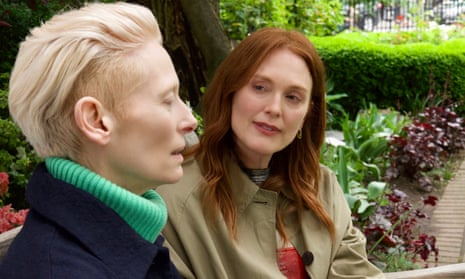
Popular author Ingrid (Julianne Moore) learns that her old magazine colleague Martha (Tilda Swinton) has terminal cancer.  A visit to the hospital leads to much reminiscing (there are flashbacks to Martha’s early life and career as a war journalist) and a startling request.

Martha has obtained a “euthanasia drug” on the dark web.  She wants Ingrid to accompany her to a vacation rental in the Catskills where Martha plans to end her life. (“Cancer can’t get me if I get myself.”) She wants Ingrid simply to be on hand in an adjacent bedroom so she won’t feel she’s totally on her own.

Ingrid is reluctant (she hasn’t seen Martha in five years and, besides, her most recent book examines her own fear of death) but finally acquiesces when she learns that several other friends have already turned down Martha’s request.

The source material here is Sigrid Nunez’s 2020 novel What Are You Going Through, and there are times when the English dialogue (I believe this is the first all-English language movie in Almodovar’s resume) sounds like it has been strained through a translation app.

But the real issue here is one of tone. Almodovar is known for his wonderful wackiness (“Women on the Verge…,” “I’m So Excited”), his camp sensibilities and  his deep appreciation of over-the-top melodrama.

None of which is in evidence here.  Even Almodovar’s visual panache has been muted as if intimidated by the grim subject matter.  (Although the closer Martha comes to taking the pill, the more colorful the wardrobe she chooses.)

Clearly Almodovar wants to move us.  But I felt peculiarly unmoved.

It’s not the actresses’ fault.  Moore is solid as a reluctant participant in what is legally a crime, while Swinton, with her glacial pallor and skeletal physique certainly looks like she’s about to cash in.

Then, too, the screenplay has digressions that seem not to go anywhere.  John Turturro has a couple of scenes as the pessimistic writer both women have had relationships with.  Alessandro Nivola is a moralistic police detective who in an unnecessary coda grills Ingrid for her part in the death. 

And at the very end Martha’s estranged daughter briefly shows up. She also is played by Swinton, whose appearance has been subtly altered (either by makeup/prosthetics or CGI makeover).

Okay. Almodovar has gotten that out of his system. Let’s move on.

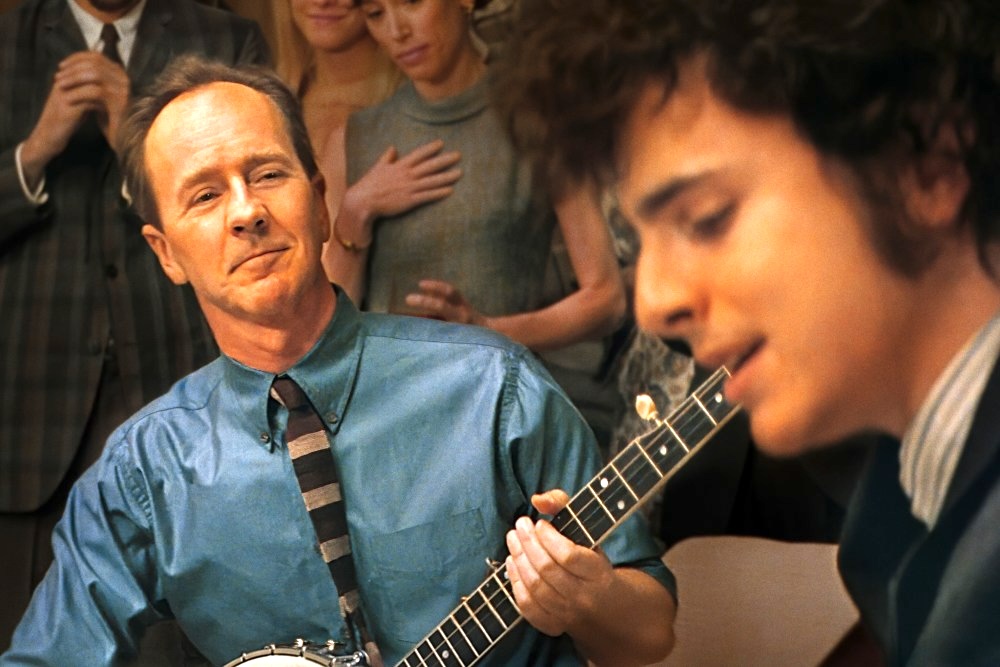
Edward Norton as Pete Seeger, Timothee Chalomet as Bob Dylan

A COMPLETE UNKOWN” My rating: B (Apple+)

141 minutes | MPAA rating: R

“A Complete Unknown” is about as good a Bob Dylan biopic as we’re likely to get.

First, it absolutely nails the where and when of the early 60s folk scene in New York City.

And second, it knows that no matter how hard it tries, its main character will remain an enigma.

I mean, I’ve been listening to Bob Dylan for more than half a century and I still couldn’t give you a reading on his personality.  Would I like him in person? Would he be a pain in the ass?  

Shut up and listen to the music.

Anyway, James Mangold’s film (the excellent screenplay is by Mangold, Jay Cocks and Elijah Wald) covers Dylan’s early years in the Big Apple, from his crashing the hospital room of the dying Woody Guthrie to his controversial (we’re talking “Rite of Spring” outrage) embrace of an electric guitar at the Newport Folk Festival.

Along the way Oscar-nominated Timothee Chalomet delivers a terrific central performance, capturing his subject’s physical and vocal quirks (the musical numbers were all recorded live on camera) while carefully concealing the innermost Bob. It shouldn’t work. It does.

Just as good is Edward Norton as folkie purist Pete Seeger, who takes Dylan under his wing, only to go ballistic when our man turns his attention to rock’n’roll.

Monica Barbaro is solid as folkie “it” girl and Dylan squeeze Joan Baez.  

You don’t need an excuse to drag out your old Dylan records, but don’t be surprised if after watching this  you do a deep dive into the catalogue.

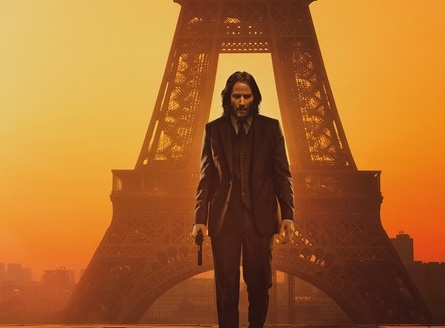
Keanu Reeves

“JOHN WICK: CHAPTER 4” My rating: B (Roku) 

169 minutes | MPAA rating: R

So far there have been four John Wick movies…although actually they’re the same movie with slightly different fight scenes.

“John Wick: Chapter 4” has the same story line as all the others.  Good-guy assassin John Wick (Keanu Reeves) once again finds himself in a one-man war against the numberless minions of The Table, the all-powerful international crime syndicate.

“Wick” regulars Ian McShane, Donnie Yen and Laurence Fishburne reprise their supporting roles…the main baddie this time around is played by Bill Skarsgard as a sort of sinister fop.

The story doesn’t matter.  It’s the fights that count, and “Wick 4” is crammed with them.

In fact, there’s so much to it  that midway through this nearly 3-hour bloodiest I found myself zoning out from too much good fight choreography. (It’s like movie nudity.  One naked woman gets your attention; 100 of them leaves you kinda ho-hum.)

Happily the film concludes with a doozie, a nearly 40-minute battle in which our man Wick must kill his way up a long outdoor staircase leading to Paris’ Sacre Coeur Cathedral where he is to engage in a final duel with his main foe.  

What’s interesting here is that director Chad Stahelski and his writers (Shay Hatten, Michael Finch, Derek Kolstad) finally accept the ridiculousness of it all and inject some humorous elements into the mayhem.  

After killing dozens of bad guys and nearly reaching his goal, Wick is sent tumbling back to the bottom of the stairs to start the whole thing over again.  It’s like that old two-reeler in which Laurel and Hardy are deliverymen attempting to carry a piano up an endless flight of stairs.

Reeves even allows a bit of comic exasperation to creep into his performance. He doesn’t quite roll his eyes at the silliness, but he comes close.

| Robert W. Butler

Read Full Post »

Michael Fassbender

“THE KILLER” My rating: B (Netflix)

118 minutes | MPAA rating: R

David Fincher’s latest is a minimalist epic about  a contract killer who appears to have no personality whatsoever.

Despite all this, it is a wildly entertaining effort.

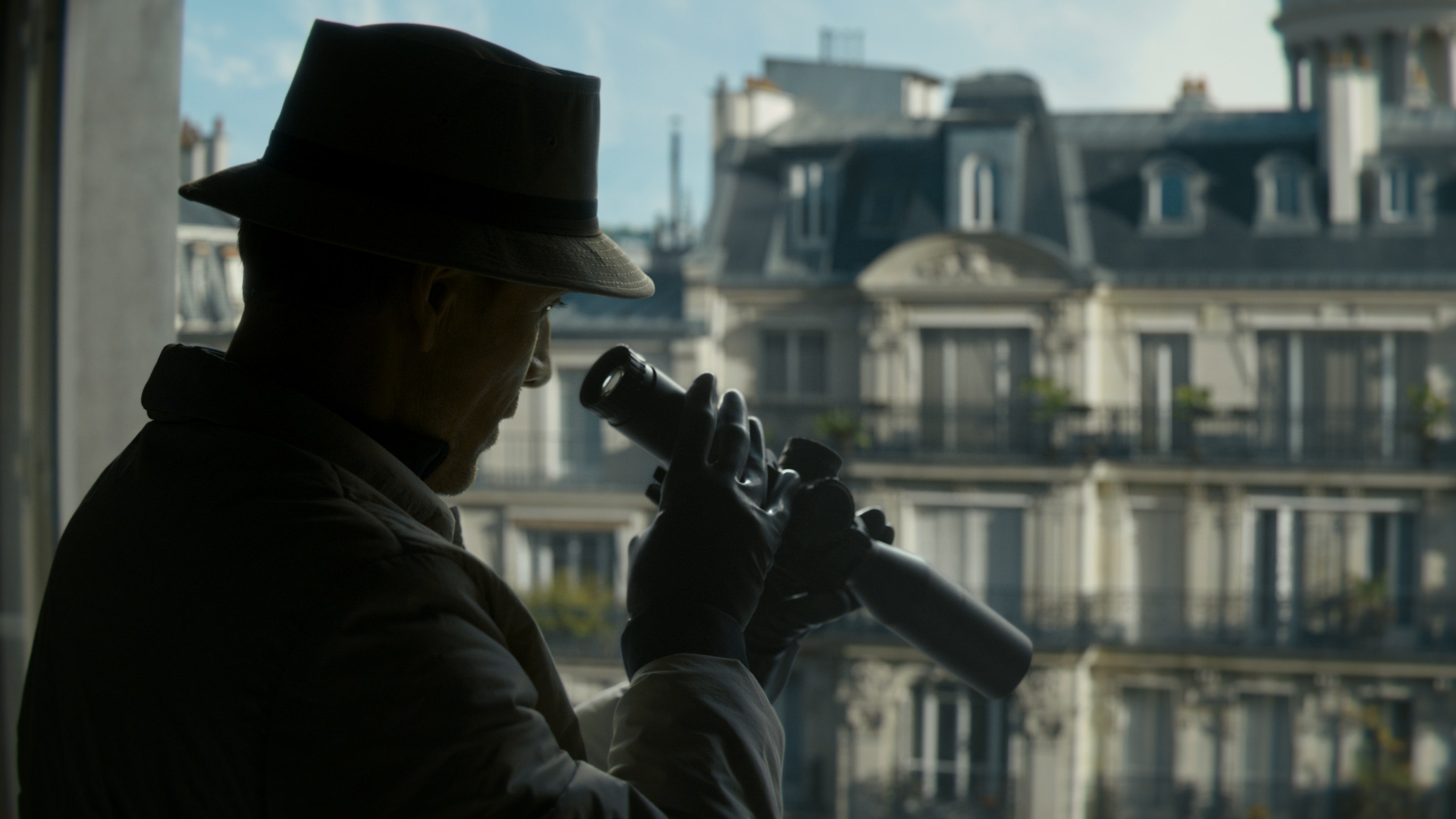
Michael Fassbender is our unnamed protagonist, whom we meet in an under-renovation apartment in Paris.  He’s been there for days awaiting the arrival in the building across the street of his target.  We don’t know who he’s supposed to kill. or why.

All we know is that the Killer exhibits an astonishing level of patience. He passes the time scanning the street through a scope and doing yoga.

In the film he says almost nothing.  Well, that’s not quite true. In the first 30 minutes he gives us, in narration, a sort of primer on hitman etiquette.  In this he is quite chatty, holding forth on the necessity of anticipation and the dangers of improvisation.  As for the moral consequences of his actions… there’s no mention of that.  Doesn’t seem to matter.

The screenplay by Andrew Kevin Walker, Alexis Nolent and Lucy Jacamon is astonishingly straightforward.

The Paris job goes wrong. The Killer flees to his  palatial home base in the Dominican Republic only to find that rival killers from his employer have beat him there, torturing his girlfriend (Sophie Charlotte) so badly that she’s in the hospital.  

This calls for revenge.  Quickly, methodically and implacably the killer goes about eliminating the threats against him.  

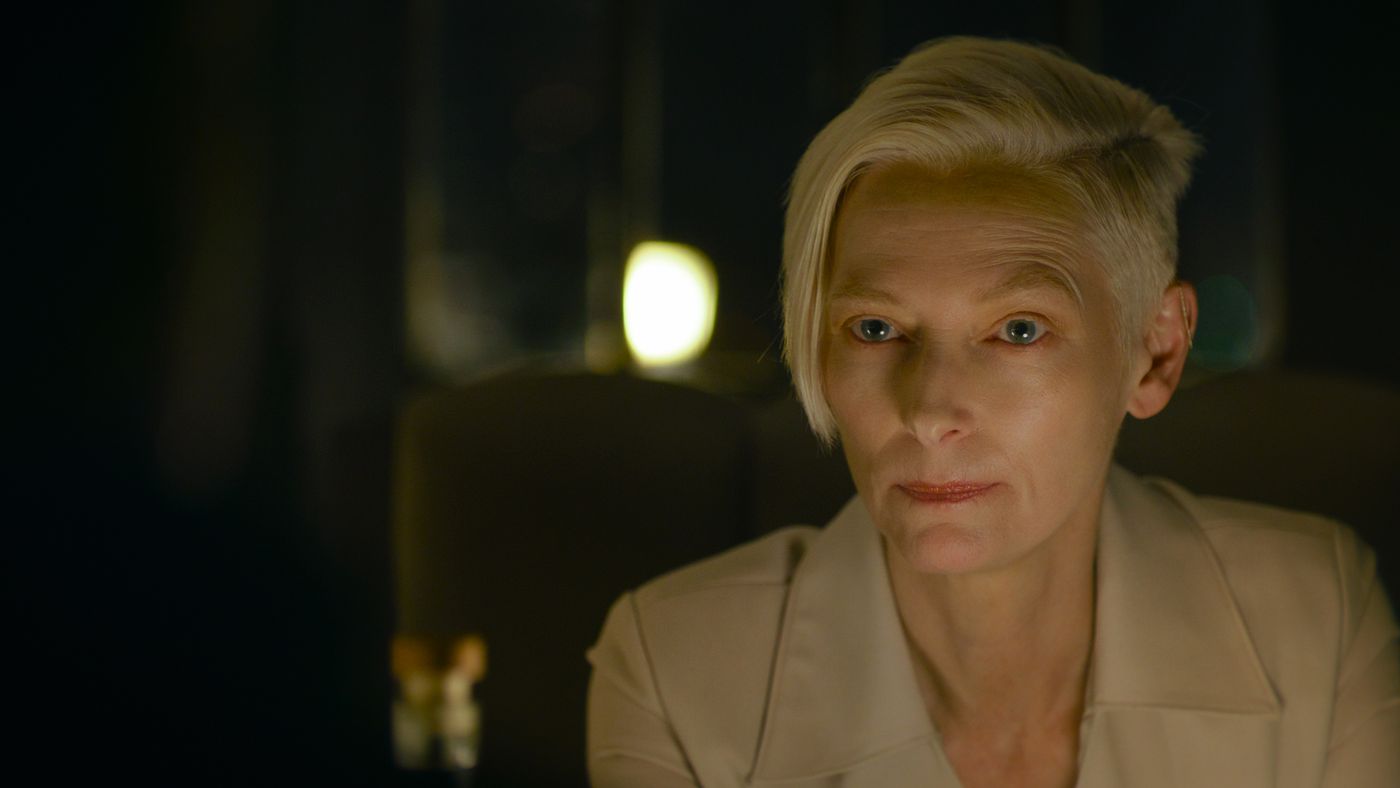
Tilda Swinton

That means paying a visit to the crooked New Orleans lawyer (Charles Parnell) who hands out his deadly assignments, the Florida thug (Sala Baker) who beat up his girl, the thug’s New York-based co-killer (Tilda Swinton) and finally the impossibly rich mover and shaker (Arliss Howard) who ordered the Paris hit.

As I mentioned, the Killer rarely says anything.  Not so most of his targets, who when facing death become remarkably loquacious.  A lot of good it does them. (The only one as silent as the Killer is the hulking goon in Florida; the two of them have a mano-a-mano smackdown for the ages.)

Now this all sounds terribly grim, and it should be pointed out that “The Killer” is often slyly amusing.  For example, our protagonist has a collection of fake identities (with attendant IDs, passports, credit cards and other documentation) in the names of classic TV sitcom characters: Felix Unger, Oscar Madison, Archibald Bunker, etc.

And then there’s the Killer’s clothing choices.  In voiceover he announces that the whole idea is to be so freaking bland that nobody can remember you; for much of the film he wanders around looking like a suburban dad at Disney World.

There’s no moral to “The Killer,” hardly any plot and certainly no characters you’d want to actually meet (okay, maybe the girlfriend, but she got beat up protecting a man she knows is a murderer).

Nevertheless, it’s a fun ride precisely because of its menagerie of cooly calculating/brutal/smooth talking creeps. 

| Robert W. Butler

Read Full Post »

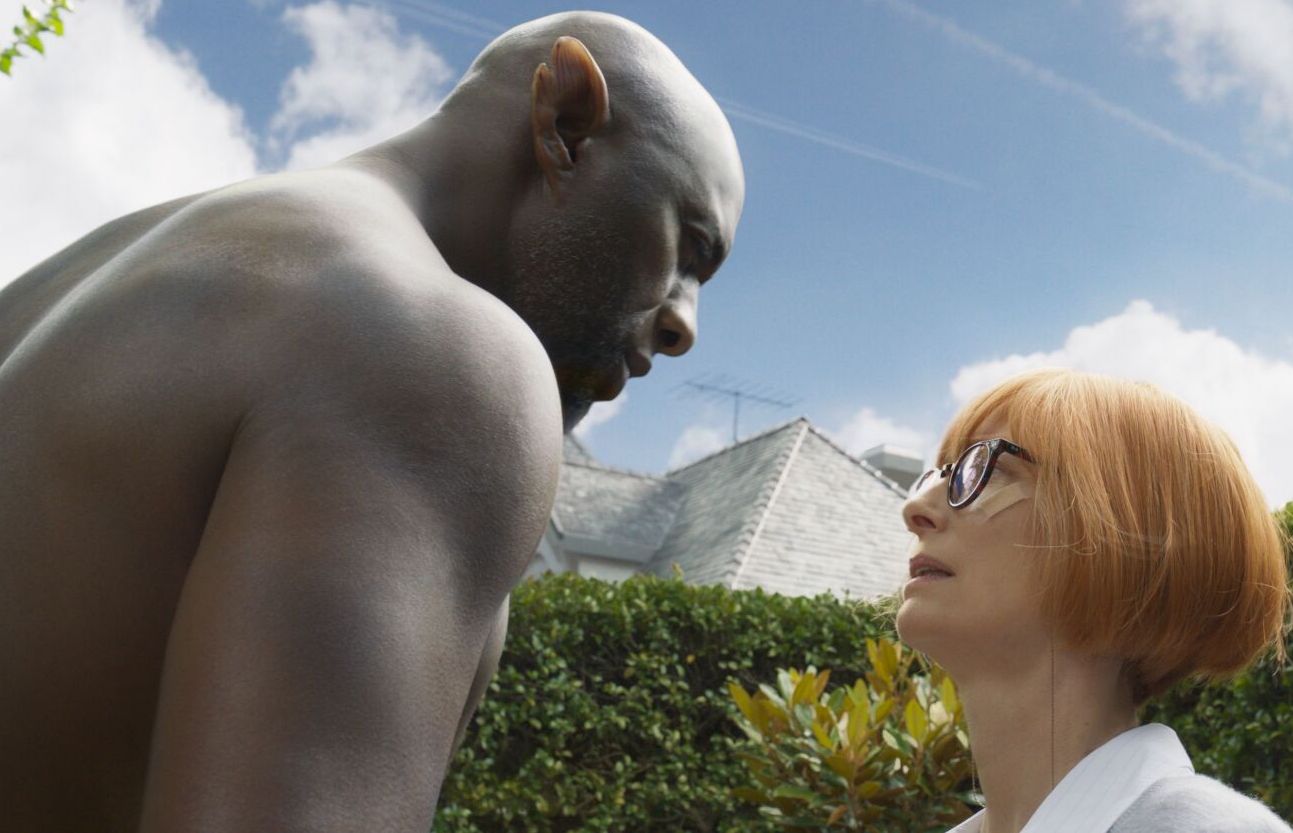
Idris Elba, Tilda Swinton

“THREE THOUSAND YEARS OF LONGING” My rating: B+ (Amazon Prime)

104 minutes | MPAA rating: R

Love stories have always been a staple of the movies, but really effective romantic films — I’m thinking “Somewhere in Time”-level  heart grippers — are surprisingly rare.

To the list of swoonworthy cinema we must now add “Three Thousand Years of  Longing,” a romantic/erotic fantasy from director George Miller (the”Mad Max” and “Babe” franchises) that begins with pure escapism and gradually works its way into your guts.

This adaptation of A.S. Byatt’s 1994 novel The Djinn in the Nightingale’s Eye (the screenplay is by Miller and Augusta Gore) stars the chameleonic Tilda Swinton as Alithea, a Brit academic whose specialty is the art of storytelling.  In pursuit of new tales Alithea has traveled to Istanbul for a conference of her fellow narratologists.

As a souvenir of her trip she purchases an old blown-glass vial from a cluttered shop; back in her hotel room she pops the top of her new find and with a smokey whoosh a huge genie (or djinn) fills her suite.

This fantastic creature (Idris Elba) quickly adapts to his new environment, shrinking to human size and learning Alithea’s English language (a surprising amount of the film’s dialogue is presented in ancient Greek and other languages without benefit of subtitles— just one of many ways in which the film insists on immersing the viewer in new and evocative states of mind).

What follows is a sort of riff on “1001 Arabian Nights,” with the Djinn relaying to the fascinated story lady his experiences over the last three millennia…much of which was spent in various lamps and bottles where the unsleeping Djinn had plenty of time to contemplate notions of freedom.

The Djinn’s astonishingly colorful yarns feature the likes of King Solomon and the Queen of Sheba (he observed their love story from just a few feet away), a slave girl who with the help of the Djinn bewitched the Sultan Suleiman, and a 19th-century  proto-feminist who with the help of the Djinn (who also became her lover) went on an inventing spree worthy of Leonardo.

The Djinn (Idris Elba) and Sheba (Aamito Lagum)

Each passage has been spectacularly designed by Roger Ford, evocatively captured by cinematographer John Seale (“Witness,” “Mad Max: Fury Road,” “The English Patient”) and perfectly performed by an international cast.

Always lurking in the background, though, are two inescapable issues.  

First, to gain his freedom the Djinn must grant his new owner three wishes — and Alithea is too smart a cookie not to anticipate the unforeseen fallout generated by a carelessly worded request.

Second, there’s a slowly pulsing undercurrent of sexuality constantly at work.  Must of this has to do with the vibes given off by the shirtless Elba, who really doesn’t have to work at exuding sexual power.  Then there’s the fact that both characters spend the film in fluffy hotel bathrobes.

And finally there’s the weird magic of Swinton, an eccentric-looking actress who can turn her gaunt frame, pale complexion and lank red hair into formidable tools of seduction — all without ever obviously going for it.

What does it say about us (or about me, anyway) that the most effective love stories are those rooted in fairy tales, science fiction and spiritual yearning?

That’s a topic for another day.  Right now I’m considering watching “Three Thousand Years of Longing” one more time.

| Robert W. Butler

Read Full Post »

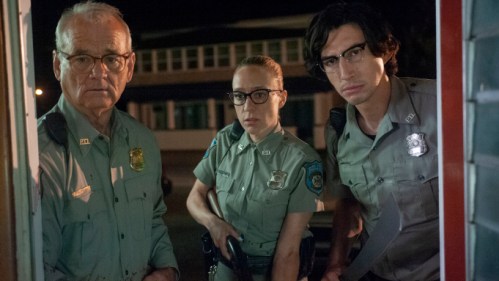
Bill Murray, Chloë Sevigny and Adam Driver

“THE DEAD DON’T DIE” My rating: C+

104 minutes | MPAA rating: R

The world really doesn’t need another zombie movie.

On the other hand, the world can always use another Jim Jarmusch movie.

Except, I guess, when it’s a zombie movie.

The latest from the idiosyncratic Jarmusch,  “The Dead Don’t Die,” has been written and played for chuckles.  It adds nothing to the zombie genre (unless you count the last-reel appearance of an alien spaceship) but allows a huge cast of players (Carol Kane and Iggy Pop, for instance, as a couple of the voracious corpses)  to have fun riffing on the whole walking dead phenomenon.

In sleepy Centerville the sheriff, Cliff Robertson (Bill Murray), and his deputy, Ronnie Peterson (Adam Driver), spend most of their time drinking coffee and keeping tabs on a forest-dwelling hermit (Tom Waits).

They mediate disputes among the citizenry, folk like a MAGA hat-wearing farmer (Steve Buscemi) and a black handyman (Danny Glover).

All the while,  Deputy Ronnie is oblivious to the fact that his co-worker, Deputy Mindy (Chloe Savigny), has a huge crush on him.

The two lawmen are a sort gun-toting Mutt & Jeff who face each new revelation of horrors with deadpan drollery.

(more…)

Read Full Post »

“ISLE OF DOGS” My rating: B

101 minutes | MPAA rating: PG-13

So much is going on in Wes Anderson’s “Isle of Dogs” that it’s hard to wrap one’s head around it.

Perhaps it’s best to let our eyes do all the work, for this is one astoundingly beautiful animated film.

Shot with the same stop-motion techniques as Anderson’s earlier effort, “The Fantastic Mr. Fox,” this new entry employs the filmmaker’s usual deadpan humor with gorgeous Japanense-inspired designs and a yarn about human/canine relations.

It’s part sci-fi, part “Old Yeller.”

In an introductory segment designed to look like Japanense screens and woodcuts and propelled by throbbing Japanese drumming, an unseen narrator (Courtney B.  Vance) relates how, after an outbreak of “dog flu” and “snout fever,” all canines in the city were banished by the cat-loving Mayor Kobayashi, head of the ruling Kobayashi clan.

The dogs were transported to an island of trash off the coast where they learned to dig through the refuse for sustenance.

But not all humans are anti-dog.  A few still long for the days of “man’s best friend”; a pro-pup scientist is even developing a cure for dog flu.

The plot proper (the screenplay is by Anderson, who developed the story with Roman Coppola, Jason Schwartzman and Kunichi Nomura) kicks in with the arrival of Atari, the ward of the Mayor who has stolen a plane and crash landed on the Isle of Dogs in search of Spots, his beloved guard dog, who was torn from him by the canine exodus.

The boy immediately teams up with a quartet of puzzled pooches (voiced by Edward Norton, Bob Balaban, Bill Murray and Jeff Goldblum) and the suspicious Chief (Bryan Cranston), who understandably nurses a bad case of anti-human sentiment. (more…)

Read Full Post »

Okra,An Seo Hyun

“OKJA” My rating: C (Now on Netflix)

118 minutes | No MPAA rating

Following up his multi-layered sci-fi extravaganza “Snowpiercer,” Korean auteur Joon-ho Bong delivers the Netflix original movie “Okja.”

Like its predecessor it blends dystopian imagery, social criticism and first-rate special effects, this time to tell the tale of a girl and her best friend, an elephant-sized pig-creature.

Unlike “Snowpiercer,” though, the pieces don’t fit together. Satire, childlike innocence and violence collide in an adventure nearly derailed by jarring tonal shifts.

The film begins with Lucy Mirando (Tilda Swinton), the head of the massive agribusiness that bears her family name (it sounds like Monsanto for a reason), announcing to the world that her firm has developed a super pig that will solve all our food needs.  To kick off the project she is sending baby pigs to farmers in 26 countries; over 10 years these porkers will be monitored as they are reared under local animal husbandry conditions.

The piglet Okja is blessed to be sent to the mountains of Korea where she is seen to by young Mija (An Seo Hyun) and her grandfather.  Mirja and the massive Okja lead a life of bucolic bliss.  They are best friends — though Bong is careful not to ascribe to Okja human intellect.

Of course, Mija doesn’t know that her big bud is destined to become superbacon.

“Okra” treads a familiar path when it becomes the tale of a fugitive child and her pet outrunning the evil forces of grown-up life.  But Bong isn’t really all that interested in that plot line, preferring to devote much screen time to a ham-handed (sorry about that) satire of corporate greed, human vanity and nitwit idealism.

(more…)

Read Full Post »

Benedict Cumberbatch

Benedict Cumberbatch

“DOCTOR STRANGE” My rating: B-

115 minutes |MPAA rating: PG-13

At this stage of the game Marvel movies have fallen into a predictable pattern, especially the third-act city-leveling smackdown (it’s like it’s guaranteed in the Constitution or something).

About two years ago I decided I was over the whole superhero thing. Unless, of course, you can show me something new.

“Dr. Strange” takes me halfway there, giving us a spell-casting protagonist who has more in common with Harry Potter than your usual Spandexed bicep bulger.

It’s got a solid first hour in which our ego-driven hero (see “Iron Man”) recognizes  the errors of his ways and gets his head turned around.

And a second hour in which a lot of shit gets blown up.

The wild card here is Benedict Cumberbatch, PBS’s current Sherlock and an actor of such range and integrity that I’m willing to give a chance to just about any project to which he lends his name.

Dr. Stephen Strange (Cumberbatch) is a ground-breaking neurosurgeon. Even among his self-aggrandizing colleagues he’s noted as a self-serving asshole who peers down his aquiline nose at lesser mortals and lives the life of a solitary genius.  In the past he had a fling with surgeon Christine Palmer (Rachel McAdams), but his most enduring relationships are with his fancy sports car, plush apartment and his own self.

A highway accident leaves Strange with crushed paws. Unable to hold a scalpel, he sees  his life dripping away and goes on an international hunt for some sort of treatment that can reverse his physical infirmities.

Which is how he ends up in Katmandu in an esoteric school run by the Ancient One (Tilda Swinton, bald and looking like a visiting space alien).  The Ancient One and her lieutenant Mordo (Chiwetel Ejiofor) put our hero through a physical and mental marathon, breaking down his sense of self, opening him up to life on the astral plane, and filling his head — and the screenplay — with enough metaphysical mumbo jumbo to make Scientology seem a viable option.


(more…)

Read Full Post »

Matthias Schonhart, Tilda Swinton, Dakota Johnson, Ralph Fiennes

Matthias Schonhart, Tilda Swinton, Dakota Johnson, Ralph Fiennes

“A BIGGER SPLASH”  My rating: B 

125 minutes | MPAA rating: R

Among the many on-screen personas of Ralph Fiennes are terrifying mob boss, casually cruel concentration camp commander, serial killer and silky aristocrat.

But nothing he’s done has quite prepared us for the acting dervish on display in “A Bigger Splash.”

In Luca Guadagnino’s steamy and visually ravishing display of psychological noir, Fiennes plays Harry, a renowned music producer who unexpectedly drops in on his old flame, rock star Marianne (Guadagnino regular Tilda Swinton), and her paramour, Paul (Matthias Schoenaerts).

Marianne and Paul are living in glorious isolation in a hilltop villa on the Sicilian island of Pantelleria, where they lounge about naked and make furious love in any and all rooms. Their choice of a retreat suggests they just want to be left alone, but neither can turn down Harry, a natural-born glad-handing speed freak who guzzles vino, pees where he likes, and is determined to be the life of the party.

For the music mogul was once Marianne’s lover and the force behind her international career. And as their relationship was winding down, Harry groomed Paul, a documentary filmmaker, to take his place in Marianne’s bed.

So suddenly the couple has as  a houseguest the motormouthed Harry, an interloper who seizes control of Marianne’s record collection, buzzing from one topic to another, erupting in rock ‘n’ roll survival stories and doing an insanely cool and ridiculously sinuous open-shirted dance to the Stones’ “Emotional Rescue.”

David Kajganich’s screenplay — an adaptation of the 1968 French film “The Swimming Pool” — centers on the question of just why Harry has shown up at this time.

For Marianne and Paul are extremely vulnerable. She’s had throat surgery to reverse the damage done by her larynx-shredding singing style. There’s no way of knowing if she’ll be able to resume her career; in the meantime she has been ordered not to speak above a whisper.

This prompts the irreverent Harry to ask Paul: “Does she write your name when she comes?”


(more…)

Read Full Post »

George Clooney

George Clooney

“HAIL, CAESAR!” My rating: C+ 

106 minutes | MPAA rating: R

The Coen Brothers’ “Hail, Caesar!” isn’t much of a movie, but as an affectionate (mostly) valentine to the Golden Age of Hollywood filmmaking, it’s a generally enjoyable goof.

The threadbare plot devised by Joel and Ethan Coen provides the siblings with multiple opportunities to go behind the scenes at the massive (and fictional) Capitol Movies studio in Los Angeles in the late 1940s.

We get to watch as America’s fantasies are brought to life. But as with sausages and laws, sometimes it’s best not to know how they’re made.

Kicking the yarn into motion is the kidnapping of stiffly handsome matinee idol Baird Whitlock (George Clooney), whose current assignment is to play a Roman centurion in the biblical epic “Hail, Caesar!”

The studio’s production chief, Eddie Mannix (Josh Brolin) gets to work recovering his ransomed movie star.

That’s about it for story.

The pleasures of “Hail, Caesar!” (the Cohen Brothers movie, not the “tale of the Christ” being filmed on the Capitol lot) are to be found in its satire/celebration of iconic Hollywood personalities and situations.

Early on Eddie must convene a meeting of faith leaders who have been asked to comment on the screenplay for “Hail, Caesar!” — it’s the movie’s funniest scene and a wickedly barbed sendup of institutionalized religion.

Channing Tatum

Channing Tatum

Eddie must contend with the potty-mouthed Esther Williams-type star of aquatic musicals (Scarlett Johansson) whose mermaid outfit now won’t fit because of pregnancy (she’s unmarried).

He drops off the ransom money on a soundstage where a Gene Kelly-ish song and dance man (Channing Tatum) is shooting a big production number about a crew of sailors dismayed at the prospect of eight months at sea without women.  Not only are Tatum’s acrobatic musical comedy skills first rate, but the slyly homoerotic elements of the dance routine suggests that these Navy swabs will find ways to let off steam during their voyage.

(more…)

Read Full Post »

Older Posts »