Feeds:
Posts
Comments

Posts Tagged ‘Vicky Krieps’

Ben Foster

“THE SURVIVOR” My rating: B+(HBO Max)

105 minutes | MPAA rating: R

How have I not discovered “The Survivor” before now?

This 2021 feature has so much going for it:  A famous director (Barry Levinson), a gut-wrenching real-life story and a lead performance by Ben Foster that made me rethink just about everything I’ve ever felt about this actor.

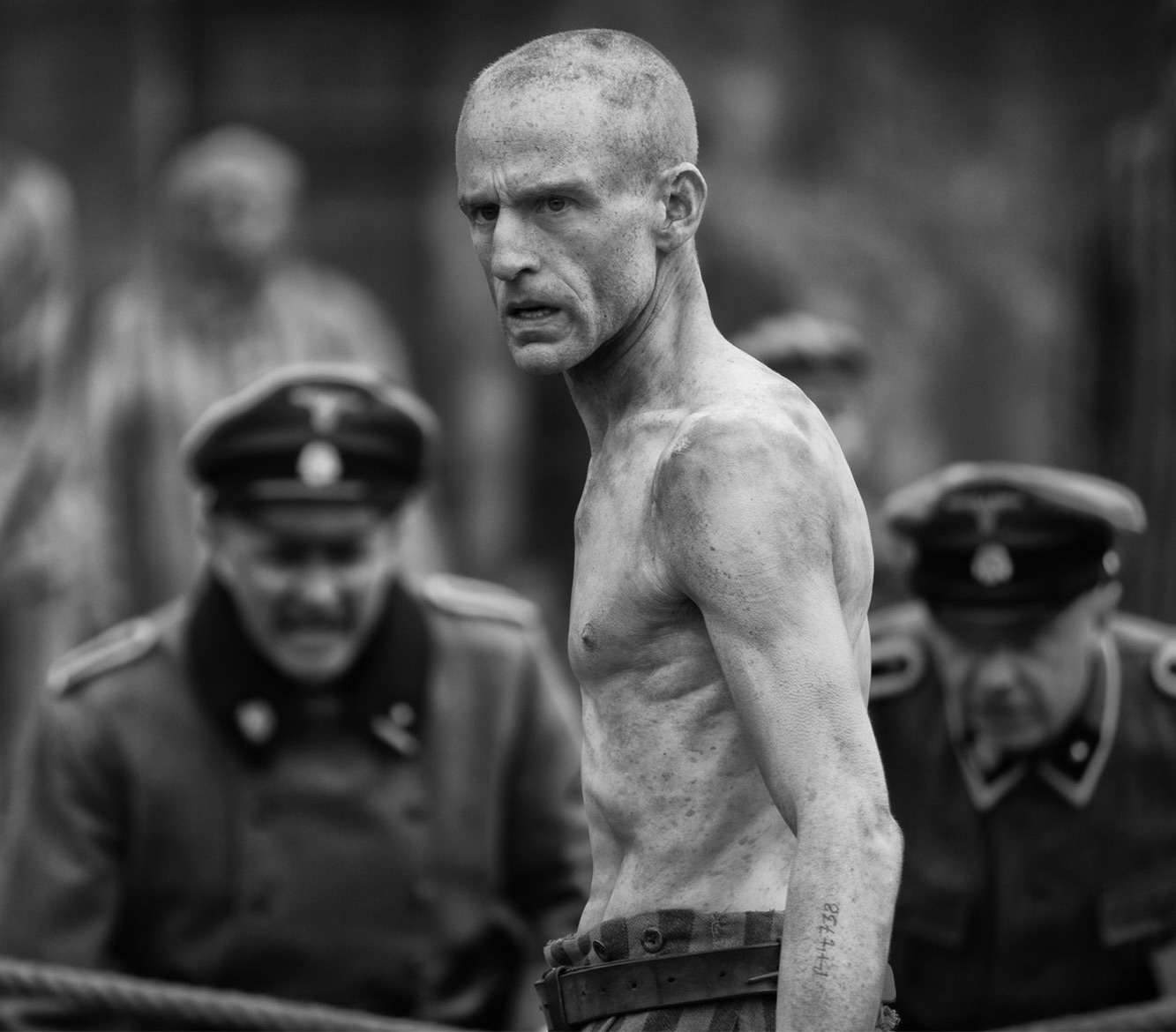
Hertzko “Harry” Haft was a Polish Jew who survived a series of Nazi death camps because of his boxing skills.  Haft fought more than 60 bloody bare-knuckle matches for the entertainment of S.S. officers who placed bets on the outcome.  Haft was betting, too…with his life.  The loser of each match was summarily executed.

Relocated to the States after the war Haft did the only thing he was good at.  For a couple of years he was a professional boxer; he even fought Rocky Marciano.

The script (by Justine Juel Kilmer, based on a nonfiction book by Haft’s son, Alan) alternates between Haft’s post-war life (these scenes are in color) and the horrors of his camp experiences (brilliantly captured by cinematographer George Steel in black-and-white images that uncannily evoke newsreels from the period).

“The Survivor” isn’t a sports movie; nor is it exclusively a Holocaust chronicle. It’s a character study of a man whose psyche was shredded by what he saw and by guilt over what he was forced to do.

Ben Foster is simply shattering in the role.  He appears to have lost 50 pounds for the concentration camp flashbacks; in the present (the film follows him through the 1960s)  he has the beefy look of a boxing pro.  In the latter scenes he’s absolutely believable as a man in a soft-stomached middle age.  It’s a transformation right up there with DeNiro’s in “Raging Bull.”

This is  a haunting performance capable of moving the viewer to tears. (Comparisons to Rod Steiger’s great performance in “The Pawnbroker” are apt.) 

I’ve not always been a Foster fan.  Following his solid feature debut (as a suburban Jewish teen in love with a black girl) in Levinson’s “Liberty Heights” he started landing roles as eye-rolling crazies (”3:10 to Yuma,” “30 Days of Night”).  But in recent years he’s shown both range and restraint (“Hell or High Water,” “Leave No Trace”).  How his work in “The Survivor” failed to register with the presenters of the various acting awards is a puzzler.
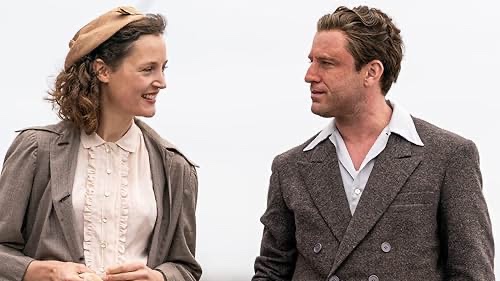
Vicky Krieps, Ben Foster

Other players include Danny DeVito and John Leguizamo as boxing coaches, Peter Sarsgaard as a sports  journalist, and Vicky Krieps as the Holocaust survivor aid worker who marries Haft.

Sonya Cullingford has a brief but unforgettable scene as Haft’s long-lost first love, with whom he  was reunited just weeks before her death from cancer.

The film’s main flaw is what it leaves out. We see in flashback how Haft escaped from a Nazi work party, but not how he survived on  his own until the end of the war.  That’s a deliberate choice.  According to his son’s book, the fugitive Haft killed three civilians he feared would turn him over to the Germans. The filmmakers obviously feared that showing those murders could turn an audience against their protagonist.

The good news is that this choice doesn’t significantly dilute the film’s power.

Margaret Qualley

“HONEY DON’T” My rating: C+(Netflix)

89 minutes | MPAA rating: R

Since splitting (temporarily, apparently) from his filmmaking sibling Joel, Ethan Coen has created two films centering on lesbian characters.  Margaret Qualley stars in both.

In 2004 ’s “Drive-Away Dolls” Qualley’s character goes on a road trip with luggage that includes a briefcase full of dildos and a severed human head.

In “Honey Don’t” she plays Honey O’Donahue, a lesbian private eye in sun-baked Bakersfield who wears high heels and hosiery with seams down the back.  The entire project (like “…Dolls” it was co-written with Tricia Cooke) plays like a Jim Thompson potboiler directed by a lesbian version of Russ Meyer.

It’s rude, it’s crude, it’s gleefully exploitative.

The cast includes Chris Evans (as the sexually voracious leader of a religious cult), Aubrey Plaza (as a gay cop), Charlie Day (as a horny police detective) and Lera Abova (as a mysterious Vespa-riding assassin).

It’s fun…until it wears out its welcome.

| Robert W. Butler

Read Full Post »

Vicky Krieps, August Diehl, Stefan Konarske

“THE YOUNG KARL MARX” My rating: C+

118 minutes | No MPAA rating

Few things are as noncinematic as a bunch of intellectuals arguing economic theory — which puts the makers of “The Young Karl Marx” on the defensive from the get-go.

Their solution is a sort of mutation on “Shakespeare in Love” in which Marx and his cohort Friedrich Engels rail at the status quo while outrunning the police and creditors, finding time to vigorously roger their ladyfolk. Along the way they establish the international Communist movement and get to work writing Capital.

Raoul Peck’s film (his last outing was the excellent James Baldwin documentary “I Am Not Your Negro”) begins in the early 1840s with unfortunate peasants being routed by cudgel-waving horsemen for having the effrontery to pick  up fallen tree limbs for firewood on a private estate.

Then we cut to young Marx (August Diehl) arguing with the writers and editors of their recently-banned newspaper; he criticizes his colleagues both for intellectual laziness and for a lack of resolve in opposing the establishment. (The film finds  Marx often insufferably arrogant…but he’s arrogant because he’s right.)

The scene ends with the entire newspaper staff hauled off to prison.

Meanwhile in Manchester England Friedrich Engels (Stefan Konarske) is appalled at the inhuman conditions imposed by his father on workers at the family’s textile mill. When the proles protest by damaging a loom, Engels Pere fumes that “Machines are expensive…not like labor.”  His son leaves in disgust.

“The Young Karl Marx” is about how these two giants of economic reasoning got together, discovering their shared styles and common interests.  We also meet Marx’s wife Jenny (Vicky Krieps, Daniel Day Lewis’ love interest in “Phantom Thread”), a member of the French aristocracy who gave it all up for love and the workers of the world.  Then there’s Engel’s squeeze Mary (Hannah Steele), an Irish factory lass who takes no guff from anyone.

There are, of course, endless discussions of Marxist theory.  Some of these get heated when the talk turns to the boys’  sincere belief in  violent revolution.

“The Young Karl Marx” is about as well acted as it can be…it’s just that it plays more like a history lesson than a viable drama.  Good production values, though…even if most of what we see are gloomy garrets, dirty factory floors and dimly-lit taverns.

| Robert W. Butler

Read Full Post »

Daniel Day-Lewis

“PHANTOM THREAD” My rating: B 

130 minutes | MPAA rating: R

“Phantom Thread” is an exquisite love story.

“Phantom Thread” is a cynical black comedy.

That both of these statements are accurate suggests the complex mix of ideas, emotions and impulses percolating through Paul Thomas Anderson’s latest film.

That “Phantom Thread” also features what is allegedly Daniel Day-Lewis final screen performance (he and Anderson collaborated earlier on “There Will Be Blood”) makes it a must-see event.

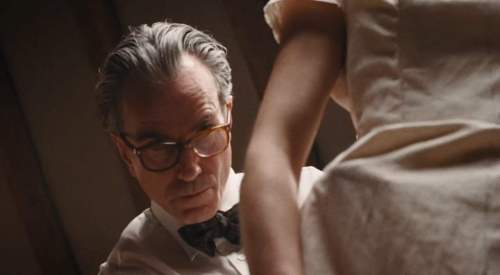
Reynolds Woodcock (Day-Lewis) is the premiere dress designer in ’50s London. He caters to the rich and titled; his fashions are elegant and controversy-free.

His effete manner and rep as a lifelong bachelor might suggest to some that the graying Reynolds is gay, but they’d be wrong. Reynolds enjoys women on the physical level.  In fact, as the film begins he indicates over breakfast to  his sister-collaborator-facilitator  Cyril (Leslie Manville) that his current paramour has worn out her welcome.

It falls to Cyril to deliver the bad news and escort the rejected young woman from the premises; a great artist like Reynolds cannot be bothered with such mundane duties.

“Marriage would make me deceitful,” he says, as if using and discarding women somehow makes him honest.

Anderson’s screenplay follows Reynolds on a side trip to his family’s seaside cottage.  At a local tearoom he encounters  Alma (Vicky Krieps), an Eastern European immigrant waiting tables. She’s a woman with a real physical presence, not one of those wraithlike models he’s used to dealing with, and she knows nothing about Reynolds or his work.

Her lack of guile, non-glamorous appearance and forthright emotional bearing appeal hugely to the jaded dress designer. He brings her to London, installs her in his household, looks to her as his creative muse  and, finally, marries her: “I feel like I’ve been looking for your for a very long time.” (more…)

Read Full Post »