Feeds:
Posts
Comments

Posts Tagged ‘Willem Dafoe’

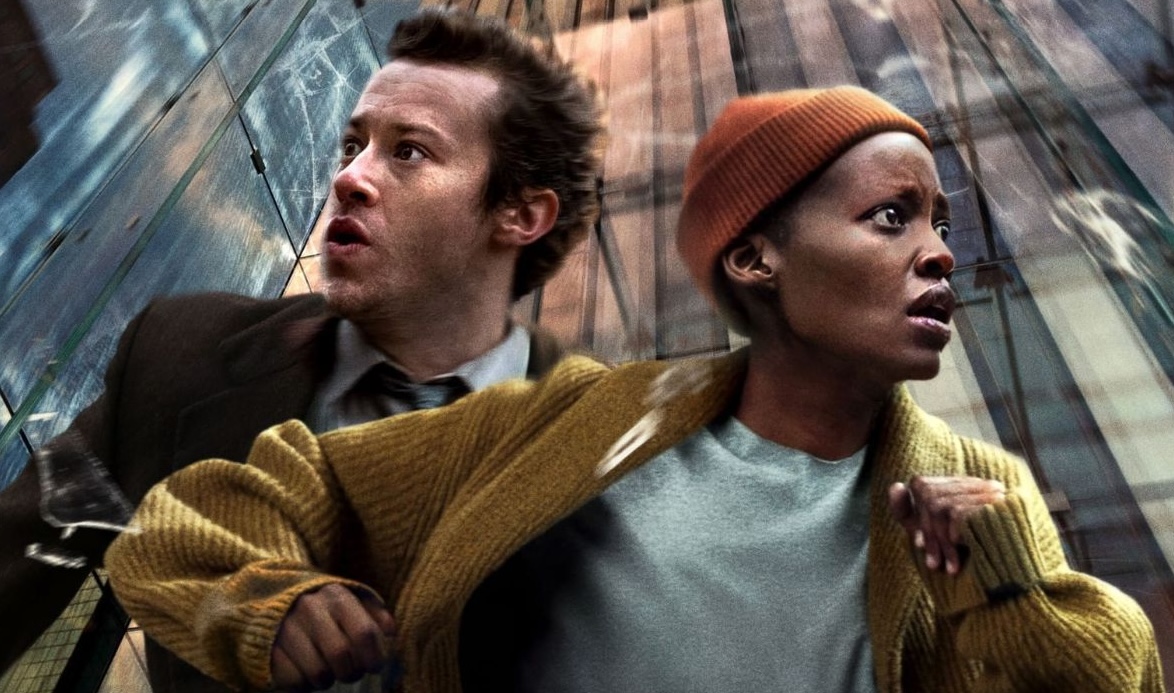
Joseph Quinn, Lupita Nyong’o

“A QUIET PLACE: DAY ONE” My rating: B (Paramount+)

99 minutes | MPAA rating: PG-13

The latest in the “Quiet Place” franchise is a harrowingly effective survival story, focusing as it does on the 24 hours after NYC is inundated with unseeing, all-hearing alien predators.

But writer/director Michael Sarnoski (who here shares screenplay credit with John Krasinski, who wrote, directed and starred in the two earlier installments) is going for something more.

For starters, the film opens in a suburban hospice populated with cancer victims waiting to die.  Among them is Sam (Lupita Nyong’o), a young woman who seems to be holding on mostly so she can share a few more moments with her beloved cat Frodo.

A rare field trip to the Big Apple is interrupted by an alien invasion. Anyone hoping to survive has to deal with a short learning curve…lay low, don’t make noises, stay near water (the creepy crawlers can’t stand the wet stuff).

Initially terrorized by the mayhem around her, Sam resolves to make her way to a pier on the East River where evacuation boats await.

She’s accompanied on this perilous trek by her pussycat and a traumatized young lawyer, Eric (Joseph Quinn), who over the course of the narrative goes from being a whimpering liability to a valuable ally…he risks his neck raiding an abandoned pharmacy to get the trans-dermal fentanol patches Sam needs for pain control.

“…Day One” delivers a scarily effective end-of-the-world ambience…viewers who initially take comfort in not having cancer suddenly find themselves in a world where imminent death seems all but assured.  It’s a disorienting shot of reality.

With her thin frame and big eyes Nyong’o makes for an absolutely convincing Sam. Quinn (here almost unrecognizable from his “Stranger Things” role as small-town Lothario Eddie Munson) makes a convincing metamorphosis from quivering wimp to man of action.

 And Schnitzel the cat’s performance as Frodo is, well, believably catlike.  The filmmakers haven’t tried to anthropomorphize the animal…he’s just a cat.

The special effects are convincing, but Sarnoski is smart enough to know that less is more.  We may not see much of the aliens, but we know they’re out there, making clicking noises and waiting for their human prey to reveal ourselves.

Margaret Qually, Jesse Plemons, Willem Dafoe

“KINDS OF KINDNESS” My rating: (Hulu)

154 minutes (MPAA rating: R)

“Weird” is a popular word in this election cycle. It certainly applies to Yorgos Lanthimos’s “Kinds of Kindness,” a triptych that feels like episodes “The Twilight Zone” and “Alfred Hitchcock Presents” viewed through a paranoid haze.

In a way it’s like a theatrical repertory company — a half dozen actors keep reappearing in different roles.

Two of the stories— the first and third — deal with individuals who have given up most of their free will to serve a cultish leader.

In “The Death of R.F.M.” (R.F.M. is a balding, bearded fellow who appears briefly in all three episodes but says almost nothing) Jesse Plemons plays Robert, an executive who literally lives for his boss, Raymond (Willem Dafoe).

Raymond provides Robert and his wife with a house and car. He gives them expensive if weird gifts (one of John McEnroe’s smashed tennis rackets). He also dictates what they eat and drink and when they have sex.

But when Raymond orders Robert to participate in what appears to be a murder (the titular R.F.M. is the intended victim), he declines.

And so is cast out of Eden.

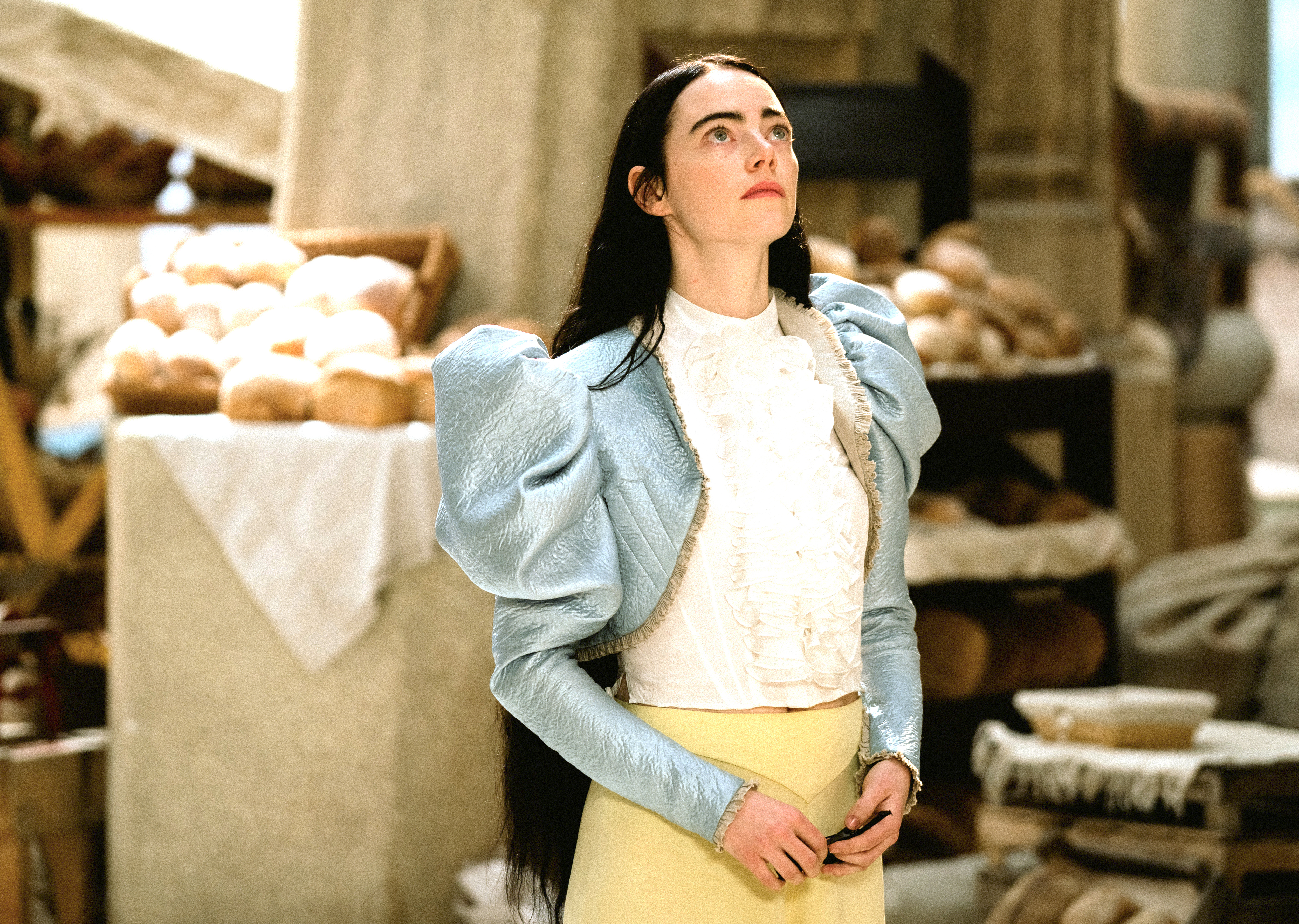
The bookend episode, “R.F.M. Eats a Sandwich,” finds Plemons and Lanthimos regular Emma Stone (“Poor Things,” “The Favourite”) traveling the country in a souped-up purple muscle car.

They are members of a cult searching for a woman who, according to the prophecies of their leaders OMI and AKA (Dafoe and Hong Chau), has the ability to resurrect the dead.  (In this one R.F.M. is a corpse in a morgue.)

Margaret Qualley is particularly good here as twin sisters, a veterinarian with astounding healing abilities and her singularly twisted sibling.

The middle episode, “R.M.F. is Flying,” is my least favorite. Plemons stars as a husband whose oceanographer wife (Stone) is missing at sea.  

When she is finally rescued from a tiny island, he suspects that she isn’t really his wife (she now likes chocolate, which she previously hated, and her shoes no longer fit). To prove herself he demands ever more bizarre sacrifices. 

“Kinds of Kindness” (the title practically drips irony…there’s not much kindness on display here) has been impeccably made but isn’t particularly inviting on either an emotional or intellectual level.

There are moments of black humor, but rarely of the laugh-out-loud variety — more funny odd than funny ha-ha. There are lots of squirm-worthy sexual undercurrents and some in-your-face nudity.

And the musical score — of dissonant piano doodling and  droning Medieval chants — nicely reflects the film’s themes of psychosis and self-denying reverence.

Actually, streaming may be the perfect way to watch it. In a theater with a running time of three hours, “Kinds of Kindness” probably ran quickly out of steam. But on Hulu we can watch it in digestible (well, almost) one-hour chunks.

Joaquin Phoenix, Vanessa Kirby

“NAPOLEON: THE DIRECTOR’S CUT” My rating: B- (Apple+)

206 minutes | MPAA rating: R

Ridley Scott’s “Napoleon” was a major letdown.

Great battle scenes. Terrific production values.  But dramatically?  Nope.  

And things weren’t helped any by Joaquin Phoenix’s interpretation of Nappy as a military savant who in all other aspects is borderline autistic.

Now we have an expanded version 45 minutes longer than the original.  And it’s a better movie. But still not a great one.

It’s hard to say sometimes exactly what is new here…in many instances it’s no more than a couple of additional shots and lines of dialogue dropped into existing scenes. 

But early on we get a look at what Josephine (Vanessa Kirby) endured before meeting Napoleon.  After the execution of her husband in the Reign of Terror, she is sent to prison where she learns some grim truths about what a woman must often do to survive.  

Josephine gets a crash course in staying alive from a fellow inmate (Ludivine Sagnier, whose performance was completely cut from the theatrical release)…it’s a sobering experience and helps explain the future Empress’s often witheringly sardonic outlook and general fatalism. 

Also getting more screen time is Sinead Cusack as our hero’s scheming mother.  In a blackly comic scene she sends the childless Emperor off to sleep with a virgin, hoping it will result in a pregnancy that proves Josephine, not Napoleon, is incapable of having children. 

Some minor characters— like the Russian Tsar Alexander (Edouard Philipponnat) — have their stories fleshed out.

But the film’s highlights remain the battle sequences.

And what about Phoenix’s Napoleon?  Well, this longer version does expand upon his relationship with Josephine (desperately ill at ease with most women, he adored her enough to tolerate her sarcasm and melancholy).  This extended cut also employs more voiceover narration to explore the relationship through the couple’s correspondence.

But the big question nagging “Napoleon” isn’t laid to rest in this version.  That being: His military triumphs notwithstanding, how could such a socially inept, introverted, essentially unlikeable figure have gained the confidence of his countrymen and been made Emperor?  

(I still wonder if the whole movie isn’t an elaborate Trumpian parody.)

Maybe we’ll learn the answer in the next Supercharged Director’s Cut.  Yes, Ridley Scott has a four-hour-plus version of “Napoleon” that, according to the few who have seen it, is the stuff of legend.

We shall see.

| Robert W. Butler
Read Full Post »

pilgrim’s progressEmma Stone

“POOR THINGS” My rating: B+ (In theaters)

141 minutes | MPAA rating: R

Yorgos Lanthimos’ “Poor Things” delivers such a unique vision, so elaborate a palette of visual wonders, so much wickedly sly humor that one is willing to forgive a padded running time and a draggy third act.

Although its literary sources are obvious enough (“Frankenstein” is a biggie; so is
“Candide”) the film’s wondrously weird sense of self is unlike that of any movie I can think of.

And it gives Emma Stone, the star of Lanthimos’ “The Favourite,” the role of a lifetime.

Here she plays Bella, a grown woman who behaves like an infant. 

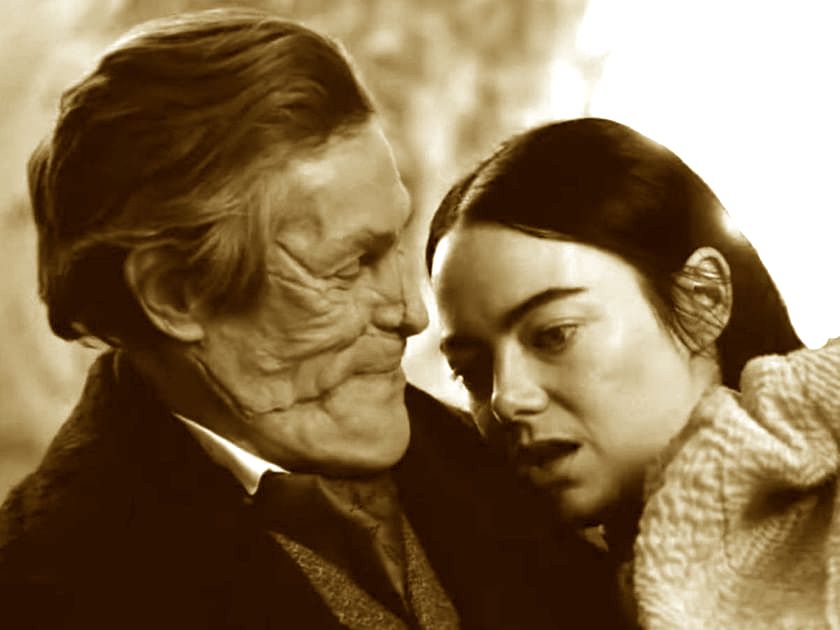
“Her mental age and body are not quite synchronized,” explains Godwin Baxter (Willem Dafoe), the hideously scarred eccentric whose home/laboratory is populated with bizarre animal hybrids (like a duck with a dog’s head). 

Godwin — Bella addresses  him as “God” — views  his ward as both his daughter and as an experiment.  He will educate this blank slate, raise her to be a reflection of his own genius.

Willem Dafoe, Emma Stone

He tolerates her childlike misbehavior (Bella routinely smashes dishes and plates just for the thrill of noisy destruction), having determined that she has an incredibly high learning curve.

In just a matter of weeks she goes from syntax-twisted baby talk to more-or-less full sentences.

Sometimes she stares in birdlike fashion off into space (reminds of Elsa Lanchester as the Bride of Frankenstein); at other times she devotes all her faculties to examining (and often destroying) some new object in God’s cluttered abode.

Now would be a good time to mention the astounding production design courtesy of Shona Heath and James Price.  “Poor Things” begins in London circa 1900 and later moves to the Continent, but historical accuracy is jettisoned in favor of a sort of Gaudi-inspired steampunk ethos.  The picture is filled with weirdly shaped and decorated rooms, bizarre ships (both seagoing and aerial), and city environments that ooze fanciful theme park artificiality.  

The sumptuous photography by Robbie Ryan (“American Honey,” “The Favourite”) embraces both crisp black and white and pastel-infused color, and his frequent use of wide-angle lenses captures a visual warp that nicely echoes the gnarly subject matter.

The great joy of “Poor Things” lies in watching Stone’s Bella blossom into her own person.

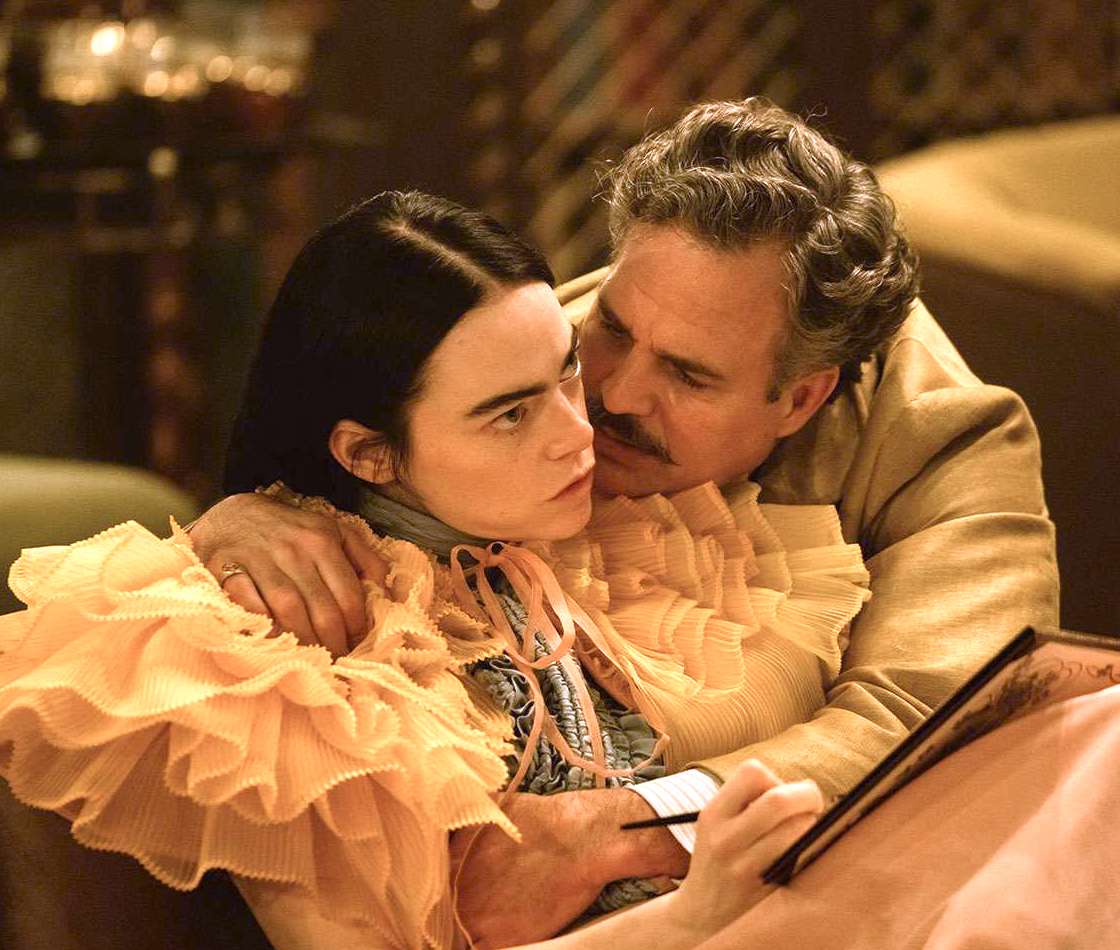
She’s abetted along the way first by Max (Rami Youssef), a sincere medical student hired by God to be Bella’s companion, teacher and possible husband, and later by  unprincipled lawyer Duncan Wedderburn (Mark Ruffalo), who spirits Bella away for a European debauch and introduces her to the wonders of sex. (Or, as she calls it, “furious jumping.”)

(Ruffalo’s comic performance falls just short of mellerdramer mustache-twirling; his depiction of Duncan’s selfish pomposity is hugely amusing, and almost makes me forget his terrible turn in “All the Light We Cannot See.”)

Bella learns and grows. Initially she moves with the jerky tentativeness of a newborn colt; before long she’s doing a funky dance of her own creation. Her vocabulary blossoms.

Emma Stone, Mark Ruffalo

What doesn’t change is her singular outlook.  Her intellect rockets right past societal norms. She has no filter and so invariably utters the truth in situations which call for discretion.

She even develops a sense of empathy and is distraught at the plight of the urban poor she discovers on her sojourn (this passage is a nifty parody of the Buddhist legend in which the privileged Prince Siddhartha ventures from his palace to discover for the first time the plight of his aged and diseased subjects).

Eventually her adventures lead to a stint in a Paris brothel where she succinctly identifies what each customer needs (men are so pathetically transparent) and delivers with a minimum of fuss, becoming rich in the process. (It’s not that Bella is immoral; she’s utterly amoral.)

Eventually the yarn returns to London where we learn of Bella’s origins and her life as the wife of a thuggish noble (Christopher Abbott).  Happily, her world-expanding experiences have prepared her to deal even with the most rampant and institutionalized chauvinism.

For its first 90 or so minutes “Poor Things” is like a birthday party in which every minute delivers a new present to unwrap. It’s a cinematic feast that just keeps on giving.

But things start to bog down in the Paris section…Lanthimos aims for raunchy laughs, with lots of nudity and cartoonish coupling (the easily offended should steer clear). But after a while the film starts to repeat itself. Yeah, yeah, we get it. Men are swine or arrested adolescents. The effect could be had in a fraction of the time it’s given here.

In fact, “Poor Things” would benefit hugely from some tightening. Less is more.

Nevertheless, the movie is a fantastic achievement. And you leave with a newfound sense of respect for the artistry and adventurousness of Emma Stone.

| Robert W. Butler

Read Full Post »

Willem Dafoe, Robert Pattinson

“THE LIGHTHOUSE” My rating: B

109 minutes | MPAA rating: R

With Robert Eggers’ “The Lighthouse” we don’t so much watch a couple of men go crazy as experience that craziness with them.

The film has been beautifully photographed, but beware…it is disconcerting, perplexing  and alienating. Eggers, who burst upon the scene a couple of years back with “The Witch,”  is less interested in solving mysteries than in creating visual and aural conundrums. We’re expected to come up with our own answers.

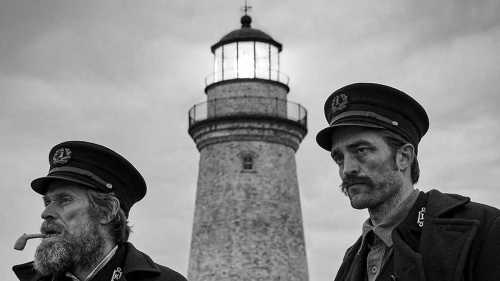
At the turn of the last century two men — the salty old Thomas Wake (Willem Dafoe) and the much younger Ephraim Winslow (Robert Pattinson) — take up their duties at a lighthouse on a remote island somewhere off the American coast. They are to be relieved in four weeks.

There’s friction from the start.  The experienced and dictatorial Thomas gives his newcomer partner the lousiest housekeeping jobs: cleaning out the cistern, emptying overflowing chamber pots, whitewashing the lighthouse while dangling in a harness, stoking the furnace that creates the steam to power the deafening foghorn. The old man claims the light itself as his special concern;  Ephraim is steer clear of the tower unless specifically ordered to climb those winding stairs.

This is bad enough. But Thomas is an irritating old coot, a monumental farter and snorer who insists on telling boring tall tales of sea life in a Long John Silver voice.

Ephraim has his own issues. He refuses to drink with Thomas…it seems likely that he is an alcoholic whose misbehavior on the mainland has led to a self-imposed exile.

(more…)

Read Full Post »

Gugu Mbatha-Raw, Edward Norton

“MOTHERLESS BROOKLYN” My rating: C+

144 minutes | MPAA rating: R

It’s easy enough to understand why an actor of Edward Norton’s capabilities — or even an actor of lesser capabilities — would jump at the chance to portray Lionel Essrog,  the central character of Jonathan Lethem’s 1999 novel Motherless Brooklyn.

Lionel lives in NYC and works in private investigations. He has a photographic memory. He’s smart.

And, oh yeah, he’s got Tourette’s syndrome, which leads to involuntary squawking, head jerking and explosions of inappropriate language. Not to mention a sense of social isolation. The poor schlub has never been in a love affair.

In other word’s, Lionel is an actor’s feast.

Wish Norton had left it at that.  For “Motherless Brooklyn” he also serves as scriptwriter and director (only his second behind-the-camera outing since 2000’s”Keeping the Faith”) and one cannot help but feel he was pulled too many ways, that his first love here is a character that he can really chow down on and that most everything else is an afterthought.

It’s not exactly a vanity project — too many big names and skilled artists are involved for that — but one can only wonder what would have happened with someone else calling the shots.

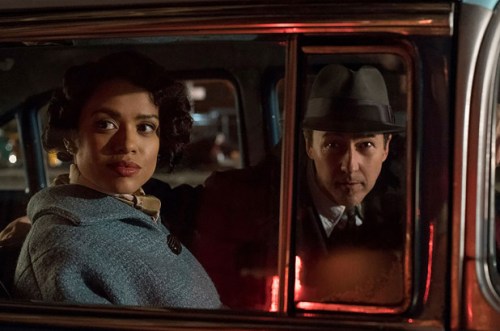
As screenwriter Norton has worked some major changes…for starters he sets the story in the early 1950s rather than the 1999 of the novel (the better to milk the yarn’s noir elements).  The tale still pivots on the murder early on of Lionel’s boss, legendary private eye Frank Minna (Bruce Willis), but in this retelling solving the crime leads not to underworld heavyweights but to governmental malfeasance.

You see, though it’s set 60 years ago, “Motherless” has a very contemporary view of politics.

Radiating arrogant malevolence, Alec Baldwin co-stars as Moses Randolph, a behind-the-scenes mover and shaker inspired by  Robert Moses, the real-life New York public official who for decades served as the powerful “master builder” of the modern city despite never having been elected to any office.

Our twitching hero’s investigation leads him to Laura, a beautiful African American lawyer (Gugu Mbatha-Raw), her thuggish nightclub-owner stepfather (Robert Wisdom), and a cool-blowing jazz trumpeter (Michael Kenneth Williams) rather obviously inspired by Miles Davis.

We also meet Lionel’s gumshoe co-workers, portrayed by Bobby Canavale, Ethan Suplee, and Dallas Roberts.

(more…)

Read Full Post »

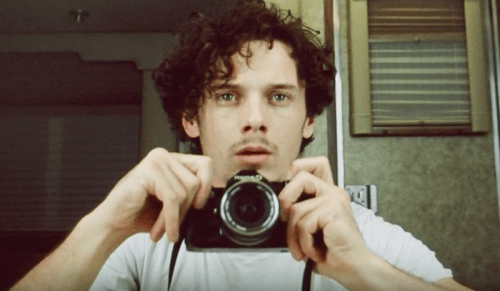
Anton Yeltsin

“LOVE, ANTOSHA” My rating: B+

93 minutes | No MPAA rating

I knew who Anton Yeltsin was, of course.  I’d seen the young actor as Chekhov in J.J. Abrams’ “Star Trek” reboots, and in a couple of other movies like Jodie Foster’s “The Beaver.”

And of course I knew he died in 2017 at age 27 in a freak accident, pinned against a metal gate by his rolling automobile.

None of which prepared me for the gut punch that is “Love, Antosha,” a love letter to the late actor signed by his parents, his boyhood friends, and his heavy-hitting acting colleagues.

It seems nobody who knew Yeltsin had anything but love for him. And that emotion comes roiling off the screen.

Garret Price’s documentary opens with home movies from Yeltsin’s childhood. What we see is an impossibly handsome kid with a big performer’s personality that fills the room.

We also get a bit of back story about his parents,  competitive Soviet ice dancers who emigrated to the U.S.A. to get away from growing anti-Semitism in the new Russian Republic.

Here’s something I did not know:  While a teen Anton was diagnosed with cystic fibrosis, the devastating lung condition (the average life expectancy of a sufferer is 37 years). He was so full of energy, so good at masking his symptoms and plowing ahead, that many of his show biz colleagues were unaware that he had gone through life essentially under a death sentence.

(more…)

Read Full Post »

Willem Dafoe as Vincent Van Gogh

“AT ETERNITY’S GATE” My rating: A-

110 minutes | MPAA rating: PG-12

Epically poetic yet aching personal, “At Eternity’s Gate” may be the best film ever about Vincent  Van Gogh.

For that matter, it is among the best movies ever made about a visual artist. Undoubtedly much of the insight and emotion radiating off the screen can be traced back to writer/director Julian Schnabel who was, of course, a famed painter long  before he began  making films.

Visually lush and aurally haunting, “At Eternity’s Gate” follows Vincent through the last year or so of his life.

It is told in fragmented fashion, with scenes built around a series of dialogues between Vincent (Willem Dafoe in the best performance of his career) and others: his supportive brother Theo (Rupert Friend), his combative fellow painter Paul Gauguin (Oscar Isaac), a fellow patient in a mental institution (Niels Arestrup), a disapproving priest (Mads Mikkelsen), a sympathetic physician (Mathieu Amalric).

And when he’s not talking, this Vincent is painting, creating before our eyes the colorful masterpieces that would not be appreciated until long after his death at age 37. A good chunk of “At Eternity’s Gate” is devoted to following Vincent on his nature walks, easel and canvasses strapped to his back, head shaded with a floppy straw hat.

This is a transcendental Vincent, a man who stands in the sunshine with his arms outstretched, smiling ecstatically at the light that bathes him.

Our first encounter with this Vincent, though, occurs in darkness. We can only hear his voice. He’s talking about loneliness, about how he feels set apart from the rest of humanity: “I just want to be one of them…I’d like them to give me some tobacco, a glass of wine, or even ask: ‘How are you?’…from time to time I’d make a sketch of one of them as a gift.”

The key to Dafoe’s inspiring, heartbreaking performance is the way in which Vincent’s almost religious love affair with the world’s beauty is undercut by his sad “otherness.”  Most people don’t like him. They make fun of him. His eccentricities, poverty and neediness bring out the worst in his fellow man. (An art dealer of my acquaintance once explained that “Everybody wants a Van Gogh in their dining room; nobody wants Van Gogh in their  dining room.”)

Thus he’s an apologetic mystic, aware that he rubs others the wrong way, but unable to escape the almost epileptic thrall into which he is forever being plunged by the beauty of the world around him.

(more…)

Read Full Post »

Kenneth Branagh as Hercule Poirot

“MURDER ON THE ORIENT EXPRESS” My rating: C  

114 minutes | MPAA rating: PG-13

The year’s strongest cast wrestles inertia to a standstill in “Murder on the Orient Express,” the latest addition to the pantheon of unnecessary remakes.

We already have Sidney Lumet’s perfectly delightful 1974 adaptation of Agatha Christie’s great  railway mystery. But as with Shakespeare, Dame Agatha’s yarns are worthy of retelling for each new generation.  Problem is, this retelling is stillborn.

It’s always difficult to know exactly why a movie goes wrong, but in this case it may very well lie with the decision to have Kenneth Branagh both direct and star as eccentric Belgian detective Hercule Poirot.

The character dominates virtually every scene, which means the acting weight alone was exhausting. To then also ride herd on a huge cast of heavy hitting thespians was too much to ask of anyone.

As it now stands, Branagh disappoints in both capacities. His features masked by absurd facial hair as obviously fake as the computer-generated backgrounds, he makes a mess of Poirot, who goes from crowd-teasing cutup to moody depressive without much in between. Lines that should evoke a laugh barely generate a tentative smile.

As for the directing end of things…well, what can you say when you have this much talent on hand and still end up with a dull yarn weighted down by blah characterizations?

Set aboard a snowbound luxury train on the Istanbul-Paris run, Michael Green’s screenplay clings to the basics of Christie’s tale (the “who” in the “whodunnit” makes for a one of the better revelations in all detective fiction) while dabbling with some of the particulars, largely in an effort to make the project more attractive to today’s mass audience.

Thus the screenplay finds time for one karate fight, a chase down a railroad trestle and a shooting — none of which are to be found in the novel or the earlier film.

While a few of the characters have undergone some tweaking (a physician aboard the train is now a Negro played by Leslie Odom Jr., providing the opportunity to dabble in some racial issues), most cling to Christie’s parameters. (more…)

Read Full Post »

Willem Dafoe, Brooklynn Prince

“THE FLORIDA PROJECT” My rating: B+

115 minutes | MPAA rating: R

Six-year-old Moonee (Brooklynn Prince) lives in the shadow of Disney World.

Not that she’s ever visited the Magic Kingdom.  Moonee and her mom Halley (Bria Vinaite) are guests/inmates at the Magic Castle, a purple monstrosity of a motel where rooms go for $36 a night and the clientele consists mostly of homeless families struggling to survive in the tourist-oriented economy of central Florida.

It’s not like Moonee feels deprived at never having been up close and personal with Mickey and Donald and all the other Disney characters. She’s the kind of kid who creates her own adventures, and if she often runs afoul of grownups  (people don’t like brats who amuse themselves lobbing phlegm bombs onto other people’s cars), she’s sassy and defiant and seemingly untamable.

Moonee and her  playmates regard the motel complex as their own personal realm, and their pint-size depredations are the bane of the existence of Bobby (Willem Dafoe), the manager forever trying to walk the fine line between corporate dictates and those of his own conscience.

Bobby chastises Moonee and pals for cutting off power to the entire motel by throwing the master switch in the utility room — but even as he does so you can sense that on another level he admires the kids’ lippy defiance.  But he’s also a sort of guardian angel to these mini-Visigoths, quickly swooping down on a pathetically feeble-minded pedophile (Carl Bradford) who hangs around the motel’s swing sets and struggling mightily to cover up Gloria (Sandy Kane), an overpainted septunagerian who insists on sunbathing topless.

(more…)

Read Full Post »

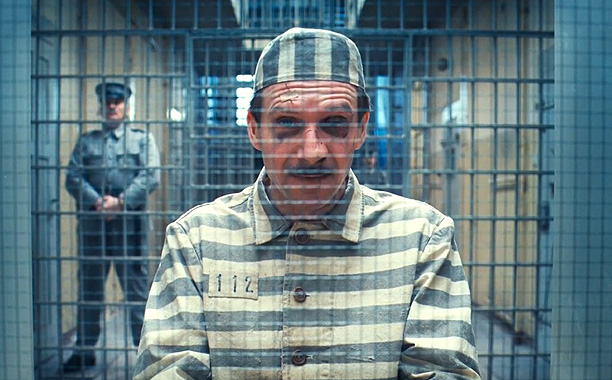
Ralph Fiennes in Wes Anderson's "The Grand Budapest Hotel"

Ralph Fiennes in Wes Anderson’s “The Grand Budapest Hotel”

“THE GRAND BUDAPEST HOTEL”  My rating: B (Opens wide on March 21)

100 minutes | MPAA rating: R

Wes Anderson’s “The Grand Budapest Hotel” is a whopper of a shaggy dog story – or more accurately, it’s a series of shaggy dog stories that fit neatly inside one another like one of those painted Russian dolls.

The film’s yarn-within-a-yarn structure and a delightfully nutty perf from leading man Ralph Fiennes are the main attractions here. I had hoped that “Grand Budapest…” would scale the same emotional heights as Anderson’s last effort, the captivating “Moonrise Kingdom.”

It doesn’t. But there’s still plenty to relish here.

Describing the film requires a flow chart. But here goes:

In the present in a former Eastern Bloc country, a young woman visits the grave of a dead author and begins reading his book The Grand Budapest Hotel.

Suddenly we’re face to face with the writer (Tom Wilkinson), who is sitting at the desk in his study. After a few introductory comments and a brusque cuffing of a small boy who is proving a distraction, the author begins telling us the plot of his novel.

Now we’re in the 1990s in the formerly sumptuous but now dog-eared Grand Budapest hotel in the Eastern European alps. Staying there is a Young Writer (Jude Law) who befriends the mysterious Mr. Moustafa (F. Murray Abraham). An aged empresario who owns several of Europe’s most luxurious hotels, Moustafa keeps the Grand Budapest running for nostalgic reasons.

(more…)

Read Full Post »