Feeds:
Posts
Comments

Archive for October, 2025

Jeremy Allen White

“SPRINGSTEEN:  DELIVER ME FROM NOWHERE” My rating: B+ (In theaters)

120 minutes | MPAA rating: PG-13

Less rock concert than chamber piece, “Springsteen: Deliver Me From Nowhere” is an intimate drama about a guy losing his mind at the same time he’s becoming one of the most famous entertainers on the planet.

As a longtime fan of the Boss, I found Scott Cooper’s film unexpectedly moving, and not just because of the brilliance of Bruce Springsteen’s songwriting.

The film is about the creative process, sure, but it’s also about  family dysfunction, personal demons, and the lifelong struggle to discover one’s true essence even when the rest of the world is all too eager to dictate what it expects you to be.

Unfolding over a year in the early 1980s, “Deliver Me…” finds Springsteen (Jeremy Allen White, stupendous) riding high from his just-completed “River” tour…or is he?  Bruce finds little satisfaction with his new star status (first new car, lakeside rental in rural Jersey, guest gigs at the Stony Pony in Asbury Park).  Something’s missing.

The screenplay by Cooper (adapting Warren Zanes’ book) follows Bruce’s retreat to his hideaway in the country where he lays low and begins writing the material that will become his album “Nebraska.” It’s less a pleasurable vacation than a furious quest. The man has ideas — dark ones at that — circling around in his head that demand expression in song.

Periodically the film delivers black-and-white flashbacks to Bruce’s childhood with a protective mother (Gaby Hoffmann) and a struggling working class father (Steven Graham) who all too often takes out his frustrations on his loved ones.

These digressions are integral to understanding the singer and his songs. Childhood trauma finds its way into the music…but, then, so do little moments of grace (dancing with Mom, being driven into the country by Dad for a romp in the cornfields).  In some cases you can draw a direct line from Bruce’s boyhood to individual songs (“My Father’s House,” “Used Cars”).

Perhaps the most problematical element of “Deliver Me…” is the brief romance between Bruce and a young waitress/mother named Faye (Odessa Young). Faye is a composite character, an amalgam of women Springsteen dated during this period. Young is solid in the role but it’s something of a thankless task…Bruce is simply so at sea with his own mental and emotional health that romantic commitment to another human being is out of the question.

Professional relationships are a bit easier to navigate.  Jeremy Strong is hugely effective as manager Jon Landau, who runs interference for his famous client and appears to care more for Bruce’s well-being than for the moneymaking machine he could soon become. When Bruce decides to release the rough demos of his “Nebraska” songs — acoustic mono, no backup musicians, no fancy mastering, no portrait on the album cover, no tour, no press — it is Landau who stands up to record company bigwigs who dismiss Springsteen’s “folk record” as a disaster in the making.

Jeremy Strong

Late in the film we see Bruce in his first session with a psychiatrist, but throughout “Deliver Me From Nowhere” we see our man making small incremental steps toward healing. The first of these is recognizing that something’s wrong.

The performances are terrific throughout, but White’s Bruce is so good that he becomes his own person.  It’s not an imitation — although White’s vocals and stage movements are uncannily accurate — but rather a reinterpretation.  There were moments when I forgot this was a film specifically about Springsteen and regarded it as a much bigger examination of the artistic imperative.  Which is saying something.

I fully expect an Oscar nomination for White…and another for Graham, whose Springsteen pere is a sad nightmare of blue-collar disappointment and emotional turmoil.  This British actor has only a few moments of screen time, but the impression he makes on the viewer gives the film a thematic backbone that keeps everything moving.

Will “Deliver Me From Nowhere” appeal to those merely on the fringes of Springsteeniana? It’s a tough call. I found the process of creating “Nebraska” and tracing the LP’s roots back to boyhood incredibly involving…but then I know these songs by heart.

But even a viewer who has never heard of Bruce Springsteen should respond to the very human conflicts depicted here. 

Fathers and sons. Failed love. Lifelong friendship. These are universal stepping stones in human life, and “Deliver Me From Nowhere” finds both the beauty and the dread.

| Robert W. Butler

Read Full Post »

Anthony Ramos, Rebecca Ferguson

“A HOUSE OF DYNAMITE” My rating: B+ (Netflix)

112 minutes | MPAA rating: R

This Halloween season’s scariest movie has nothing to do with ghosts and ghoulies.  It will nonetheless induce nighmares.

Kathryn Bigelow’s  latest directorial effort takes the same 20-minute time frame  and retells it repeatedly from different perspectives. 

 It begins with American military personnel in Alaska detecting an incoming ICBM and ends with the President faced with an impossible decision that could determine the fate of mankind.

Noah Oppenheimer’s screenplay — created with the assistance of former military types who know their stuff — exudes an aura of helplessness that not all our high-tech weaponry can dispel.

The incoming missile was launched from the Pacific, but we don’t know from where, exactly.  Without knowing who fired it, our military cannot know against whom to retaliate.  The Russians? The North Koreans?

Also. how could it be launched undetected by our surveillance capabilities?  Maybe someone inside our defense system is a saboteur?

Two of our missiles are sent to stop the intruder.  One breaks down in flight.  The other hits its target, but without effect.  The missile just keeps coming.  The most likely target is Chicago.

With each iteration of the story things get more dire, more tense. How will it end?  

“A House or Dynamite” has been crammed with familiar faces (Idris Elba. Rebecca Ferguson, Jared Harris, Tracy Letts, Anthony Ramos, Jason Clarke, Greta Lee, Renee Elise Goldsberry, Kaitlyn Dever), many of whom are on screen for only a minute or two.

They’re all solid, but I found myself being drawn to many of the background characters, soldiers and White House staffers caught in the awful realization that the horrors they trained for have now come to pass. Some maintain their by-the-book demeanor. Others come close to panicking.  Many call their families and friends with dire warnings to evacuate or simply to say “I love you.”

Bigelow cannily employs handheld cameras to capture a documentary feel; as the film progresses the tension reaches near unbearable levels.

Maybe don’t watch this one before going to bed.

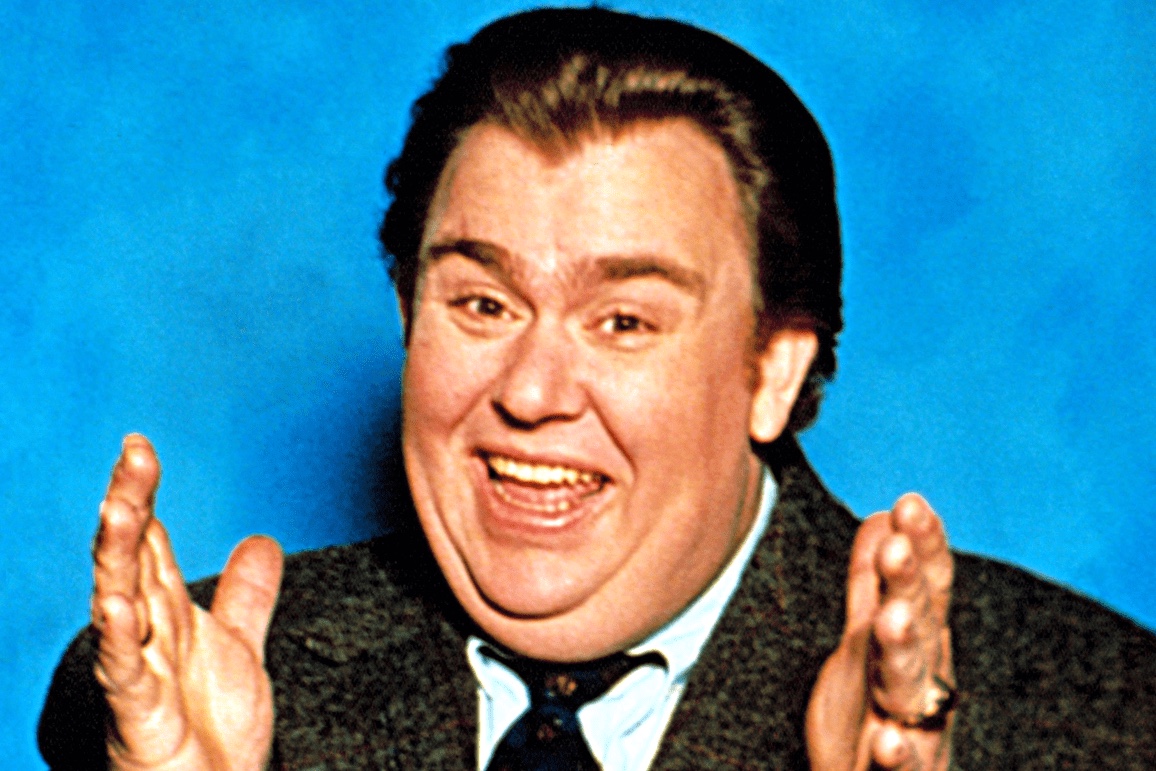
“JOHN CANDY: I LIKE ME” My rating: B (Prime)

113 minutes | MPAA rating: PG-13

The late John Candy was a very funny man, but the overwhelming feeling percolating through this documentary is one of profound loss.

Director Colin Hanks (yes, Tom’s son) seems to have interviewed virtually everyone who moved in Candy’s orbit.  Among the famous talking heads represented here are Bill Murray, Dan Aykroyd, Dave Thomas, Martin Short, Eugene Levy, Andrea Martin, Catherine O’Hara, Steve Martin, Conan O’Brien, Mel Brooks and Macaulay Culkin.

Not to mention Candy’s widow, children and siblings. 

To an individual they describe a prince of a guy  — warm, empathic, considerate.  Bill Murray struggles mightily to find something negative to say (conflict is vital to drama, right?) but in the end can’t deliver.

But we learn a lot about Candy here.  His father died of a heart attack when he was just a boy…ironically Candy would die of a heart attack at age 43.

He wasn’t comfortable with his image as a jolly fat man; interviewers back in the day subjected Candy to a not-terribly-subtle form of fat shaming that would get them fired today.  He never struck out at them…just smiled thinly and carried on.

There are, of course, a ton of clips from his stint with “SCTV” and from his many feature films, including “Planes, Trains & Automobiles,” in which Candy delivered a performance of such humor and humanity that in retrospect you’ve got to wonder what the Academy folk were thinking in not giving him a nomination.

All in all this is a warm tribute to a very good man.

Keira Knightley, Guy Pearce

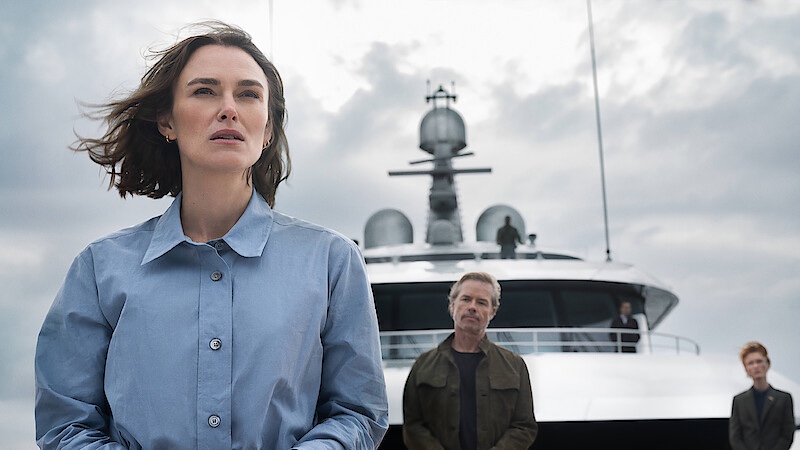
“THE WOMAN IN CABIN 10” My rating: C (Netflix)

93 minutes | MPAA rating: R

Reporter Laura Blacklock (Keira Knightley) is invited to cover the maiden voyage of a super yacht whose owners — a dying billionairess and her husband (Guy Pearce) — want to draw attention to their new charity.

The proletarian Laura feels painfully out of place among these rich creeps (Hannah Waddingham, David Morrissey, etc.), and when she reports that the woman in the cabin next to hers has fallen (or was thrown) overboard, she becomes the object of suspicion and ridicule.

Apparently Cabin 10 was never occupied.

I was kinda bored by the  first third of Simon Stone’s thriller (the screenplay is by Stone, Joe Shrapnel and Anna Waterhouse).  The middle section, in which Laura hides on the boat from unseen killers, has a sort of “Die Hard” tension going on.

It’s all wrapped up with a posh gala on a Norwegian fiord that deteriorates into a sort of soggy Velveeta pizza.  Didn’t believe a word of it.

| Robert W. Butler

Read Full Post »

Leonardo Di Caprio

“ONE BATTLE AFTER ANOTHER” My rating: B+ (In theaters)

161 minutes | MPAA rating: R

Rarely has a journey from cautious cringing to outright admiration been as marked as in the case of Paul Thomas Anderson’s “One Battle After Another.”

For the first 20 or so minutes of this epic satiric actioner I feared that the movie was going over a cliff.  Anderson is here practicing a form of exaggerated realism that, until you lock into his ethos, feels like slapstick caricature. And not very clever slapstick at that.

The dialogue in the opening minutes — most of it spoken by a sexuality-fueled young black woman with the unlikely name of Perfidia Beverly Hills (she’s played with feral ferocity by Teyana Taylor) — seems almost a parody of blaxploitation/hippie era speechifying.  

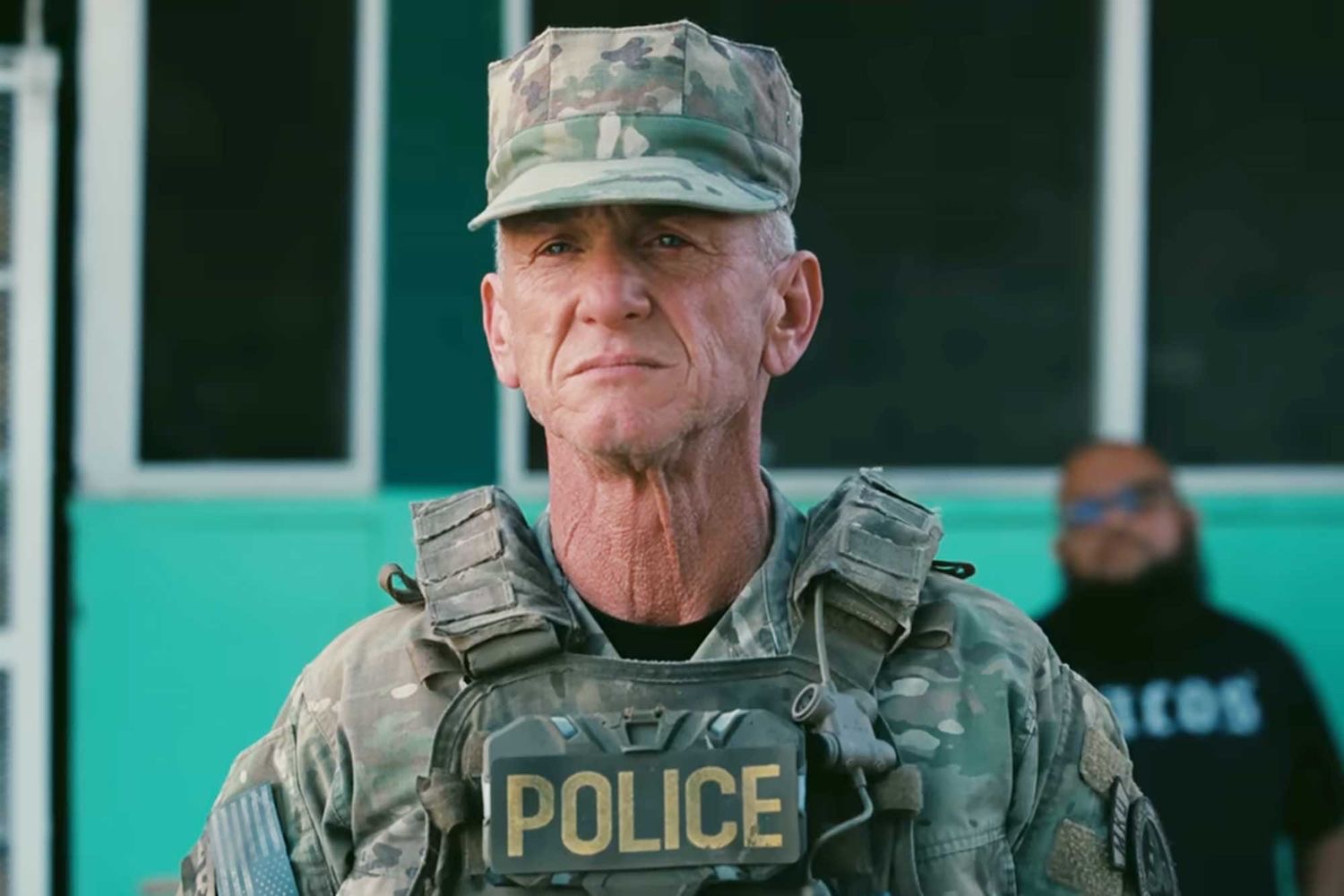
The target of her taunting is one Col. Steven J. Lockjaw (Sean Penn, looking as if he grooms with a dull-bladed Lawn Boy), the turkey-necked commander of an immigrant detention camp being raided by the French 75, the underground army of which Perfidia is one of the most outspoken and violence-prone members.

Sean Penn

Clearly Colonel Lockjaw (the names alone should have provided me with a clue as to how to navigate this material) is torn: He’s a racist being held at gunpoint by a young black woman, which is humiliating.  At the same time, this situation fulfills his most twisted  fantasies;  Perfidia sneeringly comments  on the involuntary bulge in his camouflage pants.

If all this sounds pretty over the top…well, I thought so, too.  But a funny thing happened…as the film progressed I found myself warming up to its unique blend of violence, “Dr. Strangelove”-level social/political black comedy and goofball characters.  Weirdest of all, perhaps, is “Battle’s”  genuinely moving depiction of father/daughter bonding.

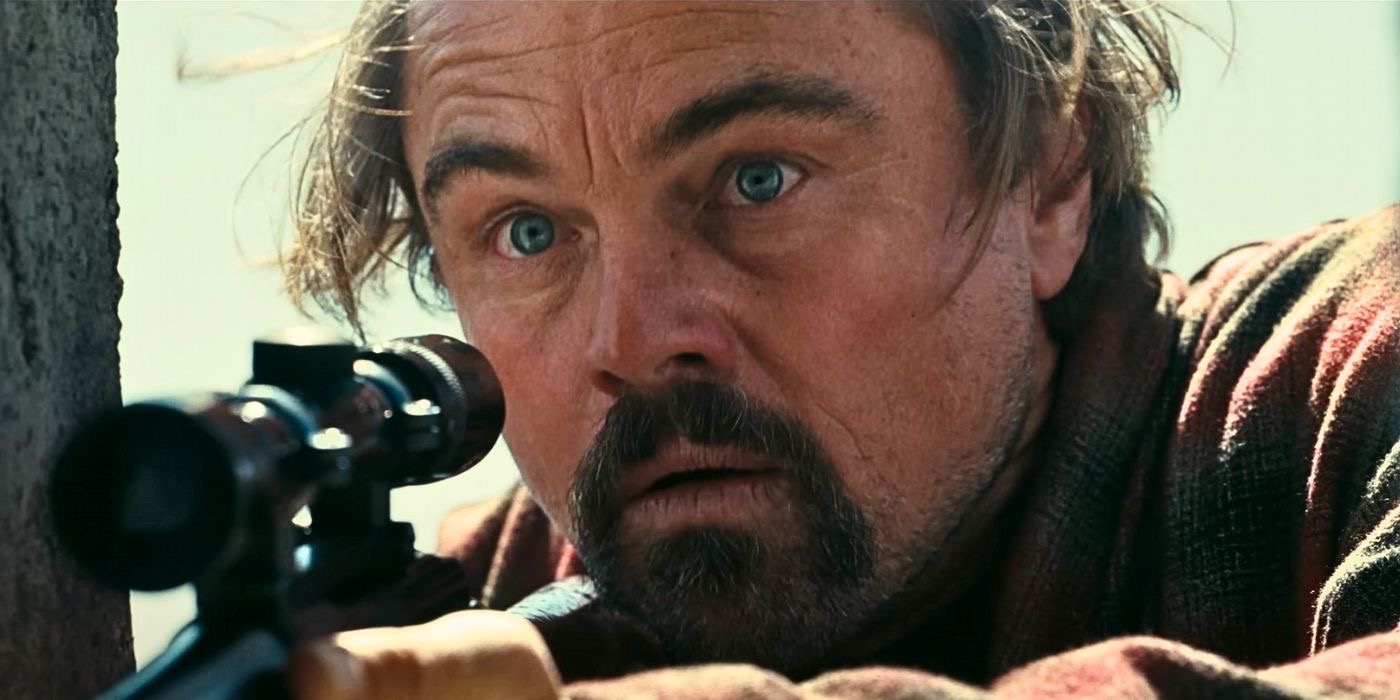
The film’s prologue depicts Perfidia’s life with her lover and fellow terrorist, a bomb-maker played by Leonardo DiCaprio.  When the two find themselves facing the prospect of parenthood, he’s all for dialing back on the radical behavior.  But not Perfidia…she keeps pushing for more and bigger actions against the Establishment.  

The segment ends with Perfidia’s arrest.  Her lover and their baby girl are relocated by the underground army to a small city  in what appears to be the Pacific Northwest. He changes his name to Bob and devotes his spare time to weed.   His daughter  Willa (Chase Infiniti) grows up hearing stories of her legendary mother; she’s an overachiever who seems determined to make up for her doofus dad’s dropout lifestyle.

The bulk of the film (it’s 2 1/2 hours long but feels much shorter) centers on Colonel Lockjaw’s obsessive hunt for Perfidia’s lover and child. To that end he orders the military invasion of the sanctuary city where the pair reside.  In the chaos father and daughter are separated; the heart of the film centers on Bob’s quest to get Willa back.

Chase Infiniti

Willa is abetted in her escape by one of her parents’ old French 75 comrades (Regina Hall), while Bob (clad in plaid bathrobe) relies on the vast underground network run by Willa’s karate instructor (a scene-stealing Benecio Del Toro), who blends zen calm with barrio bravado. 

Along the way Anderson dishes some genuinely biting satire.  Willa finds herself sheltered in a leftist convent where the nuns have daily machine gun practice. And there’s an entire subplot involving the billionaire members of the Christmas Adventurers, a clandestine ultra-right cabal dedicated to racial purity (Tony Goldwyn and Kevin Tighe are among the fat-cat members).  

DiCaprio has a truly hilarious segment in which he phones the underground army’s call center (the music you hear while on hold is Gil Scott Heron’s “The Revolution Will Not Be Televised”) and totally freaks out because after years of drugs he can no longer remember the password that will allow him to talk to his old French 75 buddies.

Now it’s pretty clear that a movie like this takes several years to get off the ground, yet “One Battle…” feels as if it was torn from today’s headlines.  Its depiction of alien roundups, concentration camps and ICE-type military actions smack of our evening news.

And the Christmas Adventurers are a savage sendup of American oligarchy that in the long run feels less satirical than prescient.

I mentioned earlier that “Battle…” features “Strangelove-ean” humor.  There are moments, in fact, when the film feels like a homage to Kubrick.  A meeting of the Adventurers unfolds with the same stiff-necked formality we saw in “2001” in the office gathering on the moon. And who is Lockjaw if not a descendant of Gen. Jack D. Ripper?

Given the outrageousness of it all, it’s a miracle that the players achieve a surprising level of depth and believability.  Exhibit No. 1 is Penn’s Lockjaw, a cartoon of military macho (the guy literally walks as if there’s a ramrod up his butt)  who somehow segues from silly to weirdly chilling and maybe even a little compelling.

“One Battle After Another” is so diverting that it’s easy to overlook Anderson’s dead-serious ideas about radicalism and the difficulty of keeping one’s idealistic edge in this America of consumer excess and moral erosion. Laugh until you cry.

| Robert W. Butler

Read Full Post »

Anthony Boyle. Louis Partridge

“HOUSE OF GUINNESS” (Netflix)

Rich people misbehaving.

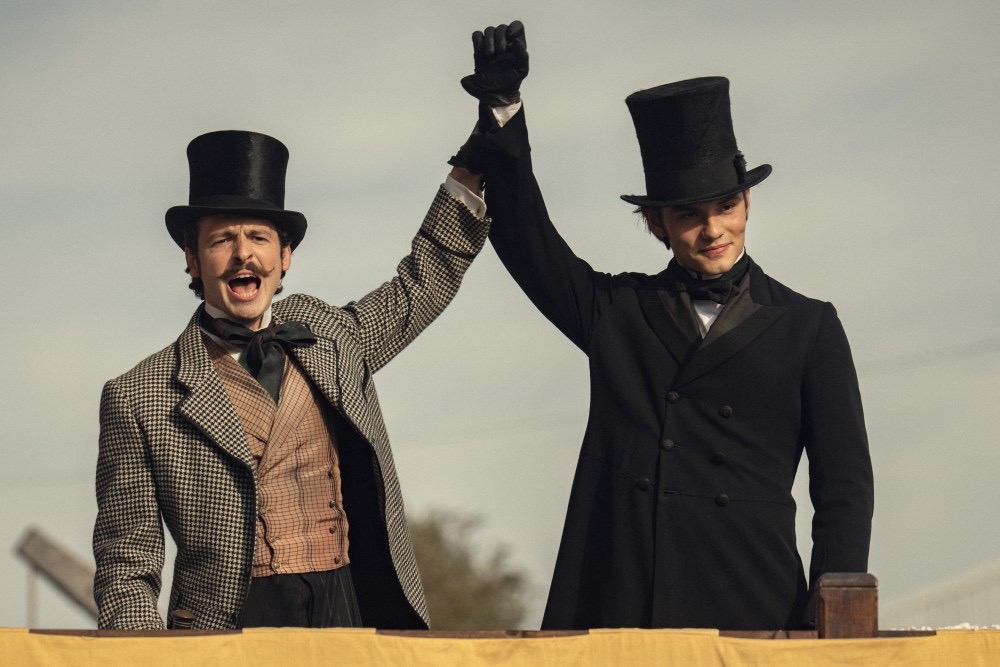
It’s not exactly a groundbreaking notion in the world of television (“Dynasty,” “Dallas,” “Succession”), but “House of Guinness” tosses in a few nifty  variations on a familiar theme.

Plus it may be the most perfectly produced/photographed/edited miniseries I’ve ever seen.  

Set in the 1860s, this series from Steven Knight (“Peaky Blinders”) zeroes in  on the Guinness family of Dublin, brewers of a stout that remains a favorite of barflies the world over.

It begins with the death of the brewer’s founder and the power struggle that ensues.

As the oldest son, Arthur (Anthony Boyle) inherits the factory and the family fortune.  But he’s spent the last decade in London engaging in a decadent gay lifestyle and knows almost nothing of the business.

Second son Edward (Louis Partridge) has lived at his father’s elbow and knows brewing inside out. He’ll continue running the biz while Arthur reluctantly campaigns for Parliament and searches for a wife who can provide cover for his true proclivities.

The third son, Benjamin (Fionn O’Shea) is a hopeless dipsomaniac barely sober enough to remain upright at the funeral.

The one daughter, Anne (Emily Fairs), is stuck in a joyless marriage but is determined to use some of the family fortune on social projects.

These familial struggles unfold against a background of political upheaval.  The Guinnesses represent the Protestant, Brit-leaning rich who control Ireland; they are opposed by a growing army of Irish rebels, among them the charismatic fire-breather Ellen Cochrane (Niamh McCormack) who, improbably enough, will find romance with a member of the Guinness clan.

There are several breakout performances here.  Boyle (“Masters of the Air”) is fascinating, infuriating and a bit heartbreaking as Arthur, whose true nature is constantly at war with the facade he’s expected to maintain.

James Norton

James Norton steals virtually every scene as Rafferty, the brewery foreman and fixer who’s not above brutality in protecting the family name and fortune.

And I find my thoughts returning often to Danielle Gilligan’s Lady Olivia, who marries Arthur knowing they’ll never share a bed.

A real left-field surprise is Jack  Gleeson.  This young actor was hated the world around for his portrayal of the spoiled, vindictive King Joffrey Baratheon in “Game of Thrones.” Here he’s almost unrecognizable as Hedges, a sort of leering human leprechaun who talks his way into becoming the Guinness brand’s agent in America and gradually takes over the clan’s political fortunes.

So, yeah, it’s a bit of a soap opera.  But an imminently watchable one.

John Cena

“PEACEMAKER” (HBO Max):

We’ve already got one ultra-violent, gleefully profane genre-busting superhero series in Prime’s “The Boys.”  HBO Max’s “Peacemaker” is in the same ballpark, but more overtly comic.

Now in its second season, this James Gunn-created series centers on one of the peripheral characters in the DC Universe.  Christopher Smith — aka Peacemaker — is a brawny, not-too-bright vigilante with a collection of masked headgear that impart to him special properties.

The joke here is that Peacemaker (John Cena) is so thick that he’s ready to kill as many people as possible in the name of peace (nothing more peaceful than a corpse, right?).  

He’s abetted in his often misguided efforts by a gang of fellow misfits (Danielle Brooks, Freddie Stroma, Steve Agee) and a foul-tempered pet eagle (brilliantly animated).  He’s also got a slow burn crush on a government spy/assassin (Jennifer Holland) who can’t decide if she likes or hates the big hunk.

The show’s comic tone is set with the opening credits, a huge dance number featuring most of the cast members in costume. That about half of them cannot dance to save their lives only makes the experience more pleasurable.

Season One found Peacemaker and crew battling an alien invasion.  Season Two centers on an alternate universe which appears far more copacetic than ours.  In this parallel world Peacekeeper never killed his brother and their father is a hero rather than a thuggish peckerwood.

Much of the fun comes in watching the characters interacting with their parallel universe doppelgängers. Not to mention an absolutely wonderful late-in-the-season reveal — turns out this isn’t the utopia Peacemaker hoped for.

Actually, our hero seems to be getting smarter and more empathetic. Nice to know he’s capable of change.

Not for the kiddies, put perfect for guys still working their way out of adolescence.

“ALIEN: EARTH”(Hulu):  

So much has already been written about this series that there’s not much I can add.

I will say that the first couple of episodes left me cold…I was tempted not to keep watching.

Glad I did. The series finds its voice by episode four and the final four installments offer an ever-tightening narrative noose.

Plus I’d watch Timothy Olyphant in anything…even as an emotionless cyborg.

| Robert W. Butler

Read Full Post »

“THE LOST BUS”  My rating: A-(Apple+)

129 minutes | MPAA rating: R

Forget your chest-busting aliens and serial killers.  The scariest monster I’ve ever seen on film is the fiery holocaust depicted in Paul Greenglass’ “The Lost Bus.”

Long a master of the historical recreation (“Sunday Bloody Sunday,” “United 93,” “Captain Phillips”), Greenglass here turns his attention to the 2018 Paradise fire, the devastating inferno that ripped through a wooded California town, killing more than 80 people and leaving thousands homeless.

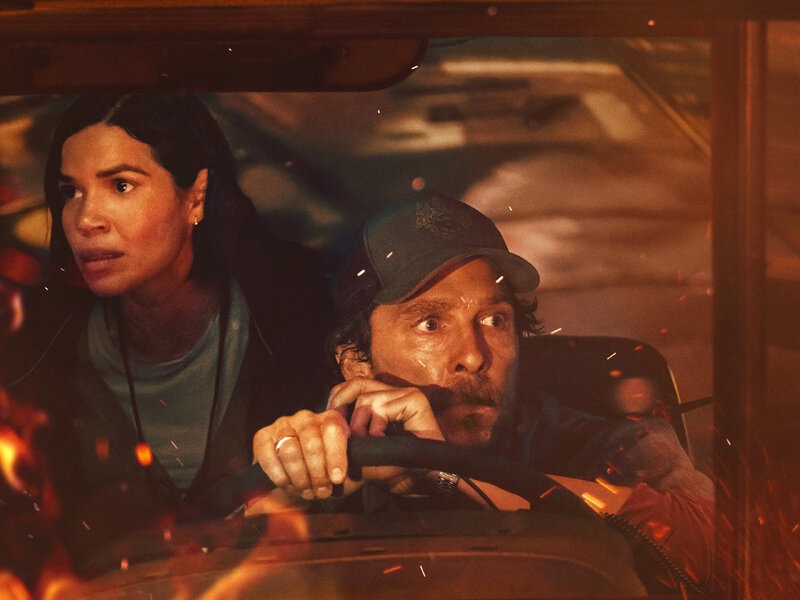
The sneakily benign title refers to the real-life experiences of school bus driver Kevin McCay and elementary school teacher Mary Ludwig, who with a busload of 22 youngsters spent a hellish day surrounded by ever-mounting flames in a desperate search for a safe route out of the burning town.

The screenplay (by Greenglass and Brad Ingelsby) finds a few minutes in which to explore the backgrounds of these two heroes.  Kevin (Matthew McConaughey) is a life-long screwup with an angry ex-wife and a teenage son who hates him.  Mary (America Ferrera)  is a wife and mother who has always regarded her backwoods California community as a refuge from a larger and more inhospitable world.

But the bulk of the film is an  almost documentary look at what happened that day, cutting between the frantic efforts of firefighters to contain the blaze (Yul Vazquez portrays the overwhelmed local fire chief) and the efforts of Kevin and Mary to get the children to safety.

America Ferrara, Matthew McConaughey

Initially they’re far from a perfect partnership.  Kevin is dismayed/angered by Mary’s calm, slow, don’t-alarm-the-kids approach to the situation; all he can think about is the red glow getting bigger  in his rear-view mirror. But surrounded by flames and facing the likelihood that they’re going to die in this big yellow oven, the two find a common bond in the need to be strong for the children.

The acting is terrific without ever looking like acting.

But the real star of “The Lost Bus” is the production itself.  It’s impossible  here to differentiate between practical real-world effects and computer-generated imagery; they combine effortlessly to depict the horrors of  that day.  

“Awesome” doesn’t seem too hyperbolic a word to describe the accomplishment of  cinematographer Pal Ulvik Rokseth and his editors (Peter Dudgeon, William Goldenberg and Paul Rubell). They have created a vision of flame and chaos so convincing that you almost imagine heat radiating from your TV screen.

And talk about tension!  No Hitchcock movie ever had me perched so dangerously on the edge of my seat.

Seriously, folks. There were moments here so intense that even after a lifetime of moviegoing I found myself fighting the urge to freeze the action and take a break.  It’s that effective.

| Robert W. Butler

Read Full Post »

“SUPERMAN” *My rating: C+ (HBO Max)

129 minutes | MPAA: PG-13

Well, it’s an improvement over the dour Zack Snyder’Henry Cavill adaptations, but James Gunn’s “Superman” mostly made me appreciate the insanely clever balancing act of the first Christopher Reeve “Superman” (1978).

No origin story here. It begins with Clark Kent (David Corenswet) already co-habiting with fellow reporter Lois Lane (Rachel Brosnahan), who is well aware of his  powers. Evil mastermind Lex Luthor (Nicholas Hoult, strangely uncompelling) wants to bring down our hero.

Superman’s alien origins are at the heart of the yarn.  Our man comes to believe (mistakenly, it turns out), that he was sent to Earth not to serve its people but to rule them.  This leads to a crisis of conscience.  Meanwhile Luthor picks up that idea and runs with it to justify his persecution of the Man of Steel.

Corenswet makes for a likable if not particularly dynamic Superman.  But he’s got no chemistry with Brosnahan.  Far more engaging is Superman’s apparently untrainable dog Krypto, a computer-animated mutt who combines puppy-like misbehavior with insane strength and speed.

Gunn’s “Superman” has been accused of woke-ness, apparently because it presents its hero as an illegal immigrant and because a subplot — about one country’s invasion of its impoverished neighbor — strikes some viewers as a commentary on the war in Gaza. Maybe. Maybe not.

“Superman” isn’t bad. Nor is it particularly good.

Lily James

“SWIPED” My rating: B (Hu;u)

110 minutes | No MPAA rating

Save your Coke bottles, ladies.  Men are shit.

That’s the unstated but inescapable message percolating through “Swiped,” a tale of female empowerment (and frustration) based on the career of Whitney Wolfe Herd, who was instrumental in creating the dating app Tinder.

Rachel Lee Goldenberg’s film (she co-wrote with Bill Parker and Kim Caramele) follows Herd (Lily James) as she navigates the treacherous waters of the social media industry in the 2000 teens.

Geeks will appreciate the tech history laid out here, but the film’s real concern is the hellish mistreatment Herd was subjected to.  If you thought the computer  world was enlightened and egalitarian compared to old school business…well, no.  Her male co-workers take credit for her innovative ideas.  And when she dares complain, she finds herself the object of corporate slut shaming.

On the personal side, the co-worker she falls in love with turns out, after a period of charming behavior, to be a sexist sleaze ball.  Herd  goes solo to develop her own app, using funds provided by a Russian tech magnate (Dan Stevens) who seems too good to be true. He is; the dude’s got Epstein-level baggage.

Ultimately Herd found true love (with someone well outside her business circles) and founded the wildly successful female-oriented dating app Bumble. She is now rich and powerful.

“Swiped” is inspirational, sure.  It’s also unsettlingly cautionary. 

| Robert W. Butler

Read Full Post »