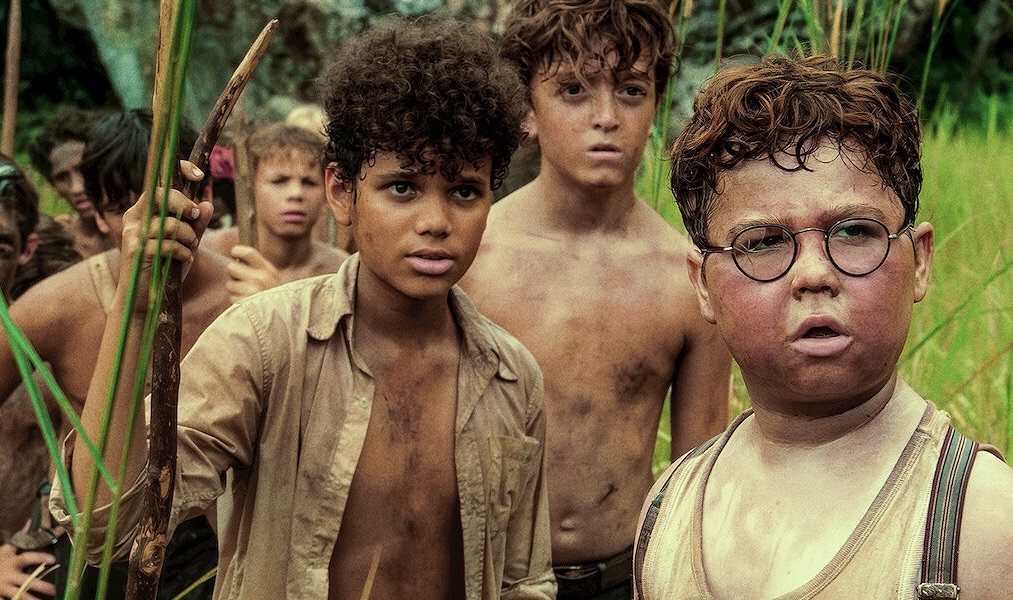
Winston Sawyers as Ralph, Ike Talbut as Simon, David McKenna as Piggy
“LORD OF THE FILES” (Netflix)
William Golding’s novel Lord of the Flies was written 62 years ago at the height of the Cold War, but seems as relevant today as it did back in the era of nuclear saber-rattling.
That’s because its true subject is man’s (or boy’s) propensity for violence, power and retribution. It’s baked into the human psyche.
There already have been two filmed versions — a 1963 rendition in stark black and white and another in 1990 — and now Netflix has dropped a brand new four-hour miniseries produced by the BBC.
It may not be perfect, but it’s about as good a cinematic interpretation of this modern classic as we’re likely to see.
The premise — for those who slept through high school English — is that a planeload of British schoolboys have been marooned on a tropical island. With their adult chaperones killed, these prepubescents are left to their own devices.
Initially they form a society based on the rules and manners drilled into them at their posh boarding school. Stiff upper lip and all that. But little by little their savage side takes over. Result: Chaos, cruelty and murder.
The man behind this retelling is writer/producer Jack Thorne, who has among his credits the amazing “Adolescence.” As that show proved, he’s got a real affinity for the behavior of young males.
Each of the episodes centers on one of the four main characters.
First we encounter Piggy, a fat kid with bottle-bottom spectacles and a bad case of asthma. As played by David McKenna, he’s a dead ringer for an 11-year-old Alfred Hitchcock.
Piggy is probably the smartest of the two-dozen castaways. He’s obviously no sportsman; he’s spent his time reading and immediately starts dispensing advice on housing, food, sanitation and the maintenance of a signal fire should a rescue ship appear on the horizon. (Piggy’s glasses play an important role…they magnify the sun’s rays to ignite collected tinder.) Piggy has the organizational imperative of a lifelong bureaucrat; he wants things neat and tidy.
One of the few boys not irritated by Piggy is the good-hearted Ralph (Winston Sawyers), who is elected chief of this ragtag tribe. Ralph is nice kid, popular and honest. Turns out he’s in way over his head.
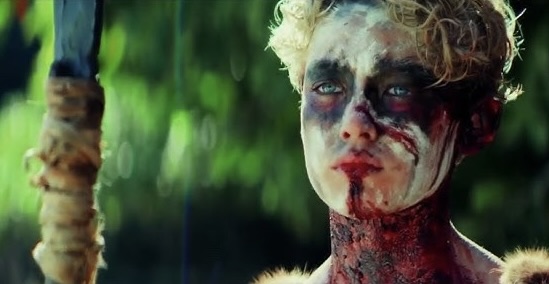
Lox Pratt as Jack
And then there’s Jack (Lox Pratt), the head boy of the school choir whose members appear in long black robes like time travelers from the Dark Ages. Basically they’re a tribe within the tribe, and under Jack’s leadership they begin rebelling against Piggy and Ralph.
Jack declares he’s going to have fun and enjoy life now that there are no grownups looking over his shoulder. He decides his singers will become hunters, tracking and killing the wild pigs that inhabit the island. And he’ll do the same to anyone who crosses him.
And finally we have the wide-eyed Simon (Ike Talbut), a sort of artist/mystic who never quite fits in and is subject to disturbing visions.
If I correctly recall, the novel suggested that the boys were part of an air evacuation to get them out of Britain on the eve of an nuclear attack. That idea is never broached here, though the mid-1950s time frame is retained.
What is new is the mixed enthicity of the cast. In addition to the white kids there are blacks, Asians and all the colors in between. Ralph, for instance, has a black mother and a white father.
Does Lord of the Flies really require four hours? Perhaps not, but one of the piece’s strengths is the way we settle into the lush landscape. This version feels truly lived in; it’s an immersive experience.
The young actors are first rate and the pacing set by director Marc Munden slowly pulls us into the horror of civilization being stripped away.
Not everything works. Most of the main characters are given flashbacks (this allows cameos by such recognizable faces as Rory Kinnear and Daniel Mays), none of which struck me as particularly informative or useful.
And director Munden (or it could be cinematographer Mark Wolf) periodically shoots through a filter (or maybe it’s post-production trickery) that turns the deep green foliage red and orange. No doubt it’s mean to reflect the growing ugliness of the boys’ society (or it may be a premonition of the flames that will all but consume this paradise)…whatever the intent, it’s more distracting than illuminating.
And several boys — especially Pratt’s Jack —seem to have undergone a make-over with blue-dyed eyelids and rosy red lips. Is this some sort of homoerotic commentary on the part of the filmmakers? Again, unnecessary.
Possibly the highest compliment I can pay this production is that it frequently took me by surprise despite my familiarity with the material.
And in the anarchistic rebellion of Jack and his minions we have a political allegory that seems all too familiar and way too uncomfortable. It’s not that Thorne and Company go out of their way to hammer home these points. They were always there in Golding’s prose…but until recently we shrugged it off as a case of it can’t happen here.
| Robert W. Butler


Leave a comment