Sam Elliott
“THE MAN WHO KILLED HITLER AND THEN THE BIGFOOT” My rating: B
98 minutes | No MPAA rating
When it comes to pulpy promise, it’s hard to beat a title like “The Man Who Killed Hitler and Then the Bigfoot.”
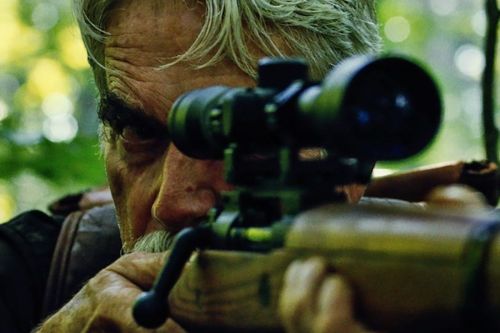
But what’s unsettling about this debut feature from writer/director Robert D. Krzykowski is the way it defies almost all audience expectations while giving us Sam Elliott in one of his greatest performances.
In fact, one cannot imagine “The Man Who Killed Hitler…” working without the presence of the 75-year-old Elliott, a white-haired warrior of such potent screen charisma that I would gladly watch him absentmindedly scratch his ass for 90 minutes.
We meet Calvin Barr in the late ’80s or early ’90s, occupying a bar stool in a tavern in the quaint Norman Rockwell-esque town he’s called his home for more than seven decades. Calvin is quiet and cryptic, a man who exudes a certain angst but would never talk about it.
Still, he’s obviously not your typical senior citizen. He makes mincemeat of a trio of punks who try to hijack his car late one night.
The first 45 minutes of Krzykowski’s screenplay follow Calvin in both the present and the past, interspersing his unremarkable daily routine with flashbacks to his service in World War II. We see glimpses of young Calvin (Aiden Turner) being sent behind enemy lines disguised as a Nazi officer. His assignment is to put a bullet in Der Fuerher.
Other flashbacks take him to the pre-war years when he worked in a shop on Main Street and wooed a pretty school teacher (Caitlin FitzGerald); he was sent to war before they could wed or even consummate their affair. That loss will haunt him to his dying day.
Which could be soon. Forty-five minutes into the film our hero is paid a visit by a federal agent (Ron Livingston) who announces that Calvin’s country once again desperately needs his help. It seems that an ever-widening area of Canadian forest is being ravaged by a mysterious influenza that is being spread by none other than Bigfoot.
Blood tests have shown that Calvin is one of the few humans immune to the virus; now he’s being sent up North to stalk the hairy creature: “If we cannot contain the beast, if we cannot destroy it and it escapes, this could be the end.”
I’ll say this about Krzykowski…whatever his talents as a filmmaker they are vastly surpassed by his abilities as a prognosticator. Basically this film predicts the pandemic we’re now experiencing. (more…)