Feeds:
Posts
Comments
Greta Gerwig, ***

Greta Gerwig, Lola Kirke

“MISTRESS AMERICA”  My rating: B (Opens Aug. 28 at the Glenwood Arts)

84 minutes | MPAA rating: R

My appreciation of the filmic collaborations of director Noah Baumbach and comic actress Greta Gerwig (“Greenberg,” “Frances Ha”) has been an on-and-off affair. Their latest, “Mistress America,” is definitely an on.

It is, in fact, about as close to a classic screwball comedy as we’re likely to witness in this era of “duh” cinema — wonderfully acted and impeccably timed.

The film begins with an insightful five-minute montage depicting the early days on an NYC campus of Tracy (Lola Kirke), a freshman who dreams of a career as a writer. Instead of life-changing experiences, Tracy finds herself lonely and isolated.

Relief arrives in the form of Brooke (Gerwig), a 32-year-old whirling dervish of energy and ambition who introduces Tracy to the odder corners of the Big Apple.  Tracy’s mother and Brooke’s father are engaged; the two women will soon be stepsisters.

Brooke immediately begins introducing Tracy to her bohemian pals as “my baby sister, Tracy.”

Here’s the thing about Brooke:  She’s all fervent ideas and no followthrough. Her current project is a restaurant that would be a bizarro amalgam of eatery, community center and hair salon.

Brooke has a motormouth that is several blocks ahead of her brain; she converses in a form of East Coast Valley Girl-ese with a stream-of-consciousness style worthy of James Joyce. She’s exhausting, but oddly delightful.

One acquaintance says of her: “I don’t know if you’re a Zen master or just a sociopath.”

Continue Reading »

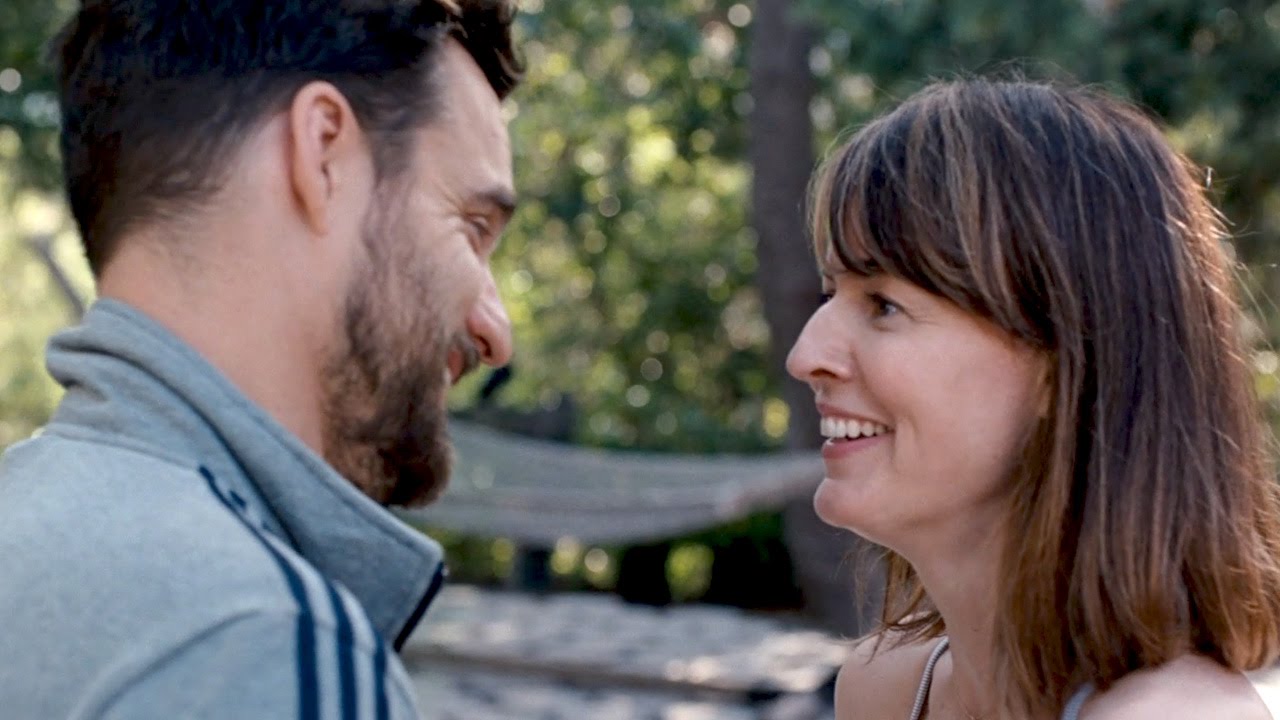
Jake Johnson, Rosemarie DeWitt

Jake Johnson, Rosemarie DeWitt

“DIGGING FOR FIRE” My rating: B (Opening Aug. 28 at the Screenland Armour)

85 minutes  | MPAA rating: R

If indie auteur Joe Swanberg isn’t careful, he’s going to start making movies that people actually see.

Up to now Swanberg’s heavily-improvised, generational-specific films have earned him cred on the cinematic fringes (and the irritating label “mublecore”).  But last year he made a modest though hugely likable splash with the family dramady “Happy Christmas” — a sign that he may be approaching his cinematic maturity.

With “Digging for Fire” he delivers his most mainstream-friendly effort to date…which is not to say that it’s conventional, only that he’s finding ways to finesse his austere signature style.

Married couple Tim and Lee (Swanberg regular Jake Johnson, who also co-wrote, and Rosemarie DeWitt) are a struggling L.A. couple with an adorable 3-year-old son (Swanberg’s son Jude, a born actor if there ever was one).  He’s a public school teacher.  She’s a yoga instructor.

A wealthy movie industry friend on a foreign shoot has invited them to spend a couple of months living in her ultra cool house on a heavily wooded slope high in the Hollywood hills. We’re talking swimming pool, hammock, plenty of room for the kid’s tricycle.

On their first day in the new digs Tim makes a discovery while walking around the property.  From an overgrown hillside he recovers what looks like a human rib and a heavily-rusted cheap revolver.

The cops aren’t interested in his find — they’ll only show up for an entire corpse. But Tim is intrigued.

Continue Reading »

Marlon Brando

Marlon Brando

“LISTEN TO ME MARLON” My rating: B+

95 minutes | No MPAA rating

Marlon Brando was arguably the greatest film actor of all time. And yet for the last 30 years of his life his motto seems to have been “Don’t send the script. Send the check.”

The widespread take on Brando is that with few exceptions his later career was thrown away on  crap for which he was paid a fortune. Moreover, the contempt he seemed to harbor for his craft bled over into his relations with the press. He was aloof and remote and pretty much a mystery.

This wildly ambitious and unexpected effort from director Stevan Riley and his cowriter, Peter Ettedgui, is based on 200 hours of audio recordings the actor made over the years. Basically Brando had conversations with himself — thus the movie’s title.  The subject matter ranged from his childhood (raised by an alcoholic mother and an abusive father) to his thoughts on acting, the price of fame, and the hollowness of Hollywood.

Though the audio tapes are arranged in roughly chronological order, this film is not strictly autobiographical. The effect is fractured and impressionistic. It helps to have a working knowledge of Brando’s life and work going in.

But the film is overflowing with revelations.


Continue Reading »

Robert "Evel" Knievel

Robert “Evel” Knievel

“BEING EVEL” My rating: B

99 minutes | No MPAA rating

Motorcycle daredevil Robert “Evel” Knieval has been gone for a decade but his influence is everywhere, from our current fascination with extreme sports, to his pioneering of what we’d now call reality TV, to a talent for self-marketing that at the time seemed goofy grandstanding but which now is standard operating procedure. (You could argue that Donald Trump has taken it all the way to presidential politics).

In “Being Evel” — a title with a double meaning, given Knieval’s late career transformation into bully/jerk/boor — Oscar-winning director Daniel Junge (for the 2012 documentary short
“Saving Face””) chronicles the man’s life and lasting influence through a plethora of hair-raising news footage and the memories of those who knew him, hated him, and still revere him.

Reared by relatives in Butte, Montana, after being abandoned by his parents, Robert Knieval became a full-fledged juvenile delinquent and wild kid (“If you dared him he’d do it”) who used his beloved motorcycle to torment the local cops.

His wife Linda — who after years of his flagrant infidelities has few good words for her late hubby — describes Robert ordering her into his car in what might have been either a kidnapping or an elopement: “Danged if we didn’t get married.”

As a young husband and father Robert decided to go for the American dream — by selling life insurance.  His powers of persuasion were legendary. In one week he sold 271 policies…to the inmates and staff of a mental institution.

He then turned to selling Harleys, and from that it was a short step to creating a cycle stunt team.  One of his first challenges was an attempt to fly his bike over a field of rattlesnakes.  He landed in their reptilian midst, sending angry diamondbacks scattering through the panicked crowd of spectators.

Throughout his career Knievel (he was given the nickname “Evil” by a jail guard, then changed the spelling in a rare display of subtlety) tended to announce outrageous stunts without ever looking into whether he could possibly pull them off.

But he quickly learned all about marketing, adopting an Elvis swagger and the King’s penchant for caped leather outfits in patriotic motifs.

Continue Reading »

look-of-silence“THE LOOK OF SILENCE” My rating: B+ 

103 minutes| MPAA rating: PG-13

An old man laughingly recalls strangling and eviscerating a bound captive — allegedly a communist — during the Indonesian genocide of 1965.

He’s talks proudly of being part of the death squads that, in the wake of a military coup, slaughtered nearly 1 million Indonesians — many of them his own neighbors — in less than a year. He claims the victims were all reds, but in fact there were relatively few communists. Most of the victims were unionists, intellectuals and farmers.

In 2013 documentarian Joshua Oppenheimer gave us the Oscar-nominated “The Art of Killing,” a ghastly yet profound experiment in which he approached former members of the right-wing death squads and gave them the wherewithall to make their own movies re-enacting the slaughter.

Costumes. Props. Fake blood.

“The Look of Silence” is the perfect companion piece, approaching the genocide from the perspective of the victims.

Ali Sumito is an optometrist who goes door to door in his province, testing his patients’ vision and writing prescriptions for eyeglasses.  Ali was born two years after his older brother, Ramli, was murdered by the local death squad.

Now he studies Oppenheimer’s decade-old filmed interviews with the killers, looking for clues to his brother’s fate and trying to understand how such a thing could have happened. He talks  to his aged mother about losing her son.

At age 44 Ali still has a pleasant, youthful countenance.  Undoubtedly that helps him in his business. It also makes him seem inoffensive and non-threatening, allowing him to talk with his older male patients about their histories.

Despite his wife’s warning that asking too many questions might lead to his own disappearance, Ali plunges ahead with his quest.


Continue Reading »

William F. Buckley, Gore Vidal in 1968

William F. Buckley, Gore Vidal in 1968

“BEST OF ENEMIES” My rating: B

87 minutes | MPAA rating: R

The early greats of television journalism — Edward R. Murrow, Walter Cronkite, Chet Huntley and David Brinkley — would undoubtedly be appalled by the partisan savagery and intellectual dishonesty that has taken over the electronic news.

Once upon a time the news was straightforward, genteel, presumably unbiased (or at least not openly divisive). The nightly broadcast was viewed as a cementer of ideas, certainly not a disruptor.

Today all bets are off.

“Best of Enemies” makes the case that the long decline of what passes for TV journalism began in 1968 when ABC-TV opted to spice up its bargain-basement coverage of that year’s  Republican and Democratic national conventions by staging “debates” between liberal gadfly  Gore  Vidal and conservative icon William F. Buckley.

It was a clever marketing move on the part of ABC, perennially the third-place TV network (remember…back then there were only three commercial networks, plus PBS). Always strapped for cash and unable to field the deep staffs of their competitors, the ABC bosses basically bought a relatively cheap fireworks show, one that largely replaced insight with controversy and insult.

Robert Morgan and Gordon Neville’s documentary makes the case that the fallout from the Vidal/Buckley confrontations today is thicker than ever.

Buckley was the man who through his National Review and “Firing Line” TV show had become the St. Paul of the conservative movement. (Although his conservatism, when compared to today’s Tea Party thuggishness, seems almost quaint.)

Vidal was a novelist and social commentator way ahead of the cultural curve in writing about homosexuality (The City and the Pillar) and transgender issues (Myra Breckinridge) and who had a long run of bestselling historical fiction.

Both men were East Coast intellectuals — elitists, in fact.  Both exuded a certain gentility. Both had run unsuccessfully for public office.

And each man genuinely despised the other.

Continue Reading »

Henry Cavill as Napoleon Solo

Henry Cavill as Napoleon Solo

“THE MAN FROM UNCLE” My rating: C+

116 minutes | MPAA rating: PG-13

Having dragged down the great Sherlock Holmes to our world of short-attention-span cinema, Guy Ritchie now turns his camera on a fondly remembered TV series from the 1960s.

And, to give credit where it’s due, he has had the good sense to go easy on his usual hyperkinesis. “The Man From U.N.C.L.E.” isn’t particularly memorable, but it introduces some interesting ideas and avoids the most headache-inducing elements of this director’s style.

The original was television’s answer to the James Bond craze. Unlike the overtly satiric “Get Smart,” “U.N.C.L.E.” (United Network Command for Law and Enforcement) took a dry, tongue-in-cheek approach to international spying.

And in Napoleon Solo (portrayed back in the day by Robert Vaughn) the series gave us an impossibly unruffled, cooler-than-cool protagonist, who could view his own imminent demise with sardonic indifference.  The series was so huge it spawned action figures, toy guns and much more — one of the lunchboxes even has a home at the Smithsonian now.

Ritchie and a small army of writers give us an origin story that is less impressive for its dramatic elements than for its painstaking re-creation of swinging Europe in the ’60s.

Things get off to a busy start when the nattily dressed Solo (Henry Cavill, the current Superman) enters squalid East Berlin to spirit Gaby (“Ex Machina’s” Alicia Vikander), a tomboyish auto mechanic, over the Berlin Wall to freedom.

Their escape is almost foiled by a Soviet agent (Armie Hammer), who with his slow-burn,  hulking presence and almost superhuman strength seems a close relation to Robert Shaw’s assassin in “From Russia With Love.”

Continue Reading »

Jason Segal as author David Foster Wallace

Jason Segal as author David Foster Wallace

“END OF THE TOUR” My rating: A-

106 minutes | MPAA rating: R

“End of the Tour” could not be more out of fashion.

Mostly it’s just two guys talking.

Yet James Ponsoldt’s film is a sublimely moving experience, a two-handed mini-drama woven from the threads of ambition and mortality.

What’s more, it allows Jason Segal — usually a shambling funny man — to give the sort of performance that earns Oscar nominations and changes careers.

Based on journalist David Lipsky’s memoir of several days spent on the book tour for David Foster Wallace’s novel Infinite Jest, the film embraces a subtlety and richness of character virtually absent from today’s short-attention-span cinema.

The film begins in 2008, when Lipsky learns of Wallace’s suicide. Then it jumps back to 1996 and the media frenzy over Infinite Jest, a 1,000-page novel that was less a story (though it was set in a dystopian near future) than it was about the experience of being David Foster Wallace.

Lipsky (Jesse Eisenberg) is a Rolling Stone writer  — and an unsuccessful novelist, that’s really important — chafing beneath assignments about boy bands. Snowed by Wallace’s just-published novel (Time magazine has since named it one of the 100 best English-language novels between 1923 and 2005) and arguing that “writers matter,” he convinces his magazine’s editors to let him accompany Wallace on the final leg of his book tour, a trip to the Twin Cities.

The two will spend a night at Wallace’s snowbound rural home outside Bloomington, Indiana (where he teaches literature at the university), then fly to Minnesota. There will be plenty of time to talk in cars, on planes and over meals.

The role of Lipsky certainly poses no great challenge for Eisenberg…a bit of Woody Allenish-neurosis and he’s good to go.

Segal, on the other hand, undergoes a rather startling transformation.  It’s not just the round spectacles, lumberjack shirt  and ever-present head bandana that are essential to the costume.  What impresses is the way this comic actor has transformed himself into a sort of lumbering child-man, changing  his bearings, his posture.  Even his voice shifts into a flat Midwestern drone with just a touch of breathiness.

Continue Reading »

Charlize Theron in "Dark Places"

Charlize Theron in “Dark
Places”

“DARK PLACES”  My rating: C+ 

113 minutes  | MPAA rating: R

“Gone Girl” is a hard act to follow.

That 2014 film — the first to be adapted from the three best-selling mystery novels by Kansas City native Gillian Flynn — offered a surfeit of riches: a gnarly yarn that nastily doubled back on itself, a scathing indictment of modern media and its consumers, and one of the most savage commentaries on marriage ever sold as popular entertainment.

Add to the mix masterful direction by David Fincher (who absolutely nailed the darkly hilarious misanthropy that characterizes Flynn’s best work) and stellar turns by Ben Affleck and Oscar-nominated Rosamund Pike, and you had a film that excelled on numerous levels.

By comparison “Dark Places,” adapted by writer/director Gilles Paquet-Brenner from an earlier Flynn novel, is fairly straightforward and one-dimensional.

The film captures Flynn’s gloomy outlook without offering the antidote of biting humor, and is so single-mindedly bent on building its narrative that there’s little room left to explore other ideas.

Most problematic, the plot relies on mind-boggling coincidence. This was bothersome on the printed page; it feels patently phony on the screen.

Libby Day (Charlize Theron) is an antisocial loner living in hoarder squalor in a Kansas City apartment (though set in Kansas and Missouri, “Dark Places” was filmed in Louisiana).

Nearly 30 years earlier she was the sole survivor of the notorious “Kansas prairie massacre” in which her mother and two older sisters were murdered on the family farm. Based largely on Libby‘s testimony, her teenage brother Ben was convicted and is now serving a life sentence.

For years the emotionally damaged and employment challenged Libby has gotten by on donations from a sympathetic/morbid public. But now her bank account is empty.

So when Lyle (Nicholas Hoult), president of a local society of true-crime groupies, offers to pay to have Libby’s brain picked by the membership, she reluctantly accepts — even though it means a bizarre confrontation with a Bob Berdella role player.

Continue Reading »

Joaquinn Phoenix, Emma Stone

Joaquinn Phoenix, Emma Stone

“IRRATIONAL MAN” My rating: C+ 

96 minutes | MPAA rating:R

Even the most devoted Woody Allen fan now approaches his new pictures with caution.

Which Woody will we get this time? The classic comedian who blends big laughs with serious themes? Or the dour dramatist who dishes joyless Scandinavian gloom?

“Irrational Man” falls mostly into the latter category. At its most basic level it is, like 2005’s “Match Point,” a murder drama. This time around, though, the satisfactions are relatively few.

Abe (an excellent Joaquin Phoenix) is an academic superstar and a miserable human being. Revered in philosophy circles, he’s a provocative teacher (“Much of philosophy is verbal masturbation”) and a rather seedy alcoholic who carries a hip flask and isn’t afraid to pull a stiff one while trudging across the quadrangle.

Having burned many bridges, Abe shows up for the summer session at a New England college and immediately draws the attention of two dissimilar women — even though he’s obviously a weary depressive with a substantial middle-age gut.

Abe begins an affair with the vaguely pathetic Rita (Parker Posey), a married colleague in the philosophy department. Initially he’s impotent (“I was hoping it would come back as mysteriously as it left”), but Rita sees that as only a slight handicap, reasoning that after her boring husband “it’s interesting to be around someone complicated.”

Meanwhile Abe launches an intellectual relationship with Jill (Emma Stone), a bright student who clearly idolizes him. Give him points for keeping his relationship with Jill platonic — at least until it isn’t.
Continue Reading »