Feeds:
Posts
Comments
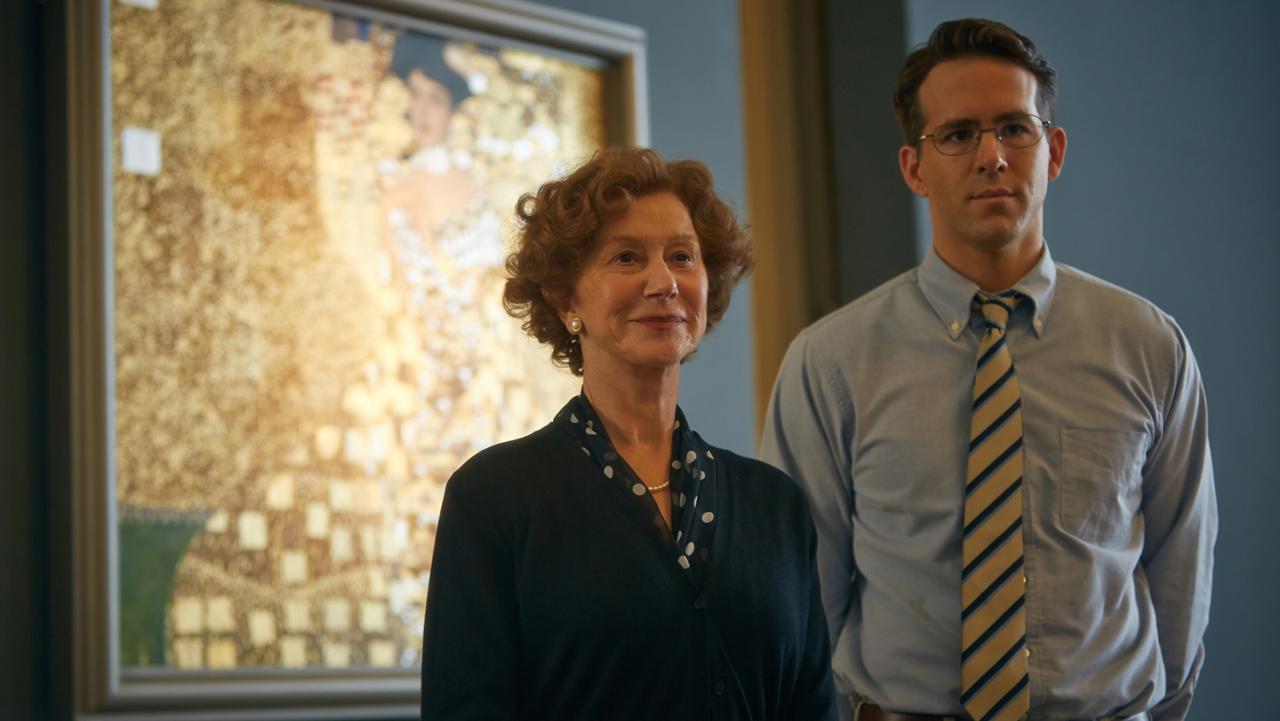
Helen Mirren, Ryan Reynolds

Helen Mirren, Ryan Reynolds

“WOMAN IN GOLD” My rating: B- 

109 minutes | MPAA rating: PG-13

Despite a tendency to dilute its message with easily digestible Hollywood moments, “Woman in Gold” provides the formidable Helen Mirren with yet another juicy role while raising some thought-provoking questions about art, ownership, and societal upheaval.

The subject is the real-life pursuit of California transplant Maria Altmann (Mirren) to reclaim several paintings stolen from her Jewish family in Vienna by the Nazis. The most  important piece is Gustav Klimt’s “Lady in Gold,” also known as “Portrait of Adele Bloch-Bauer” (Adele was Maria Altmann’s aunt). It and several additional Klimt paintings were looted by the Germans and after the war became the property of the Austrian state.

This film from director Simon Curtis (“My Week with Marilyn”)  follows parallel narratives  separated by six decades.

In the modern day  — roughly 1998 to 2006 — we follow the efforts of the octogenarian Altmann, operator of a high-end  Los Angeles fashion shop, to reclaim her family’s artwork. In this she is assisted by struggling lawyer Randol Schoenberg (Ryan Reynolds), whose own family history is rooted in Austria — he is the grandson of classical composer Arnold Schoenberg.

They make for an odd couple legal team. Maria is a friend of Randol’s mother and hopes that he will “help me out on the side…like a hobby.” She’s opinionated, sometimes brusque and in your face.

Randol, on the other hand, is not terribly successful and struggling to make ends meet. He only fully gets involved when he realizes that the paintings Maria hopes to recover are worth upwards of $150 million.

Problem is, the Austrian government sees them as priceless, as part of that nation’s psyche, with “Lady in Gold” often compared to the “Mona Lisa.”  Maria’s initial efforts are rebuffed, and it is only after she sues the Austrian government through the American legal system — a case that will go all the way to the U.S. Supreme Court — that her efforts gain any traction.

Continue Reading »

hunting-ground“THE HUNTING GROUND” My rating: B+

90 minutes | MPAA rating: PG-13

When they last teamed up in 2012, documentarists Kirby Dick and Amy Zierling gave us “The Invisible War,” a look at sexual assault in the military so damning it forced the Pentagon to review its procedures.

Now Dick and Zierling deliver “The Hunting Ground,” a study of rape on college campuses that should be mandatory viewing for teens and their parents.

But even as this film throws a spotlight on the problem of campus rape, it also explains why American colleges will have to be dragged kicking and screening to confront the issue.

The doc begins with footage of young people learning that they’ve been accepted by their first-choice universities.  Tears of joy, high fives, back slaps and big hugs are in order.

For some the joy won’t last long. “The Hunting Ground” is filled with young women talking about being sexually assaulted — often even before their freshman classes have begun.

Dick and Ziering also interview a convicted campus rapist (allegedly reformed, his face is blurred) who discusses his methodology for locating, cultivating and attacking women.

The statistics presented here are horrifying. As many as 100,000 American women will be sexually assaulted on campus each year. And yet nearly half of all U.S. campuses report no rapes at all in any year. Something’s not right.

The film doesn’t suggest that all college men are rape crazy. These crimes are committed by no more than 4 percent of male students.  Yet the reluctance of the schools to investigate rape allegations and expel the perpetrators means that this criminal 4 percent are usually repeat offenders.

This doc works superbly on several levels.  First it lets these women tell their stories — and we find that overwhelmingly they have received no satisfaction from their administrations, which bury rape reports lest word get out that their campuses are unsafe. (One of the film’s subjects is a former college head of security who prematurely ended his career rather than be complicit in rape coverups.)

Campus rapes are rarely committed by strangers. “It’s the people you do know you’ve got to be worried about,” says one young woman.

Certain fraternities on certain campuses have earned reputations for drugging and sexually assaulting women at their parties. Several young women note that SAE stands both for Sigma Alpha Epsilon and “sexual assault expected.”

Continue Reading »

merchants“MERCHANTS OF DOUBT” My rating: B

96 minutes | MPAA rating: PG-13

“Merchants of Doubt” begins with a display of sleight of hand by magician Jamy Ian Swiss, who explains that real magic lies in the ability to misdirect.

It then follows that idea into the world of business to show how the tobacco industry has thrived despite the overwhelming evidence that smoking is a major health risk.

The key to big tobacco’s survival was simply to equivocate.  To say that all  the evidence isn’t yet in.  Or that the evidence can be read in different ways.

In other words, to cast doubt on what the experts say.

“Merchants of Doubt” is an exhaustive look at how that sort of misdirection has become big business’s defense against scientific evidence of climate change, of pesticide poisoning of bees, vaccination safety or of any issue which doesn’t jibe with with the mercantile mindset.  You don’t have to introduce facts of your own — all you have to do is cast doubt on the facts presented by the opposition.

This documentary from Robert Kenner (“Food, Inc.”), based on Naomi Oreskes and Erik M. Conway’s best seller, lays out the chain of custody, if you will, of this idea from tobacco to 21st-century politics. It delves into the spin-doctor industry that has developed over the last 60 years, an industry that provides “experts” and entire think tanks devoted to not disproving but simply raising doubt about any issue that might invite government scrutiny and regulation.

“Masters of Doubt” makes it clear that it’s all about keeping the guvmint out of our business. In fact, it makes a case that many of us simply cannot recognize facts that don’t jibe with our preconceived ideas of how the world works (or should work).

Continue Reading »

Missy Peregryn, Jeff Roop...city slickers in the big woods

Missy Peregryn, Jeff Roop…city slickers in the big woods

BACKCOUNTRY  My rating: B-

92 minutes | No MPAA rating

If the movies have taught us anything it’s that bad things happen when city folk go stomping around in the woods.

In writer/director Adam MacDonald’s terse, borderline minimalist “Backcountry,” a couple of thirtysomething urban Canadians, Jenn and Alex (Missy Peregrym, Jeff Roop), leave the city for a wilderness park.  It’s the end of the season, the leaves are turning, and they have the place pretty much to themselves.

Alex came to this park often as a child, and now he wants to introduce Jenn to its wonders. Moreover, he plans to pop the big question in the warm glow of a campfire.

Naturally it goes very, very wrong.

First there’s the visit to their campsite by a vaguely sinister  local guide (Eric Balfour) that generates the expected two-men-one-woman tensions.  But this interloper is merely a red herring.  The real danger lies just over the hill, has four taloned paws and very sharp teeth.

Continue Reading »

"Furious 7"...the usual suspects

“Furious 7″…the usual suspects

“FURIOUS 7” My rating: B-

135 minutes | MPAA rating: PG-13

Subtlety is not the reason the “Fast and Furious” franchise became a box office juggernaut.

Rather, it’s all about roaring engines, outlandish stunts, bikinied babes, music-video pacing, racially diverse (if one-dimensional) characters and a playful sense of camaraderie — elements that appeal to audiences all over the world.

“Furious 7” doesn’t mess with the formula, though this latest entry can’t help coming off as bittersweet, what with the 2013 car-crash death of leading man Paul Walker as filming neared completion.

If the action is spectacular, giving us violent ballets of speed and destruction, the film’s attempts at emotion are simplistic and sappy. But the lingering sense of loss over Walker’s demise gives the material a dramatic underpinning it doesn’t really deserve.

“7” concludes with flashbacks of Walker from the previous films, and even sneerers may reach for the Kleenex.

Mostly though, Chris Morgan’s screenplay and James Wan’s direction keep things moving. Like a second-grader with ADD, the film is impossibly restless (is there one shot that lasts more than 10 seconds?). The dialogue is often stunningly (intentionally?) bad, filled with cliches from the action movie playbook.

This time around the blended team of crooks and lawmen — the alpha dog Dominic (Vin Diesel), Brian (Walker), Letty (Michelle Rodriguez), Roman (Tyrese Gibson), Tej (Ludacris) and Hobbs (Dwayne Johnson) — are being stalked by an implacable and seemingly unbeatable enemy.

Deckard Shaw (Jason Statham), brother of the criminal mastermind the crew took down in the last film, wants revenge and methodically goes after our guys.

Continue Reading »

Emma Thompson, Dakota Fanning

Emma Thompson, Dakota Fanning

“EFFIE GRAY” My rating: C+

108 minutes | MPAA rating: PG-13

The Effie Gray scandal rocked Victorian society.

Today it might generate a minor shrug and possibly a pop song. (I’m thinking Freda Payne’s “Band of Gold.”) Ah, well, times change.

The subject of Richard Laxton’s film is the unhappy marriage of Scottish lass Effie Gray to the brilliant British art critic John Ruskin, a man twice her age.

Produced and scripted by Emma Thompson (who won an Oscar for her screenplay for Ang Lee’s “Sense and Sensibility”), it stars Dakota Fanning as Effie and Greg Wise as Ruskin, who often vacationed near her home while she was growing up and, apparently, convinced himself that he was in love with the girl.

Alas, Ruskin proves to be an intellectual giant and an emotional infant.  No sooner has he planted his new bride in his parents’ home than he begins ignoring her in favor of his writing.

His doting, success-driven Mama and Papa (Julie Walters, David Suchet)  micromanage John’s life to minimize interruptions to his literary pursuits. The result is an antisocial man incapable of appreciating that his young wife is bored silly and can find no purpose to her life.

Most distressing of all, John refuses to touch Effie. On their honeymoon she presents her naked body to him, but he’s so grossed out he flees the room.

And to make matters worse, it seems likely that the medicine Mama Ruskin keeps pouring down her daughter-in-law’s pretty throat may be poisoning the girl.

Continue Reading »

xmxmxmxmx

Oh, Pig the cat, and Trig in their flying car

“HOME”  My rating: B-

94 minutes | MPAA rating: PG

Now and then voice talent can provide the make-or-break factor in an animated feature.

It’s hard to imagine “Aladdin” or “Finding Nemo” without the vocal contributions of Robin Williams and Ellen DeGeneres. Jim Parsons provides a similar service in “Home.”

Parsons, a multiple Emmy winner for playing a scientific genius/social idiot on TV’s “The Big Bang Theory,” provides the voice of Oh, an alien creature who has come to Earth along with about a million of his fellow Boovs.

The Boovs are a species of six-legged creatures with trashcan bodies, frog-like faces, prehensile ears and a chameleonic ability to change their skin coloring to fit their emotions (red for angry, blue for sad, yellow for fear…).

Though they overnight seize our world — banishing the human population to camps in the Australian Outback that are part suburban subdivision, part carnival midway — the Boovs aren’t particularly scary. They don’t kill or physically harm the dispossessed humans. They’re like a herd of shy pre-schoolers.

Except for Oh, who in comparison to his brethren is a radical rugged individualist.  Aggressively garrulous and outgoing, he irritates his reticent comrades, who dread his friendly incursions into their personal space.  He’s a well-meaning boor upsetting an otherwise sedate environment. Continue Reading »

Charlotte Gainsbour, Mastroiani

Charlotte Gainsbourg and Chiara Mastroiani…sisters in love with the same man.

“3 HEARTS” My rating: C+ 

106 minutes | MPAA rating: PG-13

The human heart is a tremendously fickle organ, at least in Benoit Jacquot’s “3 Hearts,” a heavy-sighing melodrama about a soulful taxman torn between two sisters.

Marc (Benoit Poelvoorde) has missed the last train to Paris.  He asks a woman he encounters on the street — she is played by the ever-blue Charlotte Gainsbourg — to suggest a decent hotel in this provincial burg.

But the two spend the entire night walking and talking, and by sunrise they have agreed to meet at a prearranged time in a Paris park.

The screenplay by Jacquot and Julien Boivent doesn’t make it easy for them.  For starters, the two potential lovers fail to exchange their names and phone numbers. It’s an early sign that this movie may not be unfolding in the same world the rest of us live in.

And when they fail to rendezvous (he’s delayed by a tax audit with a couple of Chinese businessmen who speak no French) the woman — her name is Sylvie — takes the train back home.  Her marriage is shaky, but she nevertheless follows her husband to a new job in the U.S.A.

A few weeks later Marc is back in town on business and is approached at the tax office by Sylvie’s sister Sophie (the eternally sad-eyed Chiara Mastroianni).  She needs advice regarding her family’s antique store.

Wouldn’t you know it? She falls for Marc.  Before long she has left her husband, married Marc, and started a family.

Continue Reading »

as the "holy family"

Tool Kiki, Ibrahim Ahmed and Layla Walet Mohamed as “Timbuktu’s”  “holy family”

“TIMBUKTU”  My rating: B+ 

97 minutes | MPAA rating: PG-13

Superficially “Timbuktu” resembles one of those old WWII dramas about the Nazi occupation of a peaceful village.

The difference is that the occupiers in “Timbuktu” are the gunmen of ISIS, and that writer/director Abderrahmane Sissako eschews propaganda for an insightful and thoroughly humane study of both the oppressors and the oppressed.

“Timbuktu”  is a Mauritanian film that  was a nominee this year for best foreign language Oscar (and which cleaned up at this year’s Cesar Awards). It is set in a desert region of Mali,  which shares a border with Mauritania in northwest Africa.

It opens with gorgeous footage of a gazelle bounding across an arid landscape. The animal is being chased by a truck flying the black flag of ISIS while passengers fire their guns — a stark example of natural simplicity compromised by human cruelty.

(right) as the ISIS leader

Abel Jafri (right) as the ISIS leader

This is followed by a scene of beautiful wooden tribal effigy figures being used for target practice.

ISIS fighters go through a village (the buff-colored buildings are reminiscent of the pueblo architecture of the American Southwest), using a bullhorn to announce the rules of the occupation: Music is forbidden. Smoking is forbidden. All women must cover their heads and wear socks and gloves.

Sissako and co-writer Kessen Tall don’t provide one through story. Rather, they give us moments from daily life as experienced by numerous characters.

One story line centers on the nomadic herdsman Kidane (Ibrahim Ahmed), who lives in a tent with his beautiful wife Satima (Toulou Kiki) and their daughter Toya (Layla Walet Mohamed). Despite a few modern conveniences like cell phones, Kidane’s family are at peace with their environment, basking in life’s simple pleasures. (They remind of Bergman’s “holy family” of actors in “The Seventh Seal.”)

But their little Eden won’t last.  The local ISIS leader, Abdelkerim (Abel Jafri), covets Satima. And Kidane’s dispute with a neighbor will have tragic repercussions.

Continue Reading »

Ronit Elkabetz and Menashe Noy

Ronit Elkabetz and Menashe Noy

“GETT: THE TRIAL OF VIVIANE AMSALEM” My rating: B+ 

115 minutes | No MPAA rating

One could hardly find a better way to observe Women’s History Month than with “Gett: The Trial of Viviane Amsalem,” a journey down the rabbit hole of Israeli divorce court that gives patriarchal attitudes a swift kick in the tush.

Civil marriage and  divorce don’t exist in Israel. Both are under the jurisdiction of rabbinical courts which will acknowledge a divorce only after a husband officially grants one.  In certain circumstances — if he’s committed adultery or physically abused his wife — a man may be compelled by the court to divorce.  Mostly though, the rabbis advise patience and try to get warring couples back together.

It’s a system stacked against women.

In “Gett” (the Hebrew word for divorce), middle-aged Viviane (Ronit Elkabetz) has already lived three years apart from her husband of 30 years, Elisha (Simon Abkarian). Now she is seeking a divorce.

But the passive-aggressive Elisha isn’t cooperating.  He won’t even show up for a hearing.  Eventually he’s jailed for contempt to force him to appear. Even then he’s totally uncooperative.

Viviane has always been unhappy in a loveless marriage. But technically she hasn’t got much of a case. Simply being miserably married doesn’t qualify.

In the meantime she’s steered clear of other men and continued with certain of her wifely duties, cooking meals that are delivered to Elisha and their youngest child (two older offspring already have moved on).

Still, Elisha stubbornly insists he wants her back. It’s less about love than about control, and to punish Viviane for her temerity in not recognizing his superiority.

Like the hapless defendant in Kafka’s “The Trial,” Viviane’s ordeal will go on for years and years through one absurd situation after another.

Elkabetz, a quietly luminous actress, wrote and directed the film with her brother Shlomi Elkmbetz, and they have employed a rigid visual and presentational format that is hugely effective.

The entire film takes place either in the courtroom or a nearby waiting room — vague, featureless  environments with white, undecorated walls and bland industrial furniture.  Most of the characters dress only in black and white. The entire movie is monochromatic, with  color provided mostly by human flesh. When late in the film a defiant Viviane shows up in a fiery red dress, it’s like a slap at the bearded jaws of her judges.

Continue Reading »