“Black Sea” is preposterous, but hugely entertaining.
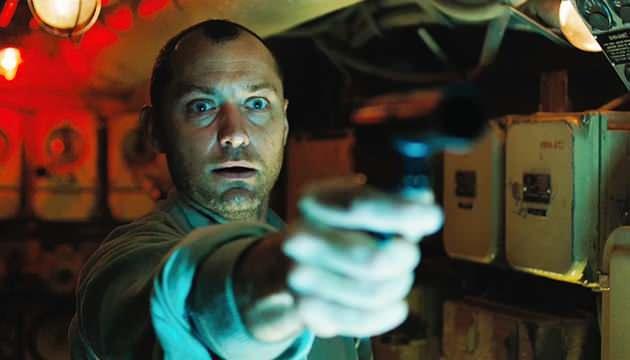
This latest from director Kevin Macdonald (“The Last King of Scotland”) is a claustrophobic heist movie about a bunch of down-on-their-luck salvage operators who buy a rusty old Soviet sub and use it to locate and loot a German U-Boat that sank during World War II with millions in gold ingots aboard.
Jude Law stars as Robinson, who just lost his job working for a big international salvage company. His long absences at sea pretty much ruined his marriage, and he’s got nothing to live for. So when a well-suited mover-and-shaker (Scoot McNairy) plays intermediary between Robinson and a rich dude willing to bankroll the project, our man is all too ready to bite.
He assembles a crew of old salts, half Russian and half British, who take no time at all to be at each other’s throats. It doesn’t help that one of the Brits, a deep sea diver played by Ben Mendelsohn, is a paranoid crazy who gets it in his head that if he can kill off a few of his crewmates, that’ll leave more gold for the survivors.
I can usually handle a pain-filled story if there’s a touch of transcendence in there somewhere.
In the case of “Cake,” a glum yarn about a woman enduring excruciating physical and mental pain, that transcendence is provided by Jennifer Aniston in the sort of soul-ripping performance we’ve never see from her.
Claire Bennett is middle aged but moves like an old lady. The scars on her face suggest she’s been through a lot, and as the movie progresses we’ll discover that not all her maladies are physical.
You get the feeling that she’s always had a dark, sardonic streak and that whatever has happened to her has kicked this into overdrive. Early in this film from director Daniel Barnz, Claire rips up other members of her support group for for their simpering responses to the suicide of one of their members.
The woman in question, Claire notes, took a header off a freeway overpass, landed in the bed of a truck and was not discovered until said vehicle had returned to its home base in Mexico, making things even more complicated for her survivors. She made her escape, sure, but at what cost to those she left behind? Way to go.
Her caustic attitude extends to just about everyone in her life, not that there are that many of them. She’s mean to her physical therapist (Mamie Gummer) and support group facilitator (Felicity Huffman). She’s brusque with her ex-husband (Chris Messina) and especially with her soulful housekeeper (Adriana Barraza), the sort of person who is almost too forgiving of the faults of others.
Patrick Tobin’s screenplay lacks a strong narrative. Mostly it provides vignettes of Claire’s troubled life as he (rather parsimoniously) deals out the facts about how she came to this sad state.
The crisis here comes when Claire is visited by the ghost of her suicidal friend (Anna Kendrick) and decides to pay a visit to the woman’s husband (Sam Worthington) and child. Maybe she’ll be able to make some sense of her life. Their lives.
I’m guessing we’re to view the ghost as metaphorical rather than literal. In either case, it’s a rather creaky device.
But at rock bottom this is a case of an actress outshining her material. “Cake” may feel a bit too carefully assembled for credibility, but Aniston’s furious, desperate performance rings true. | Robert W. Butler
Funny guy Steve Carell dons prosthetic teeth and nose for “Foxcatcher,” transforming himself into the fabulously wealthy and seriously unhinged John du Pont, a convicted murderer who died in prison in 2010.
He’s flanked in the film by Channing Tatum and Mark Ruffalo, both of whom give career-high performances.
Yet despite this terrific acting (or because of it), “Foxcatcher” is a squirm-worthy experience. We know going in that it will end badly, but Carell — with director Bennett Miller (“Capote,” “Moneyball”) and writers E. Max Frye and Dan Futterman — ups the ante by creating a mood of queasy uneasiness that slowly builds in intensity until you want to jump out of your skin.
Which puts this critic in the weird position of subtracting points because the movie was too effective. At the risk of seeming a philistine, it is difficult to wholly recommend a movie that makes one feel so uncomfortable for two hours-plus.
The story begins in the mid-’80s with wrestler Mark Schultz (Tatum), who with his older brother Dave (Ruffalo) was a big winner at the 1984 Olympics in Los Angeles.
While Dave is a family man with a decent gig teaching and coaching at a university, the unmarried, solitary Mark seems to be circling the drain, a not-terribly-bright jock whose glory days are behind him. He’s reduced to donning his gold medal to give talks to elementary school kids for a few bucks.
Enter the mysterious John du Pont, a ferret-like individual who invites Mark to become part of his Team Foxcatcher, a privately funded wrestling community the multimillionaire maintains on his vast estate.
In more than 40 years of directing, Clint Eastwood has become a master storyteller.
That is overwhelming evident in the first half-hour of “American Sniper,” Eastwood and screenwriter Jason Hall’s adaptation of Navy SEAL Chris Kyle’s memoir about his experiences as the most deadly sniper (160 confirmed kills) in U.S. military history.
They waste no time in plunging us into the action: A street in Iraq. American soldiers searching door-to-door. Watching from above is Chris Kyle (Bradley Cooper), new to the war and positioned on a rooftop.
Suddenly Chris spots movement — an Iraqi mother and her young son are approaching. The mother produces a rocket-propelled grenade from her clothing and gives it to her son, who rushes toward the Americans.
In seconds Chris must decide if his first kill will be a child.
From that hair-raising intro, the film sends jerks us back to Chris’ childhood: reared as a hunter (and possible proto-survivalist) by his father, a misspent youth as a rodeo rider, the decision to enlist in the best military unit in the world, the SEALs.
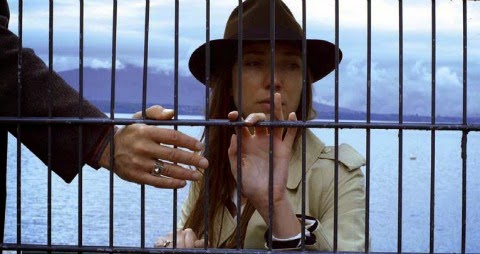
If your average American moviegoer recognizes the name of Jean-Luc Godard, it’s probably for “Breathless,” the 1959 Jean-Paul Belmondo film that singledhandedly introduced the modern era in cinematic storytelling.
Godard hasn’t been much in evidence on U.S. screens since the Sixties — his work is too experimental and challenging even for most cinephiles. But he’s made a movie almost every year for the last six decades, and finally one is playing in Kansas City.
“Goodbye to Language 3-D” already has gained some notoriety for having been anointed the best film of 2014 by the National Board of Review…a choice hotly debated within that august body (one might say the voters exhibited a perverse, cheeky humor worthy of Godard himself).
Now the film opens at Kansas City’s Screenland Crown Center, one of the few art houses around with projection equipment that can do justice to Godard’s use of 3-D photography.
This is not a conventional film…not even close. Like many of Godard’s works, it’s more of a collage on a central theme, an assault of dramatic (and antidramatic) moments, news footage, clips from old Hollywood flicks and political posturing.
The theme is summed up in the title — though since Godard relies so heavily on the spoken and written word one must assume he’s being ironic.
The picture opens at an outdoor used book stall where the patrons are roughed up by gun-toting men in black suits who attempt to intimidate readers. Periodically these thugs — who don’t seem particularly good at their job — will pop up to continue their harrassment.
A couple (Heloise Godet, Kamel Abdeli) sit around naked in an apartment holding post-coital debates. Like everyone else in the movie, they are less characters exchanging dialogue than points of view spewing socio-political maxims.
“Those lacking imagination take refuge in reality.”
Writer/director Paul Thomas Anderson has been on such a long, productive run (“Boogie Nights,” “Magnolia,” “There Will Be Blood,” “The Master”) that it was inevitable he’d mess up one day.
While you can’t categorize “Inherent Vice” as an outright disaster, it spends an awful lot of time going nowhere in particular. Mostly it spreads around lots of stoner whimsey while wasting the efforts of a terrific cast.
It’s overlong, underpopulated with anything like real characterizations and — perhaps most frustrating of all — it’s a mystery yarn so uninvolving that 10 minutes after seeing it I could no longer recall who dunnit…or what they done.
Critics describe Inherent Vice as the most reader friendly of Thomas Pynchon’s dense, hallucinogenic novels.
As compared to what? A trigonometry textbook?
It’s a riff on the classic L.A. detective yarn, set in the late 1960s and offering as our private eye protagonist a ganja-addled, sandal-wearing doofus.
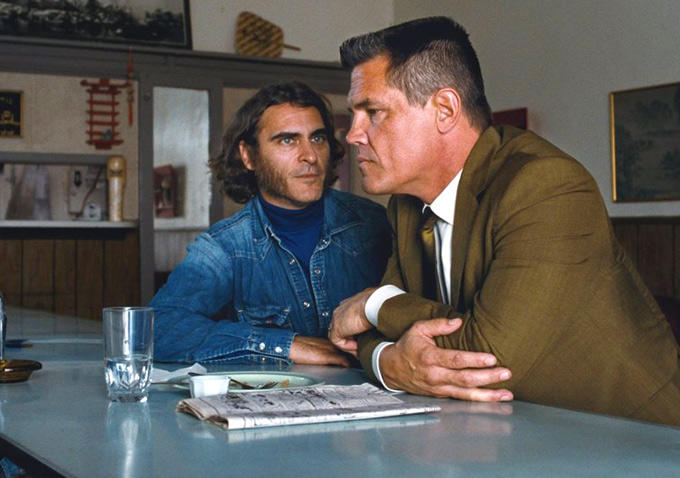
“Doc” Sportello (Joaquin Phoenix, sleepy-eyed and moving at half speed) is a beach-dwelling sleuth with offices in a free health clinic. He’s visited one night by his former girlfriend, Shasta (Katherine Waterston), a one-time flower-power love bunny who is now the mistress of the ruthless Wolfmann (Eric Roberts), L.A.’s most celebrated real estate developer.
Shasta tearfully asks Doc’s help in stopping a conspiracy by Wolfmann’s wife and her lover to have him committed to a mental institution. Doc — who for all his pharmaceutical excesses works to maintain his integrity — assents for old time’s sake.
But then both Wolfmann and Shasta go missing, and Doc finds himself dealing with coke-snorting dentist Rudy Blatnoyd (Martin Short), killer Adrian Prussia (Peter McRobbie), and a sax-playing junkie (Owen Wilson) who was declared dead but is now back among the living. Not to mention the Golden Fang, a vast drug-smuggling cartel.
That was President Woodrow Wilson’s reaction to a 1915 White House screening of the Civil War epic “Birth of a Nation,” a film whose artistic ambitions were matched only by its racism.
A century later, director Ava DuVernay has given us “Selma,” a docudrama about a pivotal campaign in the fight for civil rights for black Americans. You could say this film writes history not so much with lightning as with compassion.
“Selma” often gets the details wrong (shuffling chronologies and geography, for instance), but its emotional heft is undeniable. In re-creating the 1965 protest marches from Selma, Ala., led by the Rev. Martin Luther King Jr., the movie captures the epic sweep of social upheaval, but also the way it played out for the individuals — famous and anonymous — who made it happen.
David Oweyolo as the Rev. Martin Luther King, Jr.
It’s as close to being there as most of us will ever get.
The screenplay by Paul Webb (his first) cannily begins with three scenes that establish the film’s breadth of focus and what is at stake.
In Oslo, Norway, the Reverend King (David Oyelowo, who like most of the lead players is British) accepts the Nobel Peace Prize.
In Selma, black housewife Annie Lee Cooper (Oprah Winfrey, one of the movie’s producers) attempts to register to vote. A sneering clerk orders her to recite from memory the preamble to the U.S. Constitution. When she does so flawlessly, he tells her to come back when she has memorized the names of all the county judges in Alabama.
And in Montgomery, Ala., four black girls are killed when a bomb planted by racists goes off in their church during Sunday services.
King and other civil rights leaders focus their efforts to register black voters in Selma, a burg so racially backward and with such thuggish law enforcement that it perfectly meets their needs. With the media focused on the situation — dignified protestors being abused by white cops and racist mobs — the federal government will be forced to get involved. Continue Reading »
Angelina Jolie’s “Unbroken” is a highly polished tribute to human resiliency.
So why isn’t it more moving?
Based on the best-seller by Laura Hillenbrand (Seabiscuit), this ambitious film tells a story that would be outlandish except for the fact that it’s true.
When Louis Zamperini died earlier this year at age 97, he could look back on a personal history that included juvenile delinquency, a stint as an Olympic athlete, and WWII adventures as an Army Air Corp bombardier. Zamperini survived seven weeks drifting on the Pacific in a life raft, and two years as a prisoner of war of the Japanese, enduring hellish punishments above and beyond those routinely suffered by his fellow POWs.
That’s a lot of life to cram into a feature film — and the screenplay by Joel and Ethan Coen, William Nicholson and Richard LaGravenese already has drawn fire for what it has left out. More on that later.
Though Zamperini is played as a youth by C.J. Valleroy, the movie is owned by Brit actor Jack O’Connell, whose adult Louis quickly emerges as the one character with whom we identify. Other players come and go, but “Unbroken” is virtually a one-man show and O’Connell sinks into the role with almost documentary understatement.
Sumptuously mounted with some terrific action sequences — two bomber crashes plus those long weeks bobbing on a shark-filled sea — the film establishes early and maintains throughout the idea that after a difficult start, Louis was a man determined to survive and succeed.
Benedict Cumberbatch as early computer creator Alan Turing
“THE IMITATION GAME” My rating: B+
114 minutes | MPAA rating: PG-13
With his monumental forehead and widely spaced eyes, Benedict Cumberbatch more resembles the Star Child from “2001” than a movie sex symbol.
Nevertheless, he has his own army of groupies (the self-proclaimed “Cumberbitches”) and his unconventional looks pay off handsomely in roles as brainy outsiders.
Having already put his stamp on Sherlock Holmes for the BBC and PBS, Cumberbatch now takes on Alan Turing, the mathematician and inventor whose genius — he was instrumental in defeating the Nazis and is considered the father of the computer — wasn’t enough to keep him from running afoul of Britain’s draconian laws about “deviant” sexuality.
This film from Norwegian director Morten Tyldum (maker of the nifty thriller “Headhunter”) resembles an extremely good installment of “Masterpiece Theatre,” right down to the familiar actors.
But Cumberbatch’s central performance is so overwhelming that it elevates this historical drama into the realm of Shakespearean tragedy.
In early World War II this Turing is recruited to help crack Enigma, the Nazis’ allegedly unbeatable system for sending coded messages throughout the Reich’s war machine.
Denniston (Charles Dance), the brittle naval officer in charge of the effort, is not impressed with Turing, who seems indifferent or, worse, smug. (“Mother says I can be off-putting…”)
In fact, Cumberbatch gives us not just a brilliant eccentric but an autistic individual. He avoids eye contact. He’s incapable of reading other people’s emotions. He doesn’t “get” humor.
The protagonist of “The Gambler” is an infuriatingly self-centered, stubbornly self-destructive mess. Except that he’s being sold to us as a romantic, devil-may-care rugged individualist.
Sorry, I’m not buying.
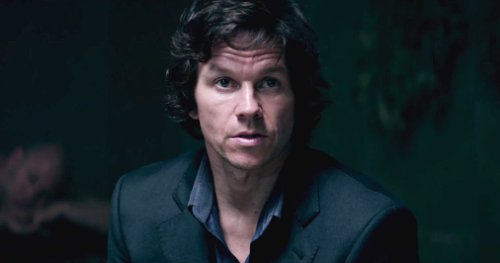
In the opening moments of director Rupert Wyatt’s film (a remake of the Karel Reisz melodrama from 1974), Jim Bennett (Mark Wahlberg) drops in on an illegal casino in the basement of a sprawling seaside LA mansion. He heads immediately for the blackjack table.
Jim doesn’t mess around with strategy. He bets everything he has — $10,000 — on a turn of the card. When he wins, he then bets all of that on the next hand. This continues until he loses everything and walks away with empty pockets.
Actually, his pockets aren’t empty. They contain $250,000 in I.O.U.s from Mr. Lee (Alvin Ing), the Korean gangster who runs the establishment, and from Neville (Michael K. Williams), a well-heeled local banger who sagely observes: “I think you’re the kind of guy who likes to lose.”
Owing so much to such unpleasant characters would be enough to make most of us curtail our gambling activities. But not Jim. He wheedles and begs until he gets another loan, loses that money, and then shrugs when the heavies show up to demand payback.
Jim is what is known in the trade as a “degenerate gambler,” a guy who couldn’t stop if his life depended upon it — which in this case it does. Ironically, during daylight hours Jim is kinda respectable — a published novelist who teaches college-level English lit — although from what we hear of his lectures, his class should be called “Early 21st Century Pretentiousness.”






 Butler's Cinema Scene