Feeds:
Posts
Comments

selma-bridge“SELMA”  My rating: B+ 

127 minutes  | MPAA rating: PG-13

“Like writing history with lightning.”

That was President Woodrow Wilson’s reaction to a 1915 White House screening of the Civil War epic “Birth of a Nation,” a film whose artistic ambitions were matched only by its racism.

A century later, director Ava DuVernay has given us “Selma,” a docudrama about a pivotal campaign in the fight for civil rights for black Americans. You could say this film writes history not so much with lightning as with compassion.

“Selma” often gets the details wrong (shuffling chronologies and geography, for instance), but its emotional heft is undeniable. In re-creating the 1965 protest marches from Selma, Ala., led by the Rev. Martin Luther King Jr., the movie captures the epic sweep of social upheaval, but also the way it played out for the individuals — famous and anonymous — who made it happen.

David Oweyolo as the Rev. Martin Luther King, Jr.

David Oweyolo as the Rev. Martin Luther King, Jr.

It’s as close to being there as most of us will ever get.

The screenplay by Paul Webb (his first) cannily begins with three scenes that establish the film’s breadth of focus and what is at stake.

In Oslo, Norway, the Reverend King (David Oyelowo, who like most of the lead players is British) accepts the Nobel Peace Prize.

In Selma, black housewife Annie Lee Cooper (Oprah Winfrey, one of the movie’s producers) attempts to register to vote. A sneering clerk orders her to recite from memory the preamble to the U.S. Constitution. When she does so flawlessly, he tells her to come back when she has memorized the names of all the county judges in Alabama.

And in Montgomery, Ala., four black girls are killed when a bomb planted by racists goes off in their church during Sunday services.

King and other civil rights leaders focus their efforts to register black voters in Selma, a burg so racially backward and with such thuggish law enforcement that it perfectly meets their needs.  With the media focused on the situation — dignified protestors being abused by white cops and racist mobs — the federal government will be forced to get involved. Continue Reading »

Jack O'Connell as Louie Zamporini

Jack O’Connell as Louie Zamporini


“UNBROKEN” My rating: B

137 minutes| MPAA rating: PG-13

Angelina Jolie’s “Unbroken” is a highly polished tribute to human resiliency.

So why isn’t it more moving?

Based on the best-seller by Laura Hillenbrand (Seabiscuit), this ambitious film tells a story that would be outlandish except for the fact that it’s true.

When Louis Zamperini died earlier this year at age 97, he could look back on a personal history that included juvenile delinquency, a stint as an Olympic athlete, and WWII adventures as an Army Air Corp bombardier. Zamperini survived seven weeks drifting on the Pacific in a life raft, and two years as a prisoner of war of the Japanese, enduring hellish punishments above and beyond those routinely suffered by his fellow POWs.

That’s a lot of life to cram into a feature film — and the screenplay by Joel and Ethan Coen, William Nicholson and Richard LaGravenese already has drawn fire for what it has left out. More on that later.

Though Zamperini is played as a youth by C.J. Valleroy, the movie is  owned by Brit actor Jack O’Connell, whose adult Louis quickly emerges as the one character with whom we identify.  Other players come and go, but “Unbroken” is virtually a one-man show and O’Connell sinks into the role with almost documentary understatement.

Sumptuously mounted with some terrific action sequences — two bomber crashes plus those long weeks bobbing on a shark-filled sea — the film establishes early and maintains throughout the idea that after a difficult start, Louis was a man determined to survive and succeed.

Continue Reading »

Benedict Cumberbatch as early computer creator Alan Turing

Benedict Cumberbatch as early computer creator Alan Turing

“THE IMITATION GAME” My rating: B+

114 minutes | MPAA rating: PG-13

With his monumental forehead and widely spaced eyes, Benedict Cumberbatch more resembles the Star Child from “2001” than a movie sex symbol.
Nevertheless, he has his own army of groupies (the self-proclaimed “Cumberbitches”) and his unconventional looks pay off handsomely in roles as brainy outsiders.
Having already put his stamp on Sherlock Holmes for the BBC and PBS, Cumberbatch now takes on Alan Turing, the mathematician and inventor whose genius — he was instrumental in defeating the Nazis and is considered the father of the computer — wasn’t enough to keep him from running afoul of Britain’s draconian laws about “deviant” sexuality.
This film from Norwegian director Morten Tyldum (maker of the nifty thriller “Headhunter”) resembles an extremely good installment of “Masterpiece Theatre,” right down to the familiar actors.
But Cumberbatch’s central performance is so overwhelming that it elevates this historical drama into the realm of Shakespearean tragedy.
In early World War II this Turing is recruited to help crack Enigma, the Nazis’ allegedly unbeatable system for sending coded messages throughout the Reich’s war machine.
Denniston (Charles Dance), the brittle naval officer in charge of the effort, is not impressed with Turing, who seems indifferent or, worse, smug. (“Mother says I can be off-putting…”)
In fact, Cumberbatch gives us not just a brilliant eccentric but an autistic individual.  He avoids eye contact. He’s incapable of reading other people’s emotions. He doesn’t “get” humor.

Continue Reading »

Mark Wahlberg

Mark Wahlberg

“THE GAMBLER”  My rating: C

111 minutes | MPAA rating: R

The protagonist of “The Gambler” is an infuriatingly self-centered, stubbornly self-destructive mess. Except that he’s being sold to us as a romantic, devil-may-care rugged individualist.

Sorry, I’m not buying.

In the opening moments of director Rupert Wyatt’s film (a remake of the Karel Reisz melodrama from 1974), Jim Bennett (Mark Wahlberg) drops in on an illegal casino in the basement of a sprawling seaside LA mansion. He heads immediately for the blackjack table.

Jim doesn’t mess around with strategy. He bets everything he has — $10,000 — on a turn of the card. When he wins, he then bets all of that on the next hand.  This continues until he loses everything and walks away with empty pockets.

Actually, his pockets aren’t empty.  They contain  $250,000 in I.O.U.s from Mr. Lee (Alvin Ing), the Korean gangster who runs the establishment, and from Neville (Michael K. Williams), a well-heeled local banger who sagely observes: “I think you’re the kind of guy who likes to lose.”

Owing so much to such unpleasant characters would be enough to make most of us curtail our gambling activities. But not Jim. He wheedles and begs until he gets another loan, loses that money, and then shrugs when the heavies show up to demand payback.

Jim is what is known in the trade as a “degenerate gambler,” a guy who couldn’t stop if his life depended upon it — which in this case it does. Ironically, during daylight hours Jim is kinda respectable — a published novelist who teaches college-level English lit — although from what we hear of his lectures, his class should be called “Early 21st Century Pretentiousness.”

Continue Reading »

James Cordern, Emily Blunt and Meryl Streep

James Corden, Emily Blunt and Meryl Streep


“INTO THE WOODS”  My rating: B-

124 minutes | MPAA rating: PG

“Into the Woods” is a terrific big-screen musical right up to the point when it suddenly stops being great and turns disheartening and annoying.

In this it is exactly like the stage version of this Stephen Sondheim/James Lapine collaboration, which I saw in previews in New York just before its 1987 debut.  I’m talking 90 minutes of wonderful followed by 30 minutes of meh. So meh, in fact, that it damn near ruins all the good stuff.

Director Rob Marshall, who more or less singlehandedly resurrected the movie musical with 2002’s “Chicago,” comes charging out of the gate here, delivering a movie that works musically and  cinematically and which strikes just the right tongue-in-cheek tone in revisiting the fairy tale cliches of our childhoods.

In a village just outside the woods the Baker (James Corden) and his wife (Emily Blunt) yearn for a child.  Their cronish neighbor (a gleefully scenery-chawing Meryl Streep), widely believed to be a witch, reveals that in his childhood she put a curse of infertility on the Baker.  Now she offers to lift the hex if the couple will obtain for her several items needed for an incantation that will restore her youth and beauty.

Among the things sought in this scavenger hunt: a cow as white as milk, a cape as red as blood, hair as yellow as corn, and a slipper as pure as gold.

Continue Reading »

Christophe Waltz, Amy Adams as the Keanes

Christophe Waltz, Amy Adams as the Keanes

“BIG EYES” My rating: B- 

105 minutes | MPAA rating: PG-13

In “Big Eyes” Tim Burton takes on the  oddball odyssey of Walter and Margaret Keane, who a half century ago launched an art-world/cultural sensation with cartoonish paintings of children with huge, sad eyes.

Despite being savaged as tasteless kitsch by the critics — the eyes were compared to “big stale jelly beans” — these “Keane Kids” became hot commodities. Fame and fortune followed.  Think of it as a pre-Tomas Kinkade display of bad taste.

Eventually the Keane Kids generated a scandal when it was proven in court that Walter Keane, who claimed to be the artist, was in fact no more than a hack taking credit for his wife’s work.

Burton has two very fine actors in Christoph Waltz and Amy Adams. His recreation of ‘60s San Francisco feels authentic. And the subject matter promises something along the lines of “Ed Wood,” for my money the director’s most heartfelt work.

After all, both films are about “artists” who specialize in…well, not art

But whereas “Ed Wood” was a very funny celebration of a tasteless filmmaker — often cited as the worst director of all time yet obsessed with capturing his questionable vision on celluloid — “Big Eyes” is a more conflicted affair.

Continue Reading »

2014 wasn’t a year of great movies.

Great performances, yes, but often in movies that were only good.

Which poses a problem for the critic assembling a 10 Best List.  Is a spectacular piece of acting enough?  Just how far can it lift a movie that in other regards  fails to reach the stratospheric atmosphere of cinema art?

Examples: Eddie Redmayne’s astounding work as cosmologist Stephen Hawking in “The Theory of Everything.”  Robin Wright in “The Congress.”  Ralph Fiennes in “Grand Budapest Hotel.”  Or Jake Gyllenhaal in “Nightcrawler.”

Ultimately you have to fall back on the basics, looking not at a film’s parts but at its totality, at the personality it presents to the world. Does the experience stick with you, burrowing into your consciousness so effectively that months or even years later you can recall the thrill of viewing?

These are the films that did it for me this year. There are several documentaries (the genre least insulting to the intelligence of audiences), one foreign title, and several independents (a couple of which came and went in the blink of an eye).

There’s only one mainstream release because…well, because Hollywood is less into discovery than into recycling the tried and true. I find it too late in the day to be treading water.

So here they are no particular order:

TO READ THE REST OF THIS STORY GO TO THE KANSAS CITY STAR WEBSITE AT http://www.kansascity.com/entertainment/movies-news-reviews/article4645131.html


20000 days

citizenfour

gone-girl-poster

homesman_ver2

ida-poster-334-b

  birdman-click
LandHo-PosterFinal-v2a-140108-webnew
  boyhoodWHIP_INTL_1Sht_Lk2_LYRD-600x852
rich_hill_ver4_xlg
Reese Witherspoon

Reese Witherspoon

“WILD” My rating: B+ 

115 minutes | MPAA rating: R

Man-against-nature stories are fairly common. Women-against-nature…well, that’s a rarer breed.

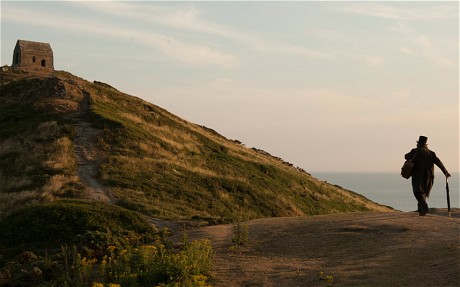
In “Wild” a perfectly unglamorous Reese Witherspoon plays real-life writer Cheryl Strayed, who some years ago hiked more than 1000 miles along the Pacific Crest Trail, which begins at the Mexican border and ends in Canada.

Strayed‘s story, as recorded in her 2012 memoir Wild, was both an escape from a tormented past (a failed marriage and drug addiction, for starters) and a long trek toward self discovery.

That journey, and the agonizing personal history that got it all started, have been effectively realized by Witherspoon (another Oscar nomination seems inevitable) and director Jean-Marc Vallee, who guided Matthew McConaughey to a best actor Oscar in “The Dallas Buyers’ Club.”

That earlier film was a middling movie elevated by a terrific lead performance. “Wild” raises the bar considerably — not only is Witherspoon superb (for much of the movie it’s just her and the scenery), but the storytelling technique proffered by Valee and screenwriter Nick Hornby (“High Fidelity,” “About a Boy,” “An Education”) almost perfectly captures the key elements of Strayed‘s tale through visual and aural poetry rather than conventional narration.

The film begins with Strayed, a tenderfoot in both the literal and figurative sense, setting out on the trail maintained by the National Park Service.

She has crammed her backpack with so much equipment that she moves like Atlas straining to lift the entire Earth.  The damn thing is so heavy it constantly threatens to flip her onto her back and leave her clawing the air like a helpless turtle.

Her new hiking boots are too tight, resulting in blood and blisters. Initially she’s lucky to cover five miles a day. She has never pitched a tent before, or tried to cook on a propane camp stove. She’s not sure how to deal with the rattlesnake in her path or the coyotes that howl all night.

But she’ll learn, just as she’ll learn to deal with heat and snow and physical exhaustion.

Continue Reading »

Martin Freeman as Bilbo (left), and Richards Armitage as Thorin (right)

Martin Freeman as Bilbo (left), and Richards Armitage as Thorin (right)

“THE HOBBIT: BATTLE OF THE FIVE ARMIES” My rating: C 

144 minutes | MPAA rating: PG-13

I am so over Peter Jackson’s Tolkein obsession.

It’s not that “The Hobbit: Battle of the Five Armies” is incompetent filmmaking. Rather, it’s empty filmmaking.

It’s got plenty of spectacle — beginning with a dragon and ending with an hour of uninterrupted combat — but it seems not to be inhabited. The characters are paper thin, and even those with whom we’ve developed some an affinity aren’t on the screen enough for genuine emotions to emerge.

Maybe this is what comes of taking a simple children’s adventure and ballooning it into a 9-hour trilogy.

Perhaps Jackson long ago emptied his quiver of tricks and is now reduced to repeating himself.

And the stuff that once wowed us — the CG that made the original Ring Trilogy such a technological marvel — now seems rather old hat.  So many of the effects on display here look patently artificial rather than real.

For hardcore fans, of course, none of this matters.  Having invested at least 15 hours in the first five Tolkein-inspired films, they’re not about to bail on the big conclusion. They’d probably stick around to watch Bilbo read from the White Pages.

Basically “Battle of the Five Armies” can be broken down into three segments.

Continue Reading »

Noah Wiseman, Essie Davis

Noah Wiseman, Essie Davis

“THE BABADOOK”  My rating: B+ 

93 minutes | No MPAA rating

The Australian-made “The Babadook” so seamlessly merges the supernatural with the psychological that it’s impossible to say if what we see on the screen is really happening or if it’s unfolding in its tortured heroine’s head.

Either way, writer/director Jennifer Kent has given us an unnerving experience, marked by two superlative performances that grab us by the throat and won’t let go.

Amelia (Essie Davis) is a widow raising her seven-year-old son Sam (Noah Wiseman).  Like a lot of single moms, she’s struggling — financially, emotionally, sexually.

But Amelia has a special cross to bear, for Sam is, well, different. The kid is cute and bright and is working on a magic act.  But he’s also a handful, a tyke who so fears monsters under his bed that he has fashioned his own dart-shooting crossbow and a shoulder-mounted catapult to hold them at bay.

That’s only the beginning of Sam’s behavioral problems. He rarely sleeps through a night, usually waking Amelia to search his room for supernatural invaders (she is majorly sleep deprived). During waking hours Sam demands his mother’s undivided attention and he’ll throw a grand mal temper tantrum when he doesn’t get it.

Continue Reading »