Feeds:
Posts
Comments
Tom Hanks as Walt Disney, Emma Thompson as P.L. Travers

Tom Hanks as Walt Disney, Emma Thompson as P.L. Travers

“SAVING MR. BANKS” My rating: B+ (Opening wide on Dec. 20)

125 minutes | MPAA rating: PG-13

“Saving Mr. Banks” — a serio-comic look at Walt Disney’s tireless courtship of “Mary Poppins” author C. L. Travers — can be viewed either as a charming explanation of how one of the best family films of all time came to be made, or as an infuriating example of corporate self aggrandizement.

While cognizant of the latter, I’ll go with the former.

The latest  from director John Lee Hancock (“The Rookie,” “The Blind Side”) is set during Travers’ two-week visit to L.A.  in the early 1960s, arranged so that Disney — who more than two decades before had sworn to his wife and daughters that he would bring their favorite heroine of children’s literature to the screen — could coax, canjole and charm the dubious author into signing over the movie rights to her books.

Disney was nothing if not determined. Without authorization he had been working for years on the a screenplay and his in-house tunesmiths — brothers Robert and Richard Sherman —  already had written the songs for what would be one of the greatest movie soundtracks of all time.

Continue Reading »

a 12-Years-A-Slave“12 YEARS A SLAVE”

Based on the true story of a free black man kidnapped and enslaved just before the Civil War, Steve McQueen’s film is not only about the horrors of slavery but also the toll that “peculiar institution” takes on those who practice it. Brilliant perfs from Chiwetel Ejiofor, Michael Fassbender and Lupita Nyong’o.

a blue“BLUE IS THE WARMEST COLOR”

Adele Exarchopoulous, 19, gives one of the greatest screen performances of all time as a French high school girl who falls hopelessly and totally in love with an older woman (Lea Seydoux). Abdellatif Kechiche’s film has been knocked in some quarters for its graphic sex scenes – but that’s 12 minutes in a three-hour movie that follows a young woman’s life over several years in astonishingly psychological detail.

a enough“ENOUGH SAID”

Writer/director Nicole Holofcener is the master of the modern relationship film. In this wise, witty and wonderful comedy a divorced mom (Julia Louis-Dreyfus) finds herself befriending a trendy poet (Catherine Keener) while falling for the poet’s scruffy but loveable ex (the late James Gandolfini).  It’s a charming look at late love filled with juicy dialogue, dead-on performances and gentle social satire. Continue Reading »

Christian Bale...fat, bald, and out of control

Christian Bale…fat, bald, and out of control

“AMERICAN HUSTLE” My rating: C+ (Opens wide on Dec. 18)

138 minutes | MPAA rating: R

David O. Russell’s “American Hustle” is crammed with near-brilliant moments and performances.

Yet the film itself left me cold. More than cold. Alienated.

Granted, mine seems to be a minority opinion. Other scribes are tossing words like “masterpiece” and “great American comedy”  at “Hustle.” Maybe they’re seeing something I missed.

Amy Adams

Amy Adams

Inspired (loosely) by the ABSCAM operation of the late 1970s (when the FBI lured — entrapped? — politicians into taking bribes through an elaborate ruse that involved a phony oil sheik), it’s the story of a couple of con artists who get swept up by the feds and, to avoid prosecution, agree to help the government set up an even bigger con.

The film begins with a superb wordless introduction in which con man/dry cleaning magnate Irving Rosenfeld (Christian Bale) emerges from the shower and gets to work on the face he presents to the world. The normally cut Bale (he’s Batman, fer chrissakes) put on maybe 40 pounds to play the tubby, middle-aged Irving.  Now he stands in front of a mirror creating, strand by strand, spray by spray, the world’s most atrocious comb-over ‘do. It’s awesomely funny, in an I-don’t-believe-what-I’m-seeing way.

Irving is smoking a stogie at a pool party when he gets a glimpse of Sydney Prosser (Amy Adams), a young woman on the make both professionally and romantically. He’s ugly, she’s beautiful (unlike every other director in America, Russell looks at Amy Adams and sees rampant sexuality, God love him) and they bond over jazz. Soon he’s teaching her the ropes of financial scamming, and together they’re enjoying an erotic field day.

The catch is that Irving is married to the gold-digging Rosalyn (Jennifer Lawrence), a quintessential Jersey princess. She won’t divorce him and, anyway, Irving is absolutely crazy about her young son, whom he has adopted.

Continue Reading »

inside llewyn 2“INSIDE LLEWYN DAVIS” My rating: B+ (Opening Dec. 20 at the Glenwood Arts)

105 minutes | MPAA rating: R

I freakin’ love “Inside Llewyn Davis,” the Coens’ moody, bitterly funny, dead-on accurate recreation of the early ’60s New York folk scene.

I love it despite the fact that it’s a downer — similar in mood to “Barton Fink” — and that its protagonist is a talented but selfish sphincter.  I love its atmosphere, I love the music.

Of course, the main character is a dick, and I might  love the film even more if it showed even a teeny bit of heart, but then it wouldn’t be a Coen Brothers movie.

We meet our titular protagonist, Llewyn Davis (Oscar Isaac), playing and singing in Greenwich Village’s Gaslight club in 1961. Llewyn (pronounced Lew-In) is performing a traditional song called “Hang Me Oh Hang Me,” and he’s really, really good.

Of course he’s also a folkie purist, a snob, and an artiste whose uncompromising vision pretty much rules out anything like commercial success. He’s like a perverse King Midas — everything he touches turns to crap.

The film follows Llewyn as he drifts around the city during a cold snap. Wearing nothing but a threadbare sports coat and a muffler, his touseled hair blowing in the frigid breeze, our man could almost be a character out of Dickens. (Clearly, the Coens have  studied the cover of “The Freewheelin’ Bob Dylan” LP.)

He’s got no home so he crashes where he can. He spends a night with a Columbia University professor and his wife, and inadvertently lets the couple’s big orange cat escape. Locked out of the apartment, Llewyn has no option but to carry the feline about on his chilly perambulations.

Continue Reading »

kathleen hannah incest_“THE PUNK SINGER” My rating: B (Opens Dec. 20 at the Tivoli)

80 minutes | No MPAA rating

I was already too old to appreciate the punk scene in its prime, and while a few days ago the name Kathleen Hanna might have triggered the briefest flicker of recognition in my reptilian brain, I couldn’t tell you why.

But “The Punk Singer,” the new documentary about the singer/songwriter behind the essential punk bands Bikini Kill and Le Tigre is so good — and Hanna herself such a compelling figure — that I might have to consider her a new obsession.

Drawing on vintage video footage and newly captured interviews, Sini Anderson’s documentary traces Hanna’s career from college artist in the Pacific Northwest to underground sensation to something verging on mainstream acceptance.

Hanna was a riveting performer, musical but with plenty of attitude and a voice that could peel paint. She was fun to watch, bounding all over the stage.

kathleen-hanna-hotHer songs were angry anthems that dissected the boys’ club that was punk. Here was a feminist who took the language and sound of the oppressor (mosh pits, anyone?) and turned it against them, singing about rape, abuse, sexuality, patriarchy and, oh yeah, female empowerment.

It wasn’t just music. Hanna was instrumental in the creation and nurturing of the Riot Grrrl movement, which found voice not only in song but in grass-roots fanzines. Her influence even extended to fashion.

And then, in 2005, Hanna vanished from the scene. The film reveals that she had been suffering for years from a debilitating condition. Finally it was diagnosed as Lyme disease (she could recall being bitten by a tick many years before); today Hanna (who is married to the Beastie Boys’ Adam Horovitz) is slowly rebuilding her life and tentatively dipping her toe back in the musical pool.

This is an essential portrait of a smart, talented and, yes, sexy woman whose greatest contributions, I hope, are still ahead of her.

| Robert W. Butler

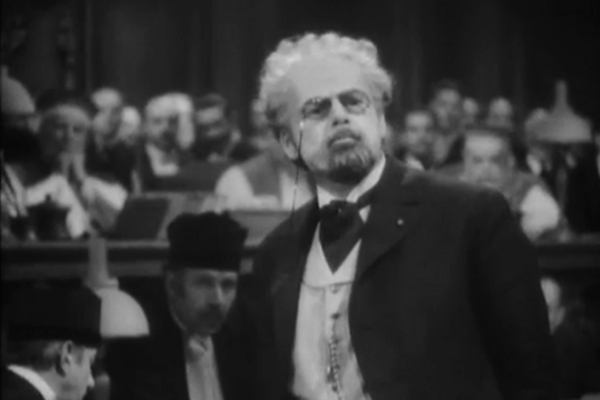
Paul Muni (right) as Louis Pasteur

Paul Muni (right) as Louis Pasteur

“THE STORY OF LOUIS PASTEUR” screens at 1:30 p.m. Saturday, Dec. 21, at the Kansas City Central Library, 14 W. 10th St., as part of the film series Muni the Magnificent.

The work of scientists generally doesn’t lend itself to dramatization.

In real life, earthshaking breakthroughs are fairly rare. Great cures and life-changing inventions are most often the result of painstaking trial and error over years or decades.

Not that Hollywood has ever let facts get in the way of a good story.

Take, for example, the opening sequence of “The Story of Louis Pasteur.”  In mid-19th century Paris, a physician prepares to go on a house call. He places his instruments in his black bag and, dropping one on the floor, picks it up, wipes it off on his pants leg, and puts it in with the rest.

The camera then pans to a dark alcove. A figure emerges holding a gun. Bang! Dead doctor.

What’s this bit of melodrama got to do with the great microbiologist Louis Pasteur?

Just this. The shooter is the husband of a woman who died at the hands of the doctor. Apparently the widower had read a pamphlet published by Pasteur which excoriates France’s physicians for their failure to sterilize their hands and instruments. And now the distressed husband is taking his revenge.

“The Story of Louis Pasteur” isn’t a full film biography, as it only covers about a decade in the great chemist’s life. For modern audiences it is less about one man than it is about the bad old days of head-in-the-sand medicine, when doctors didn’t think a wound was healing without a lot of pus and took pride in their filthy instruments.

The bulk of physicians, in fact, thought that Pasteur was either a madman or a con artist for his assertion that disease was caused by tiny creatures – germs – that could be seen only under the microscope.

Continue Reading »

Chiwetel Ejiofor in "12 Years a Slave"

Chiwetel Ejiofor in “12 Years a Slave”

Steve McQueen’s ante-bellum drama “12 Years a Slave” made off with the big wins Sunday in voting by members of the Kansas City Film Critics Circle.

The movie won top honors for best picture, best actor (Chiwetel Ejiofor), supporting actress (Lupita Nyong’o), supporting actor (Michael Fassbender) and for John Ridley’s screenplay adaptation.  McQueen tied for best director with “Gravity’s” Alfonos Cuaron.

Sandra Bullock was named best actress for her performance as an astronaut stranded in space in “Gravity.”

A second tie occurred in the animated featuring voting, with the honors split between “Frozen” and “Despicable Me 2.”

France’s “Blue Is the Warmest Color” was named best foreign language film.

Best original screenplay honors went to Spike Jonze for “Her,” in which an introvert played by Joaquinn Phoenix falls in love with the Siri-like operating system on his computer. “Her” also won the Vince Koehler Award for Best Fantasy, Science Fiction or Horror film.

“The Act of Killing,” in which former right-wing Indonesian death squad members were encouraged to re-enact their crimes for the camera, was named best documentary.

| Robert W. Butler

Martin Freeman as Bilbo Baggins

Martin Freeman as Bilbo Baggins

“THE HOBBIT: THE DESOLATION OF SMAUG” My rating: C+ (Opens wide on Dec. 13)

161 minutes | MPAA rating: PG-13

I am happy to report that “The Hobbit: The Desolation of Smaug” is a better movie than last year’s interminable “The Hobbit: An Unexpected Journey.”

Of course, this is a bit like congratulating grandma for outrunning great grandma.

Both movies are overpadded, meandering, and infuriating in their insistence on turning a whimsical  book for children into a lumbering behemoth of narrative and economic overkill.

Against their dramatic shortcomings, one must balance the undeniable technical creativity behind director Peter Jackson’s vision.

“Smaug” finds our Hobbit hero Bilbo Baggins (Martin Freeman) and his band of waddling dwarves drawing ever closer to the mountain beneath which the dragon Smaug lurks with his vast treasure of stolen riches.

There are moments here that I recognize from my long-ago reading of “The Hobbit,” like the gigantic spiders that  wrap up the adventurers in the forest of Mirkwood, putting them into storage for future meals. Or Bilbo’s figuring out of a an ancient riddle that will open that secret mountainside doorway to Smaug’s vast underground realm.

But Jackson and his co-writers (Fran Walsh, Philipa Boyens) have tossed in a lot of stuff that never appeared  in the book. Foremost among these is the reappearance of Orlando Bloom’s Legolas (a character from the “Lord of the Rings”) and the introduction of a lady elf, Tauriel (Evangeline Lily), who has been cut from whole cloth.

Tauriel and Legolas are an item, sort of, but she is inexplicably taken with Kili (Aidan Turner), the least grotesque of the dwarfs … could a bit of Middle Earth miscegination be our future? Stay tuned.

Continue Reading »

Paul Muni (left) in "I Am a Fugitive from a Chain Gang"

Paul Muni (left) in “I Am a Fugitive from a Chain Gang”

“I AM A FUGITIVE FROM A CHAIN GANG” screens at 1:30 p.m. Saturday, Dec. 14, at the Kansas City Central Library, 14 W. 10th St., as part of the film series Muni the Magnificent.

The old-time movie moguls weren’t interested in making art or changing minds.

“If you want to send a message,” M-G-M’s San Goldwyn is reported to have said, “use Western Union.”

But the Great Depression nevertheless found the big studios dabbling heavily in what we now call “social problem pictures.” These movies, while frequently very entertaining, also brought to the public’s attention flaws in the system. They exposed injustices, they picked at situations and policies detrimental to society.

Problem pictures could range from gangster dramas (purportedly intended to inform the public of the criminal scourge created by Prohibition, but popular for their violence and the outsized personalities of the characters) to prison films, stories of mob justice, and tales of poverty, unemployment, and police corruption.

Prostitution and “fallen women” were also dealt with … but that ended in 1934 when Hollywood began enforcing the Motion Picture Production Code, which among other things banned all mention of sex from the screen.

The greatest of all social problem pictures was Warner Bros.’ “I Am a Fugitive from a Chain Gang,” released in November, 1932.

Continue Reading »

out furnace“OUT OF THE FURNACE” My rating: C (Opens wide on December 6)

116 minutes | MPAA rating: R

Certain movie genres are best not messed with.

Revenge melodramas and porn, for example. Get too artsy – try too hard to make them relevant and meaningful – and you deny the audience the crude thrills they’ve paid for.

“Out of the Furnace,” a crime drama from writer/director Scott Cooper  (“Crazy Heart,” “Austin Powers: The Spy Who Shagged Me”), tries to make up for its clichéd yet wildly improbable plotting by pretending to be a character study.

It has a few solid moments, but finally runs aground on the rocks of its own lofty (yet ill defined) ambitions.

Russell Baze (Christian Bale) lives in a Pennsylvania factory town and labors in the local steel mill (the “furnace” of the title). He’s hard-working, decent and in love with the beautiful Lena (Zoe Saldana). He  should be the subject of a Bruce Springsteen song.

His younger brother Rodney (Casey Affleck) is a National Guardsman who has gone through four tours of duty in Iraq (the year is 2008). After all that, normal domestic life seems utterly empty.  Rodney – a gambler usually in arrears with the loan sharks – has taken to participating in illegal bare-knuckle fights. He’s the sort who can take a savage beating for five minutes; then something clicks inside and he becomes a rabid monster.

The first half of “Out of the Furnace” is all about milieu and character. Russell tends to his dying dad and goes deer hunting with his uncle (Sam Shepard). He secretly pays off Rodney’s debts with the local small-town wise guy (Willem Dafoe).

He goes to prison for vehicular homicide when he crashes into another car after a night at the local bar. When he comes out, his girl Lena has taken up with a local cop (Forest Whitaker).

All this is very depressing. There are a couple of fine moments – particularly a tearful, rueful reunion between Russell and Lena during which she announces she’s pregnant by her new man – but the plot seems to have stalled in a swamp of blue-collar angst. Continue Reading »