The borderline insufferable “Mr. Malcolm’s List” owes its existence almost exclusively to “Bridgerton,” the Netflix Regency-era bodice ripper that melded multi-racial casting with Jane Austen-ish sensibilities and a good dose of heavy breathing.
Screenwriter Suzanne Allain (adapting her novel) and director Emma Holly Jones (the two also collaborated on a 2019 short film drawn from the book) have given us one of those costume-heavy romances of manners so popular with fans of Anglo-centric entertainment.
The gimmick — not that it’s much of a gimmick in the wake of “Bridgerton” and the recent Dev Patel “David Copperfield” — is that the many characters, from snooty aristocrats to household retainers, are played by a diverse cast representing many races.
Thus our heroine — the sweet, sensible, honest and basically broke Selina — is played by Indian star Freida Pinto of “Slumdog Millionaire” fame; her comically scheming, nose-in-the-air cousins are portrayed by Zawe Ashton (whose mother is Ugandan) and Oliver Jackson-Cohen (generic white guy, natch).
The Mr. Malcolm of the title — a fabulously wealthy gent who keeps a list of all the qualities he demands from a potential wife — is played by Sope Dirisu, who is of Nigerian descent.
There’s considerable talent on display given the credits of the many cast members, but all have been undone by the simpering, artificial tone imposed by the writing and directing. The players assume a sort of comic exaggeration that reeks of high school theatrics. I didn’t believe a minute of it.
Moreover, the film never took me by surprise. The plot appears to be strictly by the numbers…I say “appears” because I could only take about 45 minutes of “Mr. Malcolm’s List.” In the unlikely chance that the film utterly redeems itself in the last three reels, I hereby offer my apologies.
Production values are okay, but most of us are past the point where we’ll happily leave the theater whistling the gowns.
Sixty years on it may be difficult for young people to truly fathom the earth-shaking phenomenon that was Elvis Aaron Presley.
Now, thanks to Biz Luhrmann’s monumental “Elvis,” a new generation can relive the madness and wonder of the early years of rock ‘n’ roll.
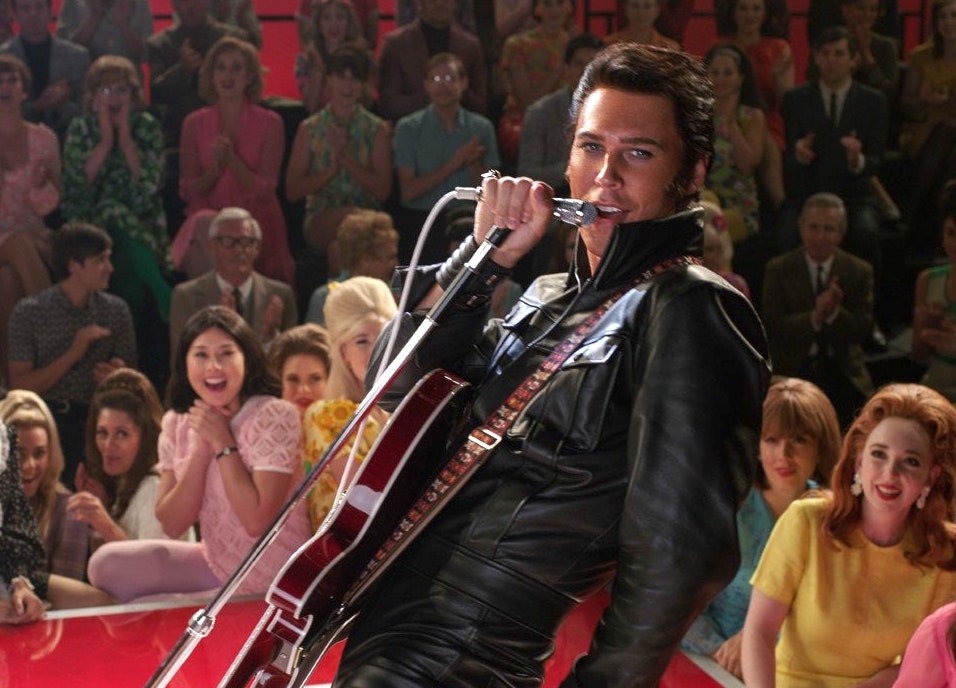
At its best “Elvis” is a kinetic fever-dream fantasia on rock’s most enduring icon, with newcomer Austin Butler portraying The King in such convincing style that there are moments when I wasn’t sure if I was watching an actor or old footage of the real man.
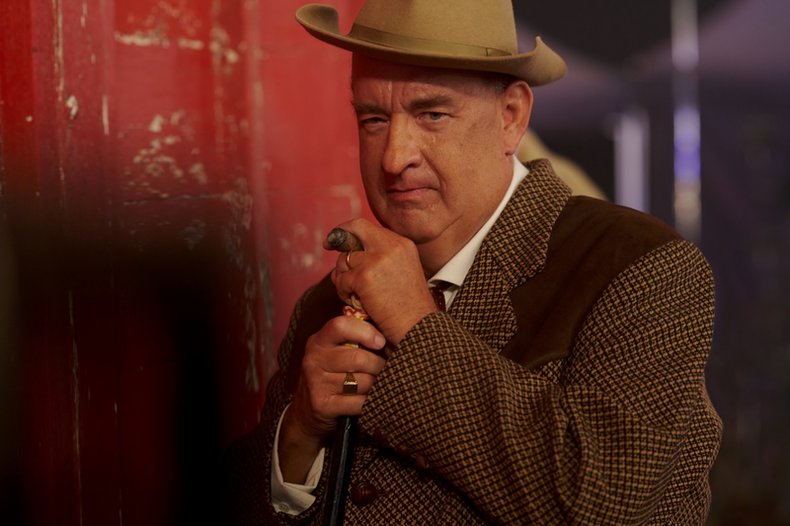
At other times the film presents as an overlong saga that bogs down in the unchanging relationship between Elvis and his creator/nemesis, Colonel Tom Parker, played by a prosthetics-heavy Tom Hanks as a sort of mumbling Jabba the Hutt.
Presley’s story is not without controversy. He was a natural performer whose sexual charisma flowed effortlessly, but he also seems to have been lazy, self indulgent and weak willed. He played other people’s songs (did he write any of his hits?) and was accused of hijacking the work of black performers. In latter years he was an addict whose bloated form had to be squeezed into those sequined jumpsuits.
But do not expect a revisionist approach in the screenplay by Luhrmann, Sam Bromell and Craig Pearce. If anything the film is borderline hagiographic (enough so that it carries glowing endorsements from Elvis’ former wife and daughter). What criticism it dishes is aimed squarely at Parker, who boosted his client’s career with brilliant marketing innovations like a Las Vegas residency and satellite concerts while, we’re told, smothering Elvis’ creative impulses through micromanagement.
Remember, this is a Baz Luhrmann movie, one that exploits all the tricks the Australian has perfected over a quarter century of Rococo filmmaking: swooping camera work, insistent rapid-fire editing, variations in film and video stock, animation…the complete contents of Luhrmann’s noggin seem to be splashed across the big screen. It’s such a staggering display that questions and objections fall by the wayside.
“Elvis” works best in its first half, when we get caught up in the giddy, dizzying whirlwind of first-generation rock. We see Elvis as a boy torn between the gutbucket blues he hears in a Mississippi roadhouse and the Gospel celebrations witnessed in a revival tent.
To those fertile elements young Elvis introduced a pelvis-pumping sexual braggadocio. It may have been a calculated act (initially he’s a bit embarrassed by it all), but by God did the girls (and not a few of their mothers) ever respond. These moments are sexy, funny and utterly captivating…after all these jaded years it still seems wholly fresh and original.
“Elvis” is narrated by Colonel Parker…who was neither a colonel nor a Parker but rather a Dutch con artist (he proudly proclaims himself a “Snow Man”) who entered the U.S. illegally and managed to live much of his life off the grid, promoting country music shows. Hanks adopts a near-indecipherable European accent (quite a shock if you’re expecting a good-ol’-boy drawl) that must work its way around an ever-present cigar.
So on top of this being the story of Elvis, we get a heaping helping of Parker apologetics, with the Colonel defending himself from charges that he kept Elvis from realizing his full potential. (For instance, Elvis never realized his dream of a world tour because Parker vetoed the idea. At the time nobody realized that the Colonel didn’t have a passport and couldn’t get one without facing deportation.)
And that’s a problem because Hanks’ Parker is a repellant character. I wanted to spend less time with him and more with Elvis.
More to the point, the Colonel is an unreliable narrator, self-serving and sly. (Luhrmann has fun cinematically name-dropping in the opening scene, referencing Orson Welles’ “Citizen Kane” as Parker suffers a heart attack in his memorabilia-crammed home — briefly we see that event through the cloudy atmosphere of a snow globe).
Tom Hanks as Colonel Tom Parker
Basically this is a two-character drama. Oh, there are plenty of peripheral characters — Elvis’ parents (Helen Thomson, Richard Roxburgh), his child bride Priscilla (Olivia DeJonge), not to mention fellow musicians like Little Richard (Alton Mason), Big Mama Thornton (Shonka Dukureh),Sister Rosetta Thorpe (Yola), Hank Snow (David Wenham) and B.B. King (Kevin Harrison Jr.).
But most of these characters are little more than window dressing (or, in the case of the black performers, a way of deflecting charges of cultural appropriation). Aside from Elvis and the Colonel, nobody here seems to have a whole lot of gravitas.
Which means there’s much resting on the young shoulders of Butler. Well, out of costume the kid doesn’t look all that much like Elvis but manages — with the help of makeup and wigs — to absolutely nail Presley’s onstage essence, from the gyrating hips to the slightest cock of his cocky head. Like I said, there are moments — especially a late scene in which an on-his-last-legs King croons “Unchained Melody” to a legion of fans) when Luhrmann seems to be cutting between original Elvis footage from 50 years ago and newly filmed material with Butler. Which is which? Damned if I know.
It’s a high wire act. Butler must suggest the darker side of Elvis, must make a nod to the drugs and women and dissipation without undermining the film’s worshipful attitude toward the man’s capacity to entertain and enchant. In a weird way “Elvis” is as important for what it leaves out as what it keeps in, but through it all Butler somehow keeps this big ship steady through sheer force of his screen persona.
It’s a phenomenal movie debut.
Hanks no doubt captures the essence of the Colonel, but I found myself on edge every time the big creep appears.
So to sum up: Butler is a great Elvis. Luhrmann’s kitchen-sink style mostly proves the perfect way to present the King’s story. But in its final third the film runs out of steam…more importantly, when it’s not recreating one of those iconic concert moments “Elvis” becomes emotionally muted, perhaps the result of the filmmakers’ efforts to present its legendary subject in the best possible light.
It’s not a whitewash, exactly, but it comes close.
A promising premise goes nowhere in “Spiderhead,” a si-fy-ish melodrama that at least allows Chris Hemsworth to play something not of the Marvel Universe.
Scripted by George Saunders, Paul Wernick and Rhett Reese (on whose short story it is based), the film unfolds in a futuristic concrete edifice perched on the edge of an island.
Inside it looks like maybe a posh-if-sterile spa melded with a swingers’ resort. There are video games for the residents to play, good food and apparently a hands-off attitude when it comes to romantic connections between the participants.
But we soon discover that this is actually a high-tech prison dedicated to medical experiments. The residents/subjects are inmates from the mainland who have volunteered to be guinea pigs in return for a more relaxed environment: no armed guards, no bars, no locked doors. Moreover, most of the men and women are non-violent offenders.
We learn about the place through Jeff (Miles Teller), who was convicted of vehicular manslaughter. Most of the time he cohabits with Lizzy (Jurnee Smollett), who serves as chef in a well-equipped kitchen.
But periodically Jeff is called to the Spiderhead, a testing center run by Steve Abnesti (Hemsworth), a bespectacled brainiac who is clearly working hard to exude an aura of frat-bro affability. He treats his inmate/subjects like buddies…until it no longer serves his purposes.
Steve is a pharmaceutical wiz who has formulated a wide array of mood-altering drugs. His subjects — all volunteers, remember — never know what they’ll be dosed with when they start a session. It might be potion that makes them laugh uproariously at even the lamest joke. For that matter, under the influence thy will find even human suffering hilarious.
There’s a drug that makes two strangers fall almost instantly and carnally in love…although when the effect has worn off there are no residual feelings of romance or lust.
The worst tests, though, involve Darkenfloss, which plunges the subject into the deepest imaginable depression.
That’s where Jeff has issues. He is expected to collaborate with Steve on who gets Darkenfloss and the dosage to be administered…and he’s deeply disturbed at seeing his fellow human beings in the throes of crippling, even suicidal, downers.
A contest of wills develops between Jeff and Steve…at which point Steve shows his true fascistic colors.
The notion of drugs that can drastically change a person’s mood — almost like a hypnotic suggestion — should be fertile ground for some interesting scenes — everything from comedy to tragedy.
And yet “Spiderhead” — which was directed by Joseph Kosinski of “Top Gun: Maverick” fame — never really takes advantage of the possibilities. In a lot of ways it’s a standard-issue mad-scientist flick.
Let’s give some credit, though, to Hemsworth, who seems to have de-bulked for his role (he never takes his shirt off) and offers a physical vulnerability that is in sharp contrast with his Thor persona. He does a good job of nailing Steve’s malevolent scheming while hiding behind the guise of an apologetic and sympathetic sort.
Even Adam Sandler haters should have a good time with “Hustle,” a warm-hearted sports drama that taps into the acting chops Sandler demonstrated in “Uncut Gems” without the attendant angst and anger.
Sandler plays Stanley Sugarman, a globe-trotting scout for the Philadelphia 76ers. A former college player who screwed up his hand in a car accident, Stanley worships the game of basketball. But years of nearly nonstop travel checking out far-flung potential players have taken their toll…Stanley has spent a big chunk off his life away from his wife (Queen Latifah) and tweener daughter (Jordan Hull).
And then there’s his unfulfilled ambition to become a coach. The team’s aged owner (Robert Duvall) is amendable, but his dickish son and heir (Ben Foster, at his dickishest) wants to keep Stanley exactly where he is. This arrogant tool doesn’t care if Stanley always misses his kid’s birthday parties.
Taylor Materne and Will Fetters’ screenplay centers on Stanley’s discovery in Spain of towering amateur player Bo Cruz (real-life NBA pro Juancho Hernangomez), who shows up on the public courts wearing clunky work boots and humiliates all comers.
“It’s as if Scottie Pippen and a wolf had a baby,” Stanley marvels.
On his own dime Stanley brings Bo back to the States, only to find that his bosses don’t see the same potential he does. The plot has Stanley underwriting Bo’s total-immersion training regimen in preparation for an appearance at the NBA draft combine, where hopeful players get to strut their stuff before team owners and coaches.
“Hustle” is packed to the gills with sport-flick cliches. There’s coach/player bonding, an extended (too extended, in fact) training montage, and the usual roadblocks that threaten to derail Bo’s journey to the pros.
But under Jeremiah Zagars’ direction and thanks to a supporting cast of real-life NBA legends (Julius Erving, Allen Iverson, Charles Barkley, Shaquille O’Neal — it’s like a sports-themed edition of “Where’s Waldo”), “Hustle” feels authentically lived in.
Indeed, one gets the impression that everyone involved in this project absolutely loves the game, and that affection wraps the enterprise in a warm glow.
The seriocomic interplay between Sandler’s and Hernangomez’s characters feels absolutely authentic…maybe Hernangomez is just playing himself, but he seems utterly at ease in front of the camera.
The result is two hours of feel-good that goes down easily. For basketball fans the whole experience should prove borderline orgasmic.
Is “Eiffel” an historic epic posing as a romantic soap opera? Or the other way around?
In the end it may not matter. This French entry about the building of the Eiffel Tower mixes equal parts engineering/historic geekiness with a bittersweet love yarn that may be largely fictional…and the results are imminently watchable.
Martin Bourboulon’s film (the screenplay is by Caroline Bongrand, Thomas Bidegain and Natalie Carter) begins in New York City where French engineer Gustave Eiffel (Romain Duris) is being feted for his part in erecting the Statue of Liberty. Eiffel did not design the statue, but the steel framework he created for its interior ensures that the great lady will survive centuries of wind and water.
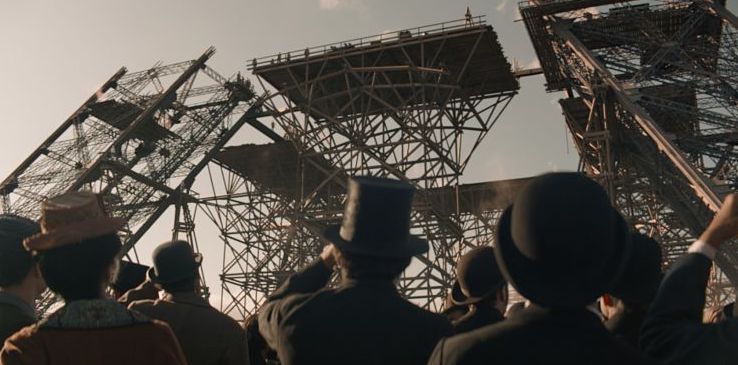
Back in Paris the architect becomes involved in a competition to create a visual landmark for the upcoming International Exposition of 1889. Other teams have proposed towers, but Eiffel deems all their designs “ugly.” He envisions something graceful and sweeping, a skyward soaring monument that appears to defy gravity.
Basically what we have here are two movies. In one the engineer struggles to bring his creation into being.
There are scenes set in the sweaty caissons sunk into the sloppy banks of the Seine which allow workers to prepare the ground in pressurized underwater chambers. There are labor issues. There are a host of design challenges. We see the tower at various stages…one assumes it’s all done with CG but it looks pretty dang convincing.
And then there’s the love story. One of the government officials overseeing the project is Eiffel’s old college buddy Antoine de Rustic (Pierre Deladonchamps); the widowed Eiffel (he has four children) gets the shock of his life when he meets Antoine’s beautiful wife Adrienne (Emma Mackey)…she is none other than the great love of his early years.
A fair chunk of “Eiffel” is devoted to a flashback set 20 years earlier when Eiffel, just starting his career, designed a provincial bridge and fell hard for the spoiled daughter (Mackey, mais oui) of a local bourgeoise. Their secret affair uncovered, the lovers were torn apart. Feeling betrayed, Eiffel got on with his life and career.
But seeing Adrienne again gets those juices flowing and the two once again become lovers, though fate is no kinder the second time around.
Aside from what he accomplished, Gustave Eiffel does not appear to have been a terrifically interesting personality; good thing, then, that Duris oozes quiet charisma. Newcomer Mackey, on the other hand, radiates a the sort of beauty and appeal one associates with Italian actresses like Claudia Cardinale or maybe even Gina Lollobrigida.
But the real star of the show, it’s safe to say, is cinematographer Matias Bouchard, whose images of a bygone era are picture postcard perfect.
“DOWNTON ABBEY: A NEW ERA” My rating: B (Theaters)
125 minutes | MPAA rating: PG
The chickens — every last one of them — have come home to roost by the time “Downton Abbey: The New Era” wraps up the saga of the Grantham clan.
Seriously, folks, there are at least a dozen or so mini-plots playing out against the two main narratives in Julian Fellows’ screenplay…just about every character gets his/her moment in the spotlight before bringing down the curtain.
On one level it’s ridiculous…like watching a stage juggler keep a dozen balls in the air while doing a tap dance on one leg and singing “Old MacDonald” in Farsi. At the same time you have to admire the craftsmanship that keeps it all from descending into pure chaos.
Fans of the PBS series and the previous film entry will be beside themselves.
The film begins with a wedding and ends with a funeral. By the time it’s over just about every character is domestically settled (if not in a conventional marriage then in an appropriate arrangement for the personalities in question).
Two big plots here. No. 1: Downton Abbey becomes a movie studio. No. 2: Half the clan heads off to the South of France to explore a new addition to the family holdings and poke around in unexplored Grantham history.
First, the movie narrative. Seems Downton has a very leaky and expensive roof to repair. When movie director Jack Barber (Hugh Dancy) proposes spending a small fortune for the right to film a motion picture at the abbey, the Granthams swallow their uneasiness about actors (you know, women plastered in makeup and men just plastered) and assent.
Michelle Dockery, Hugh Darcy
At the same time, dowager Violet (Maggie Smith) is informed that a French gentleman she knew as a young bride (we’re talking 1864…the Lincoln administration) has died and left her his estate on the Riviera. So a delegation of family and staff invade the Continent…they can check out the new digs while avoiding the chaos generated by those “movie people” back home.
So basically you’ve got two films that come together at the end.
The one set in England is a riff on “Singin’ in the Rain.” The movie crew are shooting a silent feature, but “The Jazz Singer” has just opened and halfway through filming the movie must convert to sound. (The time appears to be 1928…the Great Depression has not yet reared its ugly head.)
This poses problems for the movie-in-a-movie’s leading lady, Myrna Dalgleish (Laura Haddock), who dominates the screen with her cool beauty but in real life is an angry/insecure diva who speaks in a Cockney bray. At this point Lady Mary (Michelle Dockery), who has stayed behind to hold the fort, discovers she has a talent for voiceover work. At the same time cinema-crazed former footman Mr. Molesley (Kevin Doyle) uses his previously useless knowledge of literature to knock out desperately needed original dialogue for the actors.
Oh, yes, the male lead of the movie being shot is swashbuckling star Guy Dexter (Dominic West), who takes a shine (ahem) to the chief butler, Mr. Barrow (Robert James-Collier), who we learned in the earlier “Downton” movie bats for the other team.
And I haven’t even mentioned the simmering attraction between Dancy’s character and Lady Mary, whose husband (a race car driver played in the previous film by Matthew Goode) is off gallivanting abroad and never seen.
Meanwhile in France, Robert Grantham (Hugh Bonneville) begins to suspect that he is the offspring of an illicit dalliance between his mother and that now-deceased French fellow, whose widow (the great Nathalie Bay, here criminally underused) is incensed about losing her winter palace to a pack of stuffy Brits. But her son (Alex Skarbek) is more welcoming; he believes that Robert is his half brother.
Whoo-hooo! Dirty family laundry!
There are also minor (very minor) conundrums among the abbey staff and various far-flung Grantham relations and acquaintances.
To ensure lots of screen time for everyone in the massive cast (many of whom saw their story arcs resolved in the last movie and have little to do in this one), director Simon Curtis (“My Week with Marilyn,” “Woman in Gold”) breaks even the most banal conversation into a series of quick-cut reaction shots so as to register the faces of surrounding cast members. That way everyone gets screen time. It’s like “My Dinner with Andre” filmed like an action sequence.
Silly? Yes. Are we painfully aware of all the seams and cut-and-paste moments in the narrative? Yep.
Does it matter? Probably not. “Downton Abbey: The New Era” is like attending a reunion with people we all know well and whose company, foibles and all, we relish.
Most of us are sentimental slobs when it comes to kids, telling ourselves that children are — up to a certain age, anyway — blemish free. They’ve not yet discovered the possibility of evil.
The ironically-titled “The Innocents” isn’t having any of that.
This weriting/directing effort from Eskil Vogt (screenwriter of the Oscar-nominated “The Worst Person in the World”) makes a case that the demons of cruelty and destruction inhabit even the youngest of us.
It’s not a comforting thought, but it makes for a majorly creepy movie, thanks to four astonishing performances by child actors.
Little Ida (Rakel Lenora Flottum), her parents and her profoundly autistic older sister Anna (Alva Brynsmo Ramstad) have just moved into a high-rise apartment building in the wooded suburbs of a Norwegian city. The speechless Anna requires so much attention that the unsupervised Ida is left to her own devices.
Almost immediately she finds a new playmate in Ben (Sam Ashraf), a boy several years her senior.
Ben apparently has no friends his own age; indeed, he’s regularly bullied by older kids hanging around the complex.
But he does have unusual skills. Ben demonstrates his ability to move small objects — a bottle cap, for example — using only his mind. Of course he also has a thing for torturing and killing animals.
Apparently he’s not alone in having unusual powers. Aisha (Mina Yasmin Bremseth Asheim), another girl Ida’s age, has her own eerie skill set. Whereas Ben exhibits a sadistic streak, Aisha exudes charity. She silently focuses on Ida’s big sister Anna, who subsequently shows signs of breaking out of her catatonic bubble and actually communicating with the world beyond her head.
To a large extent “The Innocents” takes Ida’s point of view. She matter-of-factly accepts these supernatural events without comment or analysis; she makes no moral judgment on Ben’s clearly psychotic behavior.
But at a certain point the boy’s powers increase to match his pathology; he’ll move from tormenting animals to attacking the older kids and adults who have made his life miserable. What’s a little girl to do?
Vogt doesn’t attempt to explain how these children developed weird skills. Why they developed them, though, may be inferred from their status as victims. Ben and Aisha are dealing with bullying and racial bigotry (both are of Middle Eastern descent in a world of pink-cheeked blondes), and all three have reason to resent their parents.
Grownups here are viewed mostly as background figures…we’re halfway through the film before one of them is seen in closeup. And the adults have no idea of the black magic unfolding around them.
For all of their perceived stuffiness, the British do love their eccentrics. And in Kempton Bunton — portrayed in Roger Michell’s funny/stirring “The Duke” by the great Jim Broadbent — they had one of the best.
In 1961 Bunton, a 60-year-old taxi driver (among other gigs…the man couldn’t hold a job), was tried for stealing from the National Gallery a portrait of the Duke of Wellington by the great Spanish artist Goya.
A few weeks after the painting went missing Bunto strolled into the museum with the stolen artwork wrapped in brown paper, handed it to a guard and promptly admitted to the theft.
His defense was that the government had, to prevent the painting being returned to Spain, spent 140,000 pounds to purchase the portrait (which, most everyone agreed, wasn’t particularly good even if it did depict a British hero), and that all that money could have been better used to promote the common welfare.
Like, for instance, paying the TV tax of poor English families. From the late 1940s through 2000 British TV owners paid an annual tax meant to underwrite the operations of the BBC. Bunton was on a personal crusade against what he saw as an unfair and regressive tax; in fact he’d briefly gone to prison for failing to pay his own TV tax. (His novel defense was that he’d disabled his set so that it could pick up commercial stations but not the BBC, and therefore he didn’t owe the government a farthing.)
Scripted by Richard Bean and Clive Coleman and directed by Roger Michell (his last film, finished shortly before his death last year), “The Duke” starts out as a study in oddball populism and gradually picks up weight and substance until it’ll damn near have you choking back tears.
Broadbent was clearly born to play Bunton, a character of Dickensian dimensions. A perennial writer of letters to the editor, a critic of the Brit class system and an ambitious but unperformed playwright, the man is always getting into trouble.
But here’s the thing…Kempton Bunton is wildly entertaining. You can’t tell if he’s deliberately giving the middle finger to decorum and propriety, or whether he’s a sort of political/social idiot savant. He delights court watchers with his rapid-fire comebacks (asked where he was born, Bunton replies without missing a beat: “The back bedroom”). At one point the judge cautions that he’s not auditioning for a musical.
Matthew Goode
If Bunton is a rising folk hero in the Old Bailey, he’s in the doghouse at home.
His wife Dorothy (Helen Mirren, dowdied down to the nines) has just about had it with him. While her husband loses job after job she slogs away as a cleaning lady for rich folk. Moreover, she blames him for the death a few years before of their teenage daughter (the movie never really makes clear why she would think that, but there it is).
And, she notes, Kempton is a terrible role model for his two boys, especially the younger, Jackie (Fionn Whitehead), who soaks up his pa’s antiestablishment attitudes. (Indeed, as things progress Jackie, in a nifty plot twist, becomes a pivotal figure in his father’s fate.)
Matthew Goode has a juicy supporting role as Bunton’s defense attorney, who has the good sense to simply let his client be himself on the stand, thus winning the hearts of Englishmen everywhere.
“Torn from the headlines” usually indicates a tragedy in the offing. In case of Kempton Bunton it means head-shaking delights.
The bizzaro Canadian satire “Stanleyville” might best be described as a Poverty Row variation on “Squid Game.”
In this debut feature from writer/director Maxwell McCabe-Lokos a group of dissatisfied individuals are invited to compete in a series of contests, with the winner driving away in a ”habanero-orange compact sport utility vehicle.”
But there’s more at stake, according to the event’s convener, who promises nothing less than “authentic personal transcendence.”
Maria (Susanne Wuest) has a dead-end office job, a couch potato husband and a surly teenage daughter. So she’s receptive when at a shopping mall a painfully thin man who identifies himself as Homunculus (Julian Richings) approaches here with the news — he’s haltingly reciting an obviously memorized script — that she’s been specifically chosen to participate in a top secret contest.
It’s not the idea of winning a car that appeals to Maria; rather it’s the challenge. Anything to throw a monkey wrench into her humdrum existence.
Soon she finds herself in competition “pavilion,” actually a space in an old office building that looks and feels like a church social hall…or maybe the faculty lounge at an underfunded public school.
Homunculus is there to read the convoluted contest rules from a clipboard. If anybody tries to leave the room before the game is over, nobody wins.
The games themselves range from the mundane (who can blow up and explode the most balloons using only lung power?) to the wacko. For one challenge contestants are given several hours to build from a junkyard assortment of odds and ends “a functioning telecommunications device.” Maria’s invention is a conch shell outfitted with wires and antennae that throbs with hot pink illumination and actually plucks ghostly voices from the ether.
McCabe-Lokos and cowriter Rob Benvie populate this limited world with contestants who represent various attitudes reflective of our modern times.
There’s an angry young black woman (Cara Ricketts), a musclebound guy (George Tchortov) constantly slurping protein drinks while trying to rope the other players into his health supplement pyramid scheme; an incredibly fey and goofy “actor” (Adam Brown), and a pompous go-getter (Christian Serritiello) whose open contempt for the other players cannot hide the fact that he’s all windup and no delivery.
Early on the contestants are advised that the game’s most important rule is “do whatever it takes to win.” Add a pistol to the mix and bad things happen.
“Stanleyville’s” cryptic title apparently refers to the photograph on the pavilion wall of Henry Morton Stanley, the Victorian journalist who successfully penetrated the “Dark Continent” to find the missing explorer David Livingstone. Although exactly what we’re to make of this historic reference escapes this reviewer.
Some clever stuff here, but even at a tidy 89 minutes “Stanleyville” runs out of steam after a promising start, leaving us with far more questions than answers.
“TAKE ME TO THE RIVER: NEW ORLEANS” My rating: B+ (In theaters)
115 minutes | No MPAA rating
I cannot even count how many times during “Take Me to the River: New Orleans” I found myself literally bawling with pleasure.
Martin Shore’s documentary love letter to Big Easy musicians (it’s a followup to 2014’s “Take Me to the River,” which probed the Memphis sound) may not be encyclopedic (no one movie could hope to encompass the width and breadth of New Orleans’ musical heritage), but it’s pretty damn staggering nonetheless.
I mean, any film that can enthusiastically embrace Irma Thomas, Snoop Dogg, the Neville Brothers, Ani DiFranco and the Preservation Hall Jazz Band (for starters) has got a hell of a reach.
Shore’s approach is simple. He sets up recording sessions featuring the city’s players — everyone from superstars to working stiffs and even high school students — and lets their creativity run wild. He also revels in pairing music’s elder statesmen with their up-and-coming young counterparts. The results are sublime.
Thus we get blues dowager empress Irma Thomas duetting with Ledisi on “I Wish Someone Would Care.” The late Dr. John (in one of his last filmed performances) teams with Davell Crawford for “Jock-A-Mo.” Aaron Neville and the Dirty Dozen Jazz Band rip the place up with the stomping “Street Parade.” Snoop, G-Eazy and William Bell collaborate on a rap/blues reinterpretation of the classic “Yes We Can Can” (I’ve never cared much for rap, but this number blew me away).
In all there are two dozen performances on display. Not a ringer in the bunch.
And between those there are documentary digressions about the city’s Indian tribes (like the legendary Wild Tchoupitoulas), Preservation Hall,, the second line tradition, the late Allen Touissaint and the continuing fallout from Hurricane Katrina, which displaced scores of musicians, many of whom have been unable to return to Orleans.










 Butler's Cinema Scene