Feeds:
Posts
Comments

“MAKING WAVES: THE ART OF CINEMATIC SOUND” My rating: B

94 minutes | No MPAA rating

The cinema has always been dominated by its visual elements and the moving image…there’s a reason we refer to them as “the movies,” after all.

But as powerful as visual images may be, they can be enhanced immeasurably by the judicious and creative use of sound. Some filmmakers, in fact, argue that what we hear in the theater is as important — perhaps more important — than what we see.

Midge Costin’s documentary “Making Waves: The Art of Cinematic Sound” — she’s a veteran sound and dialogue editor making her directing debut — is a little bit of everything: history, aesthetic exploration, technological geek out.

It is also, for the most part, a look at the careers of two of the still-living giants of movie sound: Walter Murch, whose sound designs have graced the films of Francis Coppola, and Ben Burtt, who brought his talents to George Lucas’ “Star Wars.”

The film opens with Murch, now 77, commenting on how even before birth we are accustomed to hearing our mother’s breathing and heartbeat, as well as voices and noises coming from outside her body. For that reason, Murch asserts, hearing is a much more profound experience than viewing.

The film picks out from cinema’s past special films that advanced movie sound. There’s “King Kong,” whose sound designer manipulated the roars of zoo animals.  There was the radio era, when entire worlds were fabricated from pure sound; artists like Orson Welles exploited the artistic possibilities of radio and then brought that some creativity to the soundtrack of his “Citizen Kane” (1941). Alfred Hitchcock was an advocate of pure sound, eschewing all music for his “The Birds” (1965) and relying heavily on electronically distorted avian noises.

But these adventurous souls were few and far between. Mostly the studios were run like an assembly line that avoided adventurous sound design; each studio had its own sound library of gunshots, trains, screeching tires, ricocheting bullets and other noises that were used over and over again.

Of course for most of the sound era — which began in the late ’20s — movie sound meant monaural sound, noises coming from one speaker directly behind the screen.  It wasn’t until Barbra Streisand demanded a full stereo presentation for her 1976 “A Star Is Born” that stereo soundtracks became the norm.

In films like “Nashville” Robert Altman got creative with dialogue, wiring up everyone in a crowded scene with their own microphones and recording each actor individually so that he could manipulate what his audience heard in the final print.

Continue Reading »

Emma Watson, Florence Pugh, Saoirse Ronan, Eliza Scanlen

“LITTLE WOMEN” My rating: B+

134 minutes | MPAA rating: PG

Each generation, apparently, gets its own cinematic “Little Women.” Count Greta Gerwig’s new version among the best.

Beautifully acted, classily mounted and delivering its emotional detonations with almost clocklike precision, this adaptation manages to do justice to Louisa May Alcott’s classic novel while viewing the tale through a protofeminist lens.

Gerwig lets us know what she’s up to in the opening scene, where aspiring writer Jo March (Saoirse Ronan) meets with a New York publisher to discuss her latest story.

“If the main character is a girl,” the bewhiskered editor (Tracy Letts) advises, “make sure she’s married by the end…or dead.  Doesn’t matter which.”

This is only the first of several moments in which the film takes aim at male privilege and arrogance in 19th century America (and, by implication, in today’s world).  Not that the film ever mounts a soapbox or goes strident.  Gerwig’s screenplay effortlessly incorporates a modern sensibility into the classic tale; it feels as if she discovered these  millennial attitudes  in the original story and merely amplifies them.

This “Women” is novel as well for its narrative juggling.  The film opens several years after the Civil War…the March sisters from Concord, Mass., are now young adults.

We’ve already seen Jo pursuing a career in the Big Apple.  We find sister Meg (Emma Watson) back in Concord; she’s married, a mother and struggling with money issues.  Little sister Amy (Florence Pugh) is in France studying painting under the watchful eye of their wealthy Aunt March (Meryl Streep, doing her best Maggie Smith).

There’s a fourth sister, Beth (Eliza Scanlen), whom we meet in the flashbacks that make up the bulk of the film.  (One of the great pleasures in Gerwig’s narrative sleight-of-hand is that we’re able to compare the mature women we first meet with their much more innocent selves seven years earlier.)

Continue Reading »

Adam Sandler

“UNCUT GEMS” My rating: C+

135  minutes | MPAA rating: R

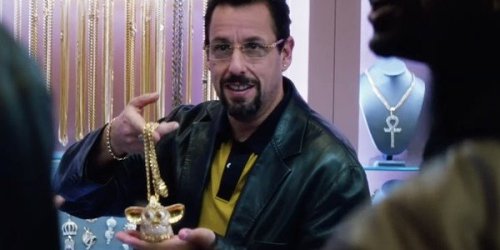
Funnyman Adam Sandler undergoes a remarkable transformation in  “Uncut Gems.”  He’s really, really effective as a Diamond District hustler whose debts and sins are rapidly closing in on him.

That said, the latest from the writing/directing Safdie Brothers (Benny and Josh) is like having an irate New Yawk cabbie screaming nonstop in your ear for two-plus hours.

Sandler plays Howard Ratner, the middle-aged proprietor of a Manhattan jewelry store.  He calls himself a jeweler but he’s not so much an expert in gemology as he is a full-time con artist, always looking for his next (not necessarily legal) kill.

Howard is an inveterate gambler who always is nurturing a get-rich-quick scheme.  He’s got a furious wife (Idina Menzel) and kids in the ‘burbs,  a girl squeeze (Julia Fox) he keeps in an apartment in the city, and a crushing gambling debt that finds him being stalked by a pair of underworld enforcers  (Tommy Dominik, Keith William Richards).

Howard’s sure that his latest scheme will turn everything around. He has somehow gotten his hands on a “black opal,” a fist-sized gem smuggled out of Africa.  He’s already arranged to have this spectacular rock sold by a prestigious auction house; surely it will leave him set for life. Or at least alive.

Or maybe not.  His streetsmart associate Demany (LaKeith Stansfield) introduces Howard to basketball star Kevin Garnett (playing himself, and most convincingly), who so loves the big opal that he asks to carry it around with him for a few days. He comes to regard it as his good luck charm.

Always looking for an edge, Howard agrees, figuring that a generous gesture now will turn the sports millionaire into a long-term bling buyer. Continue Reading »

Jonathan Pryce, Anthony Hopkins

“THE TWO POPES” My rating: B+

125 minutes | MPAA rating: PG-13

At its best “The Two Popes” is a monumental acting duel that’ll leave viewers in open-mouthed amazement.

The subjects of Fernando Meirelles’ witty and ultimately heart-tugging drama are the German Joseph Ratzinger (Anthony Hopkins), who would become Pope Benedict XVI, and the Argentinian Jorge Bergoglio (Jonathan Pryce), our current Pope Francis.

Essentially the tale told by screenwriter Anthony McCarten is one of the passing of power from one pope to the next, and how that exchange heralds a possible new beginning for Roman Catholicism. The details are fictional — the spectacularly wrought conversations McCarten delivers are his own creation — but the overall portrait he paints of these two men and the church they represent feels utterly true.

The film begins in 2005 with a convocation of cardinals to vote on a new pope.  Ratzinger — a dogmatic conservative deeply suspicious of efforts to modernize the Church — actively campaigns for the job.  He views the reform-minded Bergoglio, the favorite of the liberal cardinals, with thinly-veiled contempt.

As the two stand side by side at a sink in a Vatican restroom, Bergoglio absent-mindedly whistles “Dancing Queen.”  Ratzinger asks: “What is that hymn you’re whistling?”  Turns out he’s never heard of Abba.

A small moment, but an illuminating one. Ratzinger is an intellectual, emotionally remote, authoritarian, with little or no interest in popular culture. Even some of the faithful dismiss him as a “Nazi.”

Bergoglio is his polar opposite, a beloved charmer with the common touch, a man whose hobbies include tango dancing and soccer (for an Argentinian they are practically compulsory, he notes).

Ratzinger, of course, becomes the next pope.
Continue Reading »

August Diehl, Valerie Pachner

“A HIDDEN LIFE” My rating: B+

173 minutes | MPAA rating: PG-13

Spirituality is not something the movies do particularly well.  After all, it’s a visual medium; the inner workings of the heart are not easily captured by the camera.

Leave it to Terrence Malick, the most idiosyncratic American filmmaker ever, to find a way to put a human soul on the movie screen.

In “A Hidden Life” Malick explores the true story of Franz Jaggerstatter, an Austrian farmer who at the height of World War II decided he could not take an oath of loyalty to Adolf Hitler and so spent the rest of his days in a series of grim Nazi prisons.

Jaggerstatter’s story is, unlike most recent Malick films (the magnificent “Tree of Life” and the irritating “To the Wonder”) a fairly linear one.  But the Texas-based auteur brings to the table his trademark eye-of-God perspective, so that while “A Hidden Life” unfolds in more or less chronological order, it’s filled with visual and aural digressions.

The results are heartbreaking, moving and inspiring.

Malick opens his film with footage of Adolf Hitler from Leni Riefenstahl’s propaganda documentary “Triumph of the Will.”

We then meet Franz (sublimely underplayed by August Diehl) and his wife Fani (Valerie Pachner) swinging scythes in a blindingly green field overseen by rugged alpine crags.  A towering church steeple is always in the background, a reminder not only that Franz is a volunteer sexton (he’s the village bell ringer) but that he takes his religion very seriously.

In a series of interlocking scenes, some only seconds long and dealt like cards from a Tarot deck, we get a sense of life in this tyrolean paradise, Franz and Fani’s courtship, and the life they have built together on a drop-dead beautiful mountainside with three daughters.

It’s a world centered on home, family, farm and village. And it’s almost too beautiful and peaceful for words.

But there are intimations of things going on in the larger world. Fani freezes as an unseen plane passes overhead. Franz has furtive conversations with fellow villagers who share his anti-Nazi sentiments. The mayor (Karl Markovics) when in his cups lets fly with rants about inferior races.

Franz takes his concerns to the local priest (Tobias Moratti), who is sympathetic but advises him to shut up and do what’s asked of him: “You’ll almost surely be shot. Your sacrifice will benefit no one.”

Not even a session with the area bishop (Michael Nyqvist) provides a satisfactory answer to Franz’ heartfelt query: “If our leaders are not good, if they’re evil, what does one do?”

Continue Reading »

Taylor Swift

“CATS” My rating:  C+

110  minutes | MPAA rating: PG

It’s taken the musical “Cats” nearly 40 years to make its way from the stage to the big screen. Now we know why.

Just as there are some novels that defy dramatization, so there are stage productions that derive their power from the interaction of audience and performer, that work precisely because the viewer realizes that all the magic unfolding in front of him/her is being created by real people in real time.

Tom Hooper’s movie version, on the other hand, has been so digitally diddled with that we can’t be sure that anything we’re seeing — from the settings to the performers’ faces — is even remotely real. Characters do impossible flips in the air,  cockroaches march in formation…it’s all so artificial that the film might as well have been done as pure animation (actually that was the plan, back in the ’90s).

That said, the movie “Cats” isn’t a total wipeout. The score (the tunes are by Andrew Lloyd Webber, the lyrics derived from T.S. Eliot’s book of poems Old Possum’s Book of Practical Cats) remains humworthy and at least a couple of the performers manage to transcend their hairy makeup (all too often they look like werewolves from a ’60s Hammer film) and establish an emotional connection with the audience.

A big problem is that “Cats” lacks a real story.  On stage this wasn’t a deal breaker…the show was a musical revue with different “cats” taking center stage to sing and dance their signature numbers.  What plot there was dealt with the approaching Jellicle Ball where one lucky feline will be chosen by the ancient Deuteronomy to be reincarnated into a new life (cats get nine of them, after all).

The screenplay by Lee Hall and Hooper  centers on Victoria (ballerina Francesca Hayward, who seems capable of expressing only a quizzical attitude), abandoned by her owner in a dirty alley and adopted into the Jellicle tribe.  Her guide and guardian is Munkstrap (Robbie Fairchild), who introduces her to various other characters and the rundown corner of London they call home.

Continue Reading »

Charlize Theron, Nicole Kidman

“BOMBSHELL”   My rating: B

108 minutes | MPAA rating: R

Simultaneously an insider’s look at Fox News, a record of the rise of Trump, and an examination of sexual harassment in the workplace, “Bombshell” can boast of terrific timeliness and a killer cast of women (and one man).

What it doesn’t have is much emotional pull — aside, of course, from the indignation it’s sure  to generate in response to the culture of crassness fomented by the late Roger Ailes.

Jay Roach’s film centers on three women struggling to forge and maintain careers at Fox  News.

Two of them — network stars Gretchen Carlson (Nicole Kidman) and Megyn Kelly (Charlize Theron) — are of course real people.  The third, a newcomer to the network named Kayla Pospisi (Margot Robbie), is fictional.

Early in Charles Randolph’s screenplay Carlson secretly meets with a couple of lawyers. She’s on thin ice at the network, both for her show’s ratings and her feminist inclinations (doing one broadcast sans makeup as a sort of statement of solidarity with women viewers). Her chafing at being Barbie-tized will likely lead to her demotion or dismissal; when that day comes she wants to have plenty of documentation about groping and sexual intimidation in the hallowed halls of Fox.

Meanwhile Kelly (Theron looks so eerily like the real Kelly that audiences will end up doing double takes) makes the mistake of daring to ask tough questions of then-candidate Trump and so becomes the public object of the Donald’s ridicule (“She had blood coming out of her whatever”). Suddenly she’s the story; it’s not a comfortable place to be.

Finally there’s Robbie’s Kayla, daughter of conservatives from Out West, evidently religious, and fiercely ambitious.  She learns the Fox ropes from her cubicle mate (Kate McKinnon), a closeted lesbian, but has to make a decision when given the choice of trading a blowjob for a promotion.

Continue Reading »

Sam Rockwell, Kathy Bates, Paul Walter Hauser

“RICHARD JEWELL” My rating: B

129 minutes | MPAA rating: R

Nearly 50 years ago the great New Yorker film critic Pauline Kael wondered (in a review of Sam Peckilnpah’s “Straw Dogs,” I recall) whether fascist art was even possible.

Of course she hadn’t met late-stage Clint Eastwood.

Not that Eastwood is a fascist. But his right-leaning attitudes (in this case a big-time distrust of big government and the media, an attitude he shares with our President) are on full display in “Richard Jewell,” the fact-based story of a hero who overnight became a scapegoat.

Jewell, of course, was the security guard who at the 1996 Olympics in Atlanta discovered an abandoned backpack containing several pipe bombs. He was instrumental in clearing civilians from the area; nevertheless, in the ensuing explosion two persons died and more than 100 were injured.

For a few days Jewell was a national hero; then the FBI decided he perfectly fit the profile of the hero bomber, a man (usually white, often a law enforcement wannabe) who sets up a crisis situation so that he can play the role of a hero in saving lives. And from that point on Richard Jewell’s life became a living hell.

Billy Ray’s screenplay introduces us to Richard  (a spectacular Paul Walter Hauser) in the months before the incident. He’s working in a government office pushing around a supply cart when he meets Watson Bryant (Sam Rockwell), a combative attorney chafing under civil service bureaucracy.

Watson is initially amused by Richard, an obese fellow who years earlier had been fired from his job as a deputy sheriff and has a desperate (and wildly unrealistic) desire to get back into law enforcement. Richard is a doofus, no doubt, but a sweet and polite doofus. The two start sharing lunches, at least until Richard gets a job as a security guard at a nearby college.

That doesn’t last, either. He gets into physical confrontations with the students; he pulls over speeders on a nearby highway even though he has absolutely no jurisdiction off campus. Good news, though…with the Olympic games coming to town there’s a big demand for security personnel.

Continue Reading »

Felicity Jones, Eddie Redmayne

“THE AERONAUTS”  My rating: B  (Now showing at the Glenwood Arts; on  Amazon Prime Dec. 20)

100 minutes | MPAA rating: PG-13

An aerial thriller packed with gobsmacking visual splendors, “The Aeronauts” is also historically based…though not so much as to let facts muck up our enjoyment.

In 1862 two Londoners — one a sort of female daredevil and the other a stuffy scientific sort — risk their lives on a balloon ride into sky. Their goal is to set an altitude record for human survival…at that time about 20,000 feet.

They’ll go considerably higher than that.

Our protagonists are Amelia Wren (Felicity Jones), an experienced balloonist thanks to her late lamented husband, and James Glashier (Eddie Redmayne), who is something of a laughing stock in the science community for his theories on weather prediction.

For her the ascent is a chance to commune privately with the spirit of her dead love and revel in the wonders of our atmosphere; for him this initial ride into the sky will allow him to take measurements that will bring about understanding of the nature of this envelope of air in which our Earth resides.

There really was a James Glashier, although in 1862 he was an overweight middle-aged husband and father and already respected in scientific circles. Amelia Wren, however, is the fictional creation of director Tom Harper and co-writer Jack Thorne, an obvious attempt to create a heroic female protagonist who will resonate with women viewers.  Not that I’m complaining.

The film begins with the pair’s sendoff before a wildly cheering crowd in a London park.  Amelia arrives in paint and shortened petticoats to do cartwheels before the wicker gondola and pose prettily.  Glashier is embarrassed by all the show-biz hoopla.

But before long they’re airborne for a ride that in just 90 minutes will test them to the limit.

Continue Reading »

Kelvin Harrison Jr., Alexa Demie

“WAVES” My rating: B+

135 minutes | MPAA rating: R

“Waves” is about a suburban American family coming apart at the seams.  Featuring plot elements like teen pregnancy, substance abuse — even murder — it promises a melodramatic rollercoaster ride.

But writer/director Trey Edward Shults’ third feature (after the dysfunctional-family-reunion drama “Krisha” and the end-of-the-world-horror entry “It Comes at Night”) is more insightful than exploitative.  He’s aiming at something profound:  forgiveness.

The film’s first hour concentrates on Tyler (Kelvin Harrison Jr.), a handsome and charismatic high school senior with the world ahead of him.  He hopes to parlay his wrestling skills into a college scholarship; he has a beautiful girlfriend, Alexis (Alexa Demie); he’s a conscientious student and a talented pianist.

He lives in a nice home in Florida with his father Ronald (Sterling K. Brown), his stepmother Catharine (Renee Elise Goldsberry) and his younger sister Emily (Taylor Russell).

But small chinks are apparent in this happy facade.  Ronald, a homebuilder, practices tough love.  He insists on training with Tyler, injecting an element of unhealthy competition into the father/son dynamic. Ronald belongs to a generation of black men who see America as a racially charged environment, and so is always pushing his son: “We’re not afforded the luxury of being average.”

(For the young people depicted here, being black or white is a non-issue. They live in their own world of racial fluidity, leaving all the breast thumping to their elders.)

Tyler’s world comes crashing down when an MRI reveals a career-ending shoulder injury.  The doctor tells him to immediately stop physical activities and prepare for surgery; instead Tyler keeps this devastating diagnosis to himself, continues wrestling (until the pain won’t allow him to any more) and self medicates with liquor and pills stolen from his parents.

And for the perfect frosting on his very bad week, Alexis reports that she has missed her period. Tyler, panicked, pushes her to have an abortion. Result: an acrimonious breakup.

Then things get really ugly.

Continue Reading »