Crime story and folklore entwine in “Birds of Passage,” Colombia’s nominee for this year’s foreign language film Oscar.
Cristina Gallego and Ciro Guerre’s decades-spanning saga, which follows the creation of that country’s drug trade in the late 1960s by indigenous peoples, blends stark realism with magic realism for an experience that plays less like “The Godfather” than “Days of Heaven.”
Initially the film resembles a documentary about the Wayúu tribe occupying a remote, desert-like stretch of northern Colombia. A celebration is in progress, a sort of bat mitzvah to welcome the beautiful Zaida (Natalia Reyes) to her status as a grown woman. She’s now available for marriage and almost immediately she is claimed by Rapayet (Jose Acosta), a handsome young man from a neighboring family.
Zaire’s mother Ursula (Carmina Martinez), the clan’s matriarch, isn’t impressed with Rapayet’s credentials and sets an impossibly high dowry for her daughter’s hand. Rapayet doesn’t know how he’ll find the resources…until he runs into a couple of young Peace Corps volunteers looking to score weed.
Rapayet has some friends who grow the stuff up in the mountains, and with his colorful bud Moises (Jhon Narvaez) starts a distribution business that not only brings him Zaire’s hand but unanticipated riches. Eager gringos scoop up Rapayet’s marijuana and fly it to the U.S.; before long Rapayet and Zaire are living in a very modern new mansion (which, weirdly enough, is situated on a vast, dried-up mud flat — I kept wondering about water and sewage issues).
But Rapayet’s business corrupts not only himself but an entire way of life. Steeped in tradition and devoted to ideas of honor and sacrifice, the Wayúu quickly succumb to the get-rich-quick, trigger-happy mentality that spreads like a cancer throughout the tribe.
Give the makers of “Finding Steve McQueen” credit for at least shaking up the parameters of your standard heist movie.
For starters, this fact-based caper film about the biggest bank haul in U.S. history is thick with comic overtones thanks to a doofus of a leading man and a goofy gang of miscreants.
For another, it employs a scrambled narrative that hopscotches back and forth in time.
“Finding Steve…” centers on Harry Barber, a minor participant in the event but the only one still around to tell the tale.
Mark Steven Johnson’s film begins with Harry (Travis Fimmel) in the present (actually the early ’80s). He’s agitated. All worked up. Hearing his panicked confession, his girl Molly (Rachael Taylor) — the daughter of a local cop — freaks out when she realizes the man she’s loved for several years isn’t who he said he was.
He is, in fact, the last free member of a notorious gang, and now his time is running out.
Then we flash back to Ohio in 1972. Harry — who so worships the films of Steve McQueen that he sports “Bullitt”-ish sunglasses, a blond ‘do and tools around in muscle cars — does jobs for his uncle Enzo (William Fichtner), a veteran thief. Enzo has somehow learned that in a safe deposit box in a little nondescript bank in California there sits millions of dollars in a secret (and illegal) slush fund for President Richard Nixon. (This is true.)
Nixon-hater Enzo decides to rip off Tricky Dick…and posits that since the money is dirty the administration will probably not want to publicize the crime or make too big an effort to identify the perps.
“Climax” may be the most accessible film yet from cinematic evil genius Gaspar Noe (“I Stand Alone,” “Irreversible,” “Enter the Void”). Which is not to say that it is easy movie watching.
“Climax,” like most of Noe’s output, is a celebration of perversity.
It opens with the closing credits (???) and an overhead shot of a scantily clothed and bloodied woman struggling through a field of snow; then shifts into documentary mode before becoming an energetic dance film and ultimately deteriorating into a paranoia-fueled nightmare.
A title card informs us that the story was inspired by actual events in 1996…but I’m not buying that notion any more than I believe “Fargo” was actually based on a real crime.
For 10 or so minutes we get talking-head documentary interviews with a bunch of young French dancers who have auditioned for a special troupe preparing to tour the U.S.A. With few exceptions they lack formal training; most appear to be kids (all races and ethnicities) who learned their moves on the streets and sidewalks. Some of them are eager and ambitious; others a bit jaded and wary of their newfound legitimacy.
Noe then cuts to a long (like, 15 minutes) single-shot rehearsal in which the youngsters do an elaborate routine that allows for plenty of individual riffing (lots of spectacular hip-hop: locking, popping, cranking) all set to a deafening and hypnotic techno beat.
It’s exhilarating and wildly entertaining, and when it’s over the viewer — like the dancers themselves — is spent and ready for a bit of r&r.
“Never Look Away” is so many things at once that it takes a good chunk of its three-hour running time for it to settle down and take shape.
It is the latest from writer/director Florian Henckel von Donnersmarck, whose 2006 “The Lives of Strangers” (set in the repressive world of the East German secret police) won the Oscar for foreign language film.
This new effort is at various times a history of modern Germany, a family saga, a personal odyssey and, ultimately, a story of finding one’s voice in a world determined to tell us what to think, feel and express.
It begins in Nazi Germany at the notorious exhibition of “degenerate” modern art. An insufferably pompous guide describes how in their paintings artists like Picasso and Kandinsky promote “madness and mental illness.”
But among the gallery visitors are the beautiful Elisabeth (a screen-dominating Saskia Rosendahl) and her young nephew Kurt (Cai Cohrs), who though a child is already drawing like an adult. “Don’t tell anybody,” Aunt Elisabeth whispers in his ear, “but I like it.”
The first hour of “Never Look Away” follows Kurt’s boyhood. Aunt Elisabeth is lively and charming…and also schizophrenic. One day Kurt follows the sound of piano music to find Elisabeth sitting nude at the keyboard. He’s both appalled and fascinated.
“Never look away,” she tells him.
In Hitler’s Germany, alas, mental illness is something to be eradicated rather than treated. Kurt’s beloved aunt is hauled off by men in white coats and vanishes into a medical system that, if she’s lucky, will only sterilize her.
Meanwhile Kurt’s family suffers; his father loses his teaching job after declining to join the Nazi Party; eventually he relents. Then, after their town is “liberated” by the Russians, he is told his party membership will keep him from ever teaching again. Menial labor is all that’s left.
In the second hour Kurt (now a young man played by Tom Schilling) hand-paints signage, is admitted to an art training program, and finds himself forced to adhere to a soul-numbing socialist realism style as doctrinaire as anything embraced by the Third Reich (peasants with scythes staring bravely into the future). One bright spot: he falls for a fellow student (Paual Beer) who is not only named Elisabeth but physically resembles his lost aunt.
The downside is Elisabeth’s father, Carl (Sebastian Koch), a famed (and arrogant) gynecologist who once embraced Nazi eugenics, managed to elude trial as a war criminal, and now is a vocal supporter of Communism. Carl doesn’t view a struggling artist as good son-in-law material. (Turns out that Carl and young Kurt have a connection that neither is aware of…I won’t give it away here.)
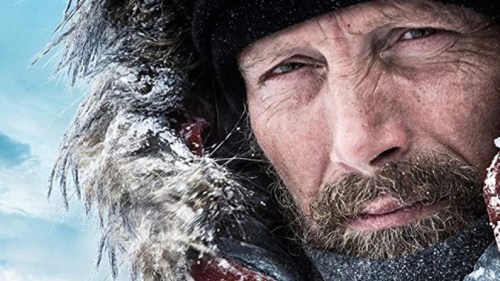
The man-in-the-wilderness survival drama “Arctic” probably didn’t need a world-class actor.
After all, there’s almost no dialogue and the star of the show spends half the time with his features hidden behind a parka hood. Just about any able-bodied thespian could have handled it.
Even so, give thanks that the great Mads Mikkelsen signed up for this nail-biting bit of outdoor adventure.
Joe Penna’s film begins with a man in a red parka using crude tools to shovel away the white snow to reveal the black rocks beneath. An overhead shot shows him to be making a huge SOS sign that can be seen by passing aircraft.
Our protagonist (Mikkelsen) has already been stranded in the snowy wastes for days. He survived the wreck of his airplane, which remains intact enough to serve as a shelter. He’s dug holes in the ice and is catching fish, eating some raw and freezing the rest.
And then, rescue! A helicopter appears and attempts to land. But a gust of wind sends it tumbling. The sole survivor is the pilot (Maria Thelma Smaradottir), a young woman rendered unconscious by the impact.
The man takes her to his plane and sees to her wounds. But she does’t wake up. Only the fluttering of her eyelids suggests an inner life.
“RODENTS OF UNUSUAL SIZE” My rating: B-(Now available from Amazon Prime Video)
71 minutes | No MPAA rating
The 20-pound, orange-fanged nutria is a South American rodent imported to Louisiana during the Great Depression as an alternative to mink farming.
But the furiously reproductive (four litters a year) creatures escaped captivity and made a new home in the swamps and bayous, which they are rapidly destroying with their voracious appetites. The greenery-scarfing nutria have ravaged the natural landscape, bringing on increased flooding; already humans are abandoning towns and farms in low-lying areas because the vegetation that once held back the waters has vanished down the nutrias’ gullets.
This ecological disaster is the subject of “Rodents of Unusual Size” (the tongue-in-cheek title is a line from “The Princess Bride”), a kitchen-sink documentary that finds equal parts humor and horror in the situation.
Directed by Chris Metzler (whose docs about California’s inland Salton Sea and the funk band Fishbone were hits at past Kansas City Film Festivals), Quinn Costello and Jeff Springer, “Rodents…” covers the nutria phenomenon from just about every angle.
We meet bayou denizens whose sole source of income is harvesting nutria and cutting off their ratlike tails to turn in for a $5 bounty. The piled corpses are left to rot.
We encounter fashionistas who have revived the use of nutria fur (apparently the bad juju of wearing the skins of caged animals raised for slaughter doesn’t apply here).
We meet a New Orleans jazz musician who as a sideline cooks up nutria (we’re told it doesn’t taste like chicken).
Actor Wendell Pierce (“Treme”) narrates an animated segment outlining the history of nutria farming.
Though it has a running time of only a bit over an hour, “Rodents…” feels padded. Metzler, Costello and Springer end up repeating themselves to make the film of (barely) feature length; perhaps they would have been better off with a tightly-constructed documentary short.
Nevertheless, there’s enough of interest here to keep us engaged. In the end, it’s a tossup as to whether mankind or rodentkind will emerge victorious.
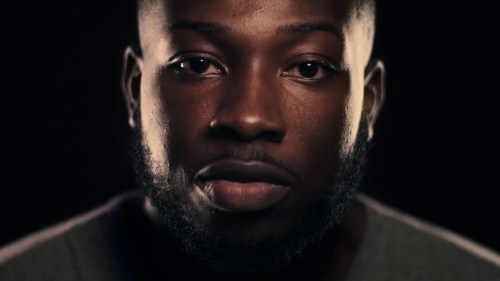
In “Black Sheep” a young black man named Cornelius Walker describes how as a child he was uprooted from his multicultural London neighborhood (his Nigerian parents feared urban violence) and relocated to a tiny burg in Essex.
There he encountered worse racism than he’d ever experienced in the big city. He was cursed and beaten and, in a desperate effort to gain acceptance, even bleached his skin and wore blue contact lenses.
And it worked. Over time Cornelius was taken in by his one-time persecutors; ironically, to please them he found himself imitating the same violent and racist behavior he sought to escape.
“I wanted love, so I made friends with monsters,” he says.
Ed Perkins and Jonathan Chinn’s doc is about 1/4 talking-head interview with Walker; the rest of the film consists of dramatic re-creations employing actors. Thirty years ago this format would have earned the contempt of documentary purists. But times change. The result is a devastating look at racism and human nature. “END GAME” (USA, 40 minutes) A
Movies don’t get more real than “End Game,” Rob Epstein and Jeffrey Friedman’s gut-twisting/transcendent look at life in a hospital ward dedicated to dying.
Epstein and Friedman — whose resumes include films as diverse as “The Celluloid Closet,” “Paragraph 175” and “The Times of Harvey Milk” — turn their cameras on the medical professionals, patients and families living and dying in the University of California Med Center in San Francisco.
Over its 40 minutes we get to know a good many of these folk who — unlike the rest of us — can no longer ignore the ultimate reality of death. They have to decide how they are going to die — not just the medical side but the human side.
“Every moment is still a gift” says one patient; even so, not every patient is willing to endure debilitating treatments in order to gain a few days or weeks.
As you’d expect, the material is explosively emotional. One is left with the utmost respect for the individuals (and their families) who were wiling to share the intimacy of their last days…not to mention the realization that the things happening on screen will undoubtedly happen some day to each and every one of us.
“LIFEBOAT” (USA, 40 minutes) B
Every year thousands of North Africans flee poverty, war, persecution and famine by clambering aboard waterlogged small boats for a dangerous trip to Europe. One in 18 of them drowns.
Skye Fitzgerald and Bryn Mooser’s “Lifeboat” looks at the efforts of the German non-profit Sea-Watch to rescue these hapless immigrants. Their cameras are aboard one rescue vessel when it comes across three boats carrying more than 1,000 refugees.
It’s an instant humanitarian emergency. These travelers suffer from dehydration, heat stroke, sea sickness…and there’s a slew of pregnant women, some of whom have gone into labor.
In the relative calm after they’re taken aboard several of these refugees explain where they come from and how they came to be on an overcrowded boat in the middle of the Mediterranean.
The captain of one of the rescue vessels says that with just one turn of the historical cycle the comfortable Western countries could find themselves living a Third World existence…and at that point their residents would become the riffraff that nobody cares about. “A NIGHT AT THE GARDEN” (USA, 7 minutes) B+
Despite a running time of only 7 minutes, Marshall Curry’s “A Night at the Garden” packs an emotional and intellectual punch that leaves viewers reeling.
In effect, Curry offers us documentary footage of a 1939 rally in Madison Square Garden attended by 20,000 Nazi supporters.
Not Germans.
No these were red-blooded American citizens who stared lovingly at banners equating George Washington and Adolf Hitler and wildly applauded bombastic make-America-great-again rants from swastika-bedecked orators. At one point a protestor somehow gets onto the stage and is beaten for his efforts while the crowd roars its approval.
One assumes that Curry has edited and shaped this archival footage…or perhaps he just threw it up on the screen as he found it. In the end it doesn’t matter. “A Night at the Garden” reveals a disturbing bit of American history that today looks all too familiar.
“PERIOD. END OF SENTENCE” (India, 26 minutes) B+
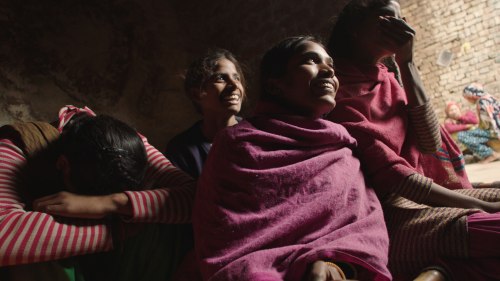
The lowly sanitary napkin hardly seems like the flashpoint for a revolution. That is, until you visit parts of rural India, where ignorance of the female anatomy and psyche is so complete that a young man, asked about menstruation, answers: “It’s a kind of illness right? Mostly affects girls?”
Rayka Zahtabchi and Melissa Berton’s “Period. End of Sentence” is about Kotex coming to the sticks. Or at least a locally-produced sanitary pad, hand-crafted by women (for most, it’s their first paying job) in a small factory and distributed to customers who initially have no idea what it is or how to use it.
Only 10 percent of Indian women use sanitary pads, we’re told. Which explains why every farming community has a vacant lot or field littered with hundreds of bloody rags, the result of the female population dealing with their periods in the age-old manner.
In a paternalistic society where menstruation is a taboo subject and girls are told that the prayers of a menstruating female will not be heard, something as seemingly retro as readily available sanitary napkins can become the spearhead of a feminist movement. And that’s the sort of uplifting momentum
“Period…” sets in motion.
“DONNYBROOK” My rating: C (Opens Feb. 15 at the Screenland Tapcade)
101 minutes | MPAA rating: R
“Donnybrook” is a fistful of cheap melodrama, what with its emphasis on the drugs and violence its protagonist encounters en route to an underground bareknuckle slugfest.
At least give writer/director Tim Sutton props for trying to elevate this yarn with the sort of ashcan realism and social commentary most commonly found in the work of Brit auteur Ken Loach (“The Angels’ Share,” “Jimmy’s Hall,” “I, Daniel Blake”).
Which is not to say that Sutton pulls it off. You can see him struggling to give this chunk of cheese relevance by peppering it with observations on blue-collar American angst. That approach worked in “Hell or High Water”; here not much of it sticks.
When we first encounter Jarhead Earl (Jamie Bell…yeah, the original Billy Elliott) he’s robbing a gun store and smashing the owner in the face. This is our hero?
Well, yeah. Jarhead may do bad things, but he does them to support his meth head wife (Valerie Jane Parker) and two young kids. By the logic of “Donnybrook” this makes him a hero. Everybody else in sight is far worse.
Especially Chainsaw Angus (Frank Grillo), the neighborhood drug dealer. Accompanied by his sister Delia (Margaret Qualley), with whom he has a master/slave relationship that reeks of incest, Chainsaw cuts a wide path of bloody destruction. He may be the only dealer who’d rather kill his clients than sell them drugs.
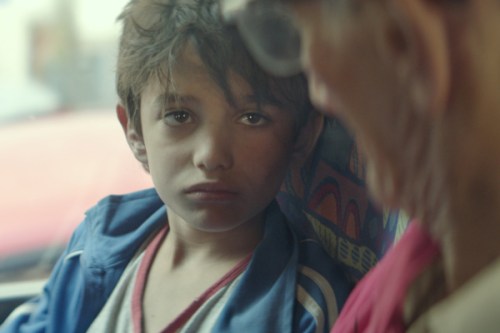
Personal drama and social commentary find an almost perfect marriage in “Capernaum,” an Oscar-nominated (for foreign language film) heartbreaker about a little boy navigating life on the mean streets of Beirut.
Written and directed by Nadine Labaki (whose earlier efforts — “Caramel” and “Where Do We Go Now?” — look simplistic by comparison), “Capernaum” stars 12-year-old Zain Al Rafeea, who gives a performance for the ages.
The story is bookended by a trial. Young Zain (Al Rafeea) is currently in juvenile lockup for, in his words, “stabbing the son of a bitch.” Now he has dragged his no-good parents (Kawsar Al Haddad, Fadi Yousef) into court; basically he’s suing them for giving birth to him.
Filmmaker Labaki does not dwell long on this improbable spectacle. Most of “Capernaum” is a long flashback depicting how things came to this sad state. Zain’s journey is like that of a Dickens protagonist through a world of few pleasures and much indifference.
Right from the get-go it’s obvious that Zain is one tough little guy. He swears like a sailor and has a chip-on-his-shoulder attitude. He is uncowed by adult authority and is openly contemptuous of his parents, crooks whose current scam is delivering drug-impregnated clothing to Zain’s imprisoned older brother.
The only family member Zain cares about is his older sister Sahar (Haita ‘Cedra’ Izzam). When the frightened girl experiences her first period, Zain explains what’s what and gives her his T-shirt to use as a menstrual pad, warning her not to tell anyone that she’s reached this milestone. Sure enough, once their parents get wind of Sahar’s condition they sell her to their landlord.
2018 OSCAR-NOMINATED LIVE ACTION SHORTS Overall rating: B+
109 minutes | No MPAA rating
“MADRE” (Spain, 19 minutes)
In this gripping nail biter form Spain a young mother (Blanca Apilanez) receives a call from her 6-year-old son, Ivan, who is vacationing with his father. (The couple are divorced or separated.)
Little Ivan is using his dad’s cell phone to report that he’s alone on a beach. He doesn’t know his location. His father left him there and hasn’t returned.
Mom keeps the boy calm; no doubt her ex will soon return. But the situation quickly escalates when Ivan reports the appearance of a strange man who starts chasing him…
The direction by Rodrigo Sorogoyen and Maria del Puy Alvarado is like a precision watch wound to the breaking point; the tension generated by this setup is almost unbearable.
In fact, the pure storytelling is so overwhelming that it takes a while for viewers to discover that, incredibly enough, the bulk of the film is one uninterrupted shot unfolding in Mom’s apartment. The logistics of pulling off this tour de force are daunting. But “Madre” delivers.
“FAUVE”(Canada, 17 minutes)B
Two boys are roughhousing in what looks like an abandoned strip mine. For several minutes they dare each other to do dangerous things, wrestle and climb over rusting equipment.
But then they find a manmade lake. It looks enticing…until they discover to their horror that the muddy banks are the consistency of quicksand and can quickly pull a child to his doom.
Jeremy Comte and Maria Gracia Turgeon rev up the tension and fear and leave us with a haunting depiction of a young life all but ruined.
“MARGUERITE”(Canada, 19 minutes)B+
The elderly Marguerite (Beatrice Picard) lives for the daily visits by her caregiver Rachel (Sandrine Bisson). But when she learns that Rachel is in a relationship with another woman it triggers Marguerite’s own memories of a stymies girl-on-girl romance from long ago.
This film from Marianne Farley is a study in gentle revelation, a heartbreakingly tender look at the life that its protagonist might have had.
“DETAINMENT” (Ireland, 30 minutes)A-
Based on a 1993 murder case that rocked Great Britain, “Detainment” is a docudrama zeroing in on the police interrogations of two 10-year-old Liverpool boys who eventually were convicted of killing 3-year-old James Bulger, whom they kidnapped from a shopping mall.
The dialogue in Vincent Lambe and Darren Mahon’s film was drawn almost entirely from the recordings of the police sessions with the boys, and what emerges is one of the most harrowing 30 minutes of cinema imaginable.
The young killers — interrogated separately but in the presence of their stricken and disbelieving parents — pose a perplexing contrast.
Jon (Ely Solan) is terrified and panic stricken, weeping helplessly in his mother’s arms. He paints himself as a victim of his partner’s malignancy.
Robert (Leon Hughes) is, by contrast, a psychopath in training, a defiant little shit who lies nonstop and uses mind tricks to try to derail the cops as they build their case. He says it was all Jon’s idea.
In all probability neither could have done it alone, but together the boys proved a lethal mix.
As ghastly and off-putting as this tale is, there is no question that Masters Hughes and Solan deliver two of the most amazing performances by child actors ever captured on film.
“SKIN” (USA, 20 minutes) B
The first moments of Guy Nattiv’s “Skin” offer a touching display of family warmth. A young boy, Troy (Jackson Robert Scott), is getting a front-porch haircut from his doting dad, Johnny (Jonathan Tucker). Then, with Mom (Danielle MacDonald), they drive out to the country with friends for a day of shooting up old cars.
Little Troy proves a crack shot with a rifle, much to his father’s delight.
Just one problem with this cozy scene. Johnny and his pals are virulent racists. We’d know that just from their tattoos, but that night upon returning to town they nearly beat to death a black man in front of his wife and children.
The friends of the victim seek revenge, not through violence (though they do kidnap Johnny right in front of his distressed son) but by using ink and a tattoo needle to turn the racist into that thing he hates so much.
With its emphasis on irony “Skin” plays a lot like an updated episode of “The Twilight Zone” or “Alfred Hitchcock Presents.” Its melodramatic elements almost go too far, but the performances keep it all in check.
(Interestingly enough, the short “Skin” is a companion piece to a feature film by Nattiv also called “Skin.” In the feature Jamie Bell portrays a real-life skinhead who rejected his racist upbringing and systematically had all his hateful tattoos removed.)
 “BIRDS OF PASSAGE” My rating: B







 Butler's Cinema Scene