Feeds:
Posts
Comments

Emily Blunt

“MARY POPPINS RETURNS” My rating: B+ (Opens wide on Dec. 19)

130 minutes | MPAA rating: PG

First, the most obvious question: Is “Mary Poppins Returns” as good as the 1965 original?

Answer: No.  But  it comes close.

Disney’s original “Poppins” is one of — if not the — greatest family films of all time. Everything about it works, from the performances to the writing, the execution, and especially the Sherman Brothers’ astounding score of instantly hummable songs.

So when director Rob Marshall (“Chicago,” “Into the Woods,” “Nine”) took on this sequel, he had a lot to live up to.

Mostly he succeeds. There are a few flat sequences and the new Music Hall-steeped score by Marc Shaiman and Scott Wittman, while perfectly serviceable and occasionally inspired (the moving “The Place Where Lost Things Go, for example), is never as catchy as the original.

But Emily Blunt makes for a slyly entertaining Mary, “Hamilton” star and creator Lin-Manuel Miranda makes a solid film debut, and several of the musical numbers  are showstoppers.  A delectable sense of childlike wonder prevails.

The plot cooked up by David Magee, John DeLuca and Marshall draws heavily from P.L. Travers’ nine “Poppins” books, and in many instances offers a sort of variation on high points from the ’65 film.

The setting has been advanced from pre World War I London to the Depression era.  Michael and Jane Banks, the kids from the original, are now adults (played by Ben Whishaw and Emily Mortimer).  Michael, the widowed father of three, still works at the bank where his father was employed; Jane, taking a cue from her suffragette mother, is a labor organizer.

Michael, who is hopeless with money, is about to lose the family home to foreclosure by his own employer (represented by two-faced exec  Colin Firth).  The family’s only hope is to find a small fortune in bank shares purchased decades earlier — but the papers have all gone missing.

Into this tense situation who should appear but Mary Poppins (Blunt), who in her own no-nonsense way organizes and entertains  the incredibly adorable kids (Pixie Davies,  Nathanael Saleh and Joel Dawson) with a series of fantastic adventures.

Our narrator through all this is a lamplighter, Jack (Miranda), who serves precisely the same function as did Dick Van Dyke’s chimneysweep Bert in the original. Introduced with the song “Lovely London Sky,” Jack is featured in “Trip a Little Light Fantastic”  featuring a host of dancing lamplighters that mirrors the “Step in Time ” extravaganza from 1965.

Continue Reading »

Yalitza Aparicio

“ROMA” My rating: B+ 

135 minutes | MPAA rating” R

A personal memoir set against a moment of national trauma, “Roma” is the most overtly artistic of Alfonso Cuaron’s films.

Unlike the bulk of his resume (“A Little Princess,” “Children of Men,” “Gravity” and a “Harry Potter” installment), it has nothing to do with science fiction, fantasy or the future.

Instead it is like a perfectly composed snapshot of a time gone by. (It’s even been filmed in eye-pleasing widescreen black and white).

The central figure of “Roma” (that’s the upper middle class neighborhood in Mexico City where Cuaron grew up) is Cleo (first-time actress Yalitza Aparicio), a maid in the household of Antonio (Fernando Grediaga), a physician, and his wife Sofia (Marina de Tavira).

It’s obvious from Cleo’s broad features and dark skin and hair that she is not only of Indian descent, but is a late comer to the big city. She speaks Spanish but in conversation with her fellow workers she still employs her native tongue; she seems out of place in busy urban settings.

Cleo is quiet, efficient and unassertive. Still, she’s a loving companion to Antonio and Sofia’s four young children (one of whom, we assume, is based on Alfonso Cuaron).  Cleo long ago drifted across the line that separates employee from family member.

So when Antonio leaves town — ostensibly for a medical seminar — and never returns, Cleo’s place as a caregiver and low-keyed moral center of the household becomes even more important. Sofia’s parenting responsibilities are neglected in favor of a massive jilted-wife meltdown, the biggest victim of which is the family sedan. The car is slowly  being demolished one fender at at time. (These are among the few overtly comic moments in the movie, and smack of something that actually happened.)

Even as the family attempts to come to term with Antonio’s absence, Cleo faces her own crisis.  She finds herself pregnant by Fermin (Jorge Antonio Guerrero), a friend of a cousin who seduced the apparently virginal maid and whose idea of post-coital cuddling is a naked bedroom demonstration of martial arts moves.

Cleo even follows Fermin to a training camp in the sticks where he and hundreds of other young men are engaging in martial exercises; confronted with his impending fatherhood Fermin threatens Cleo and beats a hasty retreat.

Continue Reading »

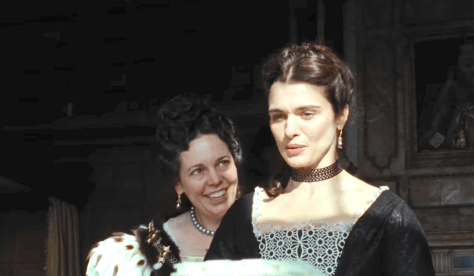
Olivia Colman, Rachel Weisz

“THE FAVOURITE”  My rating: B

119 minutes | MPAA rating: R

Deliciously nasty and morally ambiguous, “The Favourite” is a female-centric slice of history featuring three superb actresses duking it out on screen.

In addition, it may be remembered as Greek director Yorgos Lanthimos’ most accessible film. Which is not to say that it’s breezy moviegoing.

As was so obvious with his most recent English-language features — “The Lobster” and “The Killing of the Sacred Deer” — Lanthimos marches to his own weird drummer. The difference this time around is that instead of working from his own script he’s tackling a screenplay by Deborah Davis and Tony McNamara, and their reasonably conventional approach grounds this yarn in more or less familiar territory.

This feast of power-playing shenanigans is set in the 18th-century court of England’s Queen Anne, a monarch equal parts sadness and silliness.  As played by the great Olivia Colman (for my money this year’s best supporting actress), this ruler is fat, frumpy and flighty.

Small wonder that her childhood friend and now closest confidant, Lady Sarah (Rachel Weisz), treats the monarch as a sort of overgrown baby with big appetites and a short attention span. Because of their long friendship Sarah can tell Her Highness the brutal truth — for example, that her new cosmetic do-over makes the Queen look like a large badger.  (Sarah actually seems to take pleasure in dissing her hapless royal gal pal.)

In return Anne showers gifts (like castles) on her companion and makes sure that Sarah’s husband Lord Marlborough (Mark Gatiss) spends most of his time away  fighting those nasty Frenchies.

Enter Abigail (Emma Stone), Sarah’s penniless country cousin come to court in the hopes of employment.  She’s put to work in the kitchen, but little by little insinuates herself into the Queen’s household…among other things she whips up an herbal poultice to treat Her Majesty’s gouty feet.

What ensues is a sort of powdered-wig “All About Eve,” with the young interloper cannily inserting herself between the old friends. Abigail  discovers that Anne and Sarah are lovers and decides to use that information for her own advancement. Scheming, backbiting and even a bit of poison are employed.

Continue Reading »

Ron Perlman

“ASHER” My rating: C+ (Opens Dec. 7 at the AMC Town Center)

96 minutes | MPAA rating: R

“Asher” is a by-the-numbers aging hit man movie somewhat enlivened by its weirdly charismatic star — Ron Perlman — and by  being a crime drama in which virtually all the characters are Jewish.

White-haired Asher (Perlman) kills people.  He’s got it down to routine.  He stands in the hallway outside his victim’s door, lights up a cigarette and opens an umbrella. When the smoke alarm goes off and the overhead sprinklers start spraying, he waits until the alarmed target throws open the door to see what’s up and then…BLAM!!!

Or, more accurately, ZIIIIP!!!, since Asher uses a silencer.

Jay Zaretsky’s screenplay is unclear about just who Asher works for.

He gets his assignments at a Brooklyn tailor shop where the yarmulke-wearing owner passes out info and cash in plain manilla envelopes. The big boss is Avi (Richard Dreyfuss), who runs a whole crew of assassins, but whether they’re all in the employ of the Israeli government or some organized crime enterprise is left fuzzy.

Anyway, Asher is beginning to feel his age. The plum assignments are now going to the killers Asher taught.

Even more troubling, some of Asher’s colleagues — and their families — are being mysteriously slaughtered.

Continue Reading »

Willem Dafoe as Vincent Van Gogh

“AT ETERNITY’S GATE” My rating: A-

110 minutes | MPAA rating: PG-12

Epically poetic yet aching personal, “At Eternity’s Gate” may be the best film ever about Vincent  Van Gogh.

For that matter, it is among the best movies ever made about a visual artist. Undoubtedly much of the insight and emotion radiating off the screen can be traced back to writer/director Julian Schnabel who was, of course, a famed painter long  before he began  making films.

Visually lush and aurally haunting, “At Eternity’s Gate” follows Vincent through the last year or so of his life.

It is told in fragmented fashion, with scenes built around a series of dialogues between Vincent (Willem Dafoe in the best performance of his career) and others: his supportive brother Theo (Rupert Friend), his combative fellow painter Paul Gauguin (Oscar Isaac), a fellow patient in a mental institution (Niels Arestrup), a disapproving priest (Mads Mikkelsen), a sympathetic physician (Mathieu Amalric).

And when he’s not talking, this Vincent is painting, creating before our eyes the colorful masterpieces that would not be appreciated until long after his death at age 37. A good chunk of “At Eternity’s Gate” is devoted to following Vincent on his nature walks, easel and canvasses strapped to his back, head shaded with a floppy straw hat.

This is a transcendental Vincent, a man who stands in the sunshine with his arms outstretched, smiling ecstatically at the light that bathes him.

Our first encounter with this Vincent, though, occurs in darkness. We can only hear his voice. He’s talking about loneliness, about how he feels set apart from the rest of humanity: “I just want to be one of them…I’d like them to give me some tobacco, a glass of wine, or even ask: ‘How are you?’…from time to time I’d make a sketch of one of them as a gift.”

The key to Dafoe’s inspiring, heartbreaking performance is the way in which Vincent’s almost religious love affair with the world’s beauty is undercut by his sad “otherness.”  Most people don’t like him. They make fun of him. His eccentricities, poverty and neediness bring out the worst in his fellow man. (An art dealer of my acquaintance once explained that “Everybody wants a Van Gogh in their dining room; nobody wants Van Gogh in their  dining room.”)

Thus he’s an apologetic mystic, aware that he rubs others the wrong way, but unable to escape the almost epileptic thrall into which he is forever being plunged by the beauty of the world around him.

Continue Reading »

Maria Callas

“MARIA BY CALLAS” My rating:

115 minutes | MPAA rating: PG

Maria Callas seemed bigger than life in just about everything she pursued.

Her voice was legendary. As was her romance with millionaire Aristotle Onasis. She was a fashion icon. And she came to embody the very idea of “diva,” gaining a reputation for temperamental behavior after she was fired by The New York Metropolitan Opera.

During her lifetime it seemed that just about everyone had an opinion about Callas. Now, decades after her death from heart attack at age 53 in 1977, first-time filmmaker Tom Volf lets her speak for herself.

The idea behind “Maria by Callas” is to let the great singer tell her own story, employing dozens of filmed interviews, tape recordings, and excerpts from her memoir (read by K.C. native and current opera star Joyce DiDonato).

Clearly, Volf is a big-time Callas fan (“fan,” of course, being a shortened version of “fanatic”) and he seems to have scoured the planet for photos and footage of his idol.  This is an exhaustive presentation.

In fact, Volf seems not so much to have shaped all this material as to have taken a bath in it.

Some may take exception with his decision to devote at least one quarter of the two-hour documentary to musical numbers, either footage of Callas performancing on stage or sound recordings played against archival photos and footage.

On the other hand, to understand Callas you’ve got to hear her. So there.

Arranged chronologically, “Maria by Callas” follows its subject from her New York childhood to her late adolescence in Greece, her emergence as a European singing sensation and her rapid recognition on this side of the Atlantic.

Her life was beset by scandal both professionally and personally.

In 1958 she dropped out of a performance in Rome after the first act. She was vilified as a temperamental diva; Callas claims the drafty old theater gave her a devastating case of bronchitis.

Later she was cut from the Met; she claims it was about not wanting to participate in lazily-assembled retread productions of old standards. (Nearly a decade later she returned to the Met in triumph.)

Continue Reading »

Jakob Cedergren

“THE GUILTY” My rating: B

90 minutes | MPAA rating

“Guilty” is a gimmick movie, but at least it’s an effective gimmick.

Denmark’s nominee for this year’s Oscar for best foreign language film is a real-time drama that unfolds in 90 uninterrupted minutes and has, essentially, a cast of one.

Jakob Cedergren plays Asger Holm, a tough Copenhagen cop who, while awaiting a hearing on some unspecified major infraction, has been handed a set of headphones at the department’s emergency services office.

Early on we realize his heart’s not in it.  To a frantic man who calls seeking an ambulance because he may have overdosed on illegal drugs, Asger responds: “It’s your own fault, isn’t it?”

He also humiliates a fellow who reports he’s been mugged by a woman who stole his laptop; Asger recognizes the call is originating from the city’s red light district.

His boring night picks up in intensity with a call from a frantic woman who reports she’s been kidnapped by her ex-husband. She has told her captor that she is calling their young daughter, but in fact has dialed the police.

Asher quickly sizes up the situation and alerts other cops to intercept the vehicle in which the woman is being held prisoner.

He also spends phone time with the couple’s daughter, traumatized after witnessing her parents’ brawling. Asher dispatches an officer to visit the home; he reports back a grisly scene.

It’s pretty clear to Asger that the estranged husband/father went ballistic and did something awful.  At least it’s clear until a big plot reveal turns the table on the officer and the audience.

Writer/director Gustave  Moller confines the action pretty much to Asger’s desk; there’s relatively little interaction with the other cops in the room. And of course we never see any of the people Asger is talking to…we only hear their voices.

In a cleverly perverse way, this seemingly limiting approach pays off. We’re forced to use our imaginations to picture the scenes as they are reported to Asger, who over the course of 90 minutes goes from  smug arrogance to genuine emotional investment.

One actor in  a confined space doesn’t sound particularly dramatic, but “The Guilty” makes it work.

| Robert W. Butler

Eva  Melander

“BORDER” My rating: B+

110 minutes | MPAA rating: R

When we first set eyes on Tina, the insanely unlikely heroine of Ali Abbasi’s “Border,” we can’t even be sure of her sex.

In fact, Tina (Eva Melander) looks like nothing so much as one of our prehistoric ancestors.  She’s got the thick brows, big buck teeth and unmanageable mop of hair of a cave-dwelling Neanderthal. She’s so ugly people must force themselves not to stare.

For about half its running time, “Border” plays like a character study of a sensitive soul trapped in a grotesque body.

And then it takes off into high-blown fantasy territory.  It’s not stretching things to say the film is this year’s “The Shape of Water.”

Despite her animalistic looks, Tina is an intelligent young woman. She’s a Swedish customs agent and amazes her co-workers with her ability to smell (literally…with her nose) when travelers are trying to hide something. She can even pick up whiffs of guilt on objects handled by smugglers. Through her olfactory talents Tina is largely responsible for alerting authorities to a child pornography ring.

Her personal life is odd, too. She shares a cabin in the woods with Roland (Jorgan Thomsson), a long-haired doofus trying to breed pit bulls (the dogs hate Tina). Apparently their cohabitation is a chaste one; Tina repels Roland’s advances, but she does pay his way. He’s not much of a boyfriend, but at least Tina has someone.

She also has a father (Sten Ljunggren) slipping into dementia in a retirement home. Tina dotes on the old man.

Tina is given to long walks in the primordial forest where deer and foxes allow her to approach; she has a fascination with insects, though she can’t exactly say why.

Continue Reading »

Viggo Mortensen, Mahershala Ali

“GREEN BOOK”  My rating: B 

130 minutes | MPAA rating: PG-13

Most of us will go into “Green Book” knowing — thanks to the ads — what the film is about. We can predict with some certainty what notes it’s going to hit, what emotional buttons it’ll be pushing.

None of this detracts from the movie’s immense pleasures.

The latest from director Peter Farrelly (yes, of the raunch-humor Farrelly Brothers) is a fact-based buddy film that dabbles in race and ethnicity, the universal appeal of music, and the glory of Detroit engineering at a time when bigger was definitely better.

It’s 1962 in NYC where Tony Vallelonga (Viggo Mortensen) is bouncing drunks at the Copacabana nightclub. He’s Brooklyn Italian down to his toenails…which he can barely see thanks to his pasta-packed middle-aged spread.

Looking for a temporary gig while the club is undergoing a facelift, Tony signs up for a job driving a musician on  a tour of the Deep South.  And not just any musician.

Don Shirley (Mahershala Ali) is a Phd. pianist who studied music in the Soviet Union, writes and performs classical scores (although on this tour he’s offering a popular jazz sound) and also has doctorates in psychology and liturgical arts. (The real-life Shirley also was fluent in six languages.)

Oh, yeah. He’s black, too.

But the money is good and Tony swallows his ethnic prejudices. He kisses the Missus (Linda Cardelli) goodbye and gets behind the wheel of a big aquamarine land shark for an eight-week tour leading up to Christmas.  Continue Reading »

Hugh Jackman as Gary Hart

“THE FRONT RUNNER” My rating: B-

113 minutes | MPAA rating: R

It is easier to appreciate “The Front Runner” as a pivotal point in our political history than it is to warm up to it as a film.

The subject is Sen. Gary Hart’s 1988 run for the Democratic nomination for President,  the allegations of sexual impropriety that brought him down, and the media’s recognition (however reluctantly) that from here on out a candidate’s private life is fair game for coverage.

It’s been well acted and incisively directed by Jason Reitman (“Up in the Air,” “The Descendents”), yet even as it carefully lays out the parameters of the Hart affair “The Front Runner” seems remote and chilly. Perhaps there are no warm fuzzies in the film because there were no warm fuzzies in the true story.

Hart (Hugh Jackman) was a charismatic liberal with all the right responses. For those who swung left he hit the mark on race, economic disparity, the rapidly evaporating Cold War and other matters.  He might very well have made a great President, one who, according to an admirer, could “untangle the bullshit of politics so anyone can understand.”

Problem is, Hart was far easier to appreciate as a policy wonk than as an individual.  His marriage to Lee (Vera Farmiga) seemed solid — children, rustic home in the Colorado Rockies — but Hart bristled at any attempts to plum the depths of their relationship.  He insisted that the reporters covering him stick to the issues; his life behind the public image was off limits.

He wasn’t even on board with the usual photo ops, complaining that he was caught smiling “like some game show host.”

The screenplay by Reitman, Jay Carson and Matt Bai (on whose book it was based) runs on two parallel tracks.

There’s the insider workings of the Hart campaign, with an emphasis on tough-as-nails manager Bill Dixon (J.K. Simmons) and a host of young volunteers who see in Hart a politician who reflects their generational concerns.

Continue Reading »