Feeds:
Posts
Comments

Carey Mulligan, Ed Oxenbould, JakeGyllenhaal

“WILDLIFE”  My rating: B+

114 minutes | MPAA rating: PG-13

In “Wildlife,” the  mesmerizing directorial debut of actor Paul Dano, people — adults, anyway — are perplexing creatures.

A father loses his job at a country club and instead of launching a job search abandons his family for immensely dangerous and low-paying work fighting forest fires. The bitter mother flips almost overnight from June Cleaver domesticity to provocative sexuality.

These near-radical personality changes are hard to fathom — until you realize that Dano’s film (co-written with actress Zoe Kazan from Richard Ford’s novel) centers on the perceptions of the couple’s 14-year-old son. Seen through the kid’s bewildered and traumatized eyes, even the slightest change in familial surroundings registers like an earthquake.

Set in the early 1950s, the film begins with Jerry Brinson (Jake Gyllenhaal) losing his job as the golf pro in a small Montana town.  His wife Jeanette (Carey Mulligan), who never wanted to move there in the first place, does her best to beef up Jerry’s battered ego and even rejoins the workforce, teaching adult swim classes at the local Y.

All this is tremendously worrying for their 14-year-old son, Joe (a spectacularly good Ed Oxenbould). It’s hard seeing your once-upbeat dad sinking into depression and ennui. And while Mom seems to be enjoying her new economic independence, even that has a downside. She’s not at home all that much.

But Joe’s a good kid and, to help prop up the family’s failing fortunes, signs on as an assistant at the local photographic portrait studio.

Jerry’s decision to join a firefighting crew battling the stubborn blaze — which has burned for weeks in a nearby mountain range, threatening the town not only with flames but lung-congesting smoke — comes as a shock to Jeanette and Joe.  People are getting burned up fighting the conflagration.

“What kind of man leaves his wife and child in such a lonely place?” Jeanette seethes. The poetic theatricality of that line of dialogue (would your average wife phrase it in just that way?) suggests it has been refliltered through Joe’s tormented imagination and memory.

Continue Reading »

Melissa McCarthy

“CAN YOU EVER FORGIVE ME?” My rating: 
106 minutes | MPAA rating: R

Can a criminal act be a form of art?

Well, yes — at least according to “Can You Ever Forgive Me?”

Writer/director Marielle Heller’s sophomore feature (after the hair-raising “Diary of a Teenage Girl”) is based on the real case of Lee Israel, a minor author of literary and show-biz biographies who back in the early ’90s revived her flagging financial fortunes by forging and selling nearly 400 letters from famous literary types like Noel Coward and Dorothy Parker.

Starring Melissa McCarthy (in serious mode) as the curmudgeonly Israel and Richard E. Grant as her lowlife friend and co-conspirator, “Can You Ever…” walks a fine line between bathos and black humor. Along the way it gets you rooting for the “bad” guys.

When we first meet McCarthy’s Lee she’s trying to get her long-time agent (Jane Curtin) to cough up advance money for a bio of vaudeville legend Fanny Brice. That isn’t going to happen. As the agent calmly points out, there’s no interest in a Fanny Brice book and, anyway, Lee’s snarling personality pretty much alienates everyone she comes into contact with.

Indeed, Lee has just lost a temp gig for drinking on the job and loudly cursing her co-workers. Her sole friend is her cat, who needs medicine she cannot afford. Lee’s not above stealing another woman’s coat at a literary cocktail party.

She’s slugging them back at her local bar when she makes the acquaintance of Jack Hock (Grant), an aging British queen who passes himself off as a jaded sophisticate (he’s jaded, but hardly sophisticated) while living hand-to-mouth on NYC’s mean streets.

Jack’s catty, go-for-broke outlook meshes nicely with Lee’s misanthropy…they’re just what the other needs. For a while they’re mere drinking buddies.

Continue Reading »

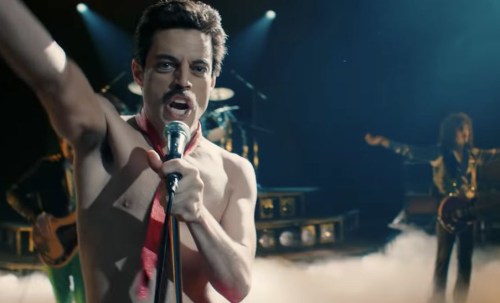
Rami Malek as Freddie Mercury

“BOHEMIAN RHAPSODY”  My rating: B

134 minutes | MPAA rating: PG-13

Remi Malek is a most unconventional star.  His biggest break to date has been as the lead of cable’s “Mr. Robot,” where he plays an emotionally-challenged computer genius, a role that perfectly meshes his acting chops with his unusual physiognomy.

He’s a weird-looking dude.

Nevertheless, in Bryan Singer’s “Bohemian Rhapsody” Malek becomes a bona fide movie star, sinking so completely into the role of flamboyant Queen vocalist Freddie Mercury that he immediately joins the frontrunners for the year’s best actor Oscar, turning a rather humdrum musical biopic into something scintillating.

Ramen is charismatic, sexy, funny and ultimately heartbreaking as Mercury, whose baroque (or is it rococo?) sensibilities made Queen one of the most unlikely rock bands of the 1970s and ’80s.

Like the new “A Star is Born,” another film that cannily mines the backstage world of pop/rock, “…Rhapsody” follows a predictable arc, being the story of a rock star’s rise to fame and descent into ego, arrogance and, eventually, death (Mercury died of AIDS in 1991).

But that familiar  — almost cliched — tale provides a solid platform for Malek’s performance —  in addition to offering a musical soundtrack that’ll have you humming days and weeks later.

Anthony McCarten and Peter Morgan’s screenplay begins with Farrokh Bulsara (Malek) hustling baggage at London’s Heathrow Airport.

Wherever he goes, the shy Farrokh is a fish out of water.  His fellow workers dismiss him as a “Paki” (Pakistani); his Farsi parents, who fled religious persecution in their native Zanzibar, don’t know what to make of his dramatically long hair and disco fashion sense.

Moreover, the kid has an amazing set of choppers…reportedly Farrokh had four extra incisors (Malek wears a lip-stretching set of fake teeth).

Early on Farrokh takes up with a struggling rock band —  guitarist Brian May (Gwilym Lee), baby-faced drummer Roger Taylor (Ben Hardy), and bassist John Deacon (Joseph Mazzello) — and amazes with his songwriting, theatrical presence and balls-to-the-walls vocals (reportedly a combination of Malek’s voice and that of Mercury impersonator Marc Matel).

Oh, yeah. He also changes his name to Freddy Mercury, a break with his heritage that alienates his traditionalist parents.

Continue Reading »

Rupert Everett as Oscar Wilde

“THE HAPPY PRINCE” My rating: B

105 minutes | MPAA rating: R

Actor Rupert Everettt — who announced that he was gay long before it was fashionable — has for years dreamed of bringing the story of Oscar Wilde to the screen.

The years of preparation have paid off. If Everett’s “The Happy Prince” (he wrote, directed and stars in it) is a sumptuously produced downer that seems to wander, there is no ignoring his performance, which is somehow both deeply personal and monumental.

“…Prince” centers on the last three years of Wilde’s life, spent in exile in Europe after he completed a two-year sentence in British prisons for “gross indecencies with men,”  specifically his affair with young Lord Alfred Douglas.

We meet the great writer in his last impoverished weeks in Paris, cadging cash off anyone who’ll sympathize and blowing it on absinthe, cocaine and young male prostitutes. (His favorites are a pair of brothers whom he compensates with coins and a serialized retelling of his children’s story “The Happy Prince”.)

He’s a pathetic portrait of dissipation — all bloat, lank hair, rouged cheeks and shabby cape — but the famous Wilde wit is ever in evidence. “There is no mystery as great as suffering,” he observes.

The film then flashes back to Wilde’s release from prison three years earlier, his escape across the Channel and his reunion with his beloved “Bosie” (Colin Morgan), a beautiful but spoiled wanker of spectacular selfishness; Lord Alfred sticks around only until his mother threatens to cut off his stipend.

Continue Reading »

Timothee Chalamet, Steve Carell

“BEAUTIFUL BOY” My rating: B

120 minutes | MPAA rating: R

Drug addiction movies are a bit like Holocaust movies.

Even if the film is well made, the subject matter is tremendously off-putting and depressing. It takes something remarkable, a new way of looking at the topic, to make the painful bearable.

“Beautiful Boy” comes close. It is based on journalist David Sheff’s memoir of dealing with his son Nic’s addiction, as well as a second memoir by Nic.  There’s little emphasis here on the usual tropes of the genre…back-alley drug buys, spoons and needles, withdrawal agonies.

Instead the film puts a parent’s horror and anxiety front and center, and by doing so it forces every viewer — or at least those with children — to question how they would deal with a similar situation.

Coddle? Criticize? Wash your hands of an uncontrollable child?

At various points in Felix Van Groeningen’s film, all those options are examined. And it helps immeasurably that the film stars Steve Carell as the elder Sheff and the ever-resourceful Timothy Chalamet as his tormented son, Nic.

The  screenplay by Van Groningen and Luke Davis cleverly juggles its time frame, opening with a conversation between the deeply concerned David and a drug counselor and then employing a series of jumbled flashbacks to tell the story of this father and son.

A narratively straightforward, step-by-step depiction of young Nic’s descent into depravity might be too much to handle; by zigging and zagging between the family’s homey past and its uncomfortable present, the film offers an emotional buffer between the audience and the film’s inescapable angst.

Continue Reading »

Alex Hannold

“FREE SOLO” My rating: B (Opens Oct. 26 at the Tivoli)

100 minutes | MPAA rating:PG-13

The faint of heart had best pass on “Free Solo,” a mountaineering documentary with so many close calls that the audience spends a good chunk of the running time with their hearts in their throats.

Jimmy Chin and Elizabeth Chai Vasarhelyi’s film follows young Alex Honnold, who eschews pitons and ropes and the usual paraphernalia of mountain climbing in favor of his hands and feet.  As a free soloist, he clambers up impossible cliffs with nothing but his own strength and a sort of sixth sense about what cracks and indentations can accommodate his fingers and toes to support his weight.

“Free Solo” follows Honnold over two years as he prepares to be the first to freestyle climb Yosemite National Park’s El Capitan, viewed by mountaineers as “the most impressive wall on earth.” We also learn that the most famous of Honnold’s fellow free soloists have fallen to their deaths…it’s a high-mortality calling.

There’s a good deal of information here about how Honnold approaches this killer challenge.  He has climbed El Capitan dozens of times using ropes  and safety equipment, trying to decide what route he’ll take once he’s on his own.  Frequently he loses his grip and falls. The lines that save him won’t be there on the day of the big climb.

Over time he maps out in his head every nook and cranny of the 2,000-foot tall mountain face, and choreographs his every move, planning what each hand and foot will be doing in a sort of life-or-death choreography.

Continue Reading »

“AFTER AUSCHWITZ” My rating: B

83nminutes | No MPAA rating

Most filmic treatments of the Holocaust — be they documentary or fictional — bend toward the atrocities of the Nazi era.

It’s hard to beat billowing smokestacks, jackbooted fascists and piles of naked corpses for compelling cinema.

What’s remarkable is how few films have addressed the fates of Holocaust survivors after their liberation from the camps.

Jon Kean’s “After Auschwitz” does precisely that. It’s not a “scientific” documentary. Oh, it has its fair share of statistics, but mostly it’s based on the  experiences of six women who emigrated to the U.S. (three are now deceased) and survived to tell their tales.

These are, in fact, the same individuals — Eva Beckman, Rena Drexler, Renee Firestone, Erika Jacoby, Lili Majzner and Linda Sherman — who formed the backbone of Kean’s 2007 doc “Swimming in Auschwitz,” which provided a record of the camps as experienced by woman prisoners.

There’s a temptation to believe that the Holocaust story ends with liberation. But beginning a new life from scratch is no easy thing.

As these women point out, their early days of freedom were anything but free. Though the Allies tried to feed them, the food was so rich it acted as poison on nutrition-starved bodies.

Moreover, liberating armies were ill prepared for the medical, psychological and social needs of thousands of former prisoners. There were few services available to the newly freed; resources were sapped just dealing with the corpses (27,000 reportedly at the Bergen-Belsen camp).

It is estimated that one in five survivors died in the first month after liberation.

Some of Kean’s subjects recall wandering into German villages and ransacking homes and stores in an attempt to find proper sustenance. They were, in effect, reduced to criminal status.

Others made their way back to their home towns, often riding on the outside of boxcars. They found the reception anything but welcoming. Countless returning Jews were murdered; many Polish Jews decided they were better off returning to Germany and taking up residence in displaced persons camps.

A majority of survivors learned they were the only members of their families still breathing. Many entered into loveless marriages (“Not a flower in sight,” recalls one woman) simply for the sake of survival. (“It filled a hole.”)

Even after years had passed and they found shelter in the U.S.  these women carried the scars of their experiences.  Depression was common. One says she couldn’t look at a uniformed Boy Scout without thinking of Hitler Youth.

Few related their horrific experiences to their family and friends. Silent suffering was the norm. Over time, though, a couple of these women became spokespersons for other survivors, speaking publicly about what they had been through.

Though filled with powerful images — lots  of vintage newsreels, Army Signal Corps footage, still photos and other visual aids — “After Auschwitz” is in some ways a scattershot affair. The film jumps from subject to subject, with the result that it’s difficult to follow the story arc of any one of these women. It’s also a bit difficult to get a handle on their personalities.

Yet the cumulative effect gets under the viewer’s skin.  Despite the darkness on display, ultimately “After Auschwitz” celebrates the resilience of the human character.

These women survived and prospered, after all. But the pain, one suspects, never goes away.

| Robert W. Butler

The Dames: Maggie Smith, Joan Plowright, Eileen Atkins, Judi Dench

“TEA WITH THE DAMES” My rating: B- 

84 minutes | No MPAA rating

“Tea With the Dames” is a slapdash affair, less a well-crafted documentary than a fly-on-the-wall peek at a reunion of four great English actresses.

Theatre geeks will be captivated. Others perhaps not so much.

The “dames” of the title are Maggie Smith, Joan Plowright, Judi Dench and Eileen Atkins, all of whom have received that honorary title from Queen Elizabeth for their contributions to English arts.

The youngest is 83, the oldest 88; one of them is blind; two are widows; the other two apparently are divorced (although their present marital status is never addressed).

For this doc director Roger Michell assembled the four at Plowright’s lovely country home (the one she shared with the late Sir Laurence Olivier) and over the course of a long weekend filmed them talking and sipping the occasional cordial.  The conversations are illustrated with clips and photos from the women’s illustrious careers.

Over the course of the film the ladies discuss their careers, their craft, their private lives (within limits). Occasionally director Michell attempts to steer the conversation, not that anyone pays him much attention. (“Let’s talk about aging,” suggests his off-camera voice. “Fuck you, Roger,” one of the dames shoots back.)

“Tea…” has no format, really.  The girls talk about what they damn well want to talk about.

Continue Reading »

Tiffany Haddish, Ike Barinholtz

“THE OATH”  My rating: B 

93 minutes | MPAA rating: R

One of the America’s most hellish rituals — the family Thanksgiving gathering — takes on even more demonic dimensions in Ike Barinholtz’s “The Oath.”

Barinholtz, a familiar face whose name you never knew, does triple duty here, serving as writer, director and star,  combining the usual holiday dysfunction with torn-from-the-headlines politics. The resulting black comedy is like finding a hand grenade in the roasted turkey.

As the film begins we learn that the U.S. president has instituted something called “the Patriot’s Oath,” a sort of loyalty waiver citizens are expected to sign.

“Nothing happens if you don’t sign,” assures a White House spokeswoman. “But there are perks if you do.”

The news infuriates suburban couple Chris (Barinholtz) and Kai (Tiffany Haddish).  Theirs is a mixed-race marriage, and as one might deduce, they are fiercely liberal.

Especially Chris, who is one of those apoplectic lefties who invariably takes a confrontational and self-righteous approach to political matters.

The citizenry has a year to decide  if they will sign; the new law goes into effect on (appropriately) Black Friday, a day after Thanksgiving.

Chris and Kai’s family gathering is like a cross section of the voting public.  Chris’ brother (Jon Barinholtz, the writer/director’s brother) is a sort of perennial frat dude whose new girlfriend (Meredith Hagnar) has a world view cloned from Ann Coulter.

Chris’ sister (Carrie Brownstein) is a fellow liberal, as is her hubby (Jay Duplass), who has come down with an intestinal monster and spends most of the holiday curled in a ball.

Mom (Nora Dunn) tries to referee the mounting sibling turmoil (“Hey, no politics!”);  Dad (Chris Ellis) keeps as low a profile as possible.

Prays Chris: “God, who I don’t believe in, please give me strength to get through the next three days.”

Continue Reading »

Jim Cummings

“THUNDER ROAD” My rating: B

92 minutes | No MPAA rating

Huge chunks of “Thunder Road,” Jim Cummings’ triple-threat Sundance feature (he’s the writer, director and star) are so cringeworthy that it takes an act of will to keep watching.

Cummings portrays Jim Arnaud, a small-town policeman whose life is coming down around his ears.

In the first scene — filmed in one long take — Jim delivers a rambling eulogy at the funeral of his mother.

Jim — who has shown up in full uniform, as if this were a military service — slowly becomes emotionally unhinged despite his best efforts to play the rational adult. Pretty soon he’s engaged in a hair-raising stream-of-consciousness rant about his mom’s work (she was both a CPA and operator of a ballet school), his own struggles (dyslexia), his wife and daughter (the marriage is going south).

His mother’s favorite artist was Bruce Springsteen, he says, and Jim has brought a boom box so that he can lip sync to “Thunder Road” while performing a two-left-feet dance routine in front of the coffin. Blessedly, the boom box malfunctions; nevertheless, Jim attempts the dance  in silence before collapsing into a weepy, humiliated glob of quivering flesh.

It’s hard to watch (yet fascinating). But writer/director Cummings isn’t finished with us yet.  After the opening credits he replays the entire opening scene; we sit twice through Jim’s very public meltdown.

The rest of “Thunder Road” — a fiendishly ironic title since 1) it suggests some sort of action drama, which this isn’t, and 2) we never do hear the Springsteen recording (probably the music rights were too expensive for Cummings’ indie effort) — consists of scenes from our protagonist’s rapidly unravelling life.

Continue Reading »