Feeds:
Posts
Comments

Richard Gere

“NORMAN”  My rating: B

118 minutes | |MPAA rating: R

You don’t have to like Norman Oppenheimer, the fast-talking character played by Richard Gere in “Norman,” to appreciate his energy and drive.

Norman is a hustler and a schmoozer, an arm twister and a facile liar. When necessary he can be a party crasher and a stalker.

He appears to be a businessman (his card vaguely reads “Oppenheimer Strategies”) who specializes in putting together deals. More accurately, he puts together people far more capable than himself who can put together deals. With luck Norman gets a cut of the action.

One of the wonders of Gere’s performance (just when did he become such a terrific actor?) is that even while Norman remains a mystery, a cypher, he’s strangely compelling.

(The movie has a secondary title: “The Moderate Rise and Tragic Fall of a New York Fixer.” That right there tells you what we can look forward to.)

In the early scenes we see Norman pestering casual acquaintances and heavy hitters on the New York financial scene (among the players are Michael Sheen, Dan Stevens, Josh Charles and Harris Yulin). Outwardly Norman oozes confidence and professionalism. He’s impeccably dressed and groomed.

But beneath that show of casual affluence you get a whiff of angst from a minor player desperate to be part of the big game. Norman is usually broke; he pops Tic Tacs in lieu of meals. He can’t afford an office, conducting all his business over his cell phone.

Writer/director Joseph Cedar’s film turns on Norman’s courting of an Israeli deputy minister visiting the Big Apple for a conference. Eshel (an excellent Lior Ashkenazi) is a bureaucratic  nobody grateful that this apparent go-getter of an American wants to befriend him. Norman even treats him to the city’s most expensive pair of men’s shoes.


Continue Reading »

“CHASING TRANE” My rating: B

99 minutes |No MPAA rating

Most practitioners of the arts seek a compromise between vision and commerce.  Your art may be pure, but what does that matter if it doesn’t sell?

The saxophonist John Coltrane (1926-’67) seems not to have been concerned by matters of money or of popularity. As the new documentary “Chasing Trane” makes clear, he followed his muse wherever it took him, sometimes into aural landscapes that continue t0 perplex even his biggest fans.

John Scheinfeld’s “Chasing Trane: The John Coltrane Documentary” wastes no time making its case that the legendary jazz man was an artist of the first order, comparable to Beethoven or Shakespeare.

A staggering array of fellow musicians (Sonny Rollins, Jimmy Heath, Benny Golson…just for starters), Coltrane biographers, his children and stepchildren, even a former Presdient of the United States testify not only to his talents but to the spirituality which fueled Coltrane’s musical adventurousness. He was so adept at channelling his emotions into his playing that listeners report being moved to tears without understanding how or why.

The facts of Coltrane’s career are cleanly laid out before us:  His childhood as the grandson of a minister, his work in the 1950s with the Miles Davis Quintet during its most productive period (his playing on the classic album “Kind of Blue” made him a household name among jazz fans) and later with Dizzy Gillespie.  His heroin addiction, which threatened to derail his career until he heroically kicked the habit cold turkey.

In 1961 Coltrane had a Top 40 hit with his instrumental take on “My Favorite Things” from the white-bread Broadway musical “The Sound of Music.”

In response to the 1963 bombing of a black Birmingham church in which four little girls died, Coltrane wrote and recorded the tune “Alabama,” described by former president and part time saxophonist Bill Clinton as a prime example of  Coltrane’s creativity and depth. It is, Clinton says with uncharacteristic poetry, a work “screaming with pain, undergirded by love.” Continue Reading »

Catherine Walker

“A DARK SONG” My rating: B

100 minutes | No MPAA rating

It’s easy enough to scare audiences with shocker editing and gross-out special effects.

But a film that gets under your skin and gnaws away at your nerve endings from the inside out…well, that’s something special.

“A Dark Song” is a horror movie, yes, but it’s also much more.

It’s a docudrama about the preparations for an Aleister Crowley-style summoning of demons and angels.

It’s a two-handed acting extravaganza that demands tremendous subtlety from stars Catherine Walker and Steve Oram.

And it’s an unexpectedly uplifting morality play that toys with shock film cliches but ultimately transcends them.

Liam Gavin’s film opens in a long-unoccupied manor house in Wales.  Sophia Howard (Walker) is being shown the place by a realtor. Apparently she has very specific requirements as to the remoteness of the property and the number of rooms. She agrees to lease the place for a year.

She’s then visited by Solomon (Oram), a balding, bearded, pudgy occultist with whom she’s been in contact. Gradually the nature of what they’re up to becomes clear.

Sophia wants Solomon to lead her through an elaborate ritual that will result in the appearance of her guardian angel. This exercise may take half a year, during which time Sophia must follow Solomon’s instructions to the letter.  She’s already abstained from sex and alcohol for several months. She’s purchased weeks’ worth of food. Once the ritual begins neither can leave the premises without dire consequences.

Now this may seem like so much fantastic b.s., but Gavin and his players are so good at establishing their characters and setting a slowly tightening mood of suspense and dread that an audience can’t help but buy into it.

Continue Reading »

Ashleigh Cummings

“HOUNDS OF LOVE”  My rating:  

108 minutes | No MPAA rating

The temptation is to dismiss “H0unds of Love” as seedy exploitation, a bit of torture porn.

Except that Ben Young’s debut feature won’t allow us that easy way out. It is too well made — and especially too well acted — for us to simply turn our backs on its unpleasantness.

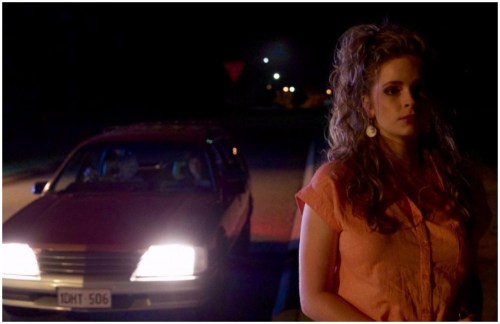
Loosely inspired by David and Catherine Birnie, a real life couple in Perth, Australia, who in the ’80s abducted and killed four young women, this creepy nail biter pits a surprisingly resilient teenage girl against a pair of serial killers.

John and Evelyn White (a spectacularly good Stephen Curry and Emma Booth) live in a nondescript suburb of Perth.  They’re not particularly popular with their neighbors, who would be horrified to learn what goes on in their utterly ordinary-seeming house.

The two snatch and imprison young women.  These victims are terrorized and abused and finally killed by John, who buries the bodies in a nearby forest.

Their latest prize, Vickie (Ashleigh Cummings), is a high schooler embittered over the recent divorce of her parents and acting out by sneaking away at night to party with her friends.  She’s walking to one of these shindigs late at night when the Whites pull up in their car and offer her a lift and a joint.

As writer and director Young doesn’t dwell on the brutality inflicted on Vickie.  The really awful stuff happens behind closed doors, out of sight (if not out of hearing).

What makes “Hounds…” so compelling is the psychological lay of the land.

Continue Reading »

Rami Maleck

“BUSTER’S MAL HEART”  My rating: B- (Opens May 12 at the Alamo Drafthouse)

96 minutes | No MPAA rating

Rami Maleck pretty much cornered the market on bizarre/brilliant manic depressives with his Emmy-winning performance on cable’s “Mr. Robot.”

“Buster’s Mal Heart,”  shot before “Robot” began production, allows the young actor to mine several alternate personalities. He’s good at all of them.

Written and directed by Sarah Adina Smith (“The Midnight Swim”),  “Buster’s Mal Heart” offers an out-of-chronology history of its title character.

When we first meet Buster he’s racing up a wooded mountainside, a posse of lawmen on his tail.

But we also see him with long hair and beard in a remote tourist cabin and in  a lifeboat afloat at sea.

Most of the screen time, though, is devoted to his life as a husband and father in the Pacific Northwest.

Clean-cut and polite, Buster seems disarmingly normal.  He’s kind and gentle with the wife (Kate Lynn Shiel) and appears to be a model employee of the semi-posh hotel where he’s the night desk clerk.  Continue Reading »

Charlie Hunnam

“KING ARTHUR: LEGEND OF THE SWORD” My rating: D+ (Opens wide on May 12)

126 minutes | MPAA rating: PG-13

Having shrunk the great Sherlock Holmes to fit the limited palette of short attention span theater (more Vin Diesel than Conan Doyle), filmmaker Guy Ritchie has now unleashed his reductive skills on the Arthurian legend.

Predictably, “King Arthur: Legend of the Sword” is visually elephantine and dramatically stunted.

Know from the start that this “Arthur” has about as much in common with Malory or Tennyson as “Clash of the Titans” did with Bulfinch. Basically it’s a big shapeless slice of sword-and-sorcery, CG battles and quirky humor (providing you find it at all amusing).

In a prologue the kingdom of Uther Pendragon (Eric Bana) is seized during a great battle (war elephants the size of battleships…in England) by his scheming brother Vortigern (a sneering Jude Law, who portrays Watson in Ritchie’s Holmes franchise).

Before dying Uther sends his young son Arthur off to safety.  The boy grows up to be hunky Charlie Hunnam (“Sons of Anarchy”), raised in a brothel and unaware of his royal origins. He’s protective of the harlots who sheltered him, and regularly attends classes at a dojo run by an Asian martial arts master. (Seriously, there’s dialogue referring to “kung fu.” In Medieval London.) Continue Reading »

(Left to right) Steve Coogan, Laura Linney, Richard Gere, Rebecca Hall

“THE DINNER”  My rating: C+ 

120 minutes | MPAA rating: R

Few things are quite as frustrating as watching great actors knock themselves out on material that’s not nearly as good as they are.

“The Dinner,” based on Herman Koch’s best-selling novel (it’s already been dramatized in Dutch and Italian versions), certainly has its moments, most of them provided in killer perfs by Richard Gere, Steve Coogan, Rebecca  Hall and especially Laura Linney.

But the film, set mostly in a restaurant so pretentious that the unctuous maitre’d announces each dish’s ingredients practically down to the molecular level, is itself off-puttingly  pretentious. Plus, the characters’ attitudes and behavior are so sleazy that you really can’t find anyone to root for.

In the first scene Paul Loman (Coogan), a former history teacher now working (abortively) on a book about the Civil War, and his wife Claire (Linney) are preparing for a family dinner at a posh eatery.

Paul isn’t keen on the gathering.  It’s the idea of his brother Stan (Gere), a U.S. Congressman now running for governor of their home state, and it’s obvious that the siblings don’t get along. Paul takes a fierce anti-establishment attitude, oozing sneering comments about his politician brother. The awesomely patient Claire somehow gets him into his clothes and out the door.

Once at the restaurant civility rapidly evaporates.  Paul is in a bitchy mood and it’s up to the wives, Claire and Katelyn (Hall), to smooth over the rough patches.

Why has Stan called this conclave?  Well, there’s a family crisis, though writer/director Owen Moverman (“Rampart,” “The Messenger”) takes his sweet time in giving us the details, relying heavily on convoluted flashbacks that almost send the narrative spinning out of control.

Continue Reading »

Adrian Titian,  Maria Dragus

“GRADUATION”  My rating: B

128 minutes | MPAA rating: R

America doesn’t have a filmmaker comparable to Romania’s Cristian Mungiu.  For more than a decade now Mungiu has served as his country’s cinematic conscience, exploring  in film after film Romania’s troubled past and infuriating present.

His biggest international hit has been  2007’s “4 Months, 3 Weeks, 2 Days.” Set in the bad old days of the communist Ceausescu regime it follows a  college student as she tries to arrange an illegal abortion for her  roommate. That film offered a portrait of a society in which ordinary individuals routinely break the law simply to ensure their day-to-day survival.

Mungiu’s latest, “Graduation,” is set in the post-Ceausescu present. But cheating as a way of life remains entrenched in Romanian culture.

Romeo Aldea (Adrian Titieni) is a physician in a provincial Romanian city. He’s a fat, middled-aged man who prides himself on never taking bribes from desperate patients seeking preferential treatment — although he may not exactly be a moral giant, since he’s having an affair with a young single mother (Malina Manovici) who was once his patient.

His daughter, Eliza (Maria Drăguş) is about to graduate from high school. She’s been accepted by Cambridge University in England, much to the delight of Romeo and his phlegmatic wife Magda (Lia Bugnar). The couple fled Romania in the bad old days and returned only after the fall of Ceausescu, anticipating a brave new world of opportunity and promise.

Things didn’t work out that way.  The country may no longer be under the thumb of a half-mad strong man, but the stifling bureaucracy makes any kind of real progress problematic.  If Eliza is to have any future, Romeo believes, she must get out of Romania.

Just one problem…Eliza can go to England only if she  geat high scores on a battery of state-mandated examinations required of all new graduates (they’re kind of like the SATs on steroids).

On the eve of the test Eliza is seriously shaken after an assault by a would-be rapist. Fearing his traumatized daughter may not be at her best for the exams, Romeo looks for an edge.

A sympathetic  acquaintance on the police force suggests that Romeo talk to a vice-mayor in need of a kidney transplant. Romeo can pull strings to move the politician up on the transplant list in exchange for Eliza being allowed to cheat on the exam.

It’s the Romanian way of doing things.


Continue Reading »

David Lynch

“DAVID LYNCH: THE ART LIFE” My rating: B

90 minutes | NO MPAA rating

You’d expect that a documentary about David Lynch would concentrate on his substantial body of film work: “Eraserhead,” “Mulholland Drive,” “The Elephant Man”…even the disastrous “Dune.”

Heck, even Lynch’s failures are interesting.

But co-directors Jon Nguyen, Rick Barnes and Olivia Neergaard-Holm go in an entirely different direction.

Rather than concentrate on the films, “David Lynch: The Art Life” centers on Lynch’s work in the visual arts…and not on his technique or subject matter but rather on his ideas about art in general.

Then result is both a sort of biography of the artist as a young man (lots of photos and films of Lynch’s youth and college years), lots of stories from his formative years.  We see examples of his current visual works that directly reflect those youthful moments of excitement and trauma (mostly trauma, if the prevailing darkness of his vision is any indication.)

Big chunks of the film show Lynch, now in his early ’70s, working in  his home studio.  His output is simultaneously childish, sophisticated and disturbing. He works with his hands, smearing paint with his fingers (often accompanied by his 2-year-old daughter).

His images are ragged, blurry, dreamlike.

The man seems compelled to create at every opportunity. (“Keep painting. Keep painting. See if you catch something.”)

We get Lynch’s memories of a happy childhood (“I never heard my parents argue, ever”), his discovery of art as an outlet, his early dabbling in experimental films.

It’s a stream-of-consciousness trip through David Lynch’s brain.

Those who want a discussion of how he makes art and what it means will be disappointed.

Those willing to think about art  as a life choice will find the film a treasure trove.

| Robert W. Butler

Gemma Atherton, Bill Nighy

“THEIR FINEST” My rating: B-

117 minutes | MPAA rating: R

What is it with filmmakers making movies about making movies?

“Their Finest,” the latest from Danish director Lone Scherfig (“Italian for Beginners”), takes that admittedly amusing self-absorption and pumps it up with World War II-era nostalgia and nascent female empowerment.

In Blitz-ravaged London, copywriter Catrin Cole (Gemma Arterton) lands the gig of a lifetime.  She’s hired by the Ministry of Information’s Film Division to write a feature film — one that is both “authentic and optimistic” — that will embody Britain’s can-do spirit in the face of Hitler’s juggernaut.

The film is intended as pan-Atlantic propaganda that will show war-wary American audiences that Britain is more than supercilious aristocrats, that it’s a nation of everyday men and women fighting heroically for survival.

Catrin finds her subject in the real-life experiences of two spinster sisters who stole their drunken uncle’s boat and became part of the mass evacuation of British troops from Dunkirk in France.

Though she already has a significant other (Jack Huston, playing an unsuccessful painter of glum cityscapes), Catrin finds intellectual stimulation (and other sorts as well) in her new writing partner, Tom Buckley (Sam Claflin). He’s one of those seen-everything cynics who nevertheless knows exactly how to manipulate an audience (“Film is real life with the boring stuff cut out”).

Together they figure out how to cajole a fading matinee idol  (Bill Nighy, playing the sort of jaded egomaniac he does so well) into taking the seemingly inconsequential role of the drunken uncle. Somewhat more perplexing is how they are to satisfy the Ministry by creating a character for a non-acting American  (Jake Lacy) who has been flying missions for the R.A.F.

Continue Reading »