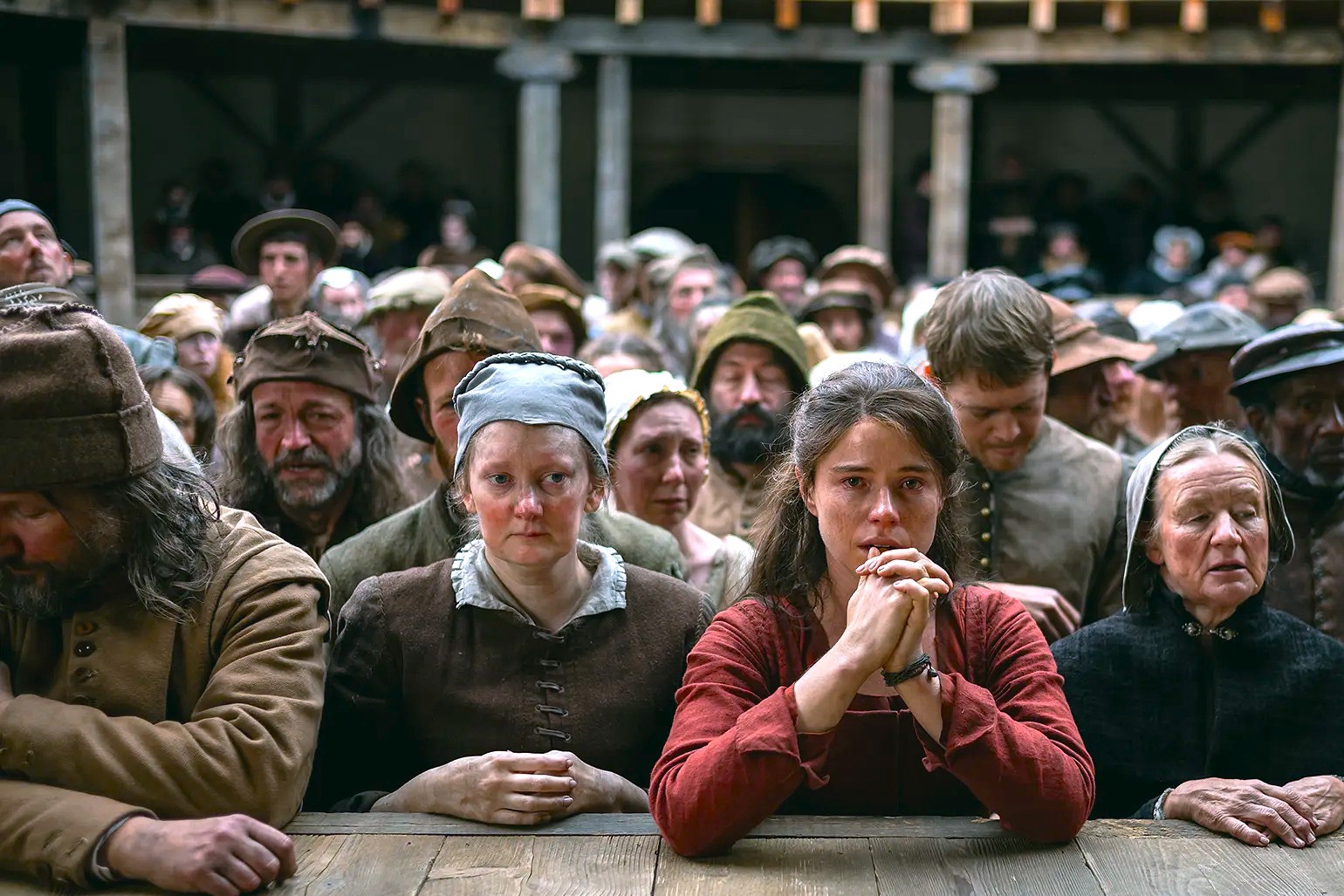
Jessie Buckley
“HAMNET” My rating: B (In theaters)
125 minutes | MPAA rating: PG-13
For a good three quarters of Chloe Zhao’s “Hamnet” I found myself diverted — fine photography, good acting — but nowhere near the emotional catharsis that has many critics calling it a masterpiece.
But just wait.
“Hamnet” only comes fully to life in the last 20 minutes, but it does so with devastating intensity.
Well, better to peak late than early, and in that regard the film will leave viewers well wrung out as they head for the exits.
This is the story of how the death of Shakespeare’s young son, Hamnet, inspired the playwright to create perhaps his most enduring and overwhelming drama, “Hamlet.”
Zhao’s screenplay abandons the jumbled timeline of Maggie’ O’Farrell’s best-selling novel for a straightforward chronological narrative. At the same time it keeps a couple of the book’s twistier aspects by leaving nameless the Shakespeare character (we know he’s the Bard, but none of his contemporaries do) and by identifying his wife as Agnes when history tells us that Shakespeare’s wife actually was named Anne.
The film begins with the courtship of a small-town Latin tutor (Paul Mescal) and an odd young woman (Jessie Buckley) who spends much time in the woods, has a pet hawk and is rumored to be the daughter of a witch.
Their respective families (Emily Watson plays the tutor’s mother) disapprove, but young love (or lust) will have its way. With Agnes pregnant, marriage is the next step.
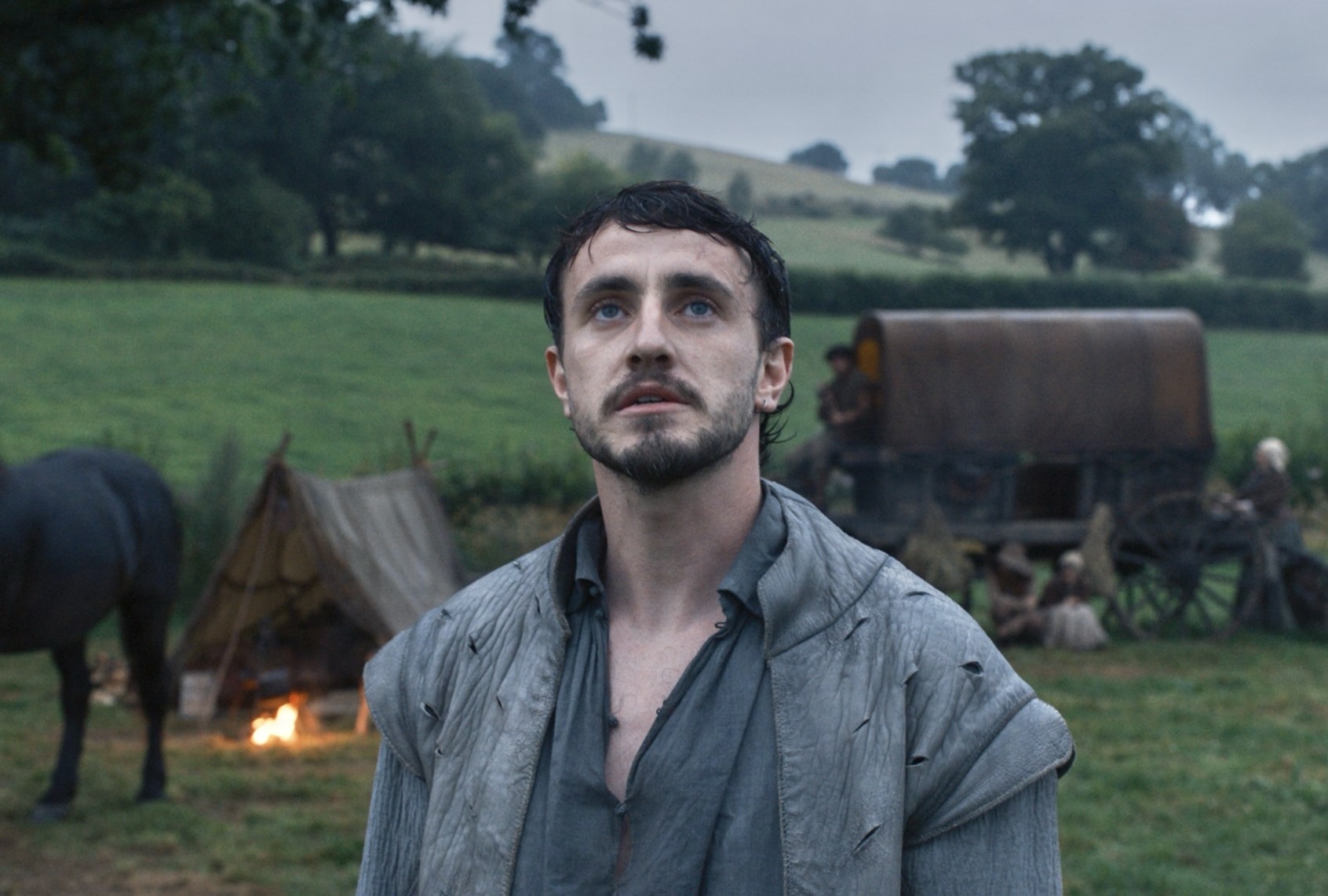
Paul Mescal
The bulk of “Hamnet” is devoted to domestic life in Stratford. The young husband begins spending time away in London (writing plays, we presume) while Agnes holds down the fort back home. Their reunions are happy ones, and the couple have three children.
The only boy is Hamnet, so charmingly played by young Jacobi Jupe that we nave no trouble imagining the fierce love his parents have for him.
At age 9 Hamnet succumbs to the plague in a horrendous death scene that leaves his mother a screaming wraith of pain. Father arrives too late to see his boy alive.
Tragedy can bring families together or tear them apart. It appears that this family will never recover from Hamnet’s death.
When Agnes learns that her spouse’s latest play references their dead son, she makes the long trip to London to confront her now-estranged husband, arriving just in time to witness one of the first performances of “Hamlet.”
It’s at this point that “Hamnet” becomes something extraordinary. Agnes enters the open-air Globe with dozens of other playgoers, pushes her way to the front of the crowd and leans on the stage, ready to hurl objections and insults at this entertainment that capitalizes on her grief.
Except that during the performance she finds herself engrossed by the extraordinary storytelling and language. Like her fellow playgoers, she is transported to Elsinore Castle and caught up in the tale of loss, revenge and existential paradox. Abandoning her initial objections, Agnes ultimately recognizes that her husband has come to grips with their loss by using the theater to resurrect their dead child.
Art as therapy.
Zhao’s recreation of an Elizabethan production is extraordinarily captivating, not the least because Noah Jupe (older brother of the actor who played Hamnet) is so spectacularly good as the actor portraying Hamlet on stage.
Watching this tragedy unfold is a transforming experience. We recognize the awe and investment of the London audience in this new play; the sheer aesthetic pleasure that transcends the tragedy.
Mescal and Buckley give fine performances, but in the end it is the eternal genius of William Shakespeare that sticks in the memory.

George Clooney
“JAY KELLY” My rating: C(Netflix)
132 minutes | MPAA rating: R
I’m a fan of George Clooney’s work. his persona and his politics. But “Jay Kelly” left me cold.
Noah Baumbach’s latest film is a character study…sort of…of a man who apparently has no character.
Jay Kelly (Clooney) is a famous movie star. Millions know him from his many screen appearances, but apparently nobody knows him, really.
His family, his friends, his co-workers…about all they get from him is suave charm, self-deprecating wit and good looks. If there’s a real human being in the attractive package, it’s yet to assert itself.
The screenplay by Baumbach and actress Emily Mortimer (who takes a small role) finds Jay on a trip to Italy to receive some sort of award. Usually he flies in a private jet, but for this trip he has decided to take the train with all the other tourists and proles. He says he doesn’t like being noticed, but he sure spends a lot of time being noticed.
If anyone is close to knowing Jay it’s his long-suffering manager Ron (Adam Sandler), who likes to think of himself as a friend. Except as Jay points out, friends don’t usually take 15 percent.
“Jay Kelly” has an astoundingly deep cast — Greta Gerwig, Billy Crudup, Laura Dern, Patrick Wilson, Stacy Keach, Isla Fisher, Jim Broadbent, Riley Keough, Josh Hamilton (for starters) — though many have only a few seconds of screen time.
The film is stranded somewhere between satirizing Hollywood and its denizens and empathizing with Jay’s late-in-life realization that as a human he’s pretty much blown it. But it’s neither funny enough or tragic enough to warrant a bloated running time (more than two hours).
Moreover, since Jay is a handsome cipher, our only real human connection is Sandler’s Ron, who must ride herd on a mercurial star while trying to hold together his own private life. It’s the film’s best performance.
“Jay Kelly” ends with Jay and an audience watching a compilation of scenes from his film and television work (actually they’re clips from George Clooney’s career, making for a sort of head-smacking meta moment). To the extent that the segment stirs pleasurable memories it gives Jay’s life an emotional arc missing from the rest of the film.
But it’s a contrived moment in a film that already feels contrived.
| Robert W. Butler


 Butler's Cinema Scene