Feeds:
Posts
Comments

Posts Tagged ‘“Hamlet”’

Amanda Seyfried as Shaker saint Ann Lee

“THE TESTAMENT OF ANN LEE” My rating: B (Hulu)

136 minutes | MPAA rating: R

Mainstream Hollywood rarely knows what to do with religion…unless it’s some sword-and-sandal silliness.

But Mona Fastvold’s “The Testament of Ann Lee” provides a sometimes brilliant evocation of ecstatic states while never commenting editorially on the truth (or falsehood) of its subject’s beliefs.

In the process it gives Amanda Seyfried the role for which she may some day be best known.

Ann Lee (Seyfried) was a British woman whose search for religious certainty led her to the Shaker movement, an offshoot of the Quakers in which dance and movement were essential to the spiritual quest. She left England for America in the years just before the Revolution, bringing with her a small band of followers who regarded her as an incarnation of Jesus. Over  years they established several communal settlements in New England, farming and manufacturing utilitarian but beautiful items of furniture that are still popular.

At one point the Shakers had nearly 5,000 members…a remarkable number given that total avoidance of sex was central to Lee’s ministry.  The church fed its ranks by adopting orphaned children who, upon reaching maturity, were allowed to decide whether to stay or seek a life in the larger world.

As scripted by director Fastvold and her husband Brady Corbet (their last outing was the spectacular “The Brutalist”), this is in many ways a straightforward historic biography.  

We follow Ann’s early life, her marriage to a blacksmith (Christopher Abbott) and the tragic deaths of their four children (a huge factor in creating her views on abstinence), her gradual rise to become a spiritual leader, her preaching partnership with her brother William (Lewis Pullman) and her determination to find a respite from persecution in the New World (only to discover that thuggish assholes are to be found just about everywhere).

It’s all been mounted with an almost documentary sense of time and place.

But here’s the twist:  in the many scenes of Shaker worship the film can only be described as a musical.

The congregants dance and sing in a reverential frenzy.  Like the whirling dervishes of Islam’s Sufi sect, the Shakers in this film seek transcendence through sound and movement, and just by observing we  can get a contact high from their shared exctasy. This is an astounding thing to say of an American feature film…simply watching it is a semi-spiritual experience.

Director Fastvold has said in interviews that while the songs and dance movements are based on real Shaker worship practices, they’ve been sweetened for this cinematic retelling. So while they may not be 100 percent authentic, they do achieve a heightened awareness in the viewer…heck, this looks like a worship service that might actually be fun.

At the core of it all is Seyfried’s performance, which makes Ann fully human even as she says and does things that many of us find, well, hugely eccentric. Apparently Ann Lee had no room for doubt, and there’s none in Seyfried’s work here. She exudes sincerity, reverence and a calm benevolence.  It’s remarkable.

Keeping “The Testament of Ann Lee” from being a near masterpiece are pacing problems.  The last third of the film drags a bit…to the point that viewers not naturally inclined to spiritual rumination may lose interest.

For the rest of us though, it’s a thought- and emotion-provoking experience.
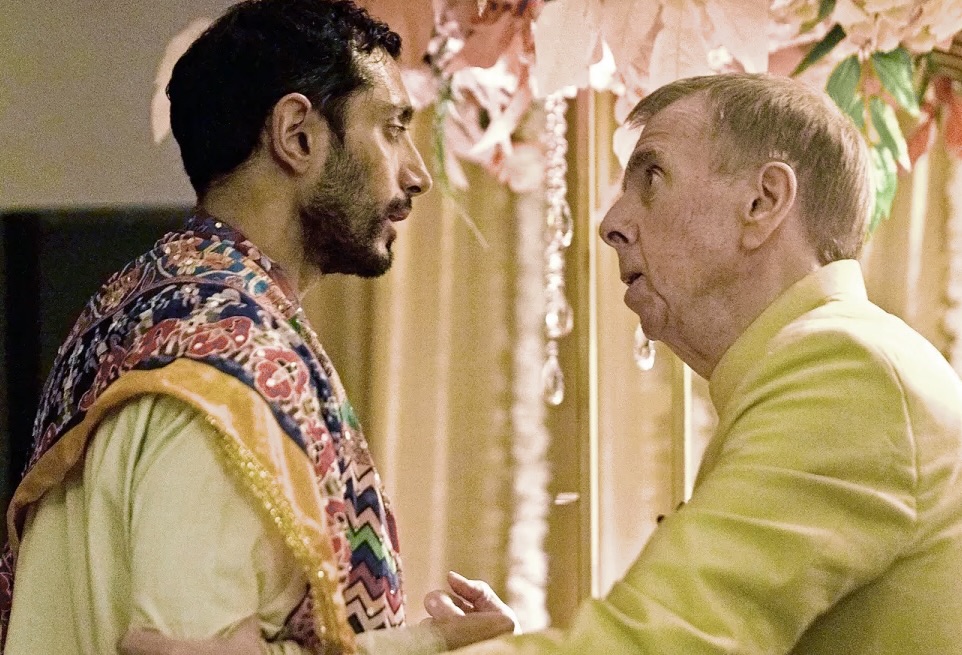
Liz Ahmed, Timothy Spall

“HAMLET” My rating: B (In theaters)

114 minutes | MPAA rating: R

“Hamlet” can survive just about any amount of directorial tinkering.  What you can’t screw with are Shakespeare’s words and the necessity of having a charismatic leading man as your Hamlet.

The new version of the tragedy from Brit director Aneil Karia works most of the time.  All the familiar monologues are intact (if sometimes arranged in a different chronology) and in Riz Ahmed we have a fiercely emotional Hamlet who may very well be sliding into madness.

This “Hamlet” is a modern dress interpretation (Ehthan Hawke starred  in another modern version in 2000) and set in London’s South Asian community.  Elsinore in this retelling is not a royal palace but the name of a massive real estate development company founded by Hamlet’s papa.

As the film begins a crew of male friends and family are preparing the magnate’s body for a traditional Hindi cremation.  Hamlet (Ahmed) has been studying abroad and is appalled to learn that not only is his uncle Claudius (Art Malik) taking over the company, but he intends to wed Hamlet’s mother Gertrude (Sheeba Chaddha).

Michael Lesslie’s adapted screenplay puts Hamlet’s precarious mental state front and center…even to the point of reducing the roles of other characters.  This is particularly true in the case of Polonius (Timothy Spall), who in this version is not an amusing pedant but rather a grimly ruthless enforcer for the company. His daughter, the fragile Ophelia (Morfydd Clark, most recently seen as Galadriel in the “Rings of Power” miniseries) and son Laertes (Joe Alwyn) haven’t quite been boiled down to walk-on perfs, but it’s a near thing.

Hindu dancers perform the play-within-the-play

The good news is that director Karia uses the unique setting to good advantage.  For instance, in his encounter with his father’s ghost Hamlet and his father converse in Hindi (with English subtitles). And in a small masterstroke, the famous play-within-a-play ploy which Hamlet uses to expose his uncle’s crimes is now performed by a troupe of Indian dancers whose half-trad, half-Bollywood showcase is one of the film’s highlights.

Ultimately, though, it all boils down to our Hamlet, and Ahmed more than holds his own.  This actor oozes intensity and physical presence (remember his Oscar-nominated turn turn as a deaf drummer in “The Sound of Metal”?) and here he channels it into one of drama’s seminal roles.

| Robert W. Butler
Read Full Post »

Jessie Buckley

“HAMNET” My rating: B (In theaters)

125 minutes | MPAA rating: PG-13

For a good three quarters of Chloe Zhao’s “Hamnet” I found myself diverted — fine photography, good acting — but nowhere near the emotional catharsis that has many critics calling it a masterpiece.

But just wait.

“Hamnet” only comes fully to life in the last 20 minutes, but it does so with devastating intensity.

Well, better to peak late than early, and in that regard the film will leave viewers well wrung out as they head for the exits.

This is the story of how the death of Shakespeare’s young son, Hamnet, inspired the playwright to create perhaps his most enduring and overwhelming drama, “Hamlet.”

Zhao’s screenplay abandons the jumbled timeline of Maggie’ O’Farrell’s best-selling novel for a straightforward chronological narrative. At the same time it keeps a  couple of the book’s twistier aspects by leaving  nameless the Shakespeare character (we know he’s the Bard, but none of his contemporaries do) and by identifying his wife as Agnes when history tells us that Shakespeare’s wife actually was named Anne.

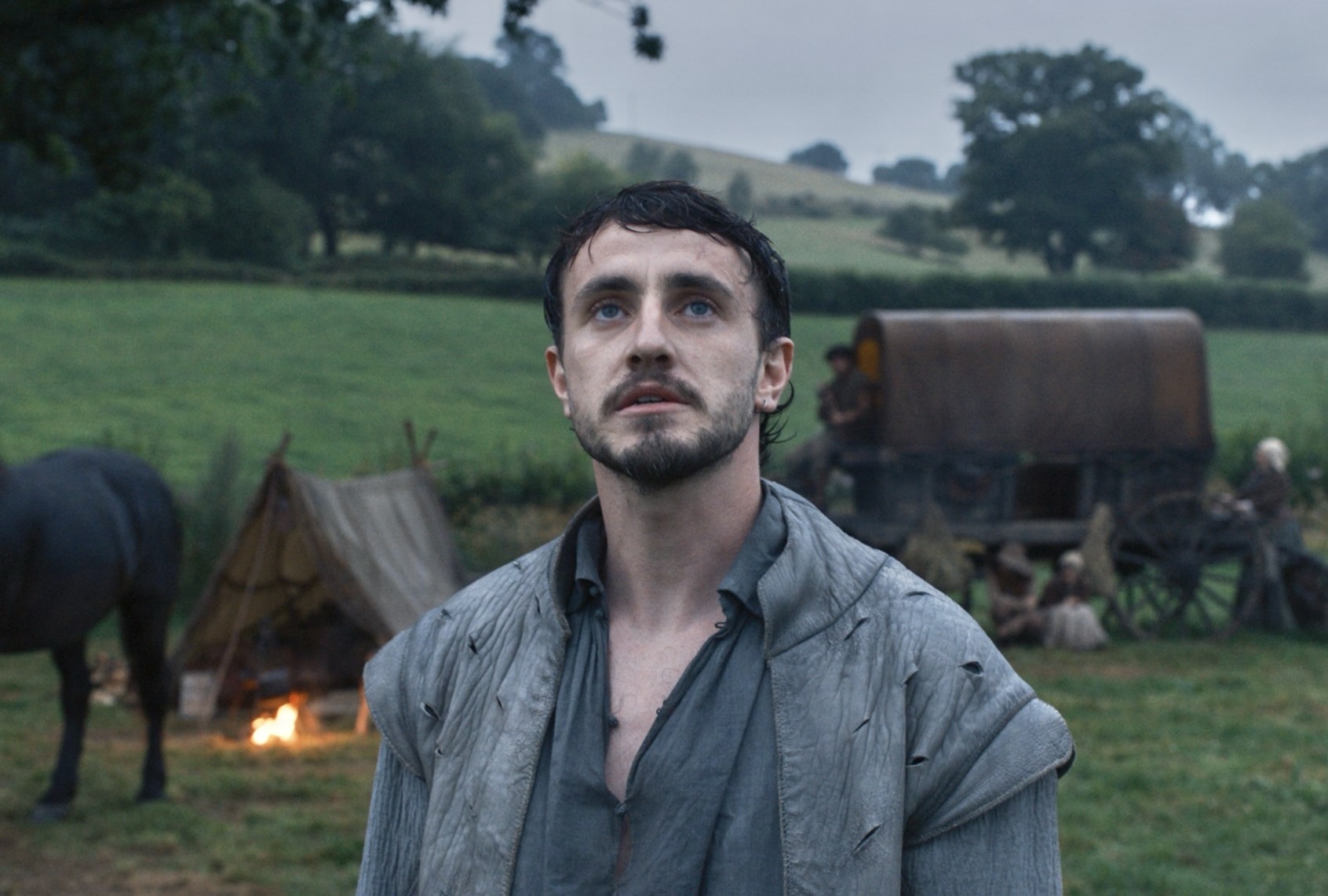
The film begins with the courtship of a small-town Latin tutor (Paul Mescal) and an odd young woman (Jessie Buckley) who spends much time in the woods, has a pet hawk and is rumored to be the daughter of a witch.

Their respective families (Emily Watson plays the tutor’s mother) disapprove, but young love (or lust) will have its way.  With Agnes pregnant, marriage is the next step.

Paul Mescal

The bulk of “Hamnet” is devoted to domestic life in Stratford.  The young husband begins spending time away in London (writing plays, we presume) while Agnes holds down the fort back home.  Their reunions are happy ones, and the couple have three children.

The only boy is Hamnet, so charmingly played by young Jacobi Jupe that we nave no trouble imagining the fierce love his parents have for him. 

At age 9 Hamnet succumbs to the plague in a horrendous death scene that leaves his mother a screaming wraith of pain.  Father arrives too late to see his boy alive.

Tragedy can bring families together or tear them apart. It appears that this family will never recover from Hamnet’s death.

When Agnes learns that her spouse’s latest play references their dead son, she makes the long trip to London to confront her now-estranged husband, arriving just in time to witness one of the first performances of “Hamlet.”

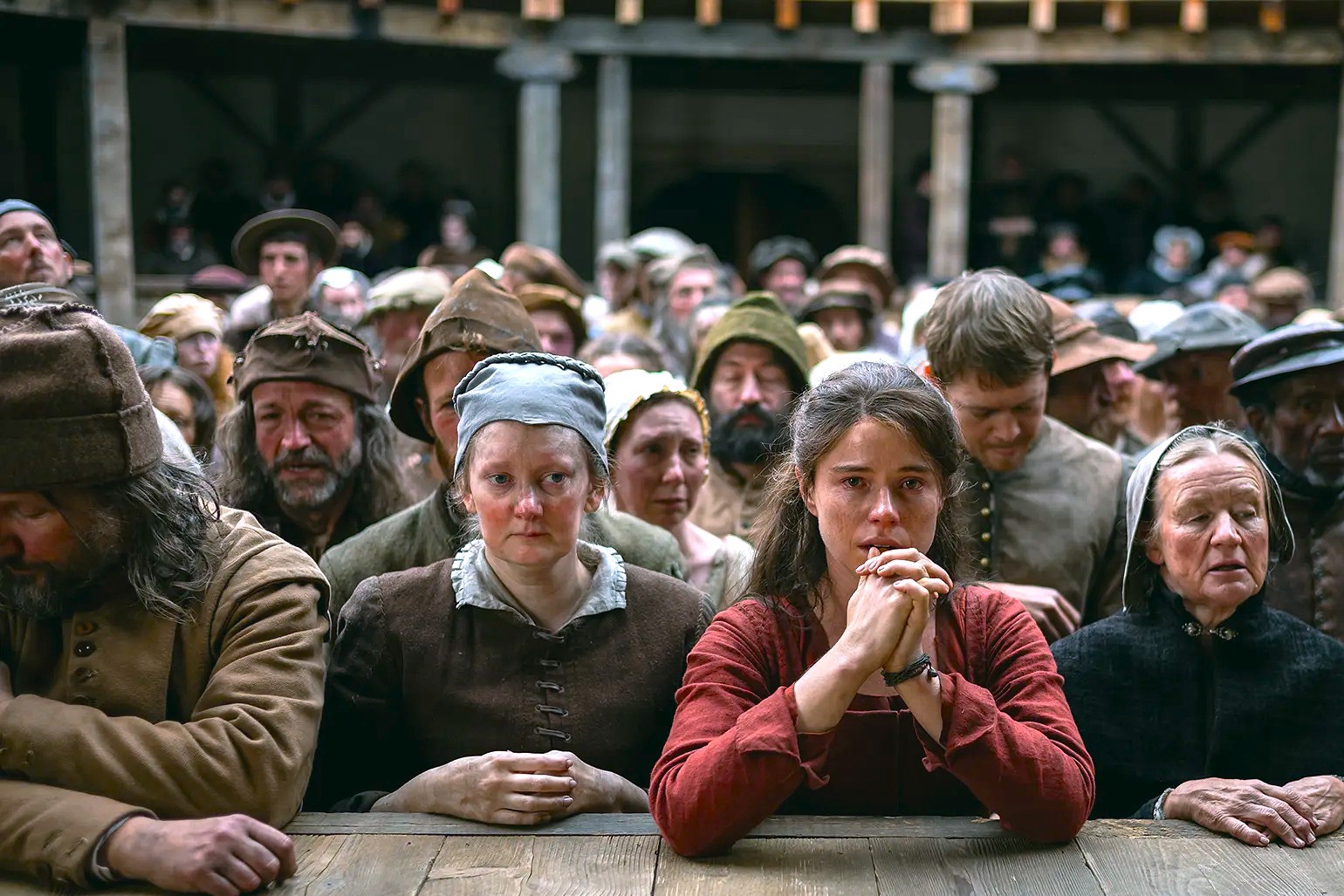
It’s at this point that “Hamnet” becomes something extraordinary. Agnes enters the open-air Globe with dozens of other playgoers, pushes her way to the front of the crowd and leans on the stage, ready to hurl objections and insults at this entertainment that capitalizes on her grief.

Except that during the performance she finds herself engrossed by the extraordinary storytelling and language. Like her fellow playgoers, she is transported to Elsinore Castle and caught up in the tale of loss, revenge and existential paradox. Abandoning her initial objections, Agnes ultimately recognizes that her husband has come to grips with their loss by using the theater to resurrect their dead child.

Art as therapy.

Zhao’s recreation of an Elizabethan production is extraordinarily captivating, not the least because Noah Jupe (older brother of the actor who played Hamnet) is so spectacularly good as the actor portraying Hamlet on stage.  

Watching this tragedy unfold is a transforming experience.  We recognize the awe and investment of the London audience in this new play; the sheer aesthetic pleasure that transcends the tragedy.

Mescal and Buckley give fine performances, but in the end it is the eternal genius of William Shakespeare that sticks in the memory.

George Clooney

“JAY KELLY”  My rating: C(Netflix)

132 minutes | MPAA rating: R

I’m a fan of George Clooney’s work. his persona and his politics.  But “Jay Kelly” left me cold.

Noah Baumbach’s latest film is a character study…sort of…of a man who apparently has no character.

Jay Kelly (Clooney) is a famous movie star.  Millions know him from his many screen appearances, but apparently nobody knows him, really.

His family, his friends, his co-workers…about all they get from him is suave charm, self-deprecating wit and good looks.  If there’s a real human being in the attractive package, it’s yet  to assert itself.

The screenplay by Baumbach and actress Emily Mortimer (who takes a small role) finds Jay on a trip to Italy to receive some sort of award.  Usually he flies in a private jet, but for this trip he has decided to take the train with all the other tourists and proles.  He says he doesn’t like being noticed, but he sure spends a lot of time being noticed.

If anyone is close to knowing Jay it’s his long-suffering manager Ron (Adam Sandler), who likes to think of himself as a friend.  Except as Jay points out, friends don’t usually take 15 percent.

“Jay Kelly” has an astoundingly deep cast — Greta Gerwig, Billy Crudup, Laura Dern, Patrick Wilson, Stacy Keach, Isla Fisher, Jim Broadbent, Riley Keough, Josh Hamilton (for starters) — though many have only a few seconds of screen time.

The film is stranded somewhere between satirizing Hollywood and its denizens and empathizing with Jay’s late-in-life realization that as a human he’s pretty much blown it.  But it’s neither funny enough or tragic enough to warrant a bloated running time (more than two hours).

Moreover, since Jay is a handsome cipher, our only real  human connection is Sandler’s Ron, who must ride herd on a mercurial star while trying to hold together his own private life.  It’s the film’s best performance.

“Jay Kelly” ends with Jay and an audience watching a compilation of scenes from his film and television work (actually they’re clips from George Clooney’s career, making for a sort of head-smacking meta moment).  To the extent that the segment stirs pleasurable memories it gives Jay’s life an emotional arc missing from the rest of the film.

But it’s a contrived moment in a film that already feels contrived.

| Robert W. Butler

Read Full Post »