Feeds:
Posts
Comments

Posts Tagged ‘Jessie Buckley’

Jessie Buckley

“HAMNET” My rating: B (In theaters)

125 minutes | MPAA rating: PG-13

For a good three quarters of Chloe Zhao’s “Hamnet” I found myself diverted — fine photography, good acting — but nowhere near the emotional catharsis that has many critics calling it a masterpiece.

But just wait.

“Hamnet” only comes fully to life in the last 20 minutes, but it does so with devastating intensity.

Well, better to peak late than early, and in that regard the film will leave viewers well wrung out as they head for the exits.

This is the story of how the death of Shakespeare’s young son, Hamnet, inspired the playwright to create perhaps his most enduring and overwhelming drama, “Hamlet.”

Zhao’s screenplay abandons the jumbled timeline of Maggie’ O’Farrell’s best-selling novel for a straightforward chronological narrative. At the same time it keeps a  couple of the book’s twistier aspects by leaving  nameless the Shakespeare character (we know he’s the Bard, but none of his contemporaries do) and by identifying his wife as Agnes when history tells us that Shakespeare’s wife actually was named Anne.

The film begins with the courtship of a small-town Latin tutor (Paul Mescal) and an odd young woman (Jessie Buckley) who spends much time in the woods, has a pet hawk and is rumored to be the daughter of a witch.

Their respective families (Emily Watson plays the tutor’s mother) disapprove, but young love (or lust) will have its way.  With Agnes pregnant, marriage is the next step.
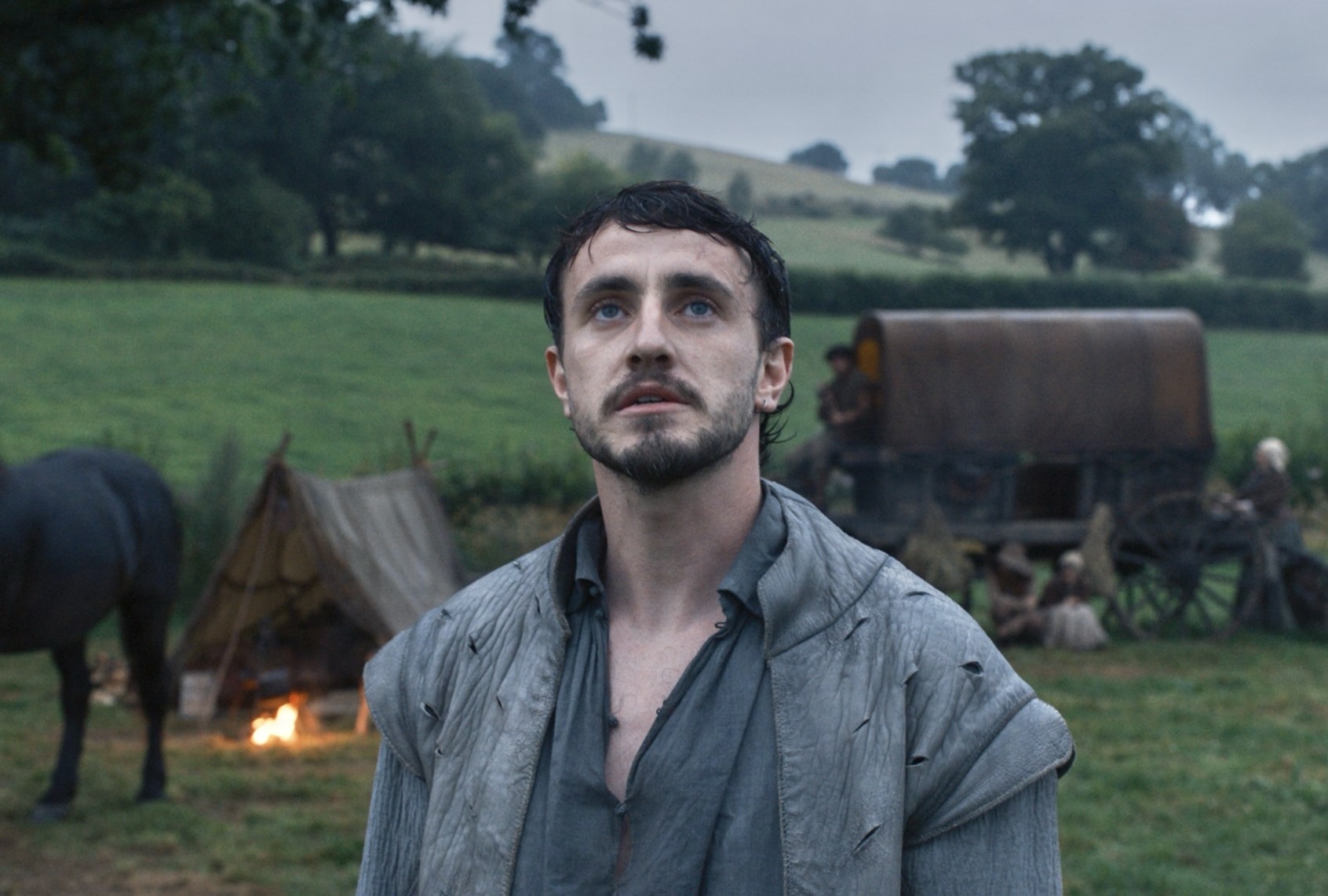
Paul Mescal

The bulk of “Hamnet” is devoted to domestic life in Stratford.  The young husband begins spending time away in London (writing plays, we presume) while Agnes holds down the fort back home.  Their reunions are happy ones, and the couple have three children.

The only boy is Hamnet, so charmingly played by young Jacobi Jupe that we nave no trouble imagining the fierce love his parents have for him. 

At age 9 Hamnet succumbs to the plague in a horrendous death scene that leaves his mother a screaming wraith of pain.  Father arrives too late to see his boy alive.

Tragedy can bring families together or tear them apart. It appears that this family will never recover from Hamnet’s death.

When Agnes learns that her spouse’s latest play references their dead son, she makes the long trip to London to confront her now-estranged husband, arriving just in time to witness one of the first performances of “Hamlet.”

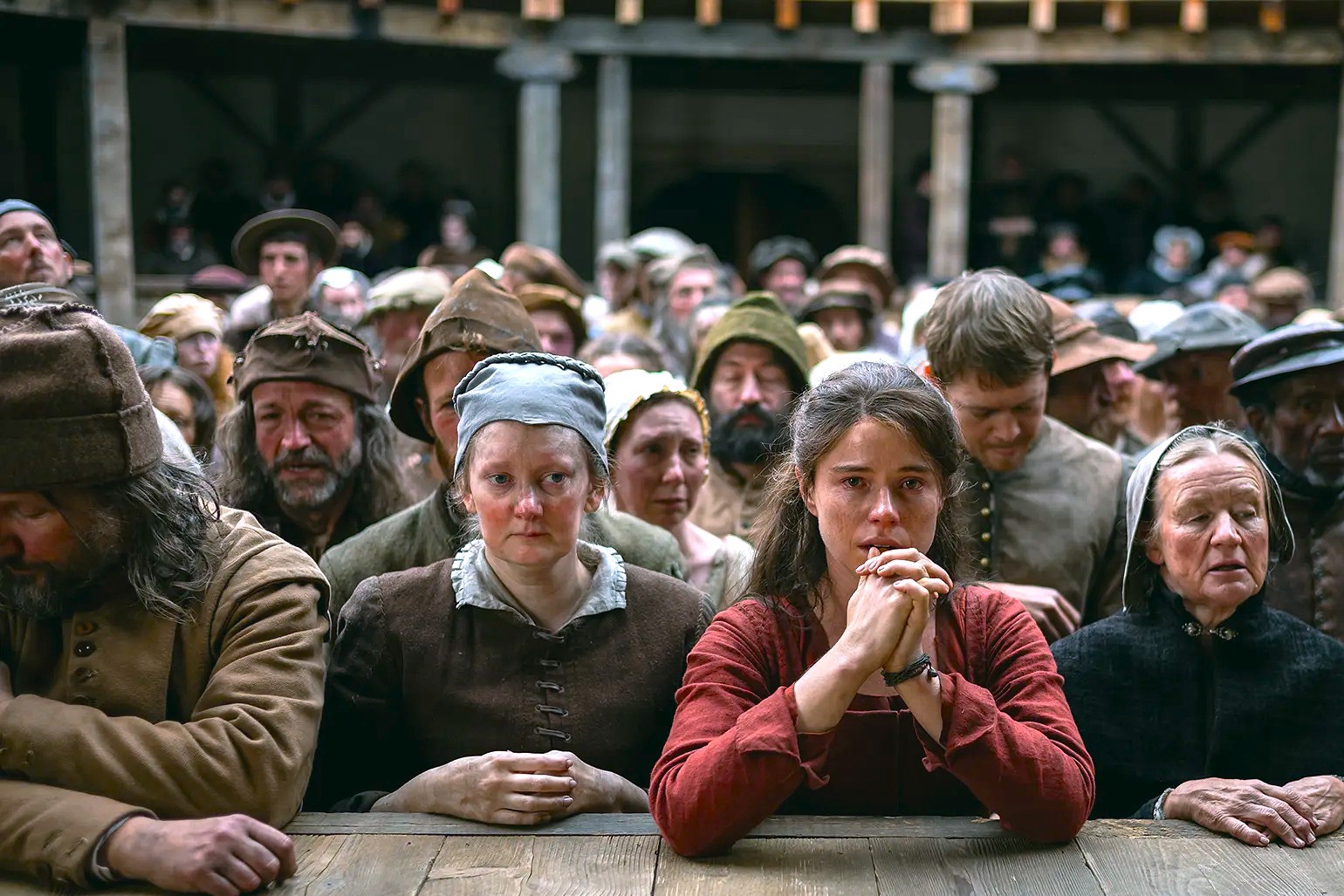
It’s at this point that “Hamnet” becomes something extraordinary. Agnes enters the open-air Globe with dozens of other playgoers, pushes her way to the front of the crowd and leans on the stage, ready to hurl objections and insults at this entertainment that capitalizes on her grief.

Except that during the performance she finds herself engrossed by the extraordinary storytelling and language. Like her fellow playgoers, she is transported to Elsinore Castle and caught up in the tale of loss, revenge and existential paradox. Abandoning her initial objections, Agnes ultimately recognizes that her husband has come to grips with their loss by using the theater to resurrect their dead child.

Art as therapy.

Zhao’s recreation of an Elizabethan production is extraordinarily captivating, not the least because Noah Jupe (older brother of the actor who played Hamnet) is so spectacularly good as the actor portraying Hamlet on stage.  

Watching this tragedy unfold is a transforming experience.  We recognize the awe and investment of the London audience in this new play; the sheer aesthetic pleasure that transcends the tragedy.

Mescal and Buckley give fine performances, but in the end it is the eternal genius of William Shakespeare that sticks in the memory.

George Clooney

“JAY KELLY”  My rating: C(Netflix)

132 minutes | MPAA rating: R

I’m a fan of George Clooney’s work. his persona and his politics.  But “Jay Kelly” left me cold.

Noah Baumbach’s latest film is a character study…sort of…of a man who apparently has no character.

Jay Kelly (Clooney) is a famous movie star.  Millions know him from his many screen appearances, but apparently nobody knows him, really.

His family, his friends, his co-workers…about all they get from him is suave charm, self-deprecating wit and good looks.  If there’s a real human being in the attractive package, it’s yet  to assert itself.

The screenplay by Baumbach and actress Emily Mortimer (who takes a small role) finds Jay on a trip to Italy to receive some sort of award.  Usually he flies in a private jet, but for this trip he has decided to take the train with all the other tourists and proles.  He says he doesn’t like being noticed, but he sure spends a lot of time being noticed.

If anyone is close to knowing Jay it’s his long-suffering manager Ron (Adam Sandler), who likes to think of himself as a friend.  Except as Jay points out, friends don’t usually take 15 percent.

“Jay Kelly” has an astoundingly deep cast — Greta Gerwig, Billy Crudup, Laura Dern, Patrick Wilson, Stacy Keach, Isla Fisher, Jim Broadbent, Riley Keough, Josh Hamilton (for starters) — though many have only a few seconds of screen time.

The film is stranded somewhere between satirizing Hollywood and its denizens and empathizing with Jay’s late-in-life realization that as a human he’s pretty much blown it.  But it’s neither funny enough or tragic enough to warrant a bloated running time (more than two hours).

Moreover, since Jay is a handsome cipher, our only real  human connection is Sandler’s Ron, who must ride herd on a mercurial star while trying to hold together his own private life.  It’s the film’s best performance.

“Jay Kelly” ends with Jay and an audience watching a compilation of scenes from his film and television work (actually they’re clips from George Clooney’s career, making for a sort of head-smacking meta moment).  To the extent that the segment stirs pleasurable memories it gives Jay’s life an emotional arc missing from the rest of the film.

But it’s a contrived moment in a film that already feels contrived.

| Robert W. Butler

Read Full Post »

WOMEN TALKING” My rating: B + (Theaters)

104 minutes | MPAA rating: PG-13

True originality in filmmaking may be impossible. After a century plus of cinema most of the easy fruit has been picked; it takes something pretty special to make us sit up straight and pay attention.

“Women Talking” does that with regularity. It’s a mix of poetic parable and docudrama that hits an emotional/intellectual sweet spot, leaving the viewer with a heady mix of feelings unlike anything I’ve experienced.

Written and directed by Sarah Polley (it’s based on the nonfiction book by Miriam Toews, who shares screenplay credit), “Women Talking” is inspired by real-world events. A decade ago in Bolivia the women of a Mennonite community realized that some of their menfolk had been dosing them with animal tranquilizers and raping them in their sleep.

This film (the setting appears to be rural Canada) imagines how those women — purposely uneducated but by no means unintelligent — might gather to decide whether to stick with their religious community or seek lives in the greater world few know much about (they’ve had no radio, no TV, no Worldwide Web).

“Women Talking” opens with a disturbing image, an overhead shot of the maiden Ona (Rooney Mara) awakening to find her legs and bedclothes smeared with blood.

Cut to a man cowering in a corncrib and being beaten by the furious Salome (Claire Foy); other men have to pull her off the miscreant lest she kill him.

In just a few carefully selected moments the film gives us the lay of the land. The men have gone off to town to bail out their lecherous brothers arrested by the cops. For a few hours the women are left alone to make a choice.

Do they forgive the transgressors and carry on as if nothing had happened? Do they stay in the colony and fight the societal structure that has always limited their ambitions? Or do they pull up stakes and move out, taking with them the younger children?

The bulk of “Women Talking” is exactly that. A dozen or so women retreat to a hayloft overlooking the fields to debate their future. Interestingly enough, none exhibits religious doubts; rather, their beef is with men who don’t live up to their half of the bargain.

Some women — embodied by the scar-faced Janz (Frances McDormand) — will stay no matter what the others decide. They simply cannot fathom a life other than the one they’ve experienced in the colony.

Salome, whose violent temper we have already witnessed, bristles with defiance, sneering at admonitions to behave with traditional feminine submission and restraint. “I’ll stand my ground and deal with God’s wrath if I have to,” she seethes.

Mariche (Jessie Buckley) is torn between fury and fear. Her husband (like the other men, we see him only glancingly, as if out of the corner of our eye) enforces household rules with his fists. If she attempts to leave with their children might be the last thing she ever does.

Striking a more conciliatory tone is Ona, now pregnant by one of her nocturnal molesters. Despite this she exudes a preternatural calm — you can’t help thinking of another virgin who found herself with child.

Ben Whishaw, Rooney Mara, Claire Foy

The debate is overseen by Agata (Judith Ivey), the oldest of the women. There are some teenage girls eager to bail on the colony if given the chance. A bit of a wild card is Greta (Sheila McCarthy), a benign eccentric who mostly wants to talk about her beloved buggy horses.

There is but one man to witness all this. August (Ben Whishaw), the colony’s school teacher, has been brought in to take notes on the proceedings (apparently none of the women can read or write). This gentle soul offers advice when asked and quietly worships Ona from afar…clearly he is hopelessly in love.

“Women Talking” could feel claustrophobic and stage bound, but Polley periodically takes us outside to mingle with the colony’s children who are awaiting their mothers’ decision. Sometimes the camera roams the rows of corn or lifts overhead like a hovering bird.

Luc Montpellier’s photography employs a desaturated color scheme; the absense of bright hues somehow focuses our senses on the issues and personalities at hand. Similarly, Hidur Gudnadottir’s quietly evocative musical score suggest a world of simple pleasures — acoustic guitar, hammered dulcimer and chimes that ultimately subsume into a piece for string orchestra.

Polley and Toews string it all together with voiceover narration provided by one of the colony’s adolescent girls (I was reminded of Linda Manz’s narration for Terrence Malick’s “Days of Heaven”). This monologue is in the form of a letter to Ona’s unborn child.

All this masterfully builds into a quietly devastating emotional crescendo, sending us off with a rare mingling of sadness and hope.

| Robert W. Butler

Read Full Post »

Dakota Johnson, Olivia Colman

“THE LOST DAUGHTER” My rating: B (In theaters)

121 minutes | MPAA rating: R

Many a man has bailed on his family and kept his social status…but let a woman exhibit indifference toward her children and the pillars of civilization start to crumble.

“The Lost Daughter,” Maggie Gyllenhaal’s impressive writing/directing debut, is about a bad mother. At least that’s what a traditional moralist would say.

But things aren’t nearly that cut and dried in this smart, thought-provoking adaptation of Elena Ferrante’s  novel. 

This is a deeply ambivalent, jaw-droopingly subtle effort that eschews the usual big dramatic exposition (“…this is why I did what I did…”) in favor of showing us, building its story (and its case) through the slow accumulation of images and information.

Leda (Olivia Colman) is vacationing alone on a Greek island.  She’s a college professor, a Brit by birth but working in America, and she’s going to spend her summer sitting in the sun and researching her next book.

She tolerates the scuzzy American ex-pat (Ed Harris) who manages the vacation home she rents.  And she’s amused by Will (Paul Mescal), her eager-to-please cabana boy. They enjoy a chaste flirtation.

But Leda is absolutely mesmerized — and appalled — by the family with whom she shares the beach.  They’re a loud, obnoxious bunch.  The head of the clan seems vaguely shady;  he’s got a pregnant trophy wife half his age.

The real object of Leda’s fascination, though, is the man’s daughter-in-law, Nina (Dakota Johnson), who has a handsome but pushy husband and a pretty but spoiled young daughter. 

Lena appears obsessed with the tiny interactions between weary, frustrated mother and willful child. When the little girl goes missing the family is thrown into a panic. Leda finds the child and returns her to the fold…but not without secretly claiming a souvenir of the encounter that will come back to haunt her.

“The Lost Daughter” is being described as a “psychological thriller.” Actually, “psychological jigsaw puzzle” seems more accurate.

Through casual conversation — Gyllenhaal’s dialogue is amazingly unforced and natural — we learn that Leda has two daughter, now in their 20s, who live with her ex.  Apparently she rarely sees them.

Peter Sarsgaartd, Jessie Buckley

In flashbacks we see her as a young mother (played now by Jessie Buckley), struggling to balance family and career, and engaging in an affair with a much-admired professor (Peter Sarsgaard, Guyllenhaal’s spouse) that will push her further away from her conventional existence.

Most women have days in which they would just as soon dump the husband and kids and strike out for parts unknown.  Leda is the rare individual who actually kicks motherhood aside in the hope of discovering a different sort of fulfillment. 

But one does not achieve that sort of liberation without paying a huge emotional price, and the wonder of Colman’s performance is how she tells us everything about what Leda is feeling without actually ever saying anything. 

A lesser filmmaker might make excuses for her heroine’s choices, providing her with explanatory monologues, poking at every little shred of guilt clinging to Leda’s consciousness.

There’s no need for that when you have a leading lady with Colman’s range.

Is Leda a heroine or a villainess?

Why not neither? Or both?

| Robert W. Butler

Read Full Post »

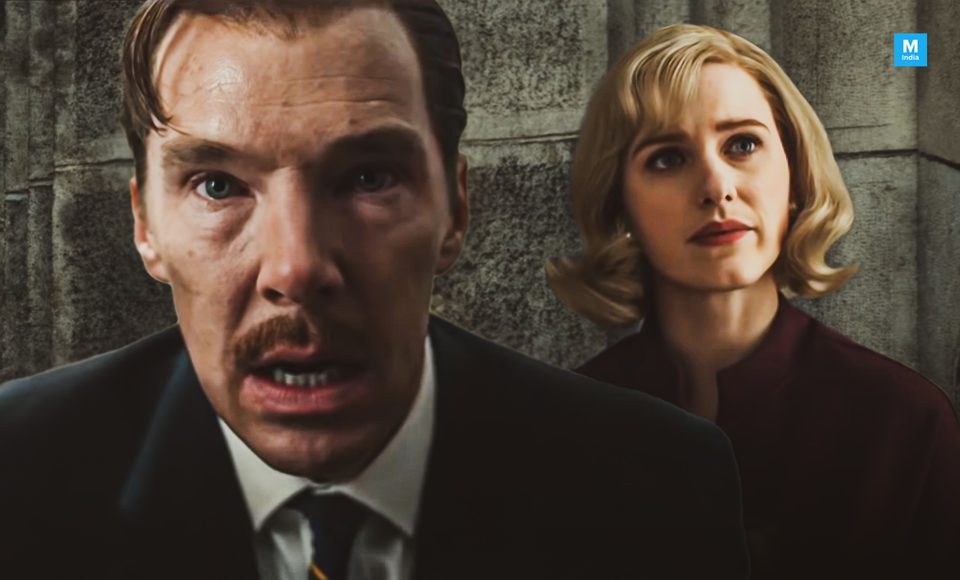
Benedict Cumberbatch, Rachel Brosnahan

“THE COURIER” My rating: B- (In theaters March 19)

111 minutes: MPAA rating: PG-13

Like its title, “The Courier” is an unprepossessing Cold War thriller that, despite an OK turn from leading man Benedict Cumberbatch and a based-on-fact birthright, never works up a full head of steam.

In the early 1960s British businessman Greville Wynne (Cumberbatch) was recruited by his country’s spymasters. An independent salesman who represented dozens of Western manufacturers, Wynne was encouraged by the M-16 spooks to expand his operation to the growing Soviet market.

Mostly he was to carry on business as usual. But from time to time he would be asked to bring pilfered Soviet secrets back to London.

Initially Wynne rejects the idea.  He’s not a spy, after all.

Noting Wynne’s unremarkable military record and his gone-to-flab physique, his handler reassures him: “If this mission were really dangerous you’re the last man we’d send.”

Wynn’s contact in Moscow is Oleg Penkovsky (Merab Ninidze), a WWII hero now working for the KGB, though his “official” title is that of trade specialist.  Penkovsky is the film’s most interesting character, a guy so traumatized by Krushchev’s podium pounding and the growing Cuban Missile Crisis that he’s willing to turn his country’s secrets over to the West in the hope of avoiding all-out nuclear war.

(more…)

Read Full Post »

Rene Zellweger as Judy Garland

“JUDY” My rating: B

118 minutes | MPAA rating: PG-13

One of the biggest thrills in moviegoing is seeing a familiar performer sink so completely into a character that you forget who  you’re watching.

That’s the case with Rene Zellweger’s portrayal of Judy Garland in “Judy.”  Bet she’s already cleared space on the mantel for another Oscar.

Scripted by Tom Edge and directed by Ruper Goold, “Judy” is a film whose flaws are more than compensated for by a monumental performance.

Set in 1969, the last year of Garland’s life, when she was persona non grata in Hollywood and had to travel to London to get a nightclub gig, the film has some rough spots, particularly in its depiction of a once-great talent circling the drain. It’s pretty depressing stuff.

But Zellweger’s portrayal lifts the entire enterprise. She not only looks like the 47-year-old, drug-worn Garland, but she channels the star’s eccentric body language. And she sings Garland’s songs — not as well as Garland did, but enough to wow moviegoers. (It helps that by this time in her career Garland’s power was more in her unique delivery than vocal strength.)

We meet Judy and her two young children returning to L.A. from a tour playing clubs in the South. It’s not a happy homecoming — they’re evicted from their hotel for back rent, and Judy’s ex, agent Sid Luft (Rupert Sewell) says that while he’ll take in the kids, he’s also going to sue for custody.

The only way to get enough cash to make her case in court is for Judy to take a gig in London, performing at a club run by a no-nonsense promoter (Michael Gambon); wise to his star’s reputation for temperamental meltdowns, he assigns a handler (“Wild Roses'” Jessie Buckley) to coax, cajole and physically push the quaking singer out onto the stage.

(more…)

Read Full Post »

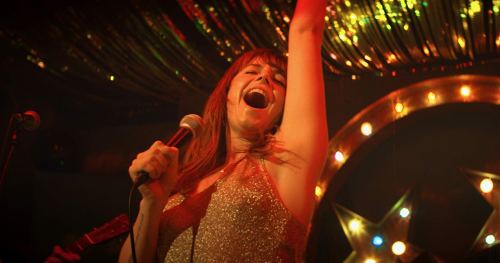
Jessie Buckley

“WILD ROSE” My rating: B

101 minutes | MPAA rating: R

The struggling young artist with an impossible musical dream has been a movie staple since the advent of sound.

Tom Harper’s “Wild Rose” recycles many of the usual tropes before putting a distinctive spin on the genre; above all else this Scottish film heralds the arrival of Jessie Buckley as a major talent.

We’ve seen the Irish-born Buckley before. In 2013’s “Beast” she played a withdrawn girl who falls for a boy who may be a serial killer; she was terrific but the movie was too much of a downer to create much buzz.

This is not the case with “Wild Rose.”

We meet Buckley’s Rose-Lynn on her last day in prison on a drug conviction. Outfitted with an ankle monitor (which she hides inside a pair of white cowboy boots) she returns to the two young children she left behind — though not before a quick shag in the park with her ex and a visit to Glasgow’s version of the Grand Ole Opry, a country music emporium that was once her home base.

The homecoming is strained. Her son and daughter have all but forgotten her and her mother (the great Julie Waters), who has been caring for them in Rose-Lynn’s absence, is more than a little dubious of her errant daughter’s commitment to responsibility.

Here’s the thing: Rose-Lynn isn’t just an accomplished screwup (though she is); she’s also  a country music fanatic whose forearm bears a tattoo reading “Three chords and the truth,” her explanation of country music’s essence. All her life she has dreamed of singing professionally…but a Scottish country singer? C’mon.

(more…)

Read Full Post »

Johnny Flynn, Jessie Buckley

“BEAST”  My rating: B- 

107 minutes | MPAA rating: R

A gnarly character study posing as a serial killer thriller, Michael Pearce’s “Beast” very nearly defies description.

On its most graspable narrative level it’s about a socially challenged young woman who falls hard for a local lad, then begins to suspect that he may be the murderer terrorizing the island on which they live.

But it’s also a wince-worthy portrayal of a destructive family dynamic, of sexual rapture after a life of chastity, and of a hermetically-sealed society driven off the rails by paranoia and panic.

Which is a lot to cram into one movie.  With his first feature writer/director Pearce sometimes struggles to keep it all in balance, but thanks to solid performances he delivers the modest goods.

Moll (Jessie Buckley) is such an outsider she seems a stranger even at her own birthday party.  With an explosion of unkempt red hair and a personality that seems always in retreat, she’s a perennial misfit.

Moll works occasionally as a tour guide — like filmmaker Pearce she lives on the Isle of Jersey, an outpost of stiff-upper-lip Britishness just off the hedonistic French coast — but mostly she’s  caretaker to her dimentia-riddled father. She’s more or less cast in that role by the rest of the family, especially her domineering and icily biting mother (Geraldine James), who treats her like a con on probation.

Which, in a sense, Moll is.  Fourteen years earlier she used a pair of scissors to skewer a bullying classmate. She still hasn’t lived down her reputation as violently unstable. (more…)

Read Full Post »