
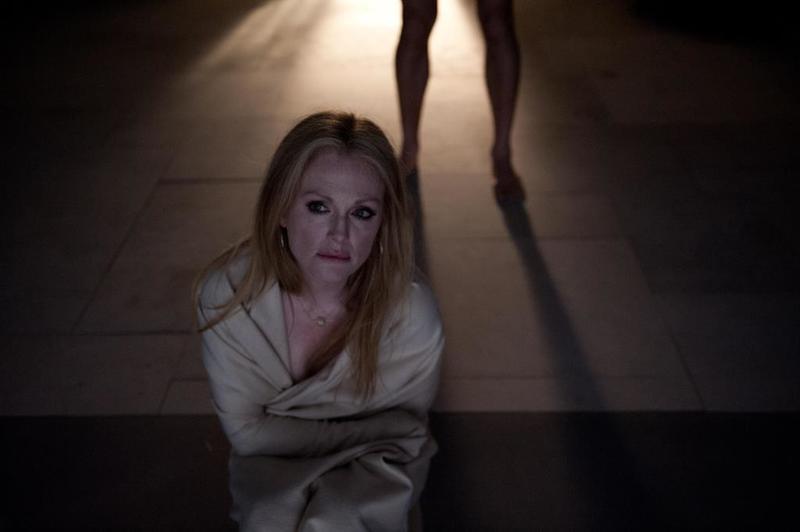
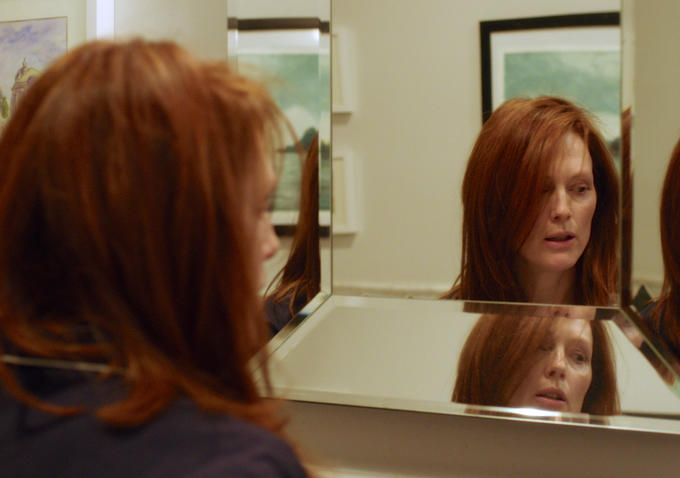
Tilda Swinton, Julianne Moore
“THE ROOM NEXT DOOR” My rating: C+ (Netflix)
106 minutes | MPAA rating: PG-13
At a certain point in every artist’s life the old mortality bug starts nibbling away. Apparently filmmaker Pedro Almodovar has reached that stage.
“The Room Next Door” is typical Almodovar in that it concentrates on relationships among women. But mostly it’s an atypical contemplation of death.
Popular author Ingrid (Julianne Moore) learns that her old magazine colleague Martha (Tilda Swinton) has terminal cancer. A visit to the hospital leads to much reminiscing (there are flashbacks to Martha’s early life and career as a war journalist) and a startling request.
Martha has obtained a “euthanasia drug” on the dark web. She wants Ingrid to accompany her to a vacation rental in the Catskills where Martha plans to end her life. (“Cancer can’t get me if I get myself.”) She wants Ingrid simply to be on hand in an adjacent bedroom so she won’t feel she’s totally on her own.
Ingrid is reluctant (she hasn’t seen Martha in five years and, besides, her most recent book examines her own fear of death) but finally acquiesces when she learns that several other friends have already turned down Martha’s request.
The source material here is Sigrid Nunez’s 2020 novel What Are You Going Through, and there are times when the English dialogue (I believe this is the first all-English language movie in Almodovar’s resume) sounds like it has been strained through a translation app.
But the real issue here is one of tone. Almodovar is known for his wonderful wackiness (“Women on the Verge…,” “I’m So Excited”), his camp sensibilities and his deep appreciation of over-the-top melodrama.
None of which is in evidence here. Even Almodovar’s visual panache has been muted as if intimidated by the grim subject matter. (Although the closer Martha comes to taking the pill, the more colorful the wardrobe she chooses.)
Clearly Almodovar wants to move us. But I felt peculiarly unmoved.
It’s not the actresses’ fault. Moore is solid as a reluctant participant in what is legally a crime, while Swinton, with her glacial pallor and skeletal physique certainly looks like she’s about to cash in.
Then, too, the screenplay has digressions that seem not to go anywhere. John Turturro has a couple of scenes as the pessimistic writer both women have had relationships with. Alessandro Nivola is a moralistic police detective who in an unnecessary coda grills Ingrid for her part in the death.
And at the very end Martha’s estranged daughter briefly shows up. She also is played by Swinton, whose appearance has been subtly altered (either by makeup/prosthetics or CGI makeover).
Okay. Almodovar has gotten that out of his system. Let’s move on.
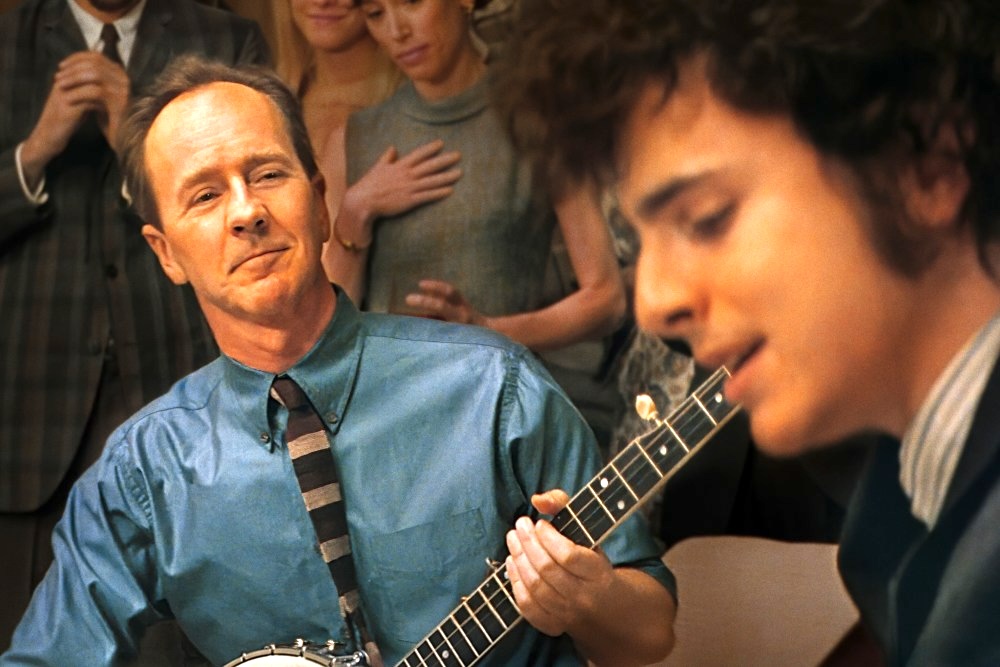
Edward Norton as Pete Seeger, Timothee Chalomet as Bob Dylan
“A COMPLETE UNKOWN” My rating: B (Apple+)
141 minutes | MPAA rating: R
“A Complete Unknown” is about as good a Bob Dylan biopic as we’re likely to get.
First, it absolutely nails the where and when of the early 60s folk scene in New York City.
And second, it knows that no matter how hard it tries, its main character will remain an enigma.
I mean, I’ve been listening to Bob Dylan for more than half a century and I still couldn’t give you a reading on his personality. Would I like him in person? Would he be a pain in the ass?
Shut up and listen to the music.
Anyway, James Mangold’s film (the excellent screenplay is by Mangold, Jay Cocks and Elijah Wald) covers Dylan’s early years in the Big Apple, from his crashing the hospital room of the dying Woody Guthrie to his controversial (we’re talking “Rite of Spring” outrage) embrace of an electric guitar at the Newport Folk Festival.
Along the way Oscar-nominated Timothee Chalomet delivers a terrific central performance, capturing his subject’s physical and vocal quirks (the musical numbers were all recorded live on camera) while carefully concealing the innermost Bob. It shouldn’t work. It does.
Just as good is Edward Norton as folkie purist Pete Seeger, who takes Dylan under his wing, only to go ballistic when our man turns his attention to rock’n’roll.
Monica Barbaro is solid as folkie “it” girl and Dylan squeeze Joan Baez.
You don’t need an excuse to drag out your old Dylan records, but don’t be surprised if after watching this you do a deep dive into the catalogue.
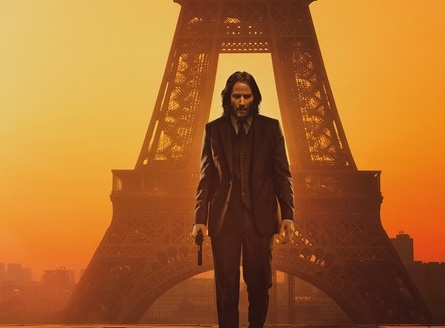
Keanu Reeves
“JOHN WICK: CHAPTER 4” My rating: B (Roku)
169 minutes | MPAA rating: R
So far there have been four John Wick movies…although actually they’re the same movie with slightly different fight scenes.
“John Wick: Chapter 4” has the same story line as all the others. Good-guy assassin John Wick (Keanu Reeves) once again finds himself in a one-man war against the numberless minions of The Table, the all-powerful international crime syndicate.
“Wick” regulars Ian McShane, Donnie Yen and Laurence Fishburne reprise their supporting roles…the main baddie this time around is played by Bill Skarsgard as a sort of sinister fop.
The story doesn’t matter. It’s the fights that count, and “Wick 4” is crammed with them.
In fact, there’s so much to it that midway through this nearly 3-hour bloodiest I found myself zoning out from too much good fight choreography. (It’s like movie nudity. One naked woman gets your attention; 100 of them leaves you kinda ho-hum.)
Happily the film concludes with a doozie, a nearly 40-minute battle in which our man Wick must kill his way up a long outdoor staircase leading to Paris’ Sacre Coeur Cathedral where he is to engage in a final duel with his main foe.
What’s interesting here is that director Chad Stahelski and his writers (Shay Hatten, Michael Finch, Derek Kolstad) finally accept the ridiculousness of it all and inject some humorous elements into the mayhem.
After killing dozens of bad guys and nearly reaching his goal, Wick is sent tumbling back to the bottom of the stairs to start the whole thing over again. It’s like that old two-reeler in which Laurel and Hardy are deliverymen attempting to carry a piano up an endless flight of stairs.
Reeves even allows a bit of comic exasperation to creep into his performance. He doesn’t quite roll his eyes at the silliness, but he comes close.
| Robert W. Butler








 Butler's Cinema Scene