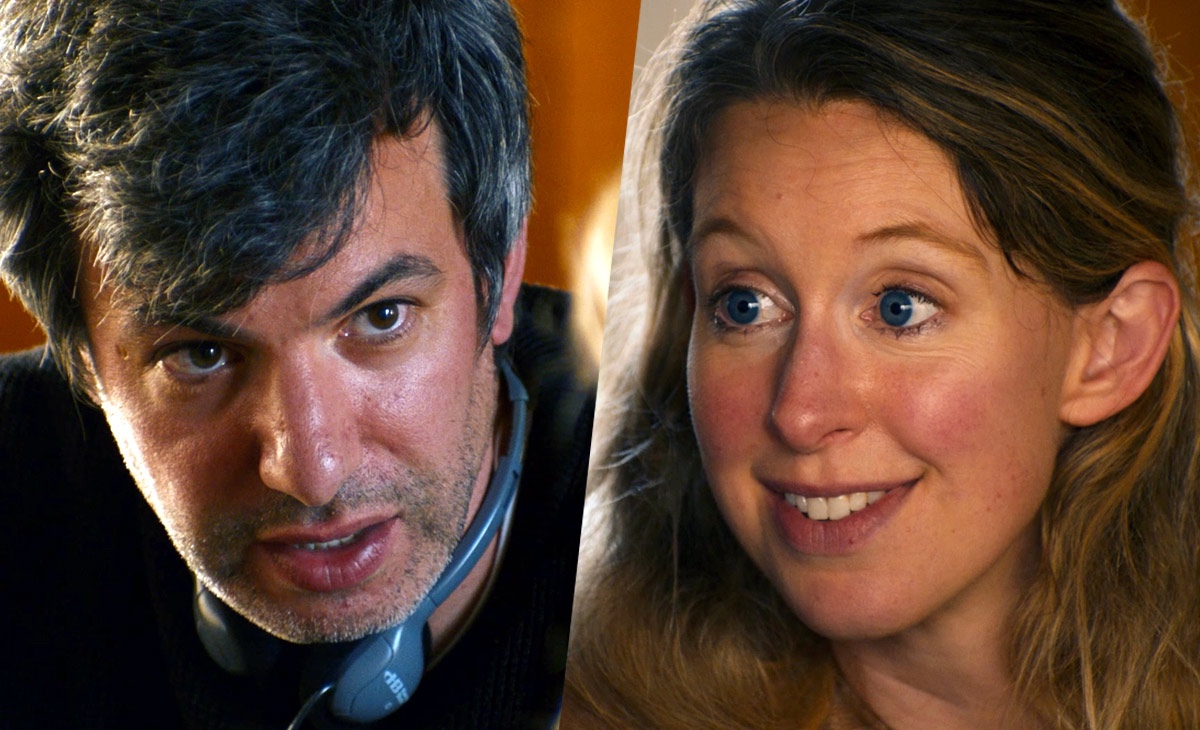
Nathan Fielder, Elizabeth Holmes
“YOU CAN SEE EVERYTHING” My rating: A- (In theaters)
175 minutes | MPAA rating: R
It’s a documentary, sure, albeit one with a second-act twist guaranteed to tie your mind and emotions into knots.
It’s a comedy of sorts, with a filmmaker becoming an uneasy character in a real-life psychodrama.
And it’s a deep-dive character study which, like most great examples of the genre, leaves us with as many questions as answers.
And here’s a guarantee: After experiencing the nearly three hours of “You Can See Everything” (don’t worry…the time flies by) you’ll spend hours and days sorting all the pieces of this fascinating, maddening jigsaw puzzle.
First things first. Filmmakers Nathan Fielder and Lance Oppenheimer somehow got 24/7 access to Theranos founder Elizabeth Holmes and her family in the month leading up to her serving an 11-year sentence in a federal prison on a fraud conviction.
Holmes, of course, was the cover girl entrepreneur whose creation — a desktop machine that from a single drop of human blood could detect dozens of diseases and conditions — has been dismissed as a giant con job.
Just how the filmmakers and Holmes hooked up is never really explored. We simply find the Holmes family — Elizabeth, her husband Billy Evans and their two young children — residing in a rented beach house near San Diego.
Director Oppenheimer stays behind the camera (cameras, actually,…there seem to have several running at all times). His colleague Fielder — a sometimes comedy actor — is front and center, sleeping in the guest room, conducting interviews, asking questions, making comments and interacting with the family.
On occasion Fielder has a sort of Woody Allen moment when it’s obvious that he’s not entirely comfortable with his fly-on-the-wall vantage point. He’s particularly nervous standing by as Holmes’ husband takes a shower (the full frontal nudity earned the doc an R rating). You’ve got to ask: Did Holmes’ mean for her promise that “You can see everything” to include her husband’s penis? Did Evans ask (or even demand) to be filmed naked? Hmmm…
At first, anyway, the family dynamic seems pretty normal. The kids are obviously loved and well cared for. Holmes and Evans cook and clean and play with their offspring on the beach.
You have to ask…what did Holmes and Evans hope to achieve by having their private lives chronicled in such detail?
Fielder’s interviews with Holmes are both revelatory and frustrating. After being confronted with her unblinking baby blues and seeming lack of guile, one understands how big brains like Henry Kissinger could have been schmoozed into supporting her Theranos project. She’s a True Believer.
Holmes maintains her innocence, stating flatly that the Theranos technology is valid and that if there was fraud being perpetrated it was the fault of her former boyfriend and business partner, Ramesh Balwani (who plays no part in this film).
For a woman facing prison she’s surprisingly upbeat. Oh, there are a few tearful moments, but more often than not her face exhibits a smile of hopeful anticipation. She seems preternaturally calm. In fact, her emotional range appears stunted.
Fielder shows her a video of the old Abbott & Costello routine “Who’s on First” and while recognizing that it’s funny (you can hear an audience roaring on the clip) Holmes cannot say why. She doesn’t understand that “Who” is the name of the player on first base.
Is she on the spectrum? And if so, does that mean that she’s vulnerable to emotional manipulation despite her apparent high IQ?
Fielder also devotes much time to Evans, a handsome and vaguely imperious fellow who says the couple fell in love at first sight and are such soulmates that they speak for each other. We’ll find out later that mostly he speaks for her.
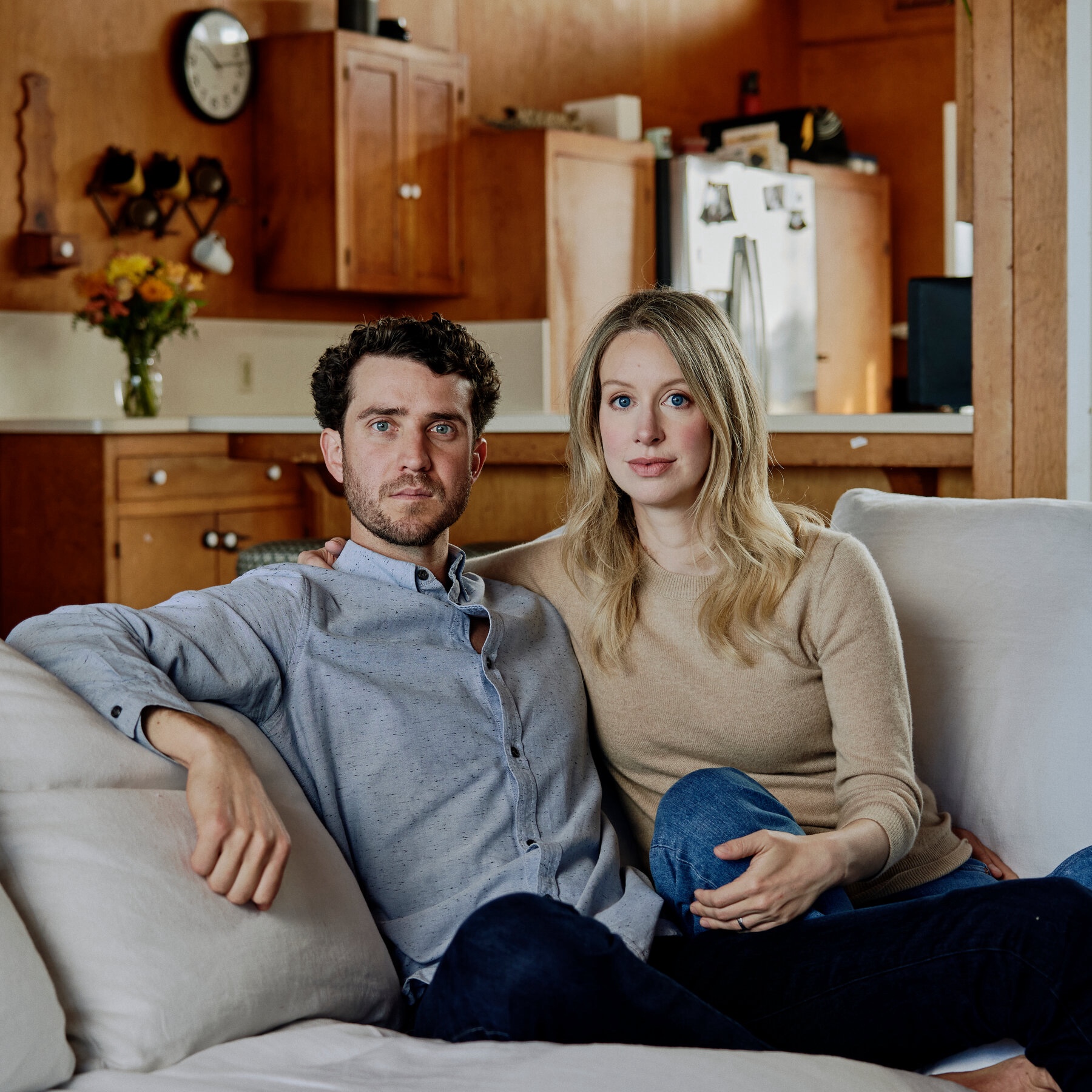
Billy Evans, Elizabeth Holmes
At one point Fielder asks Holmes to watch actress Amanda Seyfried (who won both an Emmy and a Golden Globe) portraying her in the 2022 miniseries “The Dropout.” It’s too much for Holmes, who folds into a fetal retreat.
This first act ends with Holmes entering a prison in Texas. But “You Can See Everything” is just starting to get interesting.
Clearly the filmmakers had hit an impasse. Once behind bars their access to Holmes was limited. Fielder could visit her in prison but filming or taping her was prohibited.
They continued to follow Evans, who is collecting technology and money to launch a new 2.0 version of Theranos. They talk to his investors and collaborators, all of whom see the original Theranos as a promising but mishandled blip in the march of progress. (What the hell…I hope they’re onto something. If it works it will revolutionize diagnostic medicine.)
And they reveal that Evans — seemingly without his wife’s knowing about it — strong-armed the movie studio A24 into giving him a percentage of the documentary’s profits…a virtually unheard of concession. (A final postscript informs us that eventually Evans dropped his demand for money.)
But how to deal with the absent Elizabeth Holmes?
Here Oppenheimer and Fielder pull an insanely clever rabbit our of their hat. The core of their approach is to re-enact Fielder’s jailhouse meetings with Holmes using elaborate sets and professional actors. I’d love to spill the beans on just who is portraying Holmes, but that would ruin one of the film’s great surprises.
Let’s just say that the moments that ensue take the idea of “meta” and multiply it about a hundredfold. We’re talking conceits within conceits within conceits. It’s dizzying but delightful.
And perplexing. Because the final word on Elizabeth Holmes, Billy Evans and Theranos is yet to be written. Everyone will come to their own conclusions…though in my case I find closure hard to come by.
Ultimately “You Can See Everything” is about nothing less than the elusive nature of “truth” and the unknowable complexity of the human psyche. All while being pretty damn entertaining.
| Robert W. Butler

