Feeds:
Posts
Comments

Posts Tagged ‘Leonardo DiCaprio’

Leonardo Di Caprio

“ONE BATTLE AFTER ANOTHER” My rating: B+ (In theaters)

161 minutes | MPAA rating: R

Rarely has a journey from cautious cringing to outright admiration been as marked as in the case of Paul Thomas Anderson’s “One Battle After Another.”

For the first 20 or so minutes of this epic satiric actioner I feared that the movie was going over a cliff.  Anderson is here practicing a form of exaggerated realism that, until you lock into his ethos, feels like slapstick caricature. And not very clever slapstick at that.

The dialogue in the opening minutes — most of it spoken by a sexuality-fueled young black woman with the unlikely name of Perfidia Beverly Hills (she’s played with feral ferocity by Teyana Taylor) — seems almost a parody of blaxploitation/hippie era speechifying.  

The target of her taunting is one Col. Steven J. Lockjaw (Sean Penn, looking as if he grooms with a dull-bladed Lawn Boy), the turkey-necked commander of an immigrant detention camp being raided by the French 75, the underground army of which Perfidia is one of the most outspoken and violence-prone members.
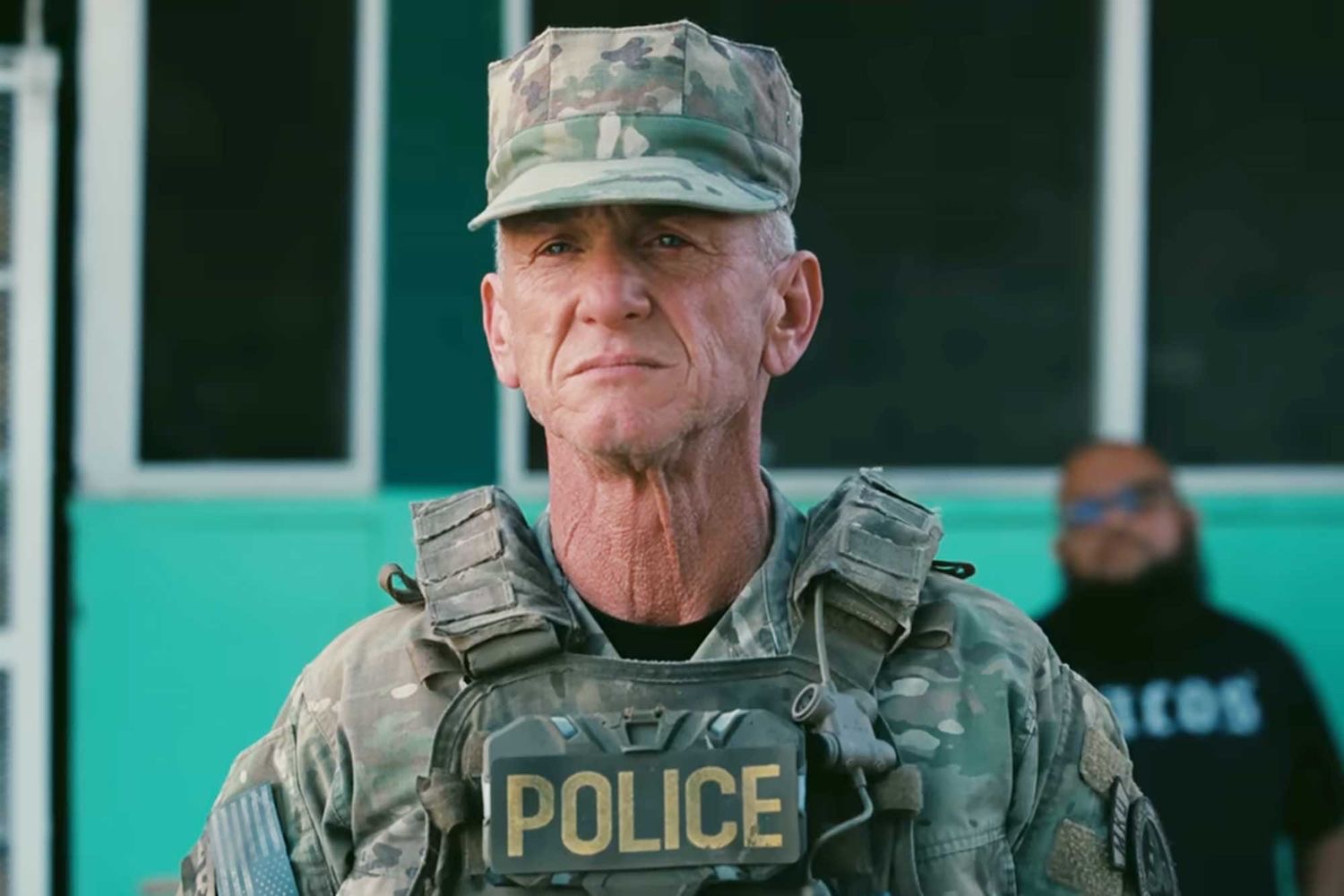
Sean Penn

Clearly Colonel Lockjaw (the names alone should have provided me with a clue as to how to navigate this material) is torn: He’s a racist being held at gunpoint by a young black woman, which is humiliating.  At the same time, this situation fulfills his most twisted  fantasies;  Perfidia sneeringly comments  on the involuntary bulge in his camouflage pants.

If all this sounds pretty over the top…well, I thought so, too.  But a funny thing happened…as the film progressed I found myself warming up to its unique blend of violence, “Dr. Strangelove”-level social/political black comedy and goofball characters.  Weirdest of all, perhaps, is “Battle’s”  genuinely moving depiction of father/daughter bonding.

The film’s prologue depicts Perfidia’s life with her lover and fellow terrorist, a bomb-maker played by Leonardo DiCaprio.  When the two find themselves facing the prospect of parenthood, he’s all for dialing back on the radical behavior.  But not Perfidia…she keeps pushing for more and bigger actions against the Establishment.  

The segment ends with Perfidia’s arrest.  Her lover and their baby girl are relocated by the underground army to a small city  in what appears to be the Pacific Northwest. He changes his name to Bob and devotes his spare time to weed.   His daughter  Willa (Chase Infiniti) grows up hearing stories of her legendary mother; she’s an overachiever who seems determined to make up for her doofus dad’s dropout lifestyle.

The bulk of the film (it’s 2 1/2 hours long but feels much shorter) centers on Colonel Lockjaw’s obsessive hunt for Perfidia’s lover and child. To that end he orders the military invasion of the sanctuary city where the pair reside.  In the chaos father and daughter are separated; the heart of the film centers on Bob’s quest to get Willa back.

Chase Infiniti

Willa is abetted in her escape by one of her parents’ old French 75 comrades (Regina Hall), while Bob (clad in plaid bathrobe) relies on the vast underground network run by Willa’s karate instructor (a scene-stealing Benecio Del Toro), who blends zen calm with barrio bravado. 

Along the way Anderson dishes some genuinely biting satire.  Willa finds herself sheltered in a leftist convent where the nuns have daily machine gun practice. And there’s an entire subplot involving the billionaire members of the Christmas Adventurers, a clandestine ultra-right cabal dedicated to racial purity (Tony Goldwyn and Kevin Tighe are among the fat-cat members).  

DiCaprio has a truly hilarious segment in which he phones the underground army’s call center (the music you hear while on hold is Gil Scott Heron’s “The Revolution Will Not Be Televised”) and totally freaks out because after years of drugs he can no longer remember the password that will allow him to talk to his old French 75 buddies.

Now it’s pretty clear that a movie like this takes several years to get off the ground, yet “One Battle…” feels as if it was torn from today’s headlines.  Its depiction of alien roundups, concentration camps and ICE-type military actions smack of our evening news.

And the Christmas Adventurers are a savage sendup of American oligarchy that in the long run feels less satirical than prescient.

I mentioned earlier that “Battle…” features “Strangelove-ean” humor.  There are moments, in fact, when the film feels like a homage to Kubrick.  A meeting of the Adventurers unfolds with the same stiff-necked formality we saw in “2001” in the office gathering on the moon. And who is Lockjaw if not a descendant of Gen. Jack D. Ripper?

Given the outrageousness of it all, it’s a miracle that the players achieve a surprising level of depth and believability.  Exhibit No. 1 is Penn’s Lockjaw, a cartoon of military macho (the guy literally walks as if there’s a ramrod up his butt)  who somehow segues from silly to weirdly chilling and maybe even a little compelling.

“One Battle After Another” is so diverting that it’s easy to overlook Anderson’s dead-serious ideas about radicalism and the difficulty of keeping one’s idealistic edge in this America of consumer excess and moral erosion. Laugh until you cry.

| Robert W. Butler

Read Full Post »

Lily Gladstone, Leonardo DiCaprio

“KILLERS OF THE FLOWER MOON” My rating: B (In theaters)

306 minutes | MPAA rating: R

More than any film I’ve seen in a decade, Martin Scorsese’s “Killer of the Flower Moon” has left me at a loss for words.

Sometimes that’s a good thing, suggesting a cinematic experience so overwhelming that it defies easy summation.

In this case it means I left the film with mixed reactions. It’s taken days to sort them out and I’m still struggling to come to a neatly encapsulated conclusion.

The setup:

“Killers…” is a lightly fictionalized version of David Grann’s superb nonfiction study of the notorious Osage murders of the 1920s.  With the discovery of oil in Oklahoma, members of the Osage tribe who had been settled on this presumably worthless land became overnight millionaires.  

This made them targets for predatory whites who often married Osage women.  Frequently those women— and other members of their clans — died under mysterious or outright murderous circumstances, with the oil rights reverting to their white husbands.  It took a major investigation by the fledgling FBI to uncover a cabal of conspirators behind the murders of at least 30 tribal members.

Scorsese’s film (co-written with Eric Roth) is noteworthy in that it isn’t really about solving a crime (the first federal agent doesn’t show up until more than two hours into the 3 1/2-hour film, and the audience knows who the bad guys are almost from the get-go).  Its focus is split between one particular marriage. and a study of unapologetic corruption.

After serving in the Great War Ernest Burkhart (Leonardo DiCaprio) arrives in Oklahoma to work for his uncle, William Hale (Robert De Niro), the most powerful white man living in the Osage Nation.


Robert DeNiro, Leonardo DiCaprio

Hale is a mover and shaker who has been among the Osage for so long he speaks their language fluently.  He advises tribal leaders and maintains that the Osage are the finest people on the planet. But beneath his benevolent paternalism there’s sinister intent.

At his uncle’s urging, the slow-witted and morally anchorless Ernest marries Mollie (Lily Gladstone), an Osage woman who, for all of her family’s wealth, is a nurturing, down-to-earth individual.  They start a family.

But little by little Ernest is drawn into his uncle’s manipulative world. Early on he participates in the armed robbery of a wealthy Indian couple; before long he’s a middleman setting up the assassinations of individuals fingered by Hale. Among the targets are his own in-laws.

The yarn is thick with moral ambiguity. For even as he does his uncle’s murderous bidding, Ernest remains desperately in love with his wife. At some point he’s going to have to choose between love and his white family.

The film’s recreation of life in Oklahoma during this period is astonishingly authentic.  Tribal customs, language and attitudes have been scrupulously researched and depicted.  Some of the long shots of oil derricks and oil pools pocking the landscape are epic (Rodrigo Prieto is the cinematographer).  Costuming and set decoration are impeccable.  The late Robbie Robertson has created a haunting minimalist musical score heavy on native drums rhythmically thudding like a heartbeat.

My hangup is the film’s emotional neutrality.  I get it, intellectually.  But I felt more an observer than a participant.

Possibly it’s best to see the film without having read the book.  That way the perfidy of the “killers” comes as a shocking revelation with attendant moral revulsion. Maybe I knew too much going into the experience.

More problematic is the focus on Ernest, a stupid, easily manipulated oaf. As played by DeCaprio he is resoundingly unempathetic, a spineless sort whose only redeeming quality is that he grows to love his wife despite his many sins against her family. (I can’t recall another major actor so willing to alienate his character from the audience, so there’s that.)

Were “Killers…” only, say, two hours long, Scorsese’s sheer filmmaking bravado might well compensate for our having to spend so much time with this thick hick. But the film’s butt-numbing length stretches matters out while diluting the dramatic impact — the movie’s trailers are more effective in this regard than the film itself.

Scorsese and Roth find some grim humor in the killers’ desperate machinations as the net closes on them (Jesse Plemons portrays the main Fed doggedly digging into the murders), but the film is largely humorless.

The saving grace in all this is Gladstone, a Native American actress whose most compelling previous performance was in Kelly Reichardt’s “Certain Woman” from 2016. Her Mollie becomes the moral/emotional center of the film, a woman radiating empathy, quiet dignity, intelligence and a sort of stoic resignation as life piles on one tragedy after another. It’s damn near impossible to explain what she does here…it’s a kind of soulfulness rarely seem on the screen.

At the other end of the spectrum is DeNiro’s William Hale, a villain with a breathtaking ability to compartmentalize the conflicting aspects of his life.  In public he’s everybody’s uncle and friend; behind closed doors Hale becomes an amoral master manipulator with an unquenchable thirst for wealth and power. Anyone smarter than the thick-headed Ernest would recognize his pervasive malevolence right off the bat.

Advance word on “Killers of the Flower Moon” has the film pegged as a masterpiece, perhaps the highlight of Scorsese’s illustrious career.

Well, it’s good. It’s got its moments.  But in my opinion not enough to fill 3 1/2 hours.

| Robert W. Butler

Read Full Post »

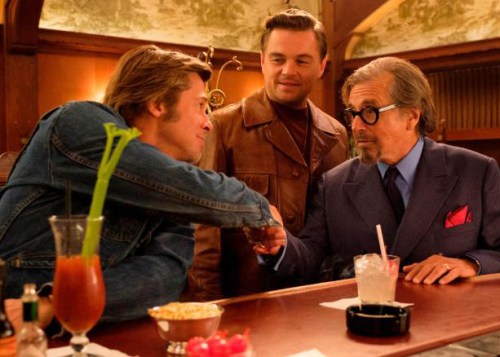
Brad Pitt, Leonardo DiCaprio, Brad Al Pacino

“ONCE UPON A TIME…IN HOLLYWOOD”  My rating: B+

161 minutes |MPAA  rating: R

Crammed with alternately bleak and raucous humor, a palpable affection for Tinseltown’s past and peccadilloes, and enough pop cultural references to fuel a thousand trivia nights, “Once Upon a Time…In Hollywood” is a moviegoer’s dream.

Here writer/director Quentin Tarantino eschews his worst tendencies (especially his almost adolescent addiction to racial name-calling) and delivers a story that despite many dark edges leaves us basking in the sunny California sunshine.

Each scene has been exquisitely crafted with every element — art direction, costuming, cinematography, editing, acting — meshing in near perfection.

In the process Tarantino rewrites history, blithely turning a real-life tragedy into a fictional affirmation of positivity. It’s enough to make a grown man cry.

The heroes (??) of this 2 1/2-hour opus are Rick Dalton (Leonardo DiCaprio), a star of TV westerns who now (the time is 1969) sees his career circling the crapper, and his stunt double, the laconic tough guy Cliff Booth (Brad Pitt), who not only steps in to perform dangerous feats on the set but serves as Rick’s best bud, Man Friday and chauffeur (Rick’s had one too man DUIs).

Tarantino’s script finds the  alternately cocky and weepy Rick (DiCaprio has rarely been better) lamenting his fading status in the industry (he’s been reduced to playing villains in episodic TV) and contemplating the offer of a semi-sleazy producer (Al Pacino) to make spaghetti Westerns in Europe.

Margot Robbie as Sharon Tate

Cliff, meanwhile, picks up an underaged hitchhiker (Margaret Qualley) who takes him to one of his old haunts, the Spahn ranch, an Old West movie set now occupied by one Charles Manson and his family of hippie misfits.

Newly arrived at the home next to Rick’s on Cielo Drive is director Roman Polanski and his beautiful actress wife, Sharon Tate (Margot Robbie). Tate is a sweetheart, an all-American beauty radiating an almost angelic innocence and positivity. But we can’t help twitching in anxiety…after all, everybody knows that in ’69 she and her houseguests were the victims of a horrific murder spree by Manson’s brainwashed minions.

(more…)

Read Full Post »

Leonardo DiCaprio

Leonardo DiCaprio

“THE REVENANT” My rating: B

156 minutes | MPAA rating: R

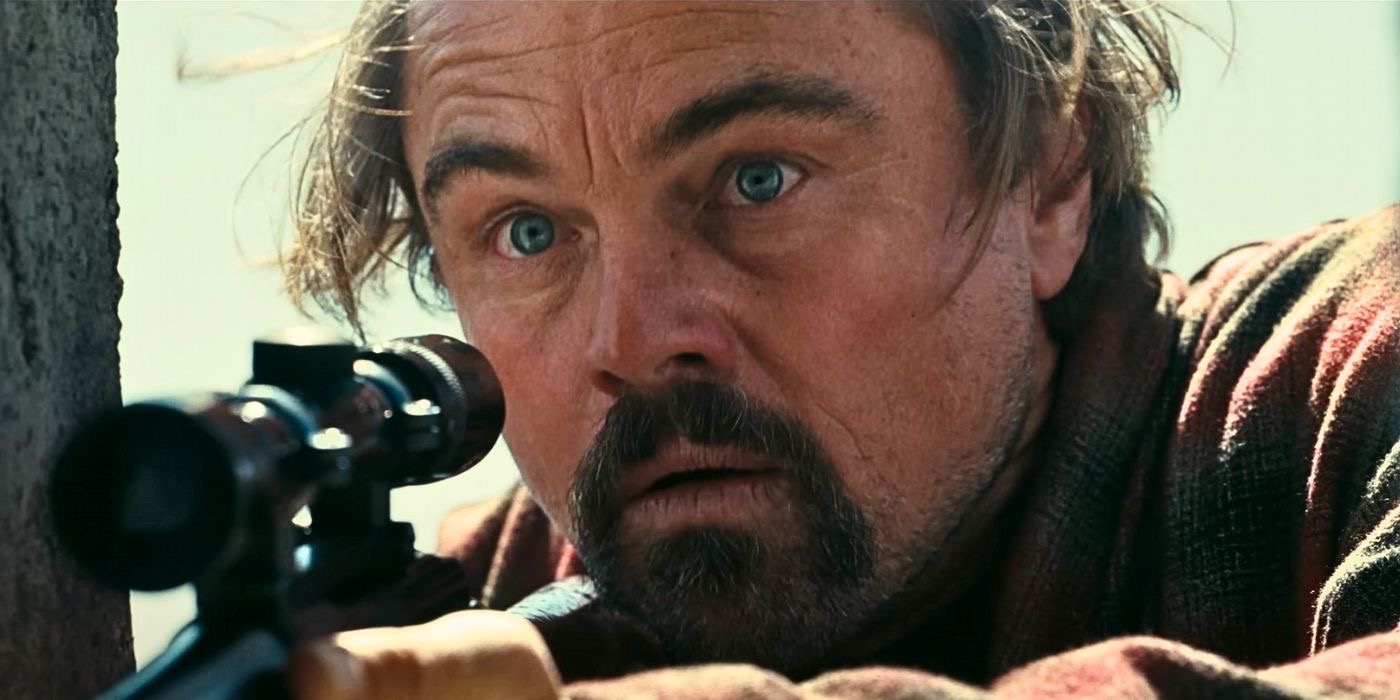
At its most basic level, “The Revenant” is a revenge melodrama with Leonardo DiCaprio playing a man who endures unimaginable hardships to get even.

But the latest from writer/director Alejandro Gonzalez Inarritu (“Birdman,” “Babel”) is much more than that.

This inspired-by-fact epic is one of the most richly sensory films ever made, an evocation of the American wilderness that is both beautiful and terrifying. In this world of heightened awareness every rock and limb seems etched by the hand of a master and the forests are alive with the creaking of timber. (Who knew aspens were so damn noisy?)

The primitive world evoked here is so sumptuous and scary that it threatens to overwhelm “The Revenant’s” dramatic elements.

The screenplay (by Inarritu and Mark L. Smith) is inspired by the true story of Hugh Glass (DiCaprio), a member of a fur trapping expedition who in 1823 was mauled by a bear. Expected to die of his injuries, Glass was left in the care of two companions instructed to give him a decent burial.

Except Glass wouldn’t die. His watchers, terrified of an Indian attack, abandoned him and rejoined their companions. But Glass clawed his way out of a shallow grave and with superhuman determination traveled 200 miles — first on his stomach, then on foot — to exact revenge.

(This story was filmed in 1971 as “Man in the Wilderness” with Richard Harris in the lead.)

On its most successful narrative level “The Revenant” is a survival story. Lacking food and weapons, DiCaprio’s Glass  must scavenge for sustenance, sucking the marrow from the bones of a long-dead elk and scarfing raw fish and buffalo innards. He cauterizes his wounds by sprinkling gunpowder over the savaged flesh and igniting it with a burning stick.

It isn’t so much that Glass wants to live as he is determined to punish Fitzgerald (a grunting Tom Hardy), the venal fellow trapper who left him for dead.

(more…)

Read Full Post »

wolf 2“THE WOLF OF WALL STREET” My rating: C+ (Opens wide on Dec. 25)

179 minutes | MPAA rating: R

Is “The Wolf of Wall Street” the result of some sort of show-biz wager?

It’s as if Martin Scorsese (arguably America’s greatest living filmmaker) and Leonardo DiCaprio (Scorsese’s latter-day DeNiro) accepted a challenge to make a three-hour movie that would entice us to laugh along with despicable characters – just because they thought they had the special juice to pull it off.

And there are moments when they come close.

“Wolf” is based on the memoir by Jordan Belfort, a poster boy for ‘90s stock market shenanigans, who made millions selling his customers worthless securities and ended up going to prison for his misdeeds.

Now I’m the sort of fellow who tries to find the essential humanity in just about everyone, but Belfort is the financial equivalent of Adolf Hitler and Pol Pot. He’s arrogant and greedy and virtually without conscience – capitalism at its most corrupt.

And DiCaprio and Scorsese have to sweat like stevedores to make him a palatable companion for 180 minutes.

This is a speedball of a movie that maniacally tears along from one scene of misbehavior to the next, hardly ever slowing down to contemplate just what message we’re to take away. Presumably Scorsese disapproves of Belfort and what he represents … but the film feels just the opposite. It seems a monumental  celebration of greed and excess.

(more…)

Read Full Post »