Feeds:
Posts
Comments

Posts Tagged ‘Luca Guadagnino’

Julia Roberts, Ayo Edebiri

“AFTER THE HUNT” My rating: B (Prime)

138 minutes | MPAA rating: R

The latest from the prolific Luca Guadagnino (“Challengers,” “Call Me By Your Name,” “Bones and All,” “Suspiria”) is an academic “Rashomon,” a she said/he said puzzle populated by presumably smart people who do some really dumb things.


“After the Hunt” opens in the off-campus apartment of Yale philosophy professor Alma (Julia Roberts) and her psychiatrist husband Frederik (Michael Stuhlbarg).  They’re hosting a soiree for friends, colleagues and students, and just about everybody is conversing in pompous academia speak.  They’re really, really irritating.

Among the partiers are Alma’s colleague Hank (Andrew Garfield), the kind of guy who puts his feet up on other folks’ furniture while waxing eloquently on existentialism.  And then there’s Maggie (Ayo Edebiri), a grad student in philosophy (and daughter of one of the university’s biggest donors); everyone expects her Ph.D. dissertation to make a big splash.

“After the Hunt” centers on an accusation of sexual assault.  The day after the party Maggie confides to  Alma that Hank drove her home and, well, you know. (Actually we don’t know, because Nora Garrett’s screenplay is so fiendishly effective at suggesting things without actually getting down to the nitty gritty.)

But here’s the thing.  Maggie is gay and may be secretly infatuated with Alma. And she recently uncovered evidence suggesting that Alma and Hank have been having an affair behind Frederik’s back. (Again, it’s suggested.Maybe it was just intense flirting.)

So perhaps the accusation of assault is a way to eliminate a competitor for Alma’s affections.

Hank, it turns out, is his own worst enemy.  He’s evasive about just what went on with Maggie.  And in his defense he says that he has accused Maggie of plagiarizing material for her dissertation.  This may be her way of discrediting him before he can go public with his suspicions.

Alma is caught in the middle…no matter what she does one of these two will see it as a betrayal.  In fact, Maggie submits to a newspaper interview in which she scorches Alma for her lack of support.  Could racism be a part of it? (Maggie is black, you see.)

Pile on top of that Alma’s disdain for the self-righteous entitlement exuded by many of her students, and you can see a career collapse coming down the road.

And then there’s her health issues…Alma only recently returned to class after a health crisis and she’s coping with pain that has her doubling up in a fetal position.  So she does something really dumb…she steals a prescription pad from the desk of her psychiatrist friend Kim (Chloe Sevigny) and fakes a script for opiates.

“After the Hunt” (a cryptic title I’m still trying to figure out) manages to be gripping even while withholding key pieces of information.  This has not a little to do with Roberts’ performance, which gos from haughty to wretched wreck. She can look great or ghastly. 

But everyone is solid, especially Stuhlbarg’s husband; Guadagnino seems to turn to this actor whenever he needs someone to represent non-flashy decency.

Elizabeth Olsen, Miles Teller, Callum Turner

“ETERNITY” My rating: C (In theaters)

114 minutes | MPAA rating: PG-13

I really wanted to like the end-of-life romcom “Eternity,” but in the end it just made me want to rewatch Albert Brooks’ “Defending Your Life.”

In this supernatural love story from David Freyne an old man chokes on a pretzel and awakens on a train pulling into the afterlife. Larry (MilesTeller) finds he’s back in his 30-year-old body.  His afterlife counselor (Da’Vine Joy Randolph) informs him that he must pick an eternity to reside in.  

Turns out heaven has multiple destinations, from a beach world where  it’s always sunny to library world (apparently not a very popular eternity).  The trick is that once you’ve chosen, there’s no changing your mind.

Anyway, the newly dead must spend their first week at a sort of gigantic trade fair in which all the various eternities have set up booths to distributed enticing pamphlets and show fun-filled videos.

Some of this is kinda cute.

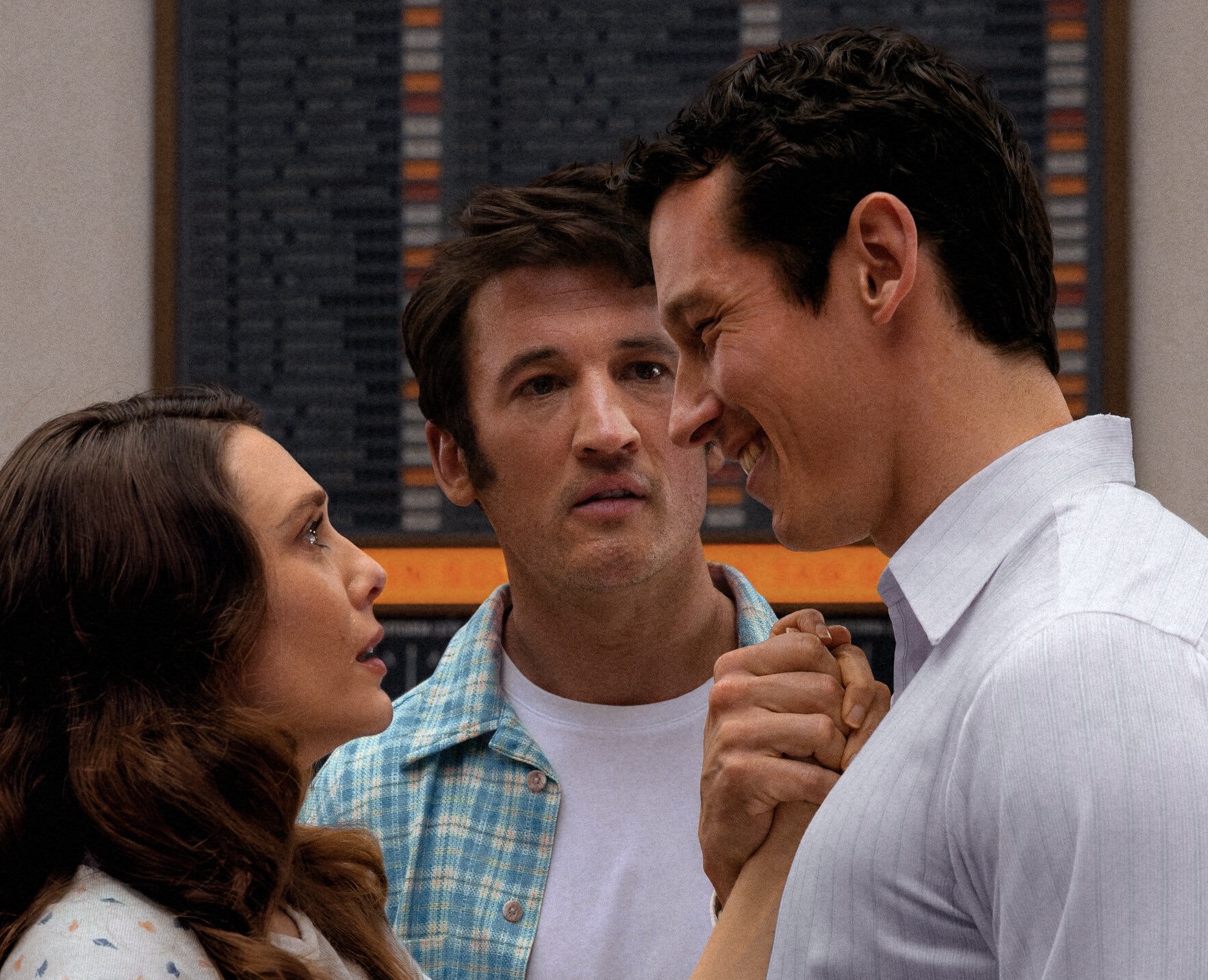
The film’s main plot, though, concerns the arrival of Larry’s wife Joan (Elizabeth Olsen) and a major complication.  Joan’s first husband Luke (Callum Turner) has been hanging around in limbo for 70 years (he died in the Korean War), awaiting Joan’s arrival.

And now Larry and Luke must compete to see which one of them Joan will choose as an enternal partner.

Quite the conundrum…and one that Freyne and co-writer Patrick Cunnane can’t really finesse.

Part of the problem is that “Eternity” is nearly 30 minutes too long; after a while it starts to feel like an eternity watching it.

| Robert W. Butler

Read Full Post »

Harris Dickinson, Nicole Kidman

“BABYGIRL” My rating: B (In theaters)

114 minutes | MPAA rating: R

Films have for so long catered to male ideals of eroticism that“Babygirl” feels almost revolutionary.

Writer/director Halina Reijn’s examination of female frustration and desire offers a situation that we’ve seen many times before: A person in a position of authority gets sexually involved with a person in their employ.

Except this time around the individual in power is a woman and her lover a young man working as an intern at her robotics company.

When we first see Romy (Kidman) she’s having very noisy sex with her husband Jacob (Antonio Banderas). Looks like an ideal relationship — hot action in the bedroom, plenty of money, two teenage daughters, a posh NYC address.

As we’ll learn, Romy has been faking it.  She’s never had an orgasm, at least not one that wasn’t self-administered.

Enter Samuel (Harris Dickinson), an intern whose weird blend of assertive cockiness and laid back coolness Romy first finds maddening, then intriguing.  She reluctantly agrees to mentor Samuel during his stay at the firm…and things start to heat up.

Reijn pulls off the near impossible here by delivering a huge blast of eroticism while avoiding the whole male gaze thing. It’s the most overtly sexual performance of Kidman’s career, but it never veers into exploitation.

Samuel initially brings Romy to a noisy orgasm just with his hands (she’s lying on the floor, fully clothed); when he’s not playing the dominant lover he’s actually quite sweet and attentive.

The problem, of course, is that Romy’s infatuation — her growing recognition that she’s a sexual submissive — threatens her job (h.r. departments frown on this sort of thing) and her marriage.

And when another intern (Sophie Wilde) attempts to blackmail Romy over the affair, her life is turned upside down.

“Babygirl” (that’s Samuel’s nickname for his boss) ends on an upbeat note I’m not sure I buy.  And the film’s first 30 or so minutes felt brittle and off-putting.

 But eventually the plot, the performances and the aura of guilty pleasure click into focus.

Ryan Destiny, Brian Tyree Henry

“THE FIRE INSIDE” My rating: B- (In theaters)

109 minutes | MPAA rating: PG-13

“The Fire Inside” follows the usual arc of a sports movie, tracing the career of an athlete from childhood to triumph on the world stage.

But it throws a couple of changeups.

First, this is the true story of Claressa “T-Rex” Shields, the first woman to win an Olympic gold medal in boxing — at the tender age of 17.  Guys who want to fight are a dime a dozen, but a girl? And one that young?

Second, the film views the fights themselves as an afterthought.  They’re brief and not particularly violent; mostly they provide the background for a couple of solid character studies and for the emerging theme of female empowerment.

Claressa is played by Ryan Destiny, who nicely captures the drive and determination of a young woman determined to pull herself out of an oppressive domestic situation.

And she’s paired here with Brian Tyree Henry as Jason Crutchfield, the volunteer boxing coach who initially was reluctant to have a girl training in his Flint, Mich., gym, but went on to become Claressa’s mentor and de facto father. 

Henry can play just about anything (he was memorable as a oft-perplexed rapper in “Atlanta”), but his ace in the hole is his ability (we  saw it opposite Jennifer Lawrence in “Causeway”) to express  basic human decency without a trace of self-consciousness. A character like this one makes you want to be a better person.

“The Fire Inside” was written by Barry Jenkins (“Moonlight”) and directed by Rachel Morrison, and in addition to exploring a character’s physical and psychological development over several years, it also takes on the struggle of female athletes to achieve economic parity with their male counterparts.

Drew Starkey, Daniel Craig

“QUEER” My rating: B- (In theaters)

136 minutes | MPAA rating: R

The novels of William S. Burroughs have rarely been made into movies.  In part it’s the unapologetic subject matter. Also, there’s rarely anything like a conventional plot.

In tackling “Queer” director Luca Guadagnino (“Call Me By Your Name,” “Challengers,” “Bones and All” ) works hard to find a cinematic equivalent for Burroughs’ distinctive literary style.  And for the first hour or so he pulls it off.

The protagonist (and Burroughs’ alter ego) is William Lee, an American living in Mexico in the 1950s. Apparently Lee has family money. He doesn’t work. Mostly he cruises for young men.

Lee is portrayed by Daniel Craig, an unlikely choice since Craig is one of  the sexiest men in movies and William Lee is an embarrassingly transparent letch on the downside of desirability.  But Craig pulls it off, mining the pathetic yearning of an aging man for some sort of physical and emotional transcendence.

He finds it (he thinks) in Eugene Allerton (Drew Starkey), a  curiously non-committal American (is he gay? straight?) only recently discharged from the military. The guy oozes indifference, which only makes Lee’s clumsy attempts at seduction all the more wince-worthy.

But talk about creating an environment! As sumptuously photographed by Sayombhu Mukdeeprom, “Queer” is simultaneously dreamlike and grittily down to earth.  Moreover, it radiates “Under the Volcano”-level decadent dissolution.

There’s also an amazingly good supporting performance by Jason Schwartzman as Joe Guidry, a character clearly based on Alan Ginsberg. Overweight and astonishingly hairy, Schwartzman utterly loses himself. It’s some of his finest work.

The film’s second half finds Lee and Allerton trekking to South America to dabble in psychedelic plants. There they hang at the jungle research station of a renegade scientist (Lesley Manville, all but unrecognizable), getting ripped on ayahuasca. 

By this time the film’s lack of anything like a real plot becomes a drawback.  As does Starkey’s one-note performance. At well over two hours, “Queer” begs for some tightening.

Still, at various moments it’s a genuinely hallucinogenic experience.

| Robert W. Butler

Read Full Post »

Timothee Chalamet, Armie Hammer

“CALL ME BY YOUR NAME” My rating: A-

132 minutes | MPAA rating: R

“Call Me By Your Name” could be categorized as a coming-out story, but that’s oversimplifying things… like saying “Citizen Kane” is a movie about the newspaper business.

Director Luca Guadagnino (“I Am Love,” “A Bigger Splash”) and screenwriter  James Ivory (yes, the director of “Howards End,” “A Room with a View” and the Kansas City-lensed “Mr. and Mrs. Bridge”) are painting on an intimate canvas here, yet their adaptation of Andre Caiman’s novel is an epic of mood and emotion.

It’s about youth, sexual awakening, family love and the warm glow of summers past. It’s enough to make you swoon.

Set in the summer of 1983, “Call Me…” chronicles a lazy but significant six weeks for 17-year-old Elio (an unbelievably good Timothee Chalamet).  The son of an American father and an Italian mother, he’s been raised in Italy with all the intellectual stimulation he can handle. He’s smart, multilingual and maybe some sort of musical prodigy.

Enter Oliver (Armie Hammer), the American grad student hired by Elio’s professor father (Michael Stuhlbarg) for a summer of research on Roman statuary. Oozing a big grin, Yankee self-confidence and nonchalant studliness, Oliver makes a big wave among the town’s young women.

Initially this visitor strikes Elio as arrogant. But Oliver also stirs something else in Elio. Not that Oliver seems at all receptive…if anything he appears oblivious.

Interestingly enough, it’s Elio’s father and mother (Amira Casar) who first notice the slow-burn sexual sizzle that’s been introduced to their household…not that they comment on it directly. But their sidelong looks speak volumes. (They must be the most understanding movie parents of all time. Atticus Finch could take lessons from them.)

(more…)

Read Full Post »

Matthias Schonhart, Tilda Swinton, Dakota Johnson, Ralph Fiennes

Matthias Schonhart, Tilda Swinton, Dakota Johnson, Ralph Fiennes

“A BIGGER SPLASH”  My rating: B 

125 minutes | MPAA rating: R

Among the many on-screen personas of Ralph Fiennes are terrifying mob boss, casually cruel concentration camp commander, serial killer and silky aristocrat.

But nothing he’s done has quite prepared us for the acting dervish on display in “A Bigger Splash.”

In Luca Guadagnino’s steamy and visually ravishing display of psychological noir, Fiennes plays Harry, a renowned music producer who unexpectedly drops in on his old flame, rock star Marianne (Guadagnino regular Tilda Swinton), and her paramour, Paul (Matthias Schoenaerts).

Marianne and Paul are living in glorious isolation in a hilltop villa on the Sicilian island of Pantelleria, where they lounge about naked and make furious love in any and all rooms. Their choice of a retreat suggests they just want to be left alone, but neither can turn down Harry, a natural-born glad-handing speed freak who guzzles vino, pees where he likes, and is determined to be the life of the party.

For the music mogul was once Marianne’s lover and the force behind her international career. And as their relationship was winding down, Harry groomed Paul, a documentary filmmaker, to take his place in Marianne’s bed.

So suddenly the couple has as  a houseguest the motormouthed Harry, an interloper who seizes control of Marianne’s record collection, buzzing from one topic to another, erupting in rock ‘n’ roll survival stories and doing an insanely cool and ridiculously sinuous open-shirted dance to the Stones’ “Emotional Rescue.”

David Kajganich’s screenplay — an adaptation of the 1968 French film “The Swimming Pool” — centers on the question of just why Harry has shown up at this time.

For Marianne and Paul are extremely vulnerable. She’s had throat surgery to reverse the damage done by her larynx-shredding singing style. There’s no way of knowing if she’ll be able to resume her career; in the meantime she has been ordered not to speak above a whisper.

This prompts the irreverent Harry to ask Paul: “Does she write your name when she comes?”


(more…)

Read Full Post »